Unit 4.2 Investigating DNA Replication
 Call Kai
 Learn
Learn Practice Test
 Spaced Repetition
 Match
Match Flashcards
 Knowt Play
1/74

There's no tags or description
Looks like no tags are added yet.
Name | Mastery | Learn | Test | Matching | Spaced | Call with Kai |
|---|
No analytics yet
Send a link to your students to track their progress
75 Terms
What happens at the very beginning of a new life being made?
Haploid sperm (single) + haploid egg (single)
After cell division proceeds to trillions of cells, what do all those new cells contain?
All new cells contain a copy of the original DNA from the single original cells
Every time a cell divides, what 2 things MUST occur?
DNA must be replicated
Results must be checked to make sure there’s no errors
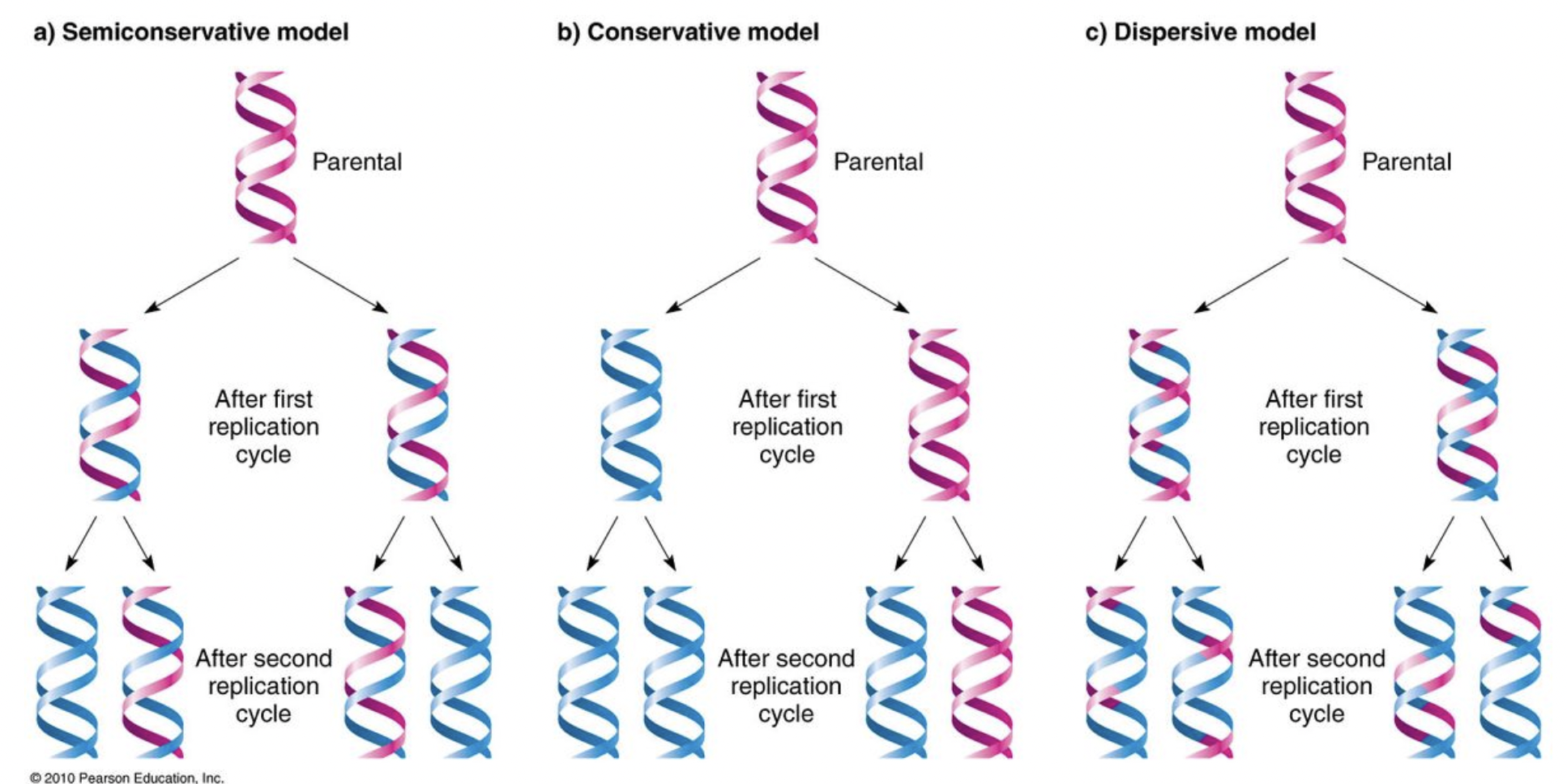
What are the names of the 3 initial DNA replication models?
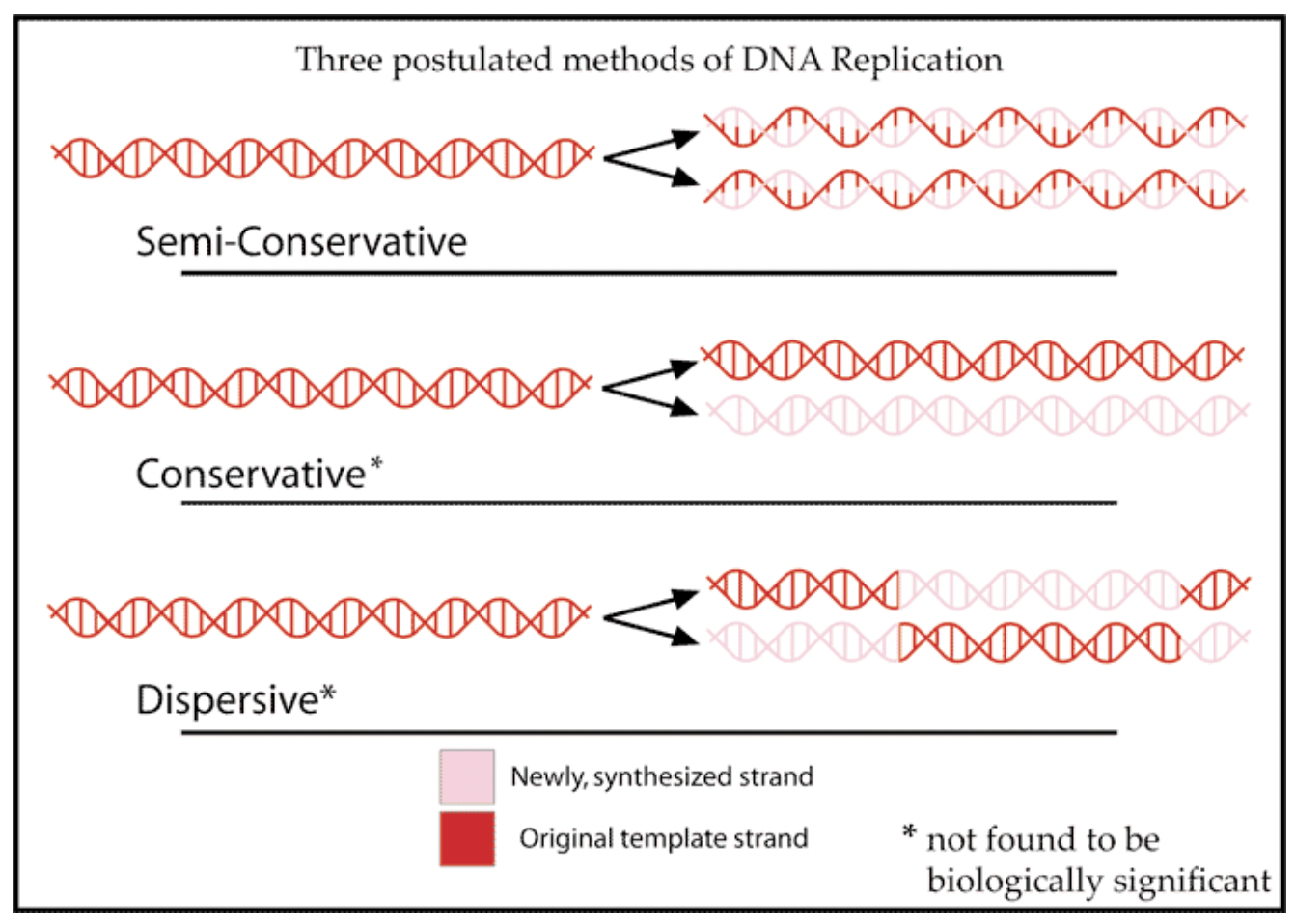
Semiconservative model
Conservative model
Dispersive model
#1 What happens in semiconservative DNA replication?
Parent DNA molecule splits apart with each strand acting as a template for the newly synthesized strand. Makes 2 new DNA molecules each containing one strand from the original parent DNA and the other made up of new DNA.
#1 In semiconservative DNA replication, is the nucleotide sequence the same in each daughter DNA molecule or different?
The same
#2 What happens in the conservative model of DNA replication?
The original parent DNA molecule produces an exact copy of itself and remains intact. Result is 2 daughter DNA molecules where one is made of entirely new nucleotides
#2 In the conservative DNA replication, is the nucleotide sequence the same in each?
Yes
#3 What happens in the dispersive model of DNA replication?
The parental DNA molecule is broken into fragments and each daughter cell is made of a random mix of parental and new DNA
#3 In the dispersive model of DNA replication, do the daughter cells have the same nucleotide sequence as the parent?
Yes
In 1958, Meselson and Stahl proved which model to be correct?
Semiconservative was right
What was the basis of Meselson and Stahl’s experiment to prove semiconservative was right?
They used nitrogen isotopes to mark new nucleotides thus distinguishing them from the ones in the original DNA
Marking nucleotides is called what?
“Tagging DNA”
During the experiment with DNA tagging to see which model was right, what would the 3 supposed results mean?
To see if DNA contained half-original and half-new nucleotides (semiconservative)
To see if the new DNA molecules were made entirely of new nucleotides (conservative)
To see if there was a random mix of both (dispersive)
Describe Meselson and Stahl’s experiment
Used E. coli bacteria. Used a heavy isotope (15N) and a lighter isotope (14N). When substances suspended in a liquid are spun in a centrifuge, the heavier substances will settle at the bottom of the test tube
What did they hypothesize they would see for the 3 models?
Semiconservative: two bands.
One betweenheavy + light, and one justlightConservative: two bands.
Oneheavyand onelightDispersive: one band.
Heavy + light
Recall- what is the difference between eukaryotes and prokaryotes?
Eukaryotes have a nucleus; prokaryotes do not have a nucleus
Is DNA replication the same in eukaryotes and prokaryotes?
Pretty much, very similar
How is the DNA in eukaryotes and prokaryotes different? Who has more?
Eukaryotes have long twisted strands of DNA; prokaryotes have circular strands of DNA and contain a thousand times fewer nucleotides
Which DNA replicates faster in who- eukaryotes or prokaryotes?
Much faster in prokaryotes than in eukaryotes. Prokaryotes can replicate in less than an hour while eukaryotes take several hours
What are the 3 main phases of DNA replication?
Initiation
Elongation
Termination
#1 What is the basic definition of initiation?
DNA is unwound and separated to expose each strand in the pair at multiple sites of replication along the DNA molecule
#1 Does the first phase of DNA replication split DNA like a zipper? Why or why not?
No. Would be too slow. Instead occurs all along the length of the DNA at 100’s or even 1000’s of replication sites
#1 The multiple DNA replication sites that occur all along the DNA molecule are called “what”?
“The origins of replication”
#1 Do the origins of replication occur at Adenine/Thymine sites or at Guanine/Cytosine sites? Why?
Adenine/Thymine because they are only bound with 2 hydrogen bonds so it is easier to break apart
#1 At each origin replication point, the double stranded DNA is unwound and separated by what? And what is it?
By helicase; an enzyme
#1 What thing breaks apart the hydrogen bonds between Adenine and Thymine? How?
Helicase; uses ATP energy
#1 When helicase breaks apart Adenine and Thymine, what does their physical shape look like and what is it called?
Looks like two prongs; called “the replication fork”
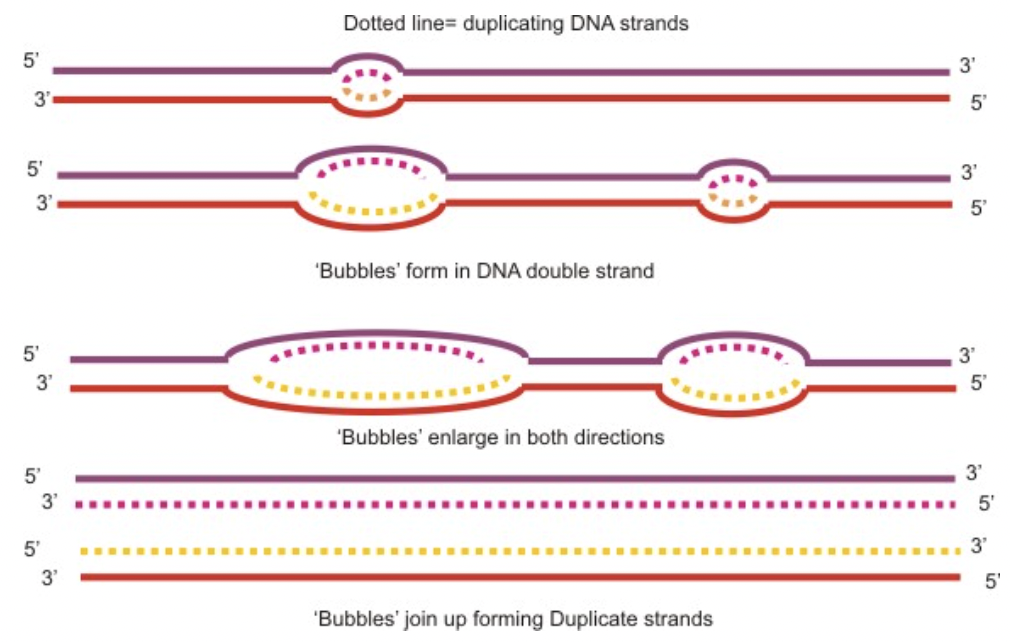
#1 All along the length of the DNA molecule as it starts to split, what is formed? How many?
Replication bubbles; 100’s to 1000’s
#1 What happens where they are enough replication bubbles?
The bubbles will merge and the segments of the daughter strands of DNA connect together to form a completely new strand!
#1 While helicase is unwinding and separating DNA, what action is happening further ahead?
Twisting and supercoiling accumulate and if it gets bad enough replication would stop
#1 What is used to combat supercoiling further ahead from where helicase is unwinding and separating DNA?
Topoisomerase
#1 What is topoisomerase? And what is an important type of it?
An enzyme; gyrase
#1 How does topoisomerase work?
It moves along the DNA just ahead of the helicase relaxing the coils
#1 Once DNA is split, what prevents it from simply re-joining (re-anneal) or bonding with other molecules?
Single-Stranded DNA Binding proteins (SSBs) which bind to the exposed bases
#2 What is the basic definition of elongation?
DNA has been split. Now enzymes attach complementary nucleotides along the exposed templates to form new strands, and check for errors
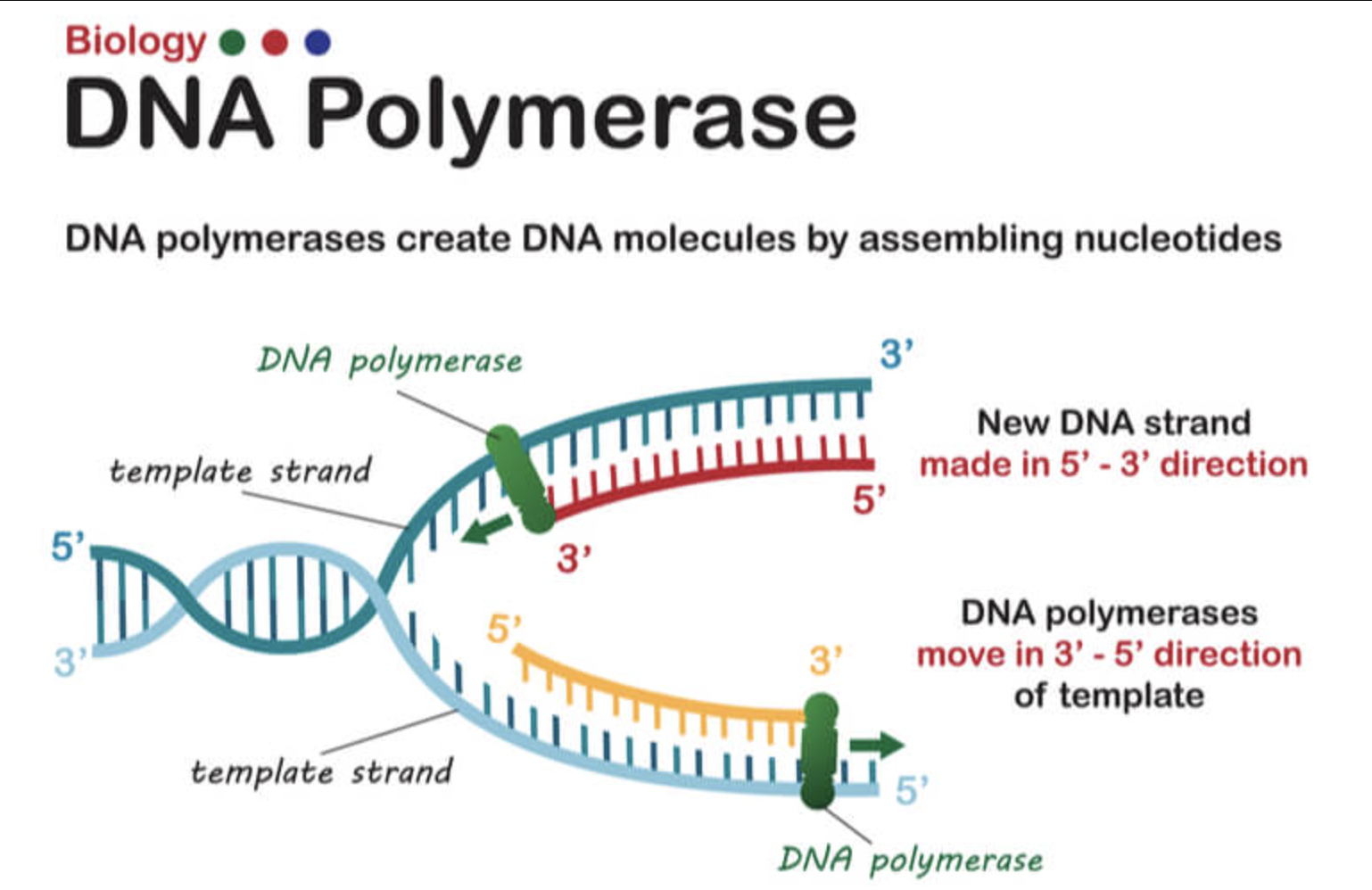
#2 What is DNA polymerase? What does it do?
An enzyme; it attaches nucleotides one at a time to the 3’ end of the pre-existing chain of nucleotides
#2 The free-floating nucleotides that DNA polymerase attaches to form new strands comes from where? What is their name?
Come from the nucleoplasm; called “Deoxyribonucleoside Triphosphates” or dNTP’s
#2 What is the difference between DNA polymerase I and DNA polymerase III?
DNA polymerase I is active mostly near when DNA replication is finishing where it removes the RNA primer; DNA polymerase III joins the nucleotides together and checks for errors
#2 What really are the deoxyribonucleoside triphosphates (dNTP’s)?
dNTP’s are the classic nucleotide bases with 2 extra phosphate groups
#2 New nucleotides are added to the growing DNA strand in what direction?
5’ to 3’
#2 DNA formation needs energy- where does it get the energy from?
When the 2 phosphates break off from the deoxyribonucleoside triphosphates, energy is released
#2 When the 2 phosphates break off from the dNTP’s and energy is released, what does this energy create?
Creates a phosphodiester bond the connects the new nucleotide to the growing chain of nucleotides on the strand
#2 When the phosphodiester bond is formed, what is released?
2 phosphate ions
#2 DNA polymerase III adds nucleotides onto an existing strand. What can’t it do?
It can’t begin the synthesis of a new strand
#2 What begins the synthesis of a new strand and how?
RNA primer; starting sequence of a short fragment of RNA attached to the exposed template strand to serve as the starting nucleotides from which DNA polymerase III can extend outwards
#2 How long is the RNA primer? Does it fit well to the exposed template strand?
10-100 base pairs long; yes, it is complementary to the strand
#2 Formation of the RNA primer requires what? What is it?
Primase; an enzyme
#2 The two strands of the newly formed DNA are assembled simultaneously. Do they happen at the same speed? Why?
Both the process and speed is different; because of their different orientations
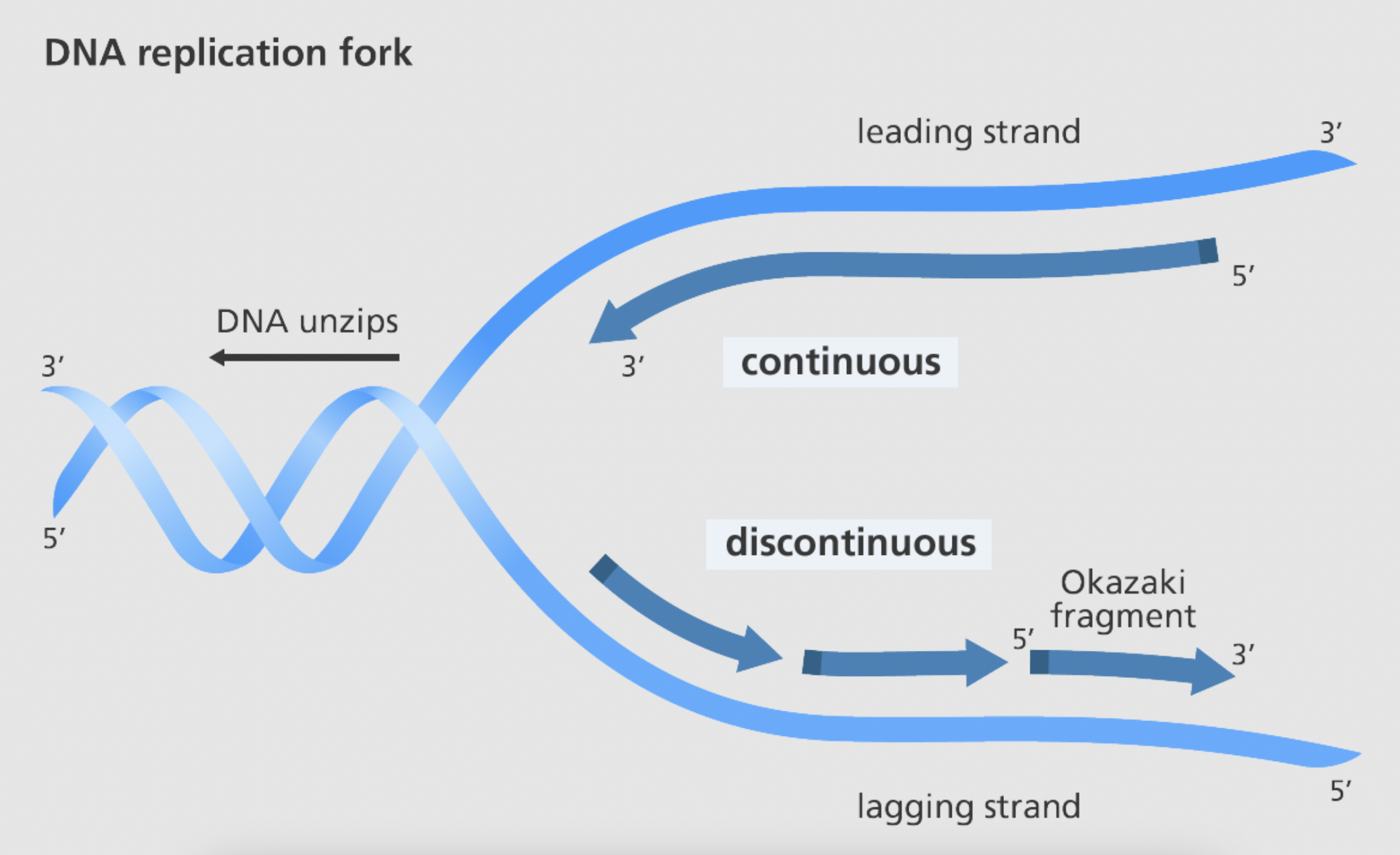
#2 How does DNA polymerase III prevent mutations?
It detects the number of hydrogen bonds a nucleotide forms. If no bonding occurs then the nucleotides are mismatched and DNA polymerase replaces them with the correct one.
#2 When DNA polymerase III checks for mutations, what is the process ‘called’?
‘Proofreading’
#2 What are errors in copying genetic code specifically called? Are they dangerous?
“Point mutations”; yes
#3 What is the basic definition of termination?
Nucleotide addition stops, enzymes are removed, and the newly formed strands of DNA coil back into the double helix shape
#3 When elongation phase is finished, what spontaneously begins to happen?
The newly formed strand of DNA begins to twist
#3 What is the result of replication?
2 complete and separate semiconservative daughter DNA molecules
#3 Why are daughter DNA molecules slightly shorter?
When the RNA primer is removed it leaves a gap which eventually breaks off leaving the daughter molecule to be shorter
#3 In terms of length, with each replication DNA gets-
-shorter
#3 This shortening of DNA- is it a problem?
Yes, this loss overtime could result in significant genetic damage
#3 In prokaryotes, do they have this problem of shorter DNA molecules? Why or why not?
No, because their DNA is circular
What is a telomere? (definition not function)
A region of several 1000 nucleotides made of a simple repeated sequence (does not code for proteins)
In humans, what is the repeated sequence of telomeres?
TTAGGG
What is the purpose of telomeres?
It’s a buffer region. It is expendable DNA that can be gradually lost over repeated replications without damaging the active genetic code. Molecular protective caps of repetitive DNA at the ends of chromosomes
Where are telomeres found?
At the end of DNA where primers have been removed after replication
Can telomeres be used indefinitely?
No, they have a finite length so can only be used a certain number of times
How are telomeres related to aging?
Cells with longer telomeres live longer and they get shorter as we age and the cells die
What can be used to extend telomeres? What is it?
Telomerase; an enzyme
What is the most important reason we need telomerase to extend telomeres?
Because some cells need to be able to replicate more times than others
When can telomerase be bad?
If it mistakenly becomes added to the wrong cells they can multiply indefinitely, think cancer cells
Define chromatid
One of the 2 identical strands of DNA that make up a chromosome
Define centromere
Joins 2 chromatids together and is the region in which fibres attach to during cell division