Topic 2A (cell membrane, phospholipid bilayer, transport)
 Call Kai
 Learn
Learn Practice Test
 Spaced Repetition
 Match
Match Flashcards
 Knowt Play
1/26

There's no tags or description
Looks like no tags are added yet.
Name | Mastery | Learn | Test | Matching | Spaced | Call with Kai |
|---|
No analytics yet
Send a link to your students to track their progress
27 Terms
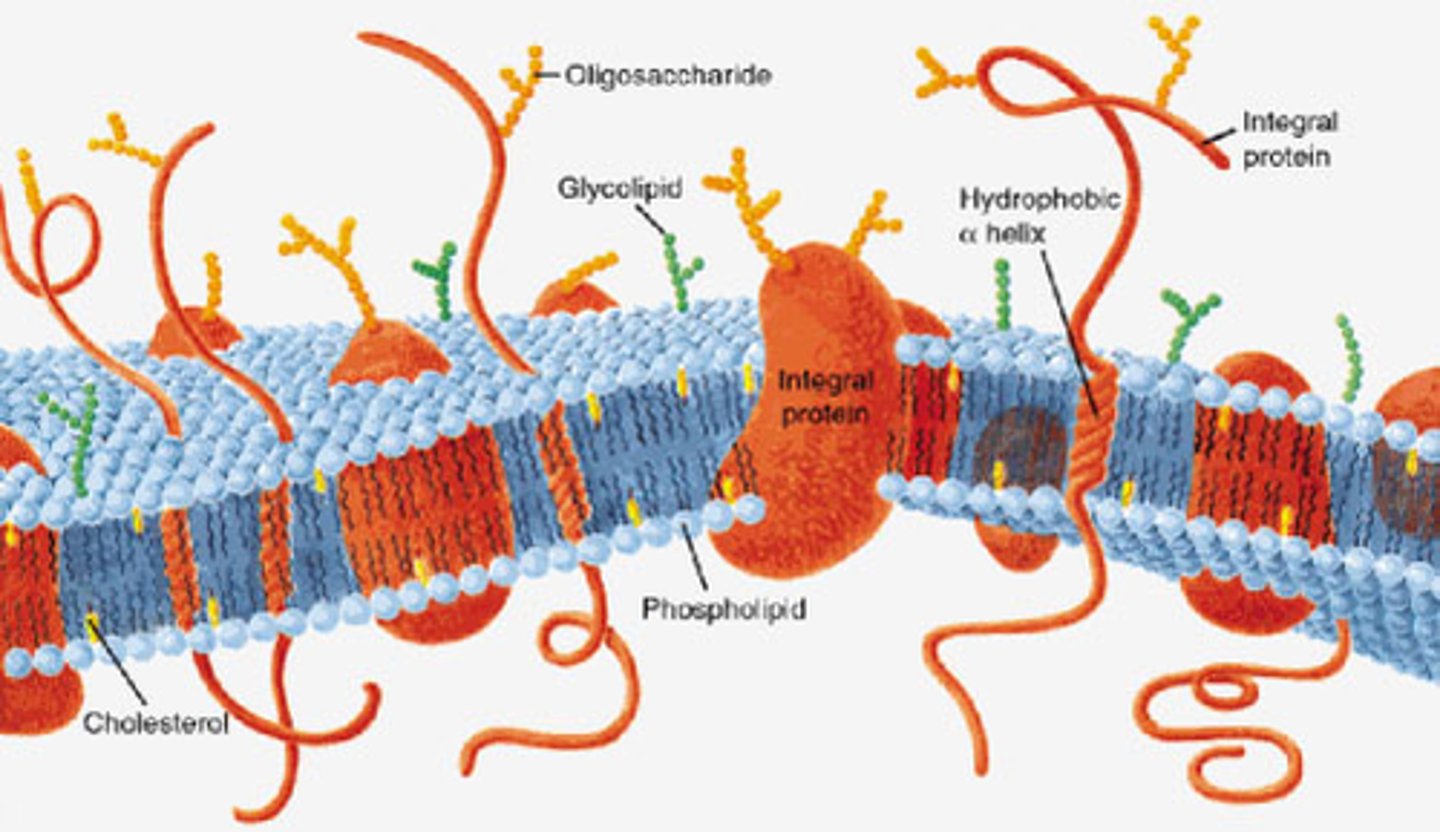
Describe the structure of the cell membrane (5marks)
- The cell membrane has a phospholipid bilayer
- Each phospholipid has a hydrophilic (polar) head facing water environment and hydrophobic (non-polar) tails facing away from water environment
- membrane contains intrinsic proteins such as channel and carrier proteins, and extrinsic(peripheral) proteins
- membrane contains glycoproteins and glycolipids
(for cell recognition)
- It also contains cholesterol within the membrane
( to regulate fluidity and stability)
Compare and contrast endocytosis and exocytosis (4marks )
- both processes involve vesicles
- both need ATP energy
- in exocytosis substances leave the cell, but in endocytosis substances enter the cell
- exocytosis involve vesicles fusing with cell surface membrane but endocytosis involve formation of vesicles from cell surface
membrane.
(exo =exit by fusing with cell membrane, endo = forming vesicles from cell membrane to enter)
Describe how the mammalian lung is adapted for rapid gas exchange
(4 marks)
- large number of alveoli present which increases SA for rapid diffusion
- alveolar wall is thin as the alveolar epithelium is one cell thick, which ensures short diffusion distance
- Blood flowing in capillaries and ventillation(breathing in/out) maintains a steep concentration gradient for gas exchange
(CO2 and O2)
- moist lining which dissolves o2 for rapid diffusion
Explain why the phospholipid molecules form a bilayer (3marks)
- because phosphate heads are hydrophillic and are attracted to water
- fatty acid tails are hydrophobic and repel water
- since there is aqueous environment on both sides of the membrane, a bilayer forms
Describe the role of proteins in cell transport mechanisms
(6 marks)
- carrier proteins are involved in active transport
- (ions / AA) molecules bind to carrier protein, causing carrier p. to change shape which allows them to pass cell membrane
- against the concentration gradient, so atp is needed
- channel proteins are involved in facilitated diffusion
(btw carrier proteins also used in f. diffusion)
- (they create pathway) allows large/polar molecules to pass through cell membrane
- down the concentration gradeint
Explain the arrangement of phospholipids in liposomes
(spherical structure)
(2marks)
- the phosphate head is hydrophilic and is attracted to water molecules, thus pointing outward
- the lipid tale is hydrophobic and is repelled by water, thus pointing inward
In simple diffusion __________ / __________ molecules can directly cross the plasma membrane/ phospholipid bilayer
give examples of all molecules that can transport via simple diffusion
hydrophobic / non polar
(as phospholipid bi-layer also has hydrophobic core)
examples:
- o2, co2,
- non-polar molecules
- hydrophobic molecules such as lipids
Explain what is meant by diffusion (3marks)
- It is a passive process where simple molecules go from area of high → low concentration
- down the concentration gradient
- no channel/carrier protein needed
Describe the two types of bulk transport?
( moving large substances across cell membranes)
[2marks]
- endocytosis, large substances entering cell in the form of vesicle using energy
(pinocytosis for liquids and phagocytosis for solids)
- exocytosis, large substances exiting/leaving cell in the form of vesicle using energy
Explain what is meant by facilitated diffusion (3marks)
facilitated diffusion:
- It is a passive process where ions/ polar molecules go from area of high → low concentration
- down the concentration gradient
- channel/carrier protein needed
Which of these molecules in facilitated diffusion use channel protein and which use carrier protein:
glucose, ions, hydrophilic molecules, amino acids, polar molecule (and large molecules)
glucose, amino acid, hydrophilic molecule = carrier P
ions/polar molecules, (& large molecules) = channel P
Explain what is meant by osmosis (3marks)
osmosis:
- A passive process where water molecules go from high water potential → low water potential
- down the water potential gradient
- through a partially permeable membrane
draw a diagram to show the structure of a phospholipid molecule
(take each molecule as circle or square, tails being lines)
[] (phosphate head, hydrophilic)
|
[] (glycerol, hydrophobic)
|
| | (fatty acid tails, hydrophobic)
- FATTY ACID WILL NOT JOIN TO PHOSPHATE HEAD DIRECTLY (they repel each other)
- glycerol acts as the bridge,
(it's actually amphipathic molecule so it has both hydrophobic and hydrophilic properties.
In our syllabus more hydrophobic)
![<p>[] (phosphate head, hydrophilic)</p><p>|</p><p>[] (glycerol, hydrophobic)</p><p>|</p><p>| | (fatty acid tails, hydrophobic)</p><p>- FATTY ACID WILL NOT JOIN TO PHOSPHATE HEAD DIRECTLY (they repel each other)</p><p>- glycerol acts as the bridge,</p><p>(it's actually amphipathic molecule so it has both hydrophobic and hydrophilic properties.</p><p>In our syllabus more hydrophobic)</p>](https://knowt-user-attachments.s3.amazonaws.com/fba94bca-6b44-46c7-b12f-657f8468b5d2.jpg)
which substances and chemicals can directly pass through cell membrane (hydrophobic core)?
- only non-polar/hydrophobic can directly pass through cell membrane (hydrophobic core)
Explain what is meant by active transport (4 marks)
- movement of molecules from low → high concentration
- against the concentration gradient
- ATP is needed
- carrier protein needed
An RBC is placed in hypotonic solution. Explain what changes can be seen. (3marks)
[hypotonic -> hippo -> cell becomes big]
- In hypotonic solution, water potential inside cell is lower than outside the cell
- so water enters the cell due to osmosis
- RBC will swell up
Explain the permeability of cell membrane to each of the following: (4marks)
sodium and chloride ions
water
steroid [which is non-polar]
glucose
- Sodium and chloride ions are polar, so they pass through the channel protein via facilitated diffusion
- water is polar , so it passes membrane through channel proteins called aquaporins
(or water is polar but is small enough to pass by osmosis)
- steroids is non-polar, so it can directly pass through the membrane (by simple diffusion)
(not repelled by fatty acid tails or hydrophobic core)
- glucose is a polar molecule, so it passes through by facilitated diffusion via channel protein
An RBC is placed in hypertonic solution. Explain what changes can be seen. (3marks)
- In hypertonic solution the water potential inside cell cytoplasm is higher/greater than
outside the cell
- so water leaves the cell due to osmosis
- The RBC will become crenated, (shrink)
Give 2 ways by which phospholipids can differ from each other
- length of fatty acid tail
- whether the fatty acid tails are unsaturated or saturated
why is Singer and Nicolson's model called the fluid mosaic model?
(2marks)
- fluid because phospholipids & proteins can move within the membrane
- mosaic because proteins are randomly distributed /embedded throughout the membrane
state the property of a cell that enables it to change shape
(1mark)
- the membrane is fluid and free to move
Explain why an increase in temperature increases fluidity of membrane
(2marks)
- increase in temperature means phospholipids have more K.E
- therefore phospholipids can move around the membrane more
State Fick's Law of Diffusion
(2marks)
- rate of diffusion proportional to SA & concentration gradient
- inversely proportional to thickness/diffusion distance

Explain why a decrease in cholesterol increases the fluidity of membrane
(2marks)
- Cholesterol holds fatty acid chains together & restricts the movement phospholipids
- so a decrease in cholesterol means less restriction on phospholipid movement, thus membrane becomes more fluid
state 3 properties of a gas exchange system other than large SA
- good blood supply/steep concentration grad
- moist lining
- thin barrier/wall
Explain why multi-cellular animals require a respiratory system and a circulatory system
(4marks)
- they have high metabolic demands and small SA:V ratio
- respiratory system is present which gives large SA as diffusion is insufficient
- due to the long distance, circulatory system is present as diffusion is too slow
- it distributes O2 and other nutrients to all parts of animal
In phospholipids, fatty acid tails are formed from which elements?
- Carbon and hydrogen only
[the fatty acid tails in cell membranes primarily consist only of carbon (C) and hydrogen (H) ]