4.2 - Sexual Reproduction in Plants
 Call Kai
 Learn
Learn Practice Test
 Spaced Repetition
 Match
Match Flashcards
 Knowt Play
1/53

There's no tags or description
Looks like no tags are added yet.
Name | Mastery | Learn | Test | Matching | Spaced | Call with Kai |
|---|
No analytics yet
Send a link to your students to track their progress
54 Terms
Flower
Organ responsible for sexual reproduction in a plant
Female gamete
Ovule
Male gamete
Pollen
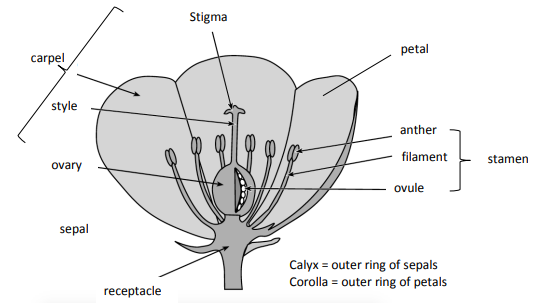
Structure of flowers
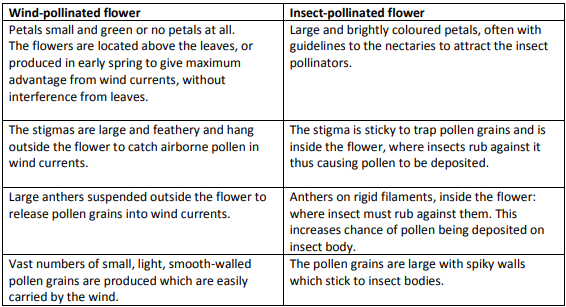
Insect- VS. Wind-pollinated flower
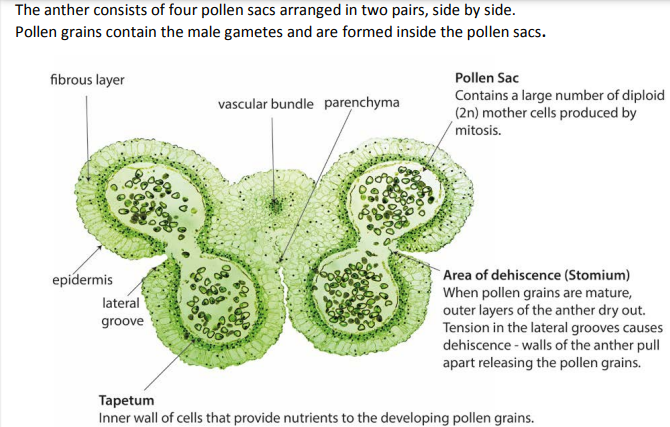
Location of development of pollen
Anther
Location of development of an ovule
Ovary
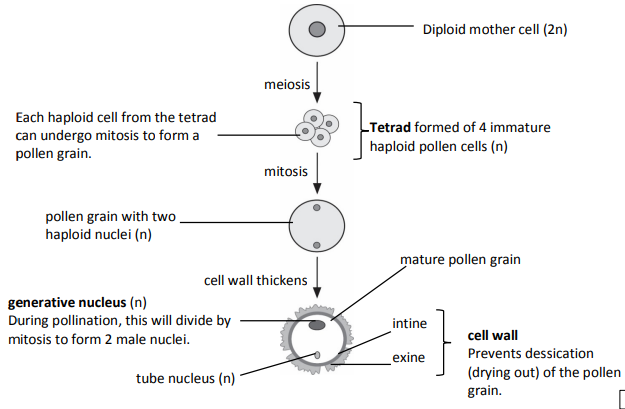
Process of development of a pollen grain
Pollen mother cells develop by mitosis.
Meiosis occurs to produce a tetrad of 4 haploid cells.
In each haploid, pollen grain mitotic division of the nucleus forms a generative nucleus (that mitotically divides to produce 2 male nuclei) and a tube nucleus.
Tension in lateral grooves increases as the anther dries out. Dehiscence occurs when walls of the pollen sac curl away exposing pollen grains to wind or insects.
Tapetum
A layer of cells that provide nutrients to developing pollen grains
Draw a labelled diagram of an anther
Draw a flow diagram of the development of pollen
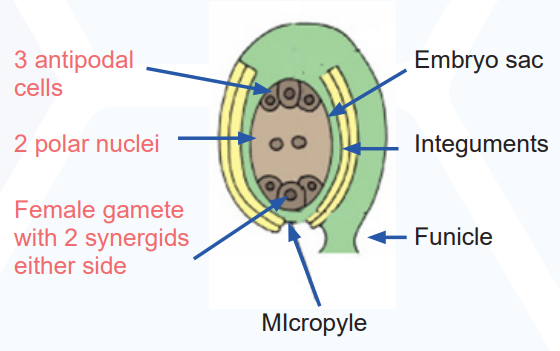
Process of development of an ovule
Megaspore mother cell undergoes meiosis
Forms 4 haploid nuclei
3 degenerate
1 undergoes 3 mitotic divisions
Forms 8 nuclei that are genetically identical;
Cell membranes form around six of the nuclei to form;
One of these cells becomes the ovum,
two synergids
3 antipodal cells
remaining two remain as free polar nuclei.
Draw a labelled diagram of an ovary
Pollination
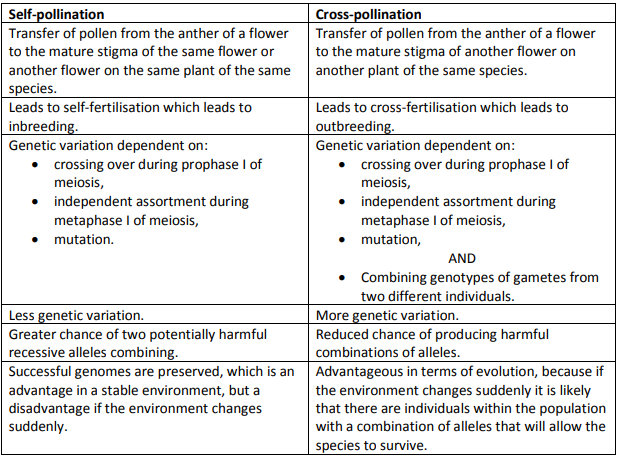
Transfer of pollen from an anther to a stigma
Self-pollination VS Cross-pollination
Ways in which plants prevent self-pollination/promote cross-pollination
Chemical self-incompatibility (gametes from the same plant cannot combine. gametes from the same parent plant are unable to fuse and form a zygote or, if the zygote forms, then it fails to develop.)
Irregular flower structure
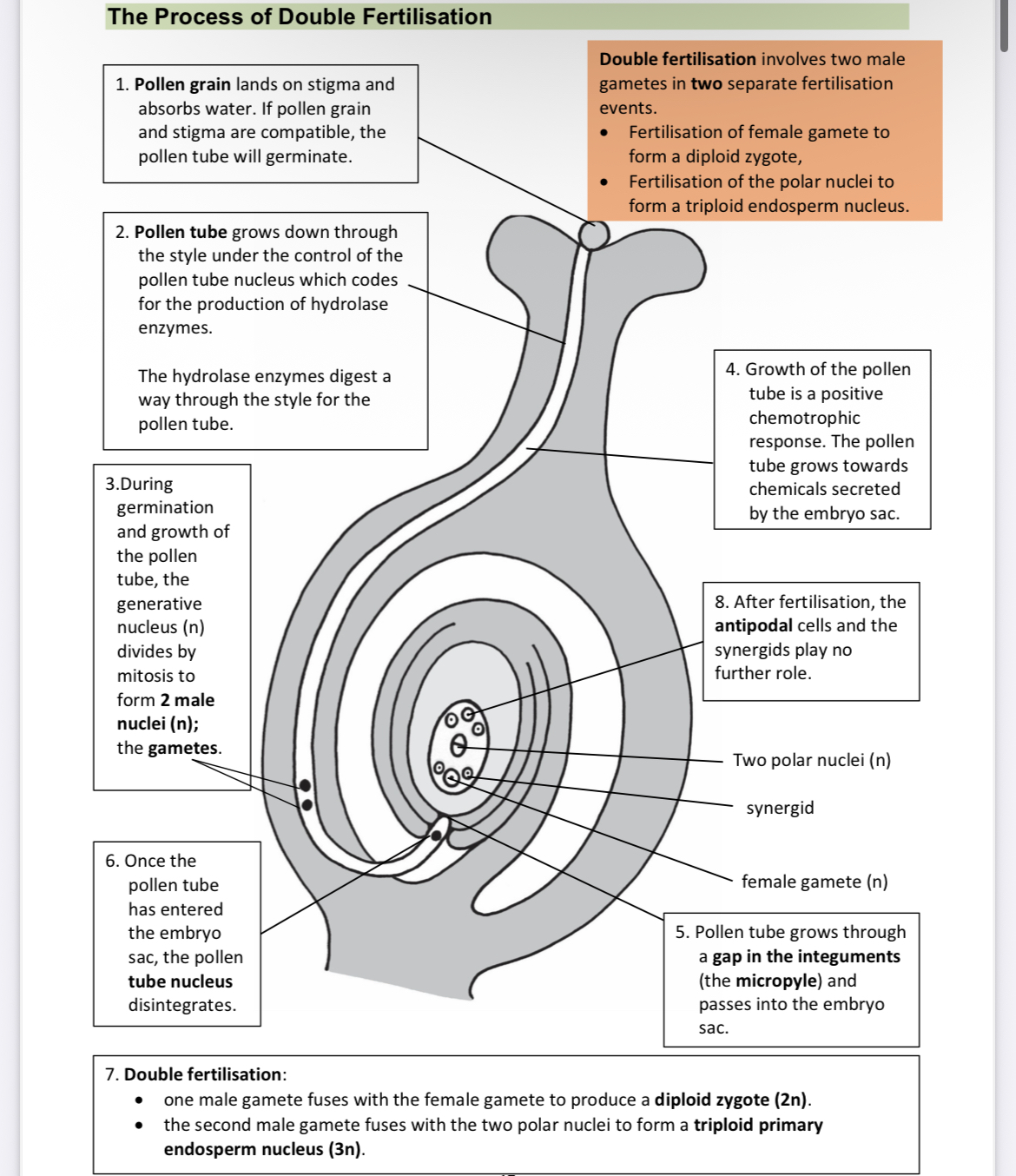
Explain the process of fertilisation
Germination of a pollen grain on a compatible stigma
Pollen grain on a compatible stigma produces hydrolase enzymes, forming a pollen tube leading to the micropyle of the embryo sac
Entry of the pollen tube into the embryo sace through the micropyle
One male gamete enters the embryo sac + fuses with the female gamete to produce a diploid zygote
The second male gamete fuses with the two polar nuclei to form a triploid primary endosperm nucleus
Draw a diagram of the process of fertilisation
Formation of a seed
Ovule developing into a seed
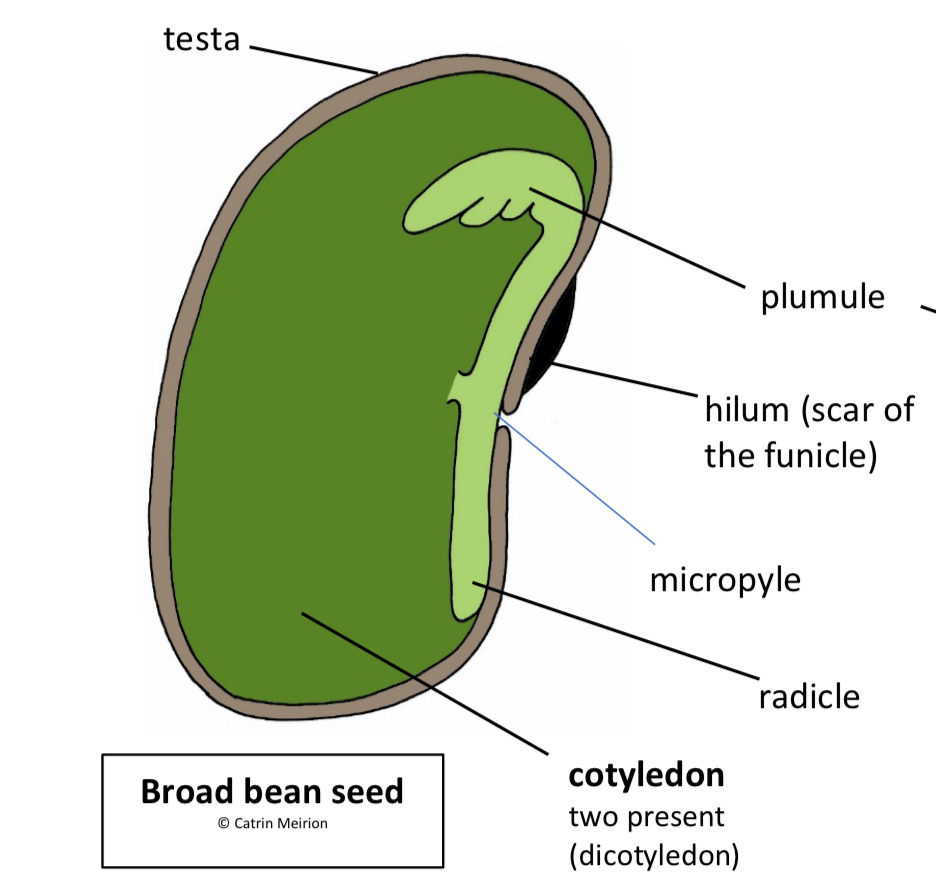
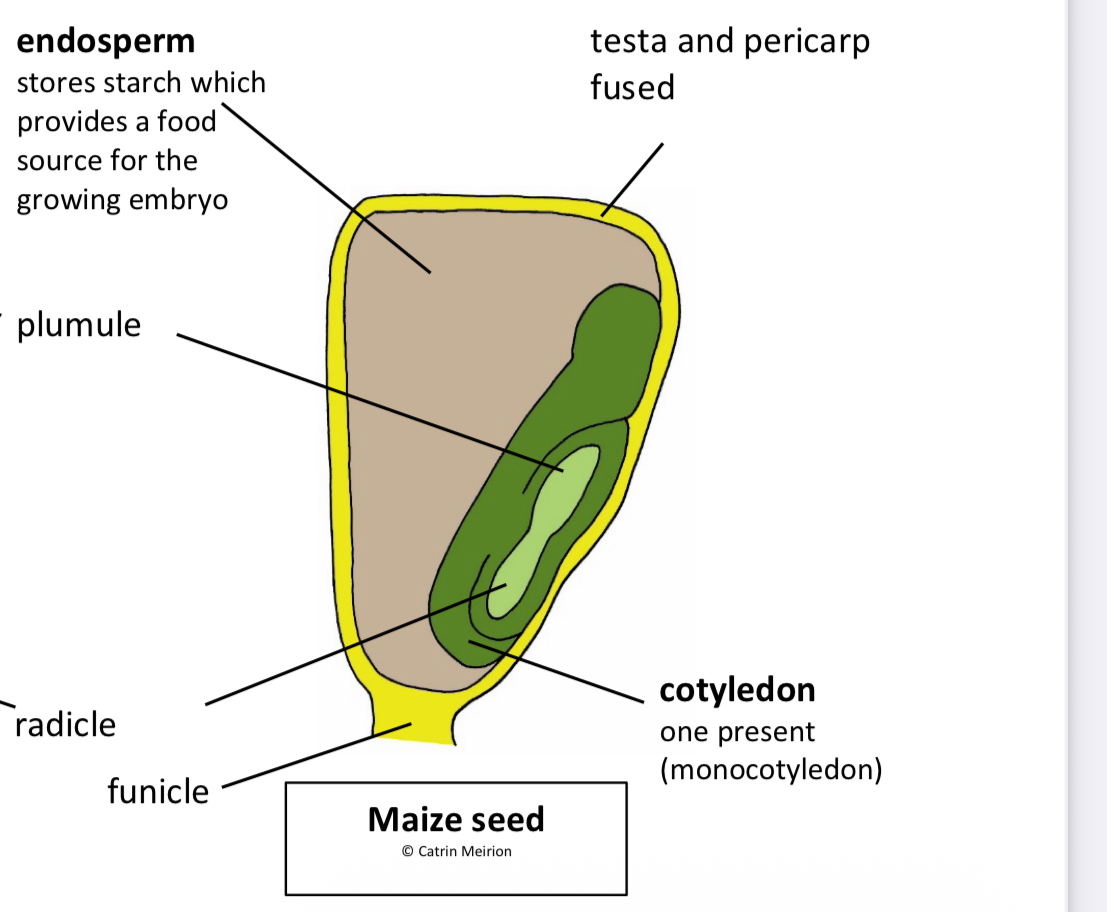
Diploid zygote divides by mitosis to form the diploid embryo, insuring of a plumule, radicle and one or two cotyledons
The triploid endosperm nucleus divided by mitosis to form endosperm tissue
Interment develop into the testa
Micropyle remains as a pore in the testa
Ovary wall develops into a fruit wall enclosing the seeds
Development of the ovule after fertilisation
Seed
Development of diploid zygote after fertilisation
Divides by mitosis to form the diploid embryo. This is made of the plumule, radical and 1 or 2 cotyledons
Development of triploid endosperm nucleus after fertilisation
Divides by mitosis to form endosperm tissue, an important food storage tissue
Development of integuments after fertilisation
Testa
Development of micropyle after fertilisation
Pore in the testa
Development of ovary after fertilisation
Develops into a fruit wall, enclosing seeds
Draw a fully labelled diagram of a broad bean
Draw a fully labelled diagram of a maize seed
Benefit of different mechanisms of dispersal of seeds
Reduces competition following germination and increases the chance of growth into mature plants
Germination definition
the series of biochemical and physiological processes through which a seed becomes a photosynthesising plant, independent of the food stores in the cotyledons
Conditions for germination
Seeds remain dormant until suitable conditions are present
Temperature; a suitable temperature would be between 5 and 30•C. Optimum temperature for the enzymes needed in germination
Water; required to make cells turgid to transport substances and to mobilise enzymes
Oxygen; required for aerobic respiration
Temperature for germination
A suitable temperature would be between 5 and 30•C. Optimum temperature for the enzymes needed in germination
Water needed for germination
Required to make cells turgid
Oxygen needed for germination
Required for aerobic respiration
Process of germination in a non-endospermic seed
Broad bean
Water imbibed/enters through the micropyle
Cotelydons swell
Test splits to allow entry of more oxygen for aerobic respiration
Food reserves from cotyledons, starch and proteins, are mobilised through hydrolysis (and lipids in some seeds)
Starch and protein used as sources of energy for use in respiration and growth of plumule and radical
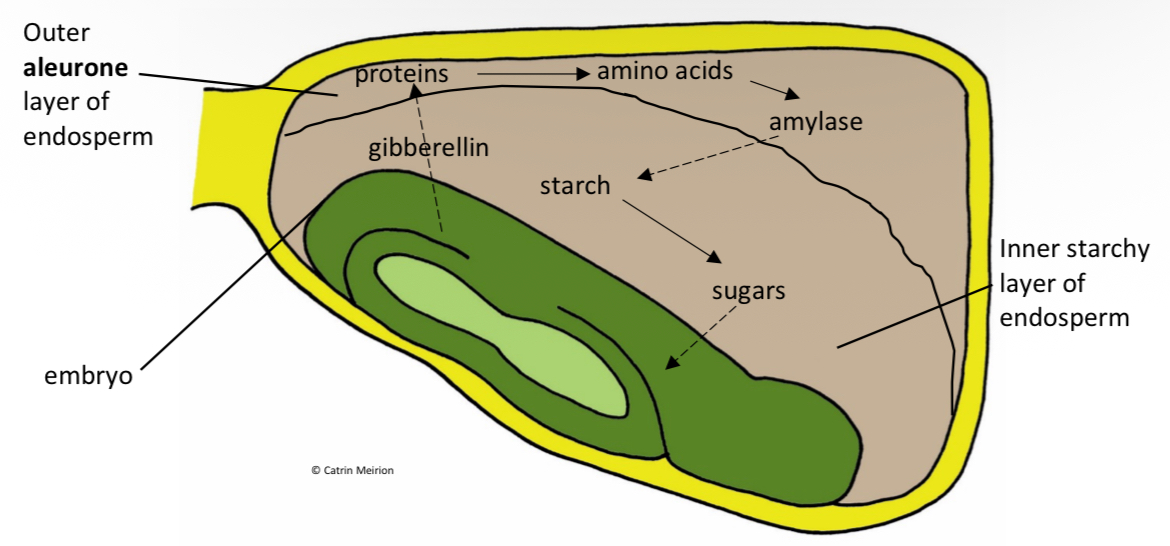
Process of germination an endosperm’s seed
Water imbibes/enters the seed
Gibberellin is released by the embryo
Diffuses to the aleurone layer which contains proteins
Amylases produced to break down stored starch in endosperm
Glucose and other nutrients diffuse to the embryo where they are used in aerobic respiration and growth
Gibberellin
Plant hormone involved in the process of germination
Hormone used in germination of an endospermic seed
Gibberellin
Male reproductive organ in plants
Anther
Female reproductive organ in plants
Ovary
Sepal
Each of the parts of the calyx of a flower, enclosing the petals
Corolla
Composed of petals
Function of the Corolla
Colourful and scented to attract insects
Corolla in a wind pollinated flower
Petals are often lacing or if present small and green
Carpel: male or female?
Female
Stamen: male or female?
Male
Carpel
Made of a sticky stigma to collect pollen from the insects bodies
Carpel of a wind pollinated flower
Large and feathery
Hangs outside the flower to collect pollen blown past
Receptacle and calyx
Outer ring of sepals that cover the flower in bud
Stamen
Made of the anther and filament is tucked inside the flower so the insect rubs past picking up pollen
Anther in a wind pollinated flower
Large and hangs outside the flower, so the small light pollen gets carried away
Draw a fully labelled diagram of the germination of an endospermic seed
Dormancy and germination
Water content of seeds is very low and is the major factor that prevents germination. Seeds will remain dormant until suitable conditions are present
Example of non-endospermic seeds
Broad bean
Example of endospermic seeds
Maize