GEOS3103 Environment, Sediment and Climate Change notes
 Call Kai
 Learn
Learn Practice Test
 Spaced Repetition
 Match
Match Flashcards
 Knowt Play
1/74

There's no tags or description
Looks like no tags are added yet.
Name | Mastery | Learn | Test | Matching | Spaced | Call with Kai |
|---|
No analytics yet
Send a link to your students to track their progress
75 Terms
How much of earth’s surface is covered by ocean
71%
What are the 3 types of Seas?
peri continental, Epicontinental and deep
Late Cretaceous flooding of continents
In 94 Ma significant transgression of the seas, resulting in widespread inundation of continental land masses.
Cenozoic Ocean gateways
In 65 Ma openings that formed between continents, significantly affecting ocean circulation and climate patterns
Ocean floor subdivision
Continental margins, deep-ocean basins and mid-ocean ridges
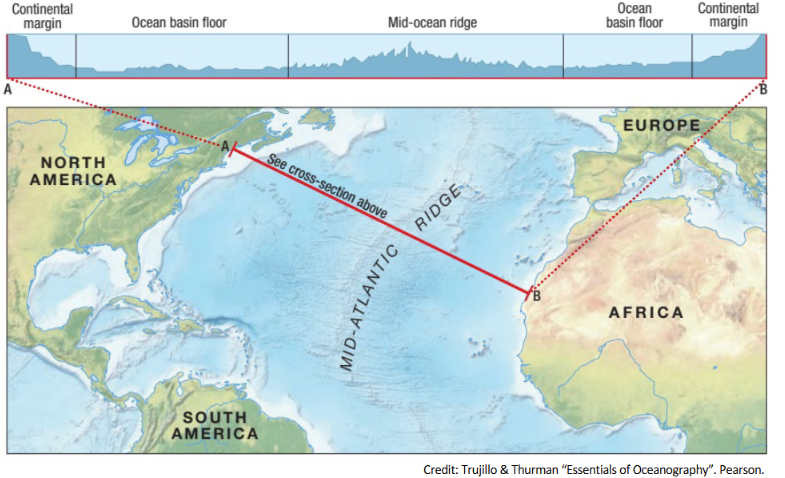
What are the 3 types of Continentals Shelf?
Glacial, Mid latitude/Siliciclastic and Tropical/Carbonate
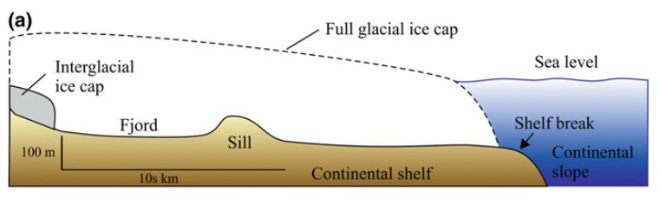
What type of shelf is this?
Glacial
Key features: fjords, sediment from ice sheet advance/retreat, rivers important (e.g. East Siberian shelf)
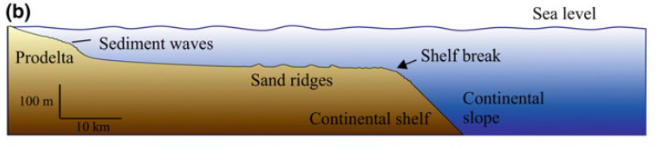
What type of shelf is this?
Mid Latitudes/ Siliciclastic
Key features: tides, storms, currents, terrigenous supply from rivers, reworking of older sediment (e.g. NSW shelf)
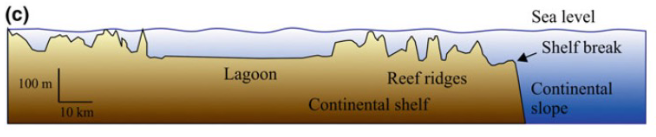
What type of shelf is this?
Tropical/ Carbonate
Key features: low gradient (<0.1°), biogenic sediment, e.g. Bahamas, Florida, Great Barrier Reef
What is the difference between an active continental margin and a passive one?
Passive: Divergent, tectonically quiet. Wide shelf, thick sediment accumulation. No earthquakes or volcanoes (Australian coast, Atlantic margins)
Active: Convergent. Subduction, earthquakes, volcanic activity. Narrow steep shelf, trenches (west South America ~ Chile)
What are the Ocean subdivision and provinces?
Continental margin: Continental shelf, continental slope, continental rise
Ocean Basin: Abyssal Plain, Mid ocean ridge, Deep Sea trench, Volcanic arcs, seamounts and guyots
What are the sediment transportation mechanisms of the continental margins?
What process is responsible for sediment transportation into and within oceanic basins?
Turbidity currents (density currents carrying suspended sediment downslope) are the major mechanism for transporting sediment from continental margins into deep ocean basins.
How are seafloor sample collected?
Grab samplers
Dredges
Box corers
Gravity corers
Piston corers
Ocean drilling (scientific drilling vessels, e.g. IODP)
What are the main types of biogenic seafloor sediment?
Siliceous: Sponge spicules, Diatoms, Sillicoflagilates and Radiolarians
Carbonates: Foraminifera, Coccolithophores, and Pteropods (Aragonite)
How do coccoliths get to the seafloor, and what are the two sinking rates?
Two pathways: (1) packaged in fecal pellets from grazers → sink fast at ~160 m/day.
(2) Discrete coccoliths → sink slowly at ~0.15 m/day. Below calcite saturation depth they begin dissolving. Packaging in pellets is critical for getting them to the seafloor before dissolution.
What are the 4 types of marine sediment?
Lithogenous: from pre-existing rocks (terrigenous clastic material)
Biogenous: from organisms (CaCO₃ and SiO₂ shells/tests)
Hydrogenous: precipitated from seawater (manganese nodules, evaporites, oolites)
Cosmogenous: from space (iron-nickel spherules, tektites, meteorites)
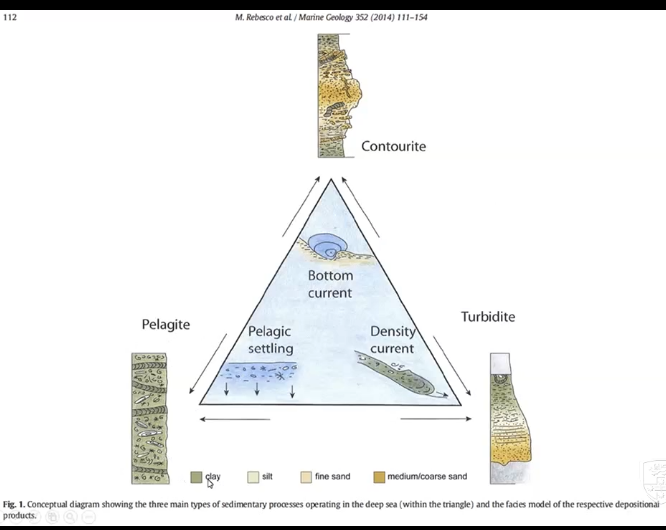
What is Pelagite and how is it formed?
A fine-grained sediment that accumulates slowly in the open ocean from suspended particles, biogenic remains, and atmospheric dust.
What is a hiatus and what is it caused by?
A gap in the sediment record (missing time record).
Caused by: Erosion (currents remove existing sediment), Dissolution (carbonates dissolve below CCD), Non-deposition (currents bypass the area). Recognisable in cores as an unconformity or sudden change in fossil assemblage.
What is HNLC and why does it occur?
High Nutrient Low Chlorophyll. Regions where major nutrients (nitrate, phosphate) are abundant but productivity is low.
Caused by: iron limitation. iron is the growth-limiting micronutrient for diatoms in many regions. Iron supplied by aeolian dust from continents.
HNLC regions: Southern Ocean, equatorial Pacific, NE Pacific.
How do oceanographic conditions at the sea surface influence the composition of biogenous seafloor sediments?
Biological productivity
Water temperature
Nutrient availability
Ocean circulation
Depth of water
Dissolution rates
These factors determine whether carbonate-rich, silica-rich, or mixed biogenic sediments accumulate.
How do carbonate and silica precipitation and dissolution affect marine sediment composition?
Carbonate and silica are produced by marine organisms. Their preservation depends on water chemistry, temperature, pressure, and depth. Increased dissolution reduces accumulation on the seafloor. Areas above dissolution depths preserve more biogenic sediment.
What is the CCD and why are Atlantic and Pacific different?
Carbonate Compensation Depth (CCD) is where carbonate dissolution = supply.
Atlantic: deep CCD (~4.5 km), young oxygenated deep water, carbonate-rich.
Pacific: shallow CCD (~3.5 km), old acidic deep water (accumulated CO₂), silicate-rich.
Thermohaline circulation is the driver.
What is the carbonate-silicate cycle?
A long-term geological cycle regulating atmospheric CO₂:
Weathering of silicate rocks consumes CO₂.
Rivers transport dissolved ions to the ocean.
Marine organisms form carbonate shells.
Carbonates are buried as sediment.
Tectonic processes recycle carbon back to the atmosphere through volcanism.
Where and how do contourite drifts form?
Sediment piles deposited by thermohaline bottom currents (contour currents) flowing along the continental slope. Sediment transported and piled against topographical obstacles. Follow thermohaline circulation pathways. (common in North Atlantic along path of NADW)
Where and how do turbidites form?
Continental slopes
Continental rises
Deep-sea fans
Abyssal plains
where turbidity currents deposit sediment.
Sediment accumulates on continental margins. → Slope failure triggers a turbidity current. →The current flows downslope carrying sediment. → Sediment settles as flow velocity decreases. = Graded beds form.
What are the characteristics of a Bouma sequence?
Ta: Massive / graded sand (rapid deposition)
Tb: Parallel laminated sand (upper flow regime)
Tc: Ripple cross-laminated sand (lower flow regime)
Td: Parallel laminated silt/mud (waning flow)
Te: Pelagic mud cap (background settling)
Represents decreasing energy as turbidity current wanes. Not always complete
What are the characteristics of a canyon and what is their role in the deposition of turbidites?
A deep, steep-sided valley cut into the continental shelf and slope.
Characteristics: Deep and narrow, Steep-sided, extend from shelf to deep ocean, often connected to river systems.
Role: They act as pathways that funnel sediment-laden turbidity currents from continental shelves into deep ocean basins, where turbidites are deposited.
Where does deep-sea clay occur and how does it form?
Where: In remote parts of ocean basins → Abyssal plains, Areas far from continents, Areas below the CCD
Form: Through slow accumulation of → Wind-blown dust, Volcanic ash, Clay minerals, Authigenic minerals
Typically accumulating at only a few millimetres per thousand years.
Where do manganese nodules occur and how do they form?
Manganese nodules occur on abyssal plains of the deep ocean, particularly in areas with very low sedimentation rates.
Form by the slow precipitation of:
Manganese oxides
Iron oxides
Trace metals (Ni, Cu, Co, REEs)
around a nucleus such as a shell fragment, shark tooth, or rock fragment. Growth rates are extremely slow (millimetres per million years).
What is the controversial nature of deep-sea mining?
Potential benefits → Access to critical metals (Ni, Co, Cu, Mn) + Supports renewable energy technologies
Concerns: →Destruction of deep-sea ecosystems, Sediment plumes affecting marine life, Loss of biodiversity, long recovery times of deep-sea habitats, Limited understanding of ecosystem impacts
What controls are on modern carbonate production accumulation?
Water temperature
Light availability
Salinity
Nutrient levels
Water depth
Biological productivity
Ocean chemistry
Wave and current energy
Maximum production generally occurs in warm, shallow tropical waters.
What is the impact if the biological community on carbonate accumulation and composition?
Different organisms produce different carbonate sediments:
Corals → reef frameworks
Molluscs → shell fragments
Foraminifera → carbonate mud and sand
Calcareous algae → carbonate grains
Coccolithophores → pelagic carbonate ooze
The dominant organisms determine sediment texture and composition.
How has the chemistry of the ocean changed through time with respect to carbonates?
Earth has alternated between:
Calcite seas (low Mg/Ca ratios favour calcite precipitation)
Aragonite seas (high Mg/Ca ratios favour aragonite precipitation)
Changes are linked to: → Seafloor spreading rates, Plate tectonics, Atmospheric CO₂ and Ocean circulation
These changes affect carbonate-producing organisms and carbonate mineralogy.
What is the global distribution and composition of cool-water carbonates?
Cool-water carbonates occur mainly: High latitudes +Temperate continental shelves
They are typically composed of: Bryozoans, Molluscs, Echinoderms &Foraminifera
Unlike tropical carbonates, they generally lack extensive coral reefs.
What are some of the key depositional environments of carbonates?
Coral reefs, Lagoons, Tidal flats, Continental shelves, Deep marine settings, Carbonate ramps, Isolated platforms, Pelagic environments
What is Folk’s and Dunham’s naming scheme?
Folk classifies carbonates based on:
Allochems (grains)
Matrix (micrite) → Biomicrite, Pelmicrite
Cement (sparite) → Oosparite
Dunham classifies carbonates based on depositional texture:
Rock Type | Description |
|---|---|
Mudstone | Mud-supported, <10% grains |
Wackestone | Mud-supported, >10% grains |
Packstone | Grain-supported with mud |
Grainstone | Grain-supported, no mud |
Boundstone | Organisms bound sediment during deposition |
What are the main biological, chemical and detrital components in carbonates and classify them according to Folk’s and Dunham’s schemes.
|
| Folk | Dunham |
Biological Components | Shell fragments (bioclasts) Corals Foraminifera Algae
| Biomicrite Biosparite
| Wackestone Packstone Grainstone Boundstone
|
Chemical Components | Ooids Pisoids Peloids
| Oomicrite Oosparite Pelmicrite
| Grainstone Packstone
|
Detrital Components | Intraclasts Reworked carbonate grains
| Intramicrite, Intrasparite
| Packstone, Grainstone
|
What are the environments of deposition for biological, chemical and detrital components in carbonates?
Biological | Chemical | Detrital |
Reefs Lagoons Shelves | High-energy shoals Tidal channels Warm shallow marine settings | Storm deposits Channels Reworked platform margins |
What is the difference between carbonate rocks and siliciclastic rocks?
Carbonate Rocks | Siliciclastic Rocks |
|---|---|
Mainly CaCO₃ | Mainly quartz and silicates |
Often biologically produced | Produced by weathering and erosion |
Can form in situ | Usually transported before deposition |
Sensitive to ocean chemistry | Controlled largely by sediment supply |
What are some common seafloor sediments?
Calcareous ooze, Siliceous ooze, Deep-sea clay, Turbidites, Pelagic sediments, Volcanic ash, Contourites, Manganese nodules
What is the difference between freshwater vadose, freshwater phreatic and marine phreatic zones and their diagenetic effect on dissolution and cementation of limestones?
Vadose zone (above water table): pores have air + freshwater. Meniscus cement (at grain contacts) and pendant/drip cement (gravity-controlled). Low-Mg calcite, stable.
Freshwater phreatic (below WT, freshwater): dissolution of aragonite + HMC, precipitation of stable LMC. Secondary porosity created.
Marine phreatic (seafloor): oversaturated in CaCO₃. Isopachous cements of aragonite and Mg-calcite form uniformly around grains.
What is the difference between vadose and phreatic cements
Vadose Cement: → Forms above the water table. Water occupies pore spaces intermittently. Often forms meniscus cements.
Phreatic Cement: → Forms below the water table. Pores completely filled with water. Typically forms uniform rim cements around grains.
What are the major fabrics of burial diagenesis?
Compaction, Pressure solution, Stylolites, Cementation, Recrystallisation, Dolomitisation, Fracturing
These processes reduce porosity and alter original sediment textures.
What is meteoric diagenesis?
Freshwater-driven diagenesis in the vadose and phreatic zones. Extensive dissolution of unstable carbonates (aragonite, HMC) and reprecipitation of stable low-Mg calcite (LMC). Fills primary porosity, creates secondary porosity (vugs, molds).
Vadose cements: meniscus + pendant. Phreatic cements: isopachous, equant (blocky spar). End result: all LMC, as is the most stable carbonate mineral.
What is the process responsible for the formation of evaporites
As seawater evaporates, salts precipitate in order of decreasing solubility:
1. CaCO₃ (calcite/aragonite) — first to precipitate
2. CaSO₄ (gypsum when wet, anhydrite when buried)
3. NaCl (halite)
4. KCl and MgSO₄ salts — last (bitterns)
The Messinian Salinity Crisis (~6 Ma) is the classic example of massive evaporite deposition when the Mediterranean was cut off from the Atlantic.
What are the settings in which evaporites form?
Evaporites form where evaporation exceeds water input, including:
Restricted marine basins, Coastal sabkhas, Salinas, Playa lakes, Arid lagoons
Conditions required → High evaporation rates, Arid climate, Restricted water circulation, Repeated replenishment of dissolved ions
What is the significance of evaporites in the geological record?
Evaporites indicate:
Ancient arid climates
Restricted marine conditions
Past sea-level changes
Basin evolution
They are also important because: →They form seals for oil and gas reservoirs. Salt can flow and create salt domes. They provide evidence of paleoenvironments and paleoclimate.
What major discoveries have resulted from scientific ocean drilling?
Confirmation of seafloor spreading
Evidence for the K–Pg impact extinction
Understanding of the PETM climate event
Discovery of the deep subseafloor biosphere
Improved reconstructions of Earth's climate and ocean history
How did scientific ocean drilling provide evidence for seafloor spreading and what evidence supports this?
Ocean drilling showed that → Ocean crust becomes progressively older away from mid-ocean ridges. Sediment thickness increases with distance from ridges. These observations confirmed seafloor spreading.
Evidence: Youngest rocks occur at ridge crests. Rock age increases symmetrically away from ridges. Sediment cover thickens with crustal age.
What is the significance and how did SOD help confirm the K-Pg Impact hypothesis?
Drilling recovered sediments containing → High iridium concentrations, Shocked quartz, Impact ejecta
These findings supported an asteroid impact at the end of the Cretaceous.
Significance: It triggered a mass extinction about 66 million years ago, including the extinction of non-avian dinosaurs.
What was the Paleo-Eocene Thermal Maximum (PETM)? and how has SOD improved our understanding?
A rapid global warming event about 56 million years ago caused by a large release of carbon into the atmosphere and oceans.
Drilled sediment cores revealed → Carbon isotope excursions, Rapid warming, Ocean acidification, Changes in marine ecosystems
What is the deep subseafloor biosphere, how was it discovered and why is it important?
A vast ecosystem of microorganisms living within sediments and rocks beneath the seafloor.
Scientific drilling recovered sediment and rock samples containing living microorganisms from deep beneath the seafloor. (Mirabilite)
Importance: Contains a large fraction of Earth's microbial life. Influences global biogeochemical cycles. Expands our understanding of life's limits on Earth.
What are the environmental challenges the ocean faces in the future?
Ocean acidification, Sea level rise, Oxygen depletion/dead zones, Slowing of the Atlantic Meridional Overturning Circulation (AMOC), Coral Bleaching and Transport challenges.
What is ocean acidification and how will it affect the future ocean?
Ocean absorbs ~30% of anthropogenic CO₂ → CO₂ + H₂O → H₂CO₃ (carbonic acid) → releases H⁺ ions → lowers pH.
Ocean pH has dropped 0.1 units since pre-industrial times (30% more acidic).
Reduces CO₃²⁻ availability → dissolves shells/skeletons of calcifying organisms (corals, pteropods, mollusks, foraminifera). Shallower CCD
Aragonite saturation horizons are shoaling. By 2100, pH projected to reach ~7.8.
What is Sea Level Rise and how will it affect the future ocean?
Caused by thermal expansion of seawater and melting ice sheets/glaciers. If all ice melted, sea level would rise ~65 m. Business-as-usual scenario projects ~2 m rise by 2100.
Impacts: coastal flooding, loss of low-lying land (e.g. parts of Sydney, Bangladesh), saltwater intrusion, increased storm surge damage, changes to shelf sedimentation and shoreline position.
What is Oxygen depletion and dead zones and how will it affect the future ocean?
Dead zones = hypoxic (low oxygen) areas. Caused by warming reducing O₂ solubility, increased ocean stratification reducing mixing, and pollution. Algal blooms → bacterial decomposition consumes O₂ → hypoxia. Currently ~10% of the world's ocean is a dead zone.
Impacts: mass mortality of marine life, coral death, expansion of oxygen minimum zones (OMZs), loss of benthic biodiversity.
What is Slowing of the Atlantic Meridional Overturning Circulation (AMOC) and how will it affect the future ocean?
AMOC is a system of currents transporting warm surface water north and cold deep water south. Driven by density differences (temperature and salinity). Melting ice adds freshwater → reduces salinity → reduces deep water formation → slows AMOC. Currently at weakest state in 1,600 years.
Impacts: Europe cools (currently keeps it up to 10°C warmer), disrupted rainfall patterns globally, La Niña becoming the norm for Australia, sea level rise on US east coast, altered deep-sea sediment transport.
What is Coral Bleaching and how will it affect the future ocean?
Thermal stress causes corals to expel their symbiotic zooxanthellae algae → corals turn white (bleach). If stress persists, corals die. Triggered by ocean warming and acidification. The 2015–2016 global bleaching event was the longest on record, affecting reefs in 38+ countries including the Great Barrier Reef.
Impacts: loss of biodiversity hotspots, collapse of fisheries, loss of coastal protection, economic damage to tourism.
What is Transport challenges and how will it affect the future ocean?
Climate extremes disrupt global shipping routes. Example: Panama Canal drought (2023–24) reduced water levels, restricting ship transit and affecting ~5% of global trade. Arctic sea ice loss opens new routes but creates new hazards. Increased storm intensity threatens port infrastructure. Sea level rise affects coastal infrastructure.
How do you classify siliciclastic rocks based on their grain-size and components?
By grain size (Wentworth scale): gravel/conglomerate (>2mm), sand/sandstone (0.0625–2mm), silt/siltstone (0.004–0.0625mm), clay/mudstone/shale (<0.004mm). Also classified by composition: quartz arenite (>90% quartz), arkose (>25% feldspar), lithic arenite (>25% rock fragments). Maturity assessed by sorting, rounding, and mineralogy.
Interpret the depositional environment of major siliciclastic rocks.
Conglomerates → high-energy environments (alluvial fans, river channels, beaches). Sandstones → rivers, deltas, beaches, deserts (dunes), shallow marine (bars, shoreface), deep marine (turbidites). Siltstones → lower energy: floodplains, tidal flats, distal turbidites. Mudstones/shales → low energy: deep marine, lakes, lagoons, floodplains.
Key indicators: sedimentary structures (cross-bedding, ripples, grading), fossils, geometry.
What are major diagenetic features of sandstone?
Compaction: grain rearrangement and deformation reducing porosity. Cementation: precipitation of minerals (quartz overgrowths, calcite, clay minerals like kaolinite/illite) in pore spaces. Dissolution: dissolution of unstable grains (feldspar, carbonate) creating secondary porosity. Replacement: one mineral replacing another. Authigenic clay formation.
Overall effect: reduces porosity and permeability over time (burial diagenesis).
What are microplastics?
Plastic Particles <5 mm in diameter. They are formed by UV degradation and biocolonisation
What is the source, transport and deposition of microplastics in the ocean.
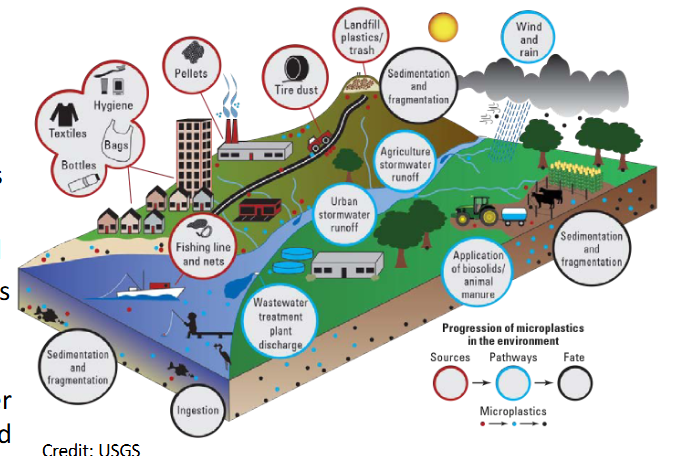
Sources: land-based (urban runoff, rivers, wastewater treatment, agriculture) and sea-based (fishing, shipping). ~80% terrestrial, ~20% marine.
Transport: rivers → coast → shelf currents and waves → canyon heads → turbidity currents carry them downslope → thermohaline/bottom currents redistribute along seafloor. Also atmospheric deposition and vertical settling.
Deposition: contourite drifts are major hotspots; also submarine fans, trenches, abyssal plains.
Total seafloor estimate ~3 million tonnes.
What does the role of sedimentology play in the understanding of how microplastics are distributed across the seafloor?
Provides the framework for understanding microplastic transport and deposition. Settling velocity depends on plastic density and shape (like Stokes' Law for sediment grains). Flow type (turbidity currents, debris flows, contour currents) determines where and how microplastics are deposited — fibers behave like organic material concentrated at bed tops; fragments behave like low-density grains. Canyon and fan systems act as conduits (same as sediment routing systems). Bottom current energy controls erosion vs. accumulation zones. Sediment facies models predict where microplastics will concentrate.
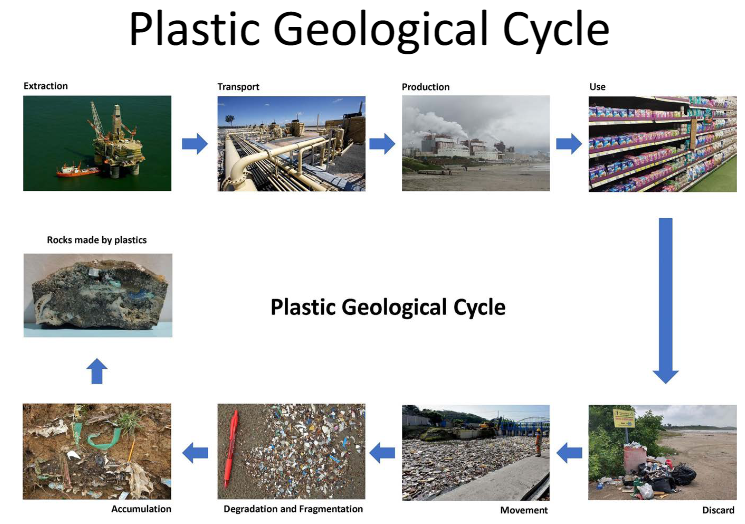
What is the Plastic geological cycle?
ETPUDM(DandF)A = Rocks made by plastic
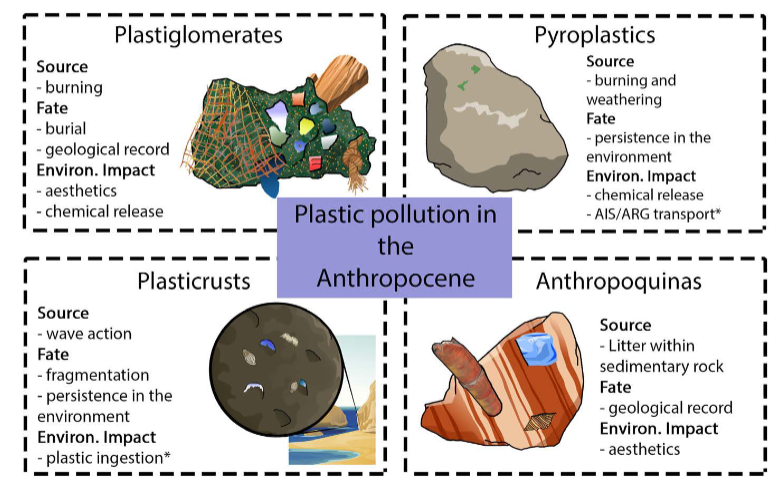
What are the names of plastics as rocks?
Plastigolmerates, Pyroplastics, Plasticrusts and Anthropoquinas
Accuracy vs precision. What is the difference and how do you test each?
Accuracy = proximity to true value. Tested using Certified Reference Materials (CRMs) — materials of known concentration run through the same procedure.
Precision = consistency/reproducibility. Tested by running replicates and calculating %RSD (% Relative Standard Deviation) = (stdev/mean) × 100. <5% is ideal. You can be precise but inaccurate (consistently wrong). You want both.
How does XRF work and what are its limitations?
Incoming X-ray knocks electron from inner shell → outer electron falls down to fill gap → releases a characteristic X-ray of specific energy for each element. Measures: major elements (Na, Mg, Al, Si, Fe etc.) in weight % oxide.
Limitations: Cannot detect O, H, C (light elements, these dilute readings and can't be quantified). Can't go below aluminium. Samples >1g needed (powder). Semi-quantitative for some elements → needs normalization (e.g. to Ti).
Why normalize XRF data to Ti?
Ti (titanium) is immobile and stable, it doesn't move during diagenesis, redox reactions, or dissolution. By expressing other elements as ratios to Ti (e.g. ln(Fe/Ti), ln(Ca/Ti)), you remove the effect of dilution by organic matter, biogenic silica, or carbonate, which can make elements appear artificially high or low. This allows meaningful comparison of relative enrichment.
What is isotopic fractionation and what is the GMWL?
Heavy isotopes (e.g. ¹⁸O) and light isotopes (¹⁶O) partition differently between phases during physical/chemical processes. In evaporation, ¹⁶O leaves preferentially → residual water enriched in ¹⁸O → recorded in carbonates. GMWL (Global Meteoric Water Line): δ²H = 8 × δ¹⁸O + 10 Describes the global relationship between H and O isotopes in precipitation. Lakes plotting below GMWL = evaporative enrichment → sensitive to climate.
What does δ¹⁸O in foram calcite tell you about past climates?
Foraminifera record the δ¹⁸O of seawater when they build their calcite tests. Temperature effect: warmer water → lighter δ¹⁸O in calcite (fractionation decreases with temperature). Ice volume effect: glaciations lock up ¹⁶O in ice sheets → ocean becomes enriched in ¹⁸O → heavier foram δ¹⁸O. Combining these effects allows reconstruction of past SST and global ice volume.
What does magnetic susceptibility tell you in a sediment core?
Magnetic susceptibility (MS) measures how easily sediment is magnetised by an applied field.
High MS: more ferrimagnetic minerals (e.g. magnetite) = more terrigenous/volcanic input, higher clastic flux from catchment.
Low MS: more biogenic sediment (carbonate or silica) diamagnetic minerals (quartz, calcite) have very low/negative susceptibility.
Changes downcore track shifts in: catchment erosion, lake level, volcanic activity, or relative biogenic vs terrigenous input.