BIO FINAL
 Call Kai
 Learn
Learn Practice Test
 Spaced Repetition
 Match
Match Flashcards
 Knowt Play
1/335

There's no tags or description
Looks like no tags are added yet.
Name | Mastery | Learn | Test | Matching | Spaced | Call with Kai |
|---|
No analytics yet
Send a link to your students to track their progress
336 Terms
What is a pathogen?
A disease-causing agent such as bacteria, viruses, fungi, or parasites
What is the immune system?
The collection of defenses that protect the body against pathogens
What is the main function of the immune system?
To distinguish self from nonself and eliminate foreign invaders
What is molecular recognition?
The specific binding of immune receptors to foreign molecules
What are the two types of immune defenses?
Innate immunity and adaptive immunity
What is innate immunity?
A fast, non-specific defense present in all animals
What is adaptive immunity?
A slower, specific defense found only in vertebrates that improves with exposure
What are barrier defenses?
The first line of defense that prevents pathogen entry
Name examples of barrier defenses
Skin, mucous membranes, secretions, stomach acid
Why can’t the body completely seal itself off?
Because it needs openings for gas exchange, nutrition, and reproduction
What is the role of mucus?
It traps pathogens and particles
What do ciliated epithelial cells do?
They sweep mucus and trapped pathogens out of the airway
What is lysozyme?
An enzyme that destroys bacterial cell walls
Where is lysozyme found?
Tears, saliva, and mucus
How does stomach acid protect the body?
Its low pH kills most pathogens in food and water
What pH is human skin and why is it important?
pH 3–5; inhibits bacterial growth
What happens if pathogens enter the body?
The immune system must recognize and destroy them internally
What is the key challenge once pathogens enter the body?
Distinguishing self from nonself
What do immune cells use to detect pathogens?
Receptor molecules that bind to foreign molecules
What is phagocytosis?
The process of engulfing and digesting pathogens
What are pseudopodia?
Extensions that surround and engulf pathogens
What happens after a pathogen is engulfed?
A vacuole forms and fuses with a lysosome
What destroys pathogens inside phagocytes?
Toxic compounds and lysosomal enzymes
What happens to debris after digestion?
It is expelled by exocytosis
What is the main barrier defense in insects?
The exoskeleton made of chitin
What is chitin?
A polysaccharide that forms a protective barrier
How do insects defend against viruses?
By destroying viral RNA using RNA interference
What is double-stranded RNA a sign of?
Viral infection
What does the enzyme Dicer-2 do?
Cuts viral RNA into small fragments
What does the Argo complex do?
Uses RNA fragments to destroy viral mRNA
What are Toll-like receptors (TLRs)?
Receptors that recognize common pathogen molecules
What do TLRs recognize?
Molecules like lipopolysaccharides, flagellin, and viral RNA
What are neutrophils?
Phagocytic cells that circulate in blood and respond to infection
What are macrophages?
Large phagocytic cells that engulf pathogens and reside in tissues
What are dendritic cells?
Cells that stimulate adaptive immunity after engulfing pathogens
What are eosinophils?
Cells that defend against parasitic worms by releasing enzymes
What are natural killer (NK) cells?
Cells that kill infected or cancerous cells by releasing chemicals
What do mast cells do?
Release histamine during inflammation
What is inflammation?
A response to injury or infection involving swelling, redness, and heat
What triggers inflammation?
Cytokines and histamine released by immune cells
What does histamine do?
Causes blood vessels to dilate and become permeable
Why does inflammation cause redness and heat?
Increased blood flow to the area
What is pus?
A mixture of dead white blood cells, pathogens, and tissue debris
What happens to fluid after inflammation?
It enters the lymphatic system as lymph
What is the lymphatic system?
A network that transports lymph and filters pathogens
What do lymph nodes do?
Contain immune cells that attack pathogens in lymph
What is systemic inflammation?
A body-wide inflammatory response
What can systemic inflammation cause?
Fever and increased white blood cells
What is septic shock?
A life-threatening systemic inflammatory response
What is chronic inflammation?
Long-term inflammation that damages tissues
What are interferons?
Proteins that inhibit viral replication
How do interferons work?
They signal nearby cells to block viral spread
What is the complement system?
A group of proteins that help destroy pathogens
What does the complement system do?
Causes lysis of pathogens and enhances inflammation
How can pathogens evade immunity?
By avoiding recognition or resisting destruction
What is an example of immune evasion?
Bacterial capsules that prevent phagocytosis
What is Mycobacterium tuberculosis?
A bacterium that survives inside immune cells
What disease does Mycobacterium tuberculosis cause?
Tuberculosis
What is an antigen?
A substance that triggers an immune response
What is an epitope?
The specific part of an antigen recognized by immune cells
What are lymphocytes?
White blood cells involved in adaptive immunity
What are the two main types of lymphocytes?
B cells and T cells
Where do B cells mature?
Bone marrow
Where do T cells mature?
Thymus
What do B cells recognize?
Intact antigens in body fluids
What do T cells recognize?
Antigen fragments presented on host cells
What is an antibody?
A soluble protein that binds specific antigens
What is another name for antibody?
Immunoglobulin (Ig)
What is the structure of a B cell receptor?
Y-shaped with two heavy and two light chains
What are variable regions?
Parts of receptors that vary and bind specific antigens
What are constant regions?
Parts of receptors that remain similar across cells
What is antigen presentation?
Display of antigen fragments on MHC molecules
What is MHC?
A protein that presents antigen fragments to T cells
Why is antigen presentation important?
It allows T cells to detect infected cells
What is receptor diversity?
The ability to recognize many different antigens
How is receptor diversity generated?
By gene rearrangement (V, J, C segments)
What is recombinase?
An enzyme that rearranges gene segments
What is self-tolerance?
The immune system’s ability to avoid attacking itself
How is self-tolerance achieved?
Self-reactive lymphocytes are destroyed or inactivated
What is clonal selection?
Activation and multiplication of specific lymphocytes
What is a clone?
A group of identical cells from one activated lymphocyte
What are effector cells?
Short-lived cells that actively fight infection
What are memory cells?
Long-lived cells that provide faster future responses
What is the primary immune response?
The first response to an antigen (slow and weak)
What is the secondary immune response?
A faster and stronger response to repeated exposure
What is immunological memory?
The ability to respond more effectively to previously encountered antigens
diffusion
when there is a difference in the concentration of a gas or other substance, such as between a cell and its immediate surroundings, ____ can result in net movement
gastrovascular cavity
structure in hydras, jellies, and cnidarians that functions in the distribution of substances throughout the body, as well as in digestion
heart
powers circulation by using metabolic energy to elevate the circulatory fluid’s hydrostatic pressure
Organ(s) that pump blood into vessels in a closed circulatory system
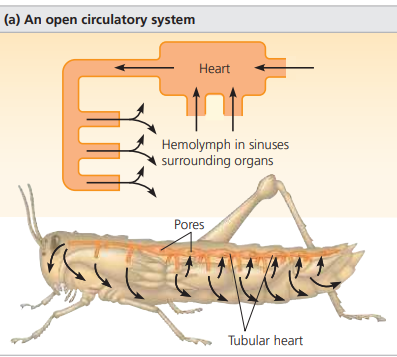
Open circulatory system
A system where circulatory fluid is not confined to vessels and directly bathes organs
Hemolymph
Circulatory fluid in an open system that also functions as interstitial fluid
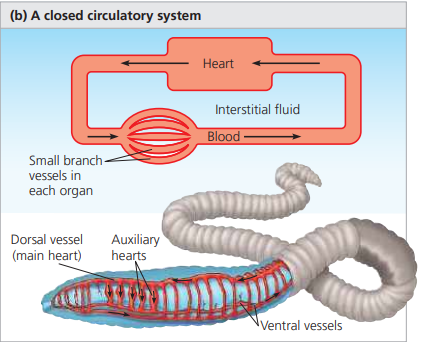
Closed circulatory system
A system where blood is confined to vessels and separate from interstitial fluid
Blood
Circulatory fluid in a closed system that remains within vessels
Cardiovascular system
The organ system consisting of the heart and blood vessels that transports blood throughout the body
Arterioles
Small branches of arteries that regulate blood flow into capillary beds
Capillary beds
Networks of microscopic blood vessels where gas, nutrient, and waste exchange occurs
Venules
Small vessels that collect blood from capillaries and transport it toward veins
Veins
Blood vessels that carry blood back to the heart
Atria
Upper chambers of the heart that receive blood entering the heart
Ventricles
Lower chambers of the heart that pump blood out of the heart