Biol 213 Chapter 13
 Call Kai
 Learn
Learn Practice Test
 Spaced Repetition
 Match
Match Flashcards
 Knowt Play
1/22

There's no tags or description
Looks like no tags are added yet.
Name | Mastery | Learn | Test | Matching | Spaced | Call with Kai |
|---|
No analytics yet
Send a link to your students to track their progress
23 Terms
The breakdown and oxidation of food occurs in three steps
Catabolism
Food + O2 →
ATP + NADH +CO2 + H2O
Cellular respiration
The breakdown and utilization of sugars in a cell
Aerobic cellular respiration
the complete oxidation of food molecules, like glucose, to CO2 and H2O
food + O2 → ATP + NADH + CO2 + H2O
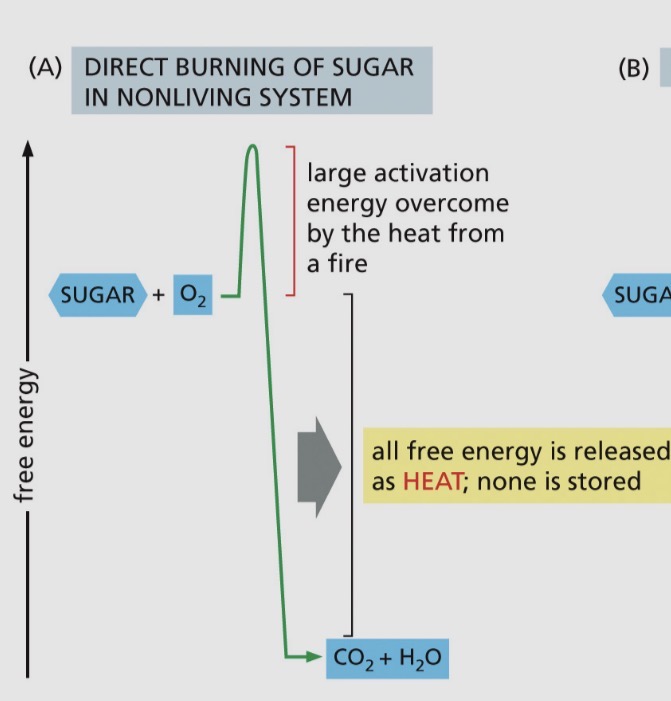
Direct burning of sugar in nonliving system
Large activation energy over some by the heat from a fire
All free energy is released as heat; none is stored
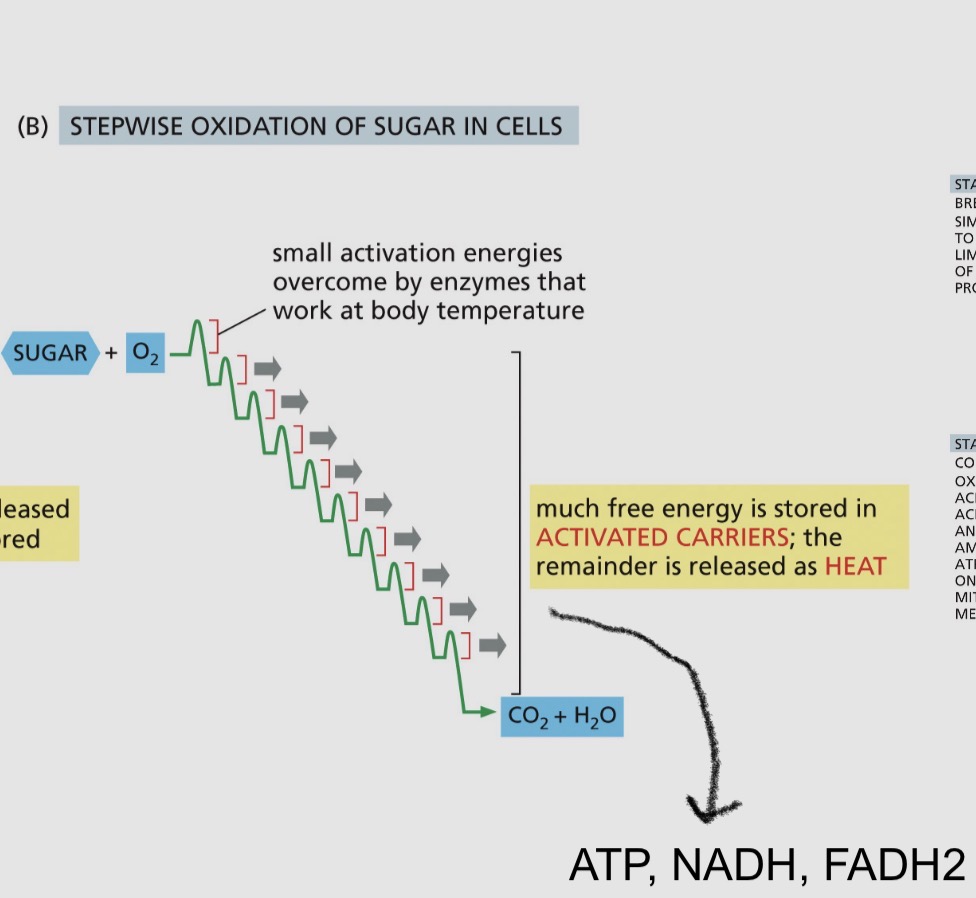
Stepwise oxidation of sugar in cells
Small activation energies overcome by enzymes that work at body temperature
Much free energy is stored in activated carriers; the remainder is released as heat
The building of sugar =
Anabolism
Hoe do plants build sugars
Through photosynthesis
How do animals build sugar
Gluconeogenesis and glycogenesis
Photosynthesis
The building and eventual storage of Sugars in a cell
the production of sugars, like glucose and starch, from light, CO2, and H2O
Light dependent reactions → Calvin cycle → sugar formation
Electron carriers
NADH
FADH2
NADPH
provide hydrogen
Glycolysis
Extraction of energy from splitting sugar
conversion of glucose (6C) to two molecules of pyruvate (3C)
10 enzymatic steps (harvest energy in small steps)
All steps occur in the Cytosol
ATP production in Glycolysis
Requires an initial investment of two ATP
• Produce four ATP
• Net yield => two ATP
In glycolysis, no O2 is involved, but
Oxidation of an intermediate occurs
(NAD+ → NADH)
Yields two NADH per glucose
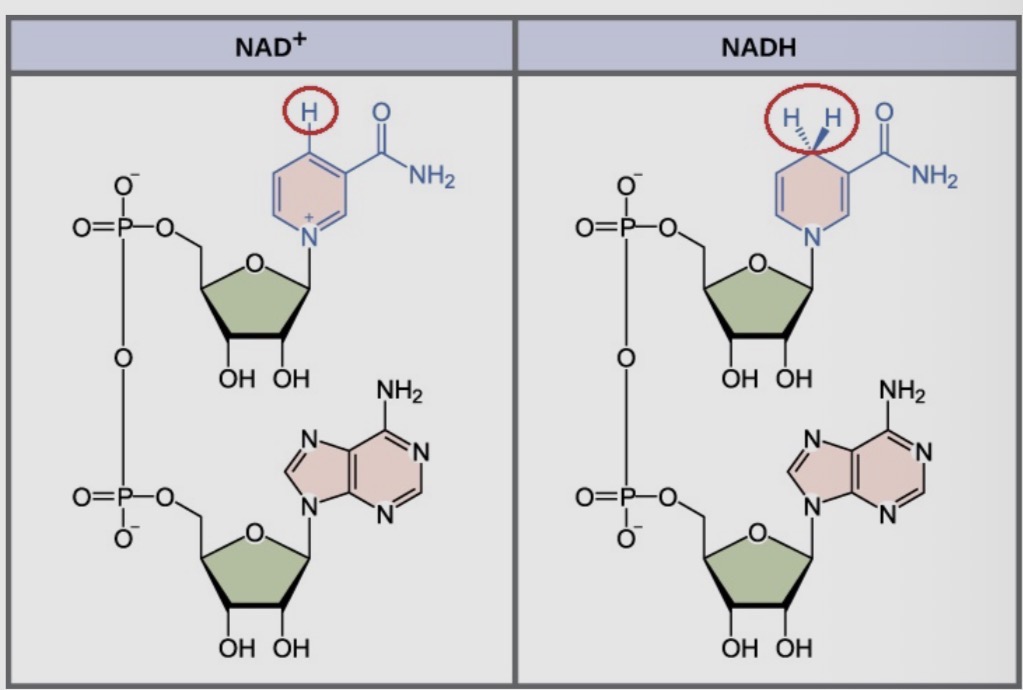
NAD+ vs NADH
NAD+ has one hydrogen while NADH has 2
Anaerobic conditions
Fermentation in a vigorously active muscle cell → muscle and cancer cells
Fermentation in yeast → yeast cells
Matrix of mitochondria in aerobic conditions
This space contains a highly concentrated mixture of hundreds of enzymes, including those required for the oxidation of pyruvate and fatty acids and for the citric acid cycle.
citric acid cycle
Pyruvate
Dehydrogenase
Inner membrane of mitochondria in aerobic conditions
Folded into numerous cristae, the inner membrane contains the phosphorylation, including the Permeability barrier electron-transport chain and the ATP synthase that makes ATP. It also contains transport proteins that move selected molecules into and out of the matrix.
Electron transport
proteins that carry out oxidative
ATP synthase
Outer membrane of mitochondria in aerobic conditions
Because it contains large, channel-forming proteins (called porins), the outer membrane is permeable to all molecules of 5000 daltons or less.
porins
Intermembrane space of mitochondria during aerobic conditions
This space contains several enzymes that use the ATP passing out of the matrix to phosphorylate other Gradient nucleotides. It also contains proteins that
are released during apoptosis (discussed in Chapter 18).
proton gradient
Pyruvate oxidation
Preparation for the citric acid cycle
Pyruvate is transported into the mitochondria where it is oxidized to acetyl CoA and CO2 by a large, 3-enzyme complex: pyruvate dehydrogenase complex
Acetylene Cora to the citric acid cycle
Complete oxidation of the acetyl
group of acetyl CoA to CO2
8 enzymatic steps (harvest energy
in small steps)
In eukaryotic cells, all steps occur in
the mitochondrion (matrix)
High energy yield (per turn):
1 GTP
1 FADH2
3 NADH
Does not use O2 directly, but
requires O2 to regenerate NAD+
Glycolysis and the citric acid cycle provide the precursors needed for
cells to synthesize many important organic molecules. Together, they are often referred to as Central Metabolism