4.2.3.1 - Economic Growth and the Economic Cycle
 Call Kai
 Learn
Learn Practice Test
 Spaced Repetition
 Match
Match Flashcards
 Knowt Play
1/39

There's no tags or description
Looks like no tags are added yet.
Name | Mastery | Learn | Test | Matching | Spaced | Call with Kai |
|---|
No analytics yet
Send a link to your students to track their progress
40 Terms
Short Run Economic Growth =
An increase in real GDP in an economy over a period of time
Long Run Economic Growth =
An increase in an economy's potential level of real output
Economic Recession =
When an economy experiences two consecutive quarters of negative economic growth
Economic Recovery =
When short-run economic growth takes place after a recession
Demand-side
Relates to the impact of changes in aggregate demand on the economy
(changes that affect components of AD)
Relationship between SREG & demand-side changes
Typically, SREG is assumed to be caused by demand-side changes (changes that affect C,I,G, or X-M)
Supply-side
Relates to changes in the potential output of the economy which is affected by the available factors of production (QQE of CELL)
Trend Growth Rate =
Reflects the annual average percentage increase in the PRODUCTIVE CAPACITY of the economy.
The rate at which output can grow, on a sustained basis, without putting upward or downward pressure on inflation.
What must happen for 'sustainable economic growth' to continue?
LRAS must shift right. The PP must remain above actual real GDP in economy
Benefits of Economic Growth:
LIPTIE
L - Living standards; higher real incomes, higher living standards
I - Investment; increased funds for investment
P - Poverty; rising wealth reduces poverty
T - Tax; more tax revenue
I - Investment; higher profits fuels investment
E - Employment; creates new employment
- Virtuous circle of greater business confidence, increased investment, greater international competitiveness, higher profits, even more growth
Chain of Analysis Benefits of EG:
SREG -->
↑DD4L --> ↑Employment --> ↓u/e ↓NOG --> ↓Welfare payments --> Fiscal Budget Improves --> National debt ↓ --> Lower tax in future
↑Average National Income --> ↑ Consumption → ↑ Access to g&s
↑Average National Income --> ↑ Income Tax --> Improves fiscal budget deficit
↑Average National Income --> ↑ Medicine, Shelter, Nutrition, ↑GNI per capita, ↑Send kids to school, Education ---> ↑HDI
↑Output --> Firms sales ↑ --> ↑Corporation tax
↑Output --> Firms sales↑ --> ↑Investment --> Multipler+Accelerator --> Further EG
↑Output --> ↓Spare capcity -->
Costs of Economic Growth:
SCI-FIE
S - Social problems arising
C - Cost; Opportunity cost of increased capital investment
I - Inflation; risk of demand-pull inflation
F - Finite resources; Overexploitation of scarce resources
I - Inequality; growth may be linked with rising inequality
E - Environmental damage; pollution from use of raw materials, production, transport
- Virtuous cycle of declining business confidence, low profits, low investment, lack of international competitiveness, even lower profits, zero growth and so on.
- Inflation can reduce international price competitiveness --> less X, more M and rising incomes --> Worsen current account position
Benefits of EG for INDIVIDUALS:
More likely to be employed
Higher incomes / less poverty
Higher standard of living
Less social issues (as less u/e --> less crime)
Better public services like NHS as gov has more money to spend on it
Rising house prices due to rising incomes/confidence --> increased wealth
Costs of EG for INDIVIDUALS:
Higher demand-pull inflation --> erodes real-wage value
Maybe more inequality --> social unrest
Rising house prices due to rising incomes/confidence --> worse for ppl without houses
Benefits of EG on the ECONOMY:
Higher tax revenue (Income, VAT, Corp)
Less u/e --> lower u/e benefits & regrettables spent on --> improved fiscal position --> reduced national debt
Costs of EG on the ECONOMY:
Demand-pull inflation -->
Reduction in international competitiveness --> worsening BoP position
Increased inequality --> hamper Consumption
Benefits of EG on the ENVIRONMENT:
Increased profits / better fiscal position --> improvements in green technology to protect our environment (GM crops, electronic cars)
Increased education --> taking more care of environment
Costs of EG on the ENVIRONMENT:
Using up finite resources (unsustainable in long-run)
Increased pollution
Sustainable Economic Growth =
Economic growth that can continue over time and does not endanger future generations' ability to expand productive capacity.
NICE growth (Non-Inflationary Consistently Expansionary)
How can we sustain economic growth
Avoiding:
- Depleting non-renewable resources
- Damaging the environment
- Causing social unrest --> political and social upheaval
Why does EG deviate from the Trend Growth Rate?
- Seasonal Fluctuations - variation of economic activity resulting from seasonal changes in economy (e.g. weather)
- Cyclical Fluctuations - economic cycle, upswings & downswings in aggregate economic activity taking place over 4-12 years
- Demand-side Shocks
- Supply-side Shocks
Economic Cycle Diagram
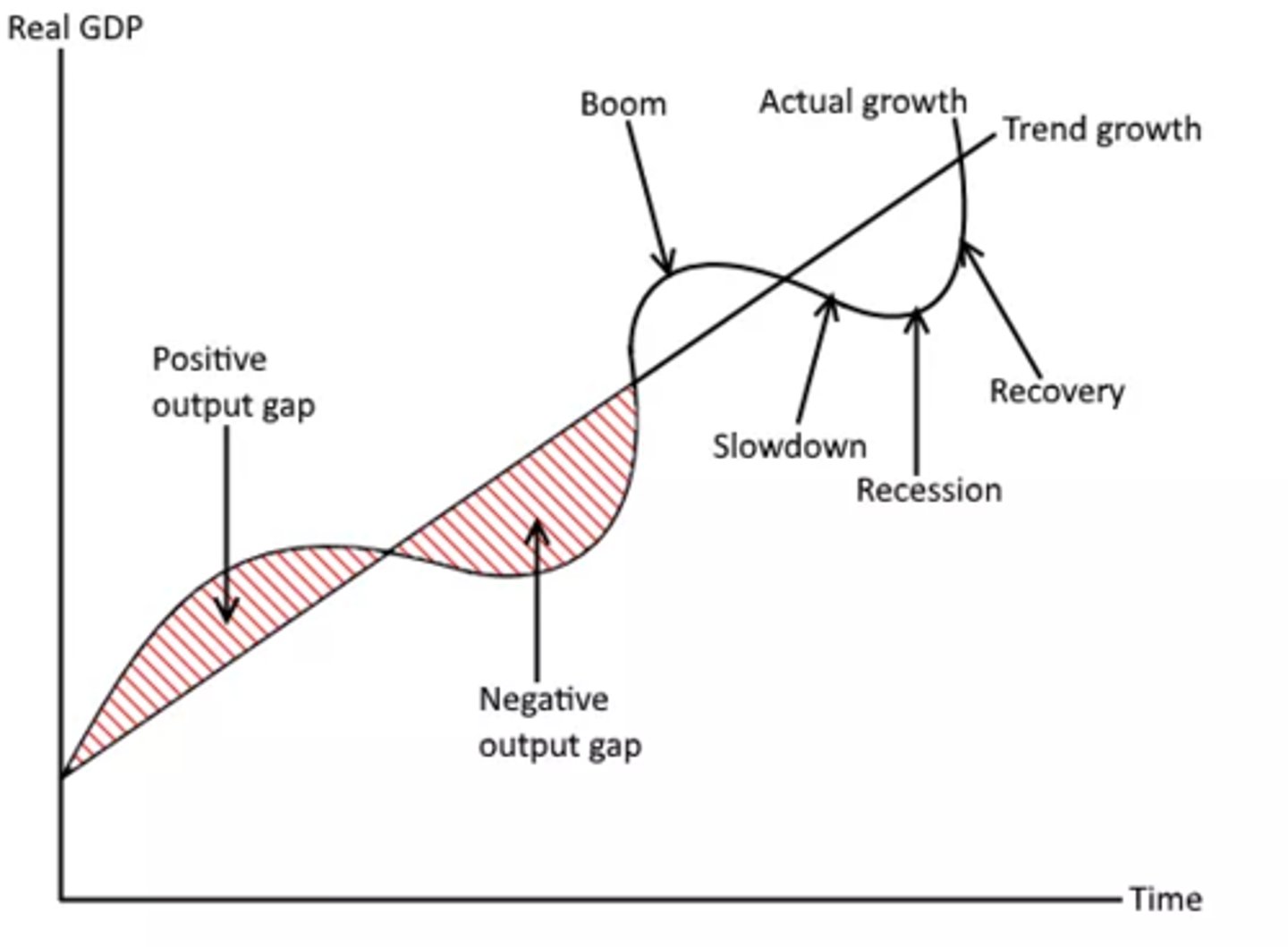
Phases of Economic Cycle
- Recovery
- Boom
- Slowdown/Peak
- Recession
- Trough
Recovery (definition, effect on: real gdp, inflation, u/e, investment)
= When SREG takes place after a recession
Things start to get better, consumers begin to increase spending, businesses feel more confident & start to invest again
Real GDP: Rising (< trend growth)
Inflation: Pressures increasing
Unemployment: Falling
Investment: Rising
Boom (definition, effect on: real gdp, inflation, u/e, investment)
= When the rate of economic growth exceeds the rate of growth of potential GDP
High levels of consumer spending, business confidence, profits & investment. Price & costs rise faster, u/e low.
Real GDP: Rising (> trend growth)
Inflation: Significant pressure
Unemployment: Nearing full employment
Investment: Falling
Slowdown/Peak (definition, effect on: real gdp, inflation, u/e, investment)
= When the rate of economic growth begins to reduce and approach zero
Falling consumer spending & confidence, lower profits for businesses, cut back on investment, Spare capacity increases
Real GDP: Falling (but >0)
Inflation: Pressures falling
Unemployment: Near full employment
Investment: Very little
Recession (definition, effect on: real gdp, inflation, u/e, investment)
= When the rate of economic growth becomes negative and real GDP actually falls
Very weak consumer spending & investment, many business failures
Real GDP: Negative
Inflation: Pressures low (or deflation)
Unemployment: Increasing & significant
Investment: Beginning to pick up
Trough (definition, effect on: real gdp, inflation, u/e, investment)
= When production is at its lowest, many business failures
Real GDP: Very low
Inflation: Pressures low (or deflation)
Unemployment: Large
Investment: Very low
Causes of Changes in the Various Phases of the Economic Cycle (causes of cyclical fluctuations)
Multiplier / Accelerator effect:
As investment increases, the multiplier effect causes a greater than proportionate increase in real GDP
The increase in real GDP causes firms to invest further (to fulfil the expanding output requirement), which accelerates the rate of investment.
This process continues until boom and slow-down phases
Political Business Cycles:
In democratic countries, general elections occur every 4-5 years
As the election approaches, the incumbent party may attempt to get votes by expanding the economy.
After the election, the party has to deflate AD to prevent over-heating
Consumer & Business Confidence:
Keynes argued that economic cycles are caused by ‘animal spirits’.
If households & firms believe there will be EG → ↑confidence → ↑C & I → ↑EG
Eventually, pessimism rises and confidence falls, ↓C & I —> Recession
Self-fulfilling prophecy
Additionally, what looks like a cycle could be due to random demand & supply-side shocks:
Demand-side Shocks:
e.g. Slump in share prices
Large boom in housing market
Unexpected cut or rise in interest rate
Unexpected rise or fall in exchange rate
Supply-side Shocks:
Changes in commodity prices
Natural disasters (poor weather affecting agriculture)
Technological breakthroughs
Cyclical Instability =
The expansion and contraction of an economy’s output - fluctuations of real GDP
Causes of Cyclical Instability:
Excessive growth in credit and levels of debt
Asset Price bubbles
Destabilising speculation and animal spirits or herding
Credit =
The funds available for households and firms to borrow
How ‘excessive growth in credit’ can lead to cyclical instability
Excessive growth in credit = The availability of credit (funds available for households and firms to borrow) has increased considerably
Impact on Consumption:
As a result, individuals & households are likely to borrow more money from financial institutions
Thus, more funds available for C → ↑C → ↑AD
Impact on Investment:
Firms are likely to borrow more money from financial institutions
Thus, more funds available for I→ ↑I→ ↑AD
+ALSO, increased C → ↑I to meet increased demand
Therefore, rise in AD will lead to short-run ‘cyclical’ economic growth.
As this increase is not part of the usual economic cycle fluctuations, the additional AD caused could be said to be causing ‘cyclical instability’
Speculation =
Engaging in risky financial transactions in an attempt to profit from fluctuations in the market value of an asset, rather than attempting to profit from the underlying value of the asset.
Destabilising Speculation =
Market behavior where investors buy assets because prices are rising (expecting further increases) or sell because prices are falling (expecting further declines).
Self-fulfilling prophecy
Exaggerates price movements
Asset Price Bubble =
When the prices of securities rise so sharply that they exceed valuations justified by fundamentals.
Animal Spirits =
Emotional and psychological factors, such as confidence, fear and optimism, that influence economic decision aking and drive human behaviou
Herd Mentality =
The tendency for people to act in the same way as the majority around them.
How Asset Price Bubbles can lead to cyclical instability
Normally priced asset
Genuine increase in demand → price of asset increasing
Animal spirits cause individuals to become bullish about the stock / the economy
Herd mentality kicks in as individuals don’t want to be left out (FOMO) → ↑demand for assets
Destabilising speculation → price rising further
Asset price rises to an all-time high
Some individuals begin to worry about longevity of price rises and become bearish
Bearish individuals sell assets → price begins to fall
Herd mentality as individuals don’t want to be left holding a declining value asset → assets sold
Bubble bursts as the asset price falls dramatically
Ways to reduce Cyclical Volatility
Monetary Policy
Fiscal Policy
Supply-side Policies
Allow Automatic Fiscal Stabilisers to work - As EG↑, U/E benefits paid decreases + Higher tax revenue. (Automatically adjusts to counter cycle fluctuations)