Biological Diversity
 Call Kai
 Learn
Learn Practice Test
 Spaced Repetition
 Match
Match Flashcards
 Knowt Play
1/112

Earn XP
Description and Tags
Grade 9
Name | Mastery | Learn | Test | Matching | Spaced | Call with Kai |
|---|
No analytics yet
Send a link to your students to track their progress
113 Terms
What happens if there is a dominant allele?
It will always be expressed
Gene
A section of DNA that codes for a trait
Allele
A different version or expression of the same gene (can be dominant or recessive)
Genotype
An organisms’s combination of alleles (heterozygous vs homozygous)
Phenotype
The physical expression of a certain gene (e.g. brown eyes)
Homozygous dominant
An organism’s gene contains 2 dominant alleles
Heterozygous
One allele is dominant and the other is recessive (the recessive allele is not expressed)
Homozygous recessive
The organism’s gene contains 2 recessive alleles
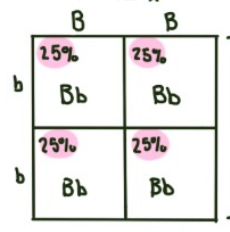
What is the percentile chance of the offspring having brown eyes
100% chance
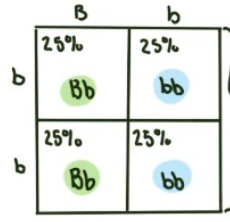
What is the percentile chance of the offspring having brown eyes
50% brown eyes, 50% blue eyes
Sexual Reproduction
A result of 2 parents donating 50% of their DNA to form a zygote whcih will become the offspring
What is the advantage of sexual reproduction
It gives a high degree of genetic variation
What are the steps in sexual reproduction
Fertilization
Mitosis
Mitosis and differentiation
Sex cells
Egg and sperm cell
n+n= 2n (50+50= 100%)
Zygote
Contains 2n (100%) of it’s own DNA
Fertilization
Process where 1 sperm cell and 1 egg cell combine
Mitosis
Process where cells divide and make copies
Blastocyst
A big ball or clump of cells
Mitosis and differentiation
The process where cells change and specialize
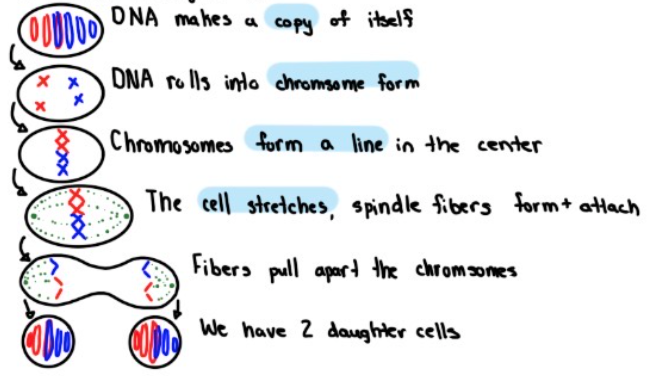
Mitosis
The replication/division process of all body cells
1 division
2 daughter cells
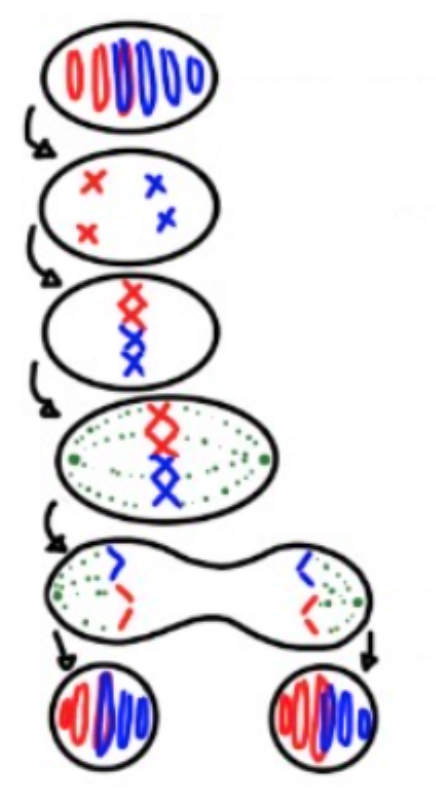
Explain each step in Mitosis
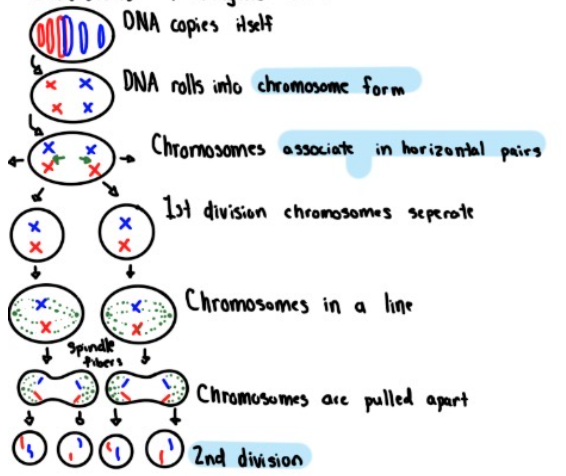
Meiosis
The process of forming gametes in reproductive organs
2 divisions
4 daughter cells
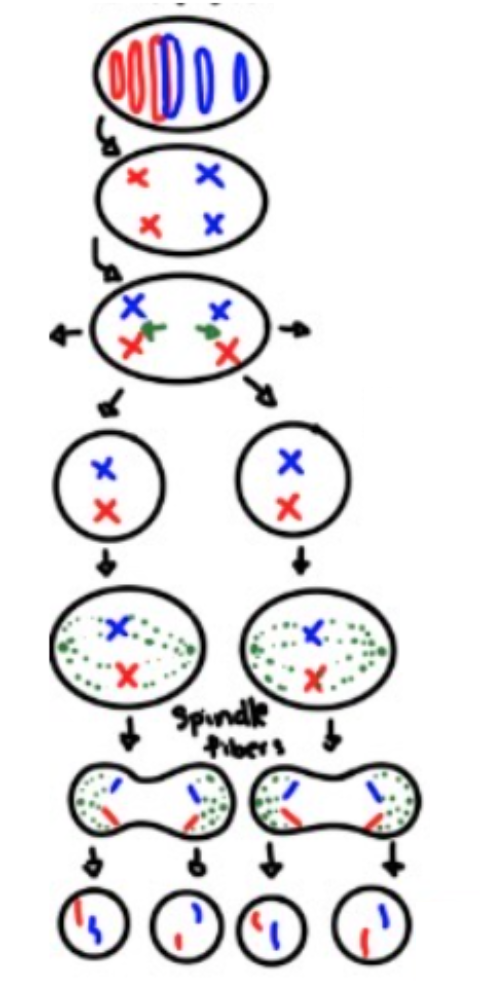
Explain each step in meiosis
What are some sexual reproduction strategies
Bacterial conjugation
Zygospores
Angiosperms
Gymnosperms
External fertilization
Internal fertilization
Disadvantages of sexual reproduction
Can be difficult to find a mate
Usually requires 2 bodies
Requires more time and energy
Physical limitations
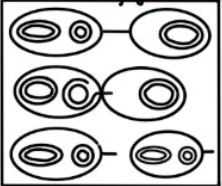
What sexual reproduction strategy is this?
Bacterial conjugation
Bacterial conjugation
Does not produce offspring
Does increase genetic variation by exchanging DNA
Zygospores
Use by mushroom, mold, etc.
Hyphae from different colonies meet up and donate DNA to form offspring with increased variation
Angiosperms
Sexual reproduction of flowering plants
Gymnosperms
Sexual reproduction of coniferous trees using cones
External fertilization
Gametes from two parents are released into the surrounding environment, usually with fish eggs and needs MANY gametes
Internal fertilization
Fertilization occurs inside of the body of the parent with an egg cell, this has a high chance of fertilization and only one egg cell is necessary
Asexual reproduction
One parent makes a copy of themselves, the offspring and parent are genetically identical (AKA cloning)
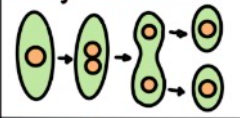
Binary fission
Primarily used by bacteria cells
Cell doubles its genetic information (DNA), and then splits into 2 genetically identical cells
This process is similar to mitosis
Spores
A single cell is formed by 1 parent to produce offspring
Spread by wind, animals and sometimes water
Very hardy, and can survive many extreme conditions
Used by mushrooms, mold, fungi and some ancient plants (e.g. ferns)
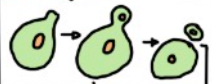
Budding
Genetic info is copied but in a smaller version (some info is lost)
A smaller daughter cell is formed
Used by yeasts, mods and some aquatic unicellular organisms
Vegetative reproduction
Propagation
A basic stem cutting
The new roots develop in soil or water
New plant growth is in cells called meristem cells
Types of asexual reproduction
Vegetative reproductions
Binary fission
Spores
Budding
Advantages of asexual reproduction
Fast- makes offspring quicker and repopulation is faster
Alone- Don’t need a partner
Possibly higher success- If the parent was successful due to genetics the offspring should be too
Disadvantages of asexual reproduction
LESS genetic variation
More vulnerable to environmental changes
Less chance of survival
Natural selection
A process which selective pressures from the environment determine which traits/adaptations are passed down to offspring (happens over many years)
Rules for a species to survive
All organisms will produce more offspring than the rate of mortality
Variation will exist within a population
Some variations will increase an organism’s chance of survival in a specific environment
Organisms that survive will reproduce and pass down traits
Overtime the population “should” have higher advantageous traits

Explain this process
The white version in this baseline is more visible to predators in this environment, then fewer white organisms survive and proportionally reproduce, each generation we see a higher proportion of pink
Types of selective breeding
Grafting
Cross pollination
Seed selection
Cross-breeding
Selective breeding
Out crossing
Grafting
Take one part of one plant and attach it to another (e.g. an apple tree with 3 varieties)
Cross pollination
We take pollen from a “desirable” plant and use it to fertilize another “desirable” plant
Seed selection
We only replant seeds from “desirable” plants
Cross-breeding
We facilitate the reproduction between 2 breeds with “desirable” traits → Hybrids (e.g. Labradoodles)
Selective breeding
We only allow individuals with certain traits to reproduce (e.g. Golden retriever)
Out crossing
Trading and breeding animals between 2 zoos to increase variation within captivity
Genetic engineering
We provide specific changes to DNA
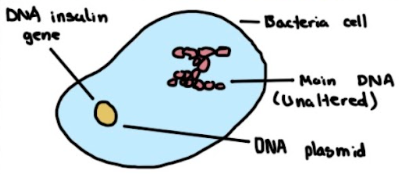
Bacterial over production
Making bacteria produce LOTS of a specific protein by injecting it with DNA
Pros and cons of bacterial overproduction
Pros- easy, quick and ethical
Cons- Public fear, limited application
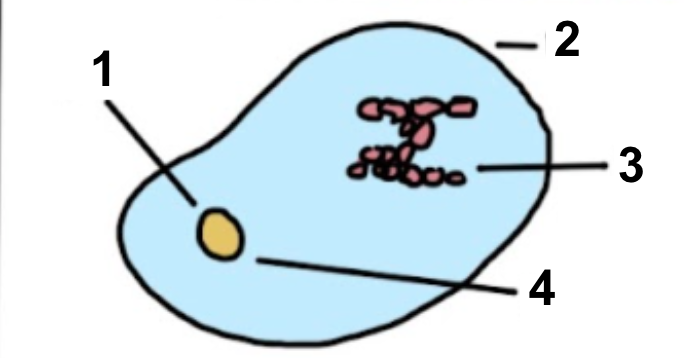
Label the diagram
Transgenic animals
Isolating a gene from one animal and inserting it in another using CRISPR+ Cas9 (e.g. cows producing silk)
Pros and Cons of transgenic animals
Pros- Many applications, no death required
Cons- Complex, ethical concerns
Adaptation
An inherited characteristic that helps an organism survive
How many kinds of adaptation are there?
2
What are the kinds of adaptation?
Structural and behavioural
Variations
Differences in characteristics caused by genetic and environmental factors
What does generational trauma effect?
Variations (behaviour)
Biological diversity
Describes the variety of life forms on Earth
Species
A group of organisms that have the same structure and can reproduce with one another (e.g. humans can only reproduce with other humans)
How does the loss of one species affect another?
When a key species (e.g. coral) dies out it can causes the collapse of the ecosystem as a whole, but in most cases the ecosystem has enough biodiversity to not collapse (still affected though). *Depends on the biodiversity in the ecosystem
Population
When members of a species live in a specific area and share the same resources (e.g. all the magpies living in one park)
Community
When populations of different species live in the same area (the park has other bird species than the magpie)
What is the difference between an ecosystem and a community?
A community is all the different populations and an ecosystem is the communities combined
Speciation
The evolution of different species from one common ancestor (e.g. lynx, bobcat and cougar all came from the same commmon ancestor)
Structural adaptation
An inherited physical characteristic that helps an organism survive in it’s environment (e.g. pitcher plant’s shaped leaves helps them catch insects)
Behavioural adaptation
An inherited behavioural characteristic that helps an organism survive in it’s environment (e.g. owls hunting at night, bird migration, etc.)
Diversity index
The measure of diversity in an area, it compares the diversity of species in the area with the total number of species in the same area.
Diversity
The number and variety of species in an ecosystem
Survival
The ability to grow, live and reproduce despite environmental challenges
Higher genetic diversity (variation)=
Higher survival
What happens to diversity when nearing the poles vs. diversity around the equator?
Diversity decreases as you near the poles and there is an increase in competition for resources near the equator
The areas closer to the poles have…
More variable temperature and humidity, and food and shelter are more scarce
The areas near the equator has…
The region of highest biodiversity. The climate, temperature, and humidity is stable and sources of food and shelter are more plentiful
Niche
Where an organism lives and it’s overal role/place
Specialists
Have a specific/narrow niche
Have specific needs
Don’t adapt easily
High number of specialist species, less populations around the world
Generalists
Have a broad/general niche
Easily adapt because they can thrive in several niches
Smaller number of generalist species, more populations around the world
Competition
the interaction between organisms trying to get an advantage with regards to resources
What kinds of resources do organisms compete for?
Food, water. shelter, territory, mates, sunlight, nutrients, etc.
Symbiotic relationship
Some organisms have evolved to live in close contact with each other, even though they are different species
Parasitism
A relationship in which one organism benefits and the other is negatively impacted
Examples of parasitism
Tape worm and human, leech and other organisms, cuckoos and other birds
Misconceptions with parasitism
Lice affects humans and dogs but not birds
Commensalism
A relationship in which one organism benefits and the other is not impacted
Examples of commensalism
Whale and barnacle, tree frogs and plants, cattle egrets and buffalo
Misconceptions with commensalism
Barnacles do not affect whales but they do harms organisms like turtles
Mutualism
A relationship in which both organisms benefit
Mutualism examples
Three sisters, bee and flower, clown fish and anemones
Misconceptions with mutualism
Cleaner fish and client
Genetic variation
Variations in heritable traits among members of the same species (e.g. height, eye colour, skin colour, etc.)
Diversity
Differences between different species, number and variety (e.g. 5 oak vs 3 spruce)
When we talk about the expression of genes to provide certain traits, how many types are there?
There are 2 types
Discrete
Variations that exist within a distinct number of separate categories (e.g. Rollins Rs, curling tongue or isothiocenate receptors)
Continuous
Variations that exist as a range of possibilities with room for nuance (e.g. hair colour, height, skin colour, etc.)
What is essential to a species survival?
Genetic variation, which is made possible due to changes in DNA