Soft Tissue Masses Part 2
 Call Kai
 Learn
Learn Practice Test
 Spaced Repetition
 Match
Match Flashcards
 Knowt Play
1/54

There's no tags or description
Looks like no tags are added yet.
Name | Mastery | Learn | Test | Matching | Spaced | Call with Kai |
|---|
No analytics yet
Send a link to your students to track their progress
55 Terms
Etiology:
Benign Neoplasm derived from Schwann cells
Granular Cell tumor
Clinical presentation:
Sessile submucosal nodule
Pink, sometimes yellow hue
Dorsal tongue most common site
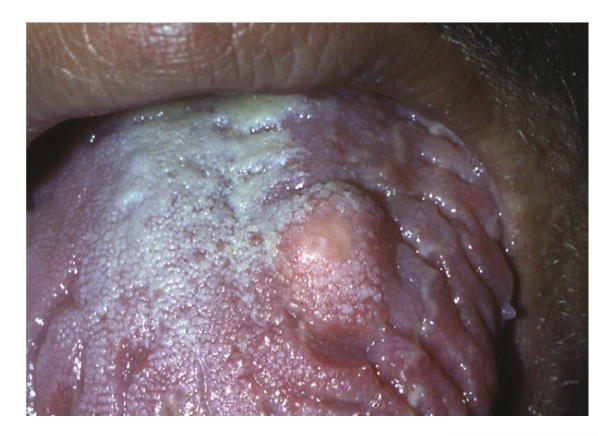
Granular Cell tumor
Etiology:
Benign tumor of fat
Lipoma
Clinical presentation:
Soft, smooth surfaced nodule
Usually Yellow, sometimes pink
Buccal mucosa and buccal vestibule most common oral sites
Lipoma
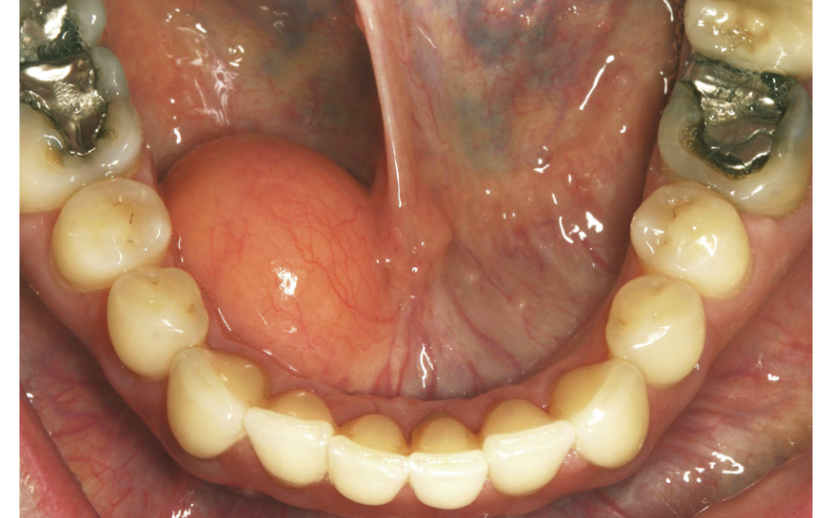
Lipoma
How to differentiate Lipoma from Fibroma?
Yellow tissue in Lipoma (fat tissue)
Where is the most common oral location for a Lipoma
Buccal mucosa and buccal vestibule
After biopsy / excision how can you determine a lipoma?
The fat will float in formalin
Etiology:
Benign Vascular tumor
Hemangioma
Clinical Presentation:
Seen in children, but will spontaneously go away
Bright red to dull blue/purple nodule
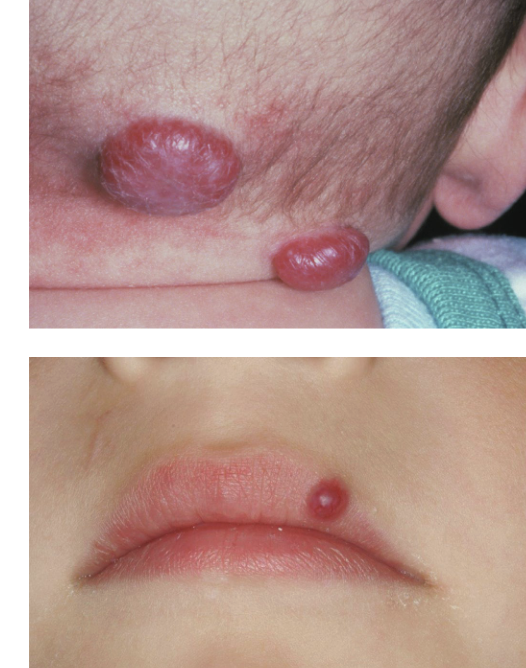
Hemangioma
What is unique about Hemangioma?
They will rapidly grow for 6-12 months, then involute (go away). 90% resolve by age 9
Etiology:
Structural anomaly of blood vessels
Vascular Malformation
Clinical presentation:
Pink/red macule to blue/purple mass
Presentation can vary based on vasculature involved
Port wine stains common on face
Vascular Malformation
Common type of Vascular malformation seen on the face?
Port wine stain
Helpful clinical test to determine if a lesion is vascular?
Diascopy: take a glass slide to compress lesion, if it blanches it is vascular.
Demographic of Hemangioma vs Vascular malformation?
Hemangioma: Kids <9 y/o
Vascular Malformation: any age
Neurofibroma and Schwannoma are what type of tumor?
Mesenchymal tumors
For a salivary gland tumor is a larger or smaller gland more likely to be MALIGNANT?
Smaller the gland, more likely to be malignant. Minor glands 50% chance to be malignant
T/f Salivary gland tumors can be benign or malignant?
True, can be either
Common sites for minor Salivary gland neoplasm?
Hard palate
Soft palate
Upper lip
Most common salivary gland benign NEOPLASM
Pleomorphic adenoma
Most common salivary gland MALIGNANCY
Mucoepidermoid carcinoma
Malignancy not found in MAJOR salivary glands
Polymorphous Adenocarcinoma
Malignant and more aggressive Salivary gland tumor that shows Perineural Invasion
Adenoid Cyst Carcinoma
Which is more likely to be malignant? Salivary gland tumor on the parotid gland or the sublingual gland?
Sublingual is more likely to me malignant since it is smaller
What is the most common site for a minor salivary gland neoplasm?
Hard palate
Etiology:
Group of malignancies characterized by overproduction of Neoplastic WBCs
Originates in bone marrow then spills into circulation
Leukemia
Where does Leukemia originate?
Bone marrow
Oral manifestation of Leukemia?
Diffuse, boggy, non-tender swelling of gingiva. With or without ulceration
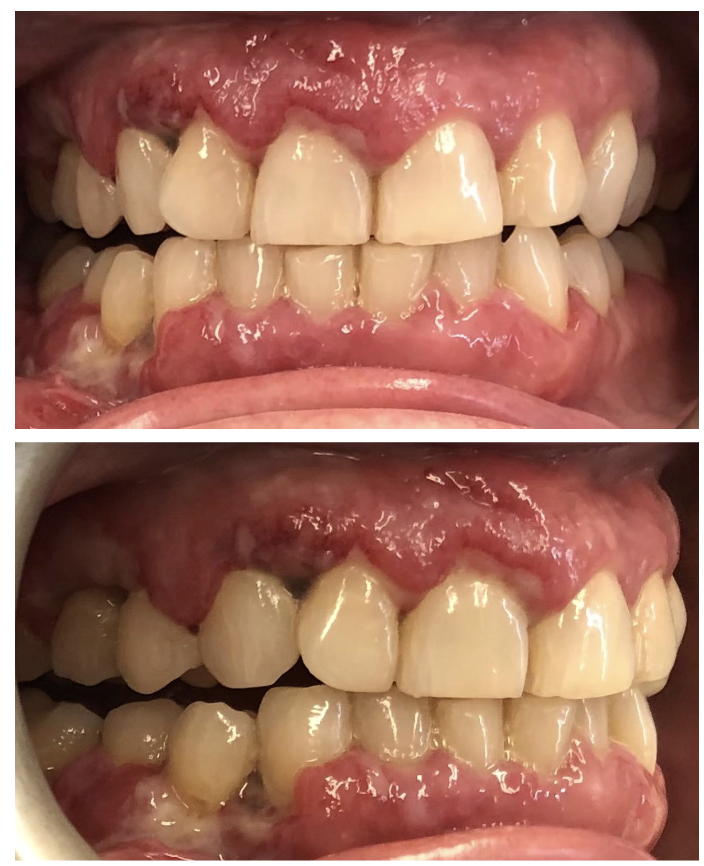
Leukemia
Is Acute or Chronic Leukemia more common in children?
Acute (ALL of us have been children, not all adults)
Etiology:
Group of malignant tumors of lymph nodes
Originates in lymph nodes then can become more widely disseminated
Lymphoma
Where does lymphoma originate?
Lymph nodes
Clinical Presentation:
Enlarging, nontender discrete mass in lymph node region
Pruritis (itchiness)
Oral nontender diffuse soft tissue swelling
Lymphoma
Most common oral sites for lymphoma lesions?
Buccal vestibule, posterior hard palate, gingiva
Oral lesions from lymphoma are most commonly due to what?
Diffuse Large B cell lymphoma
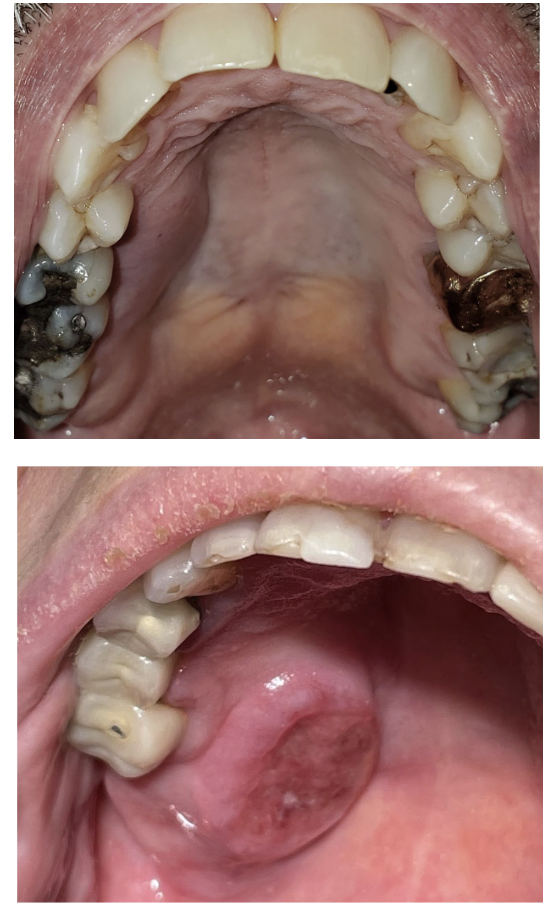
Lymphoma
Kaposi sarcoma is associated with what HHV?
HHV-8
Kaposi Sarcoma is commonly seen in what patient demographic?
HIV/AIDS
Etiology:
Vascular Malignancy
Infection with HHV-8
Kaposi Sarcoma
Clinical Presentation:
Multiple, Blue / purple macules, plaques and nodules on face and oral mucosa
Kaposi Sarcoma
Most common locations to see Kaposi Sarcoma
Hard palate, gingiva, tongue.
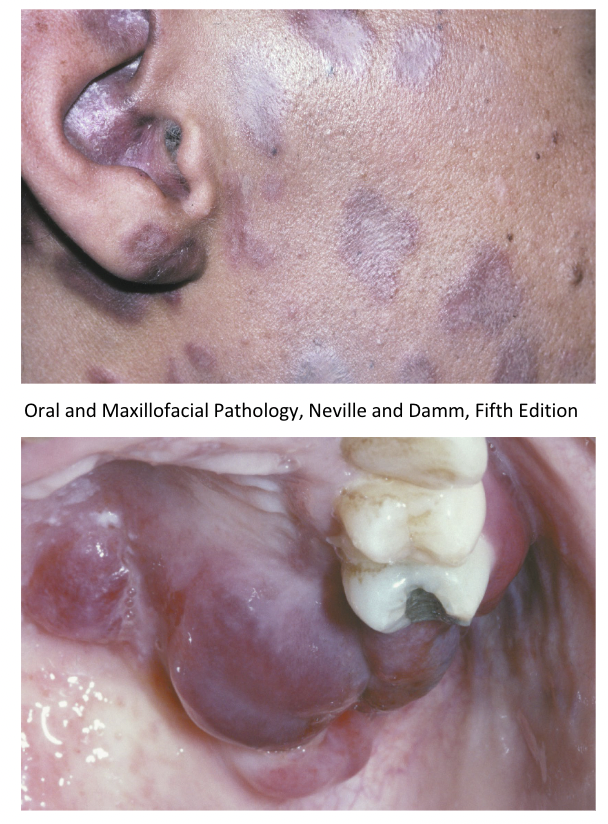
Kaposi Sarcoma
Treatment for Kaposi Sarcoma?
Underlying AIDS management
Most common Metastatic tumor types in MEN?
Lung, Kidney, Melanoma
Most common Metastatic tumor types in WOMEN?
Breast, Genital, Kidney, Lung
Clincial Presentation:
Nodular soft tissue mass, resembling hyperplastic or reactive growth.
50% on gingiva
25% of pts, primary malign. not diagnosed when seen in the mouth
Metastatic Cancer
Most common location to see metastatic cancer in the mouth?
50% on Gingiva
What categories can a Thyroid enlargement be?
Metabolic
Immune-mediated
Neoplastic
What are common causes of Thyroid enlargement
Goiter
Thyroid Adenoma (benign)
Thyroid Carcinoma (malignant)
Graves
Hashimoto
Of all the thyroid enlargment casues, which are most likely to be symptomatic?
Graves and Hashimoto
Clinical Presentation:
Diffuse thyroid enlargement
Weight loss despite increased appetite
Tachycardia
Sweating
Warm skin
Exopthalmos
Graves (hyperthyroidism)
Clincial Presentation:
Lethargy
Dry skin
swelling of face and extremities
Huskiness of voice
Bradycardia
Hypothermia
Hashimoto (Hypothyroidism
Three diagnostic techniques for Thyroid Englargement
Fine needle Aspiration
Imaging
Bloodwork
Odontogenic Neoplasms that can cause Peripheral Odontogenic Cysts / tumors
Peripheral Ameloblastoma
Peripheral Calcifying Epithelial Odontogenic Tumor