all exchange surfaces
 Call Kai
 Learn
Learn Practice Test
 Spaced Repetition
 Match
Match Flashcards
 Knowt Play
1/85

There's no tags or description
Looks like no tags are added yet.
Name | Mastery | Learn | Test | Matching | Spaced | Call with Kai |
|---|
No analytics yet
Send a link to your students to track their progress
86 Terms
why do mammals have a high metabolic rate and what does this mean they require?
Very active
Endotherms (warm blooded) and maintain their body temperature independent of the environment
This means they require high levels of oxygen into their blood.
what is it like in the nasal cavity?
the air is warmed
dust and bacteria are trapped by mucus
moist surfaces increase the humidity
what is the air like that enters the lungs and what does this ensure?
warm and humid, ensuring less evaporation of water from the surface of the ling tissue
what is cartilage, what is it’s role in breathing and where is it found?
Provides tough and flexible support for the trachea and bronchi and the larger bronchioles
Smaller bronchioles do not contain cartilage
Holds the tubes open as the air pressure changes inside them
In the trachea, arranged in C-shaped rings, in the bronchi, more irregular
what is smooth muscle, where is it found and what is its role in breathing?
Found in the walls of the trachea, bronchi and bronchioles
Contracts, constricting the airway, resulting in narrowing of the lumen of the airway
Contracts steadily and can for long periods of time
Important if harmful substances in the air - smooth muscle is involuntary muscle (no conscious control)
When the smooth muscle relaxes, the airway widens, which allows more air in for has exchange and therefore more oxygen to diffuse into the blood
what are the elastic fibres, what is there role and breathing and where are they found?
Provides strength and flexibility
Found in the walls of all the airways - especially important around the alveoli
When inhaling, the alveoli expand stretching the elastic fibres
In exhalation, the fibres then recoil back to their original size, decreasing the volume inside the lungs and forcing air out
what are the goblet and ciliated epithelial cells, where are they and what are there roles in breathing?
Goblet cells are situated under the epithelium and secrete mucus
This mucus is sticky and traps tiny particles (and bacteria) from the air, protecting the lungs
Ciliated epithelial cells have cilia (tiny hair like structures) that have synchronised movements to waft the mucus produced by the goblet cells up the trachea to the back of the throat, where it is swallowed into the stomach (where the stomach acid kills the bacteria etc.)
what are the alveoli, where are they found and what is the role in breathing?
Alveoli are the main area of gas exchange (some gas exchange can take place in the terminal bronchioles)
Elastic fibres in the alveoli stretch as air enters the lungs in inhalation
This elastic fibres then recoil, forcing air out of the lungs during exhalation
what are the properties of the alveoli to have sufficient gas exchange and why do these help?
Large surface area - there are millions of alveoli in the adults lungs, this gives a surface area of approximately 80m^2
Short diffusion distance - alveolar wall is one cell thick, made of squamous epithelial cells. Capillary wall is one cell thick, made of squamous endothelial cells. 2 flattened cells thick = 1 micrometre thick
Maintaining a steep concentration gradient - large capillary network which ensures that any oxygen that diffuses into the blood is immediately taken away. Constant ventilation ensures that fresh air, with a high concentration of oxygen is brought into the lungs
Lung surfactant - this covers the alveoli, and ensures that they remain moist so that oxygen can dissolve to aid diffusion, alveoli do not stick together when water evaporates into the air in the alveoli; our lungs would collapse if they dried out
As the lungs have no muscles, how is movement produced?
movement is produced by the diaphragm and the external and internal intercostal muscles
what is the thoracic cavity?
the space between the rib cage and the diaphragm
what are the pleural membranes, where are they and how do they help ventilation?
The pleural membranes are situated between the rib cage and the lung
The 2 pleural membranes contain pleural fluid between them
This is so the membranes slide over each other during ventilation
This is very important to reduce friction and ensure that the lungs are not damaged
what is the mechanisms of inhaling?
Diaphragm contracts and moves down flattening and lowering
External intercostals muscles contract causing rib cage to move upwards and outwards
This results in an increase in volume of thoracic cavity
This causes a decrease in the pressure inside the thoracic cavity
The pressure is lower than the atmospheric pressure outside the lungs
Air rushes into lungs down pressure gradient
what are the mechanisms of exhaling?
Diaphragm relaxes and moves up
External intercostal muscles relax causing the rib cage to move downwards and inwards
Elastic fibres in alveoli recoil
This all results in a decrease in volume of thoracic cavity
This causes an increase in the pressure inside the thoracic cavity
The pressure is higher than the atmospheric pressure outside the lungs
Air rushes out the lungs down the pressure gradient
what are the mechanisms of forced exhalation?
Diaphragm relaxes and moves upwards
Internal intercostal muscles contract causing rib cage to move downwards and inwards further
Diaphragm is further raised by contraction of abdominal wall
Volume of thoracic cavity decreases
Pressure of thoracic cavity increases
Air rushes out down the pressure gradient
what causes the pattern and volume of breathing to change?
when oxygen demands change (e.g. during rest or during exercise)
what is breathing rate?
number of breaths taken per minute
what is ventilation rate?
the total volume of air inhaled in one minute
what is the equation to calculate ventilation rate?
ventilation rate = tidal volume x breathing rate (per minute)
why during exercise do muscles require more oxygen?
they have an increased rate of aerobic respiration
how does a spirometer work?
A spirometer has an oxygen-filled chamber with a movable lid
The person breathes through a tube connected to the chamber
As the person breathes in and out, the lid of the chamber moves up and down
These movements are recorded by a pen attached to the lid of the chamber - this writes on a rotating drum, creating a spirometer trace
what is in the spirometer to absorb carbon dioxide?
soda lime
does the total volume of oxygen in the spirometer increase or decrease over time and why?
The total volume of the oxygen in the chamber decreases over time
This is because the air that is breathed out is a mixture if O2 and CO2, the CO2 is absorbed by the soda lime and so as the O2 gets used up by aerobic respiration, the total volume decreases
what are some things we should do before using a spirometer and why (setting up and health and safety)?
calibrate the spirometer, details vary from machine to machine but you need to know how to measure a litre and minute on the trace
reason: allows us to calculate the actual volume breathed
fill the drum with air
reason: to ensure normal levels of oxygen in the air to be breathed by the subject
subject should be in good health
reason: to avoid any medical issues during the experiment
subject wears a nose clip
reason: to stop air moving through nose, allows for valid measurements
use a sterile mouthpiece
reason: to avoid infection
turn on the kymograph
reason: to start the recording of the trace
what are some things we should do while using a spirometer/will happen and why?
subject breathes normally into machine through the mouthpiece
reason: to record the volume of air being breathed
the subjects exhaled air passes through a canister of soda lime
reason: to absorb CO2
subject breathes normally for at least 3 full breaths
reason: to record resting breathing rate
the drum will move up and down
reason: up as subject breathes out, down as subject breathes in
what is vital capacity and approx. volume?
the largest volume of air that can be moved in and out of the lungs in any one breath
varies depending on individual differences
approx. 5dm³
what is inspiratory volume?
how much air can be breathed in on top of the normal tidal volume
what is residual volume and approx. volume?
the volume of air that always remains in the lungs, even after the biggest possible exhalation
normally about 1.5dm³
why is the residual volume so important?
it keeps the alveoli inflated
what is tidal volume? and approx. vol?
the volume of air that moves in and out of the lungs with each breath when you are at rest
approx. 0.5dm³
what is the expiratory volume?
how much air that can be breathed out over and above the volume that is breathed in a tidal volume breath
what is the sum for total lung capacity?
total lung capacity = vital capacity + residual volume
when breathing out where does some air remain?
in the alveoli to keep them inflated (this is the residual volume)
some also remains in the trachea, bronchi and bronchioles - this is air that is not involved in gas exchange
what keeps our airways open (trachea, bronchi and bronchioles)?
rings of cartilage
what does the pleural membrane of the lungs enclose?
pleural fluid
what does the pleural fluid in the lungs do?
act as a lubricant between the ribs and the lungs
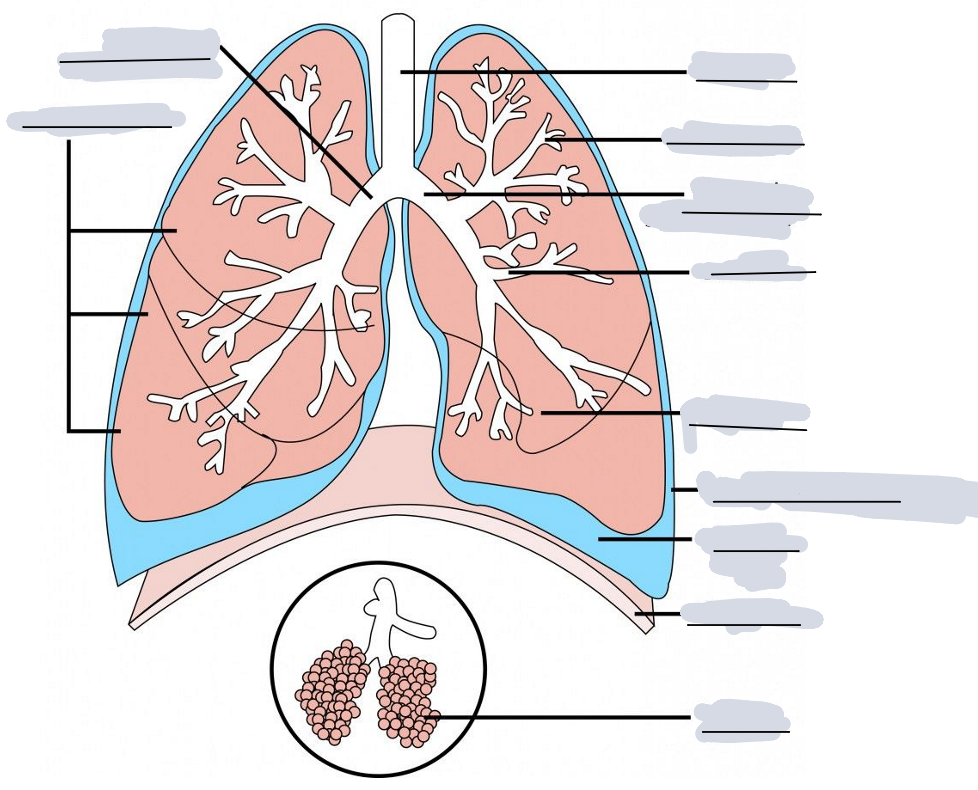
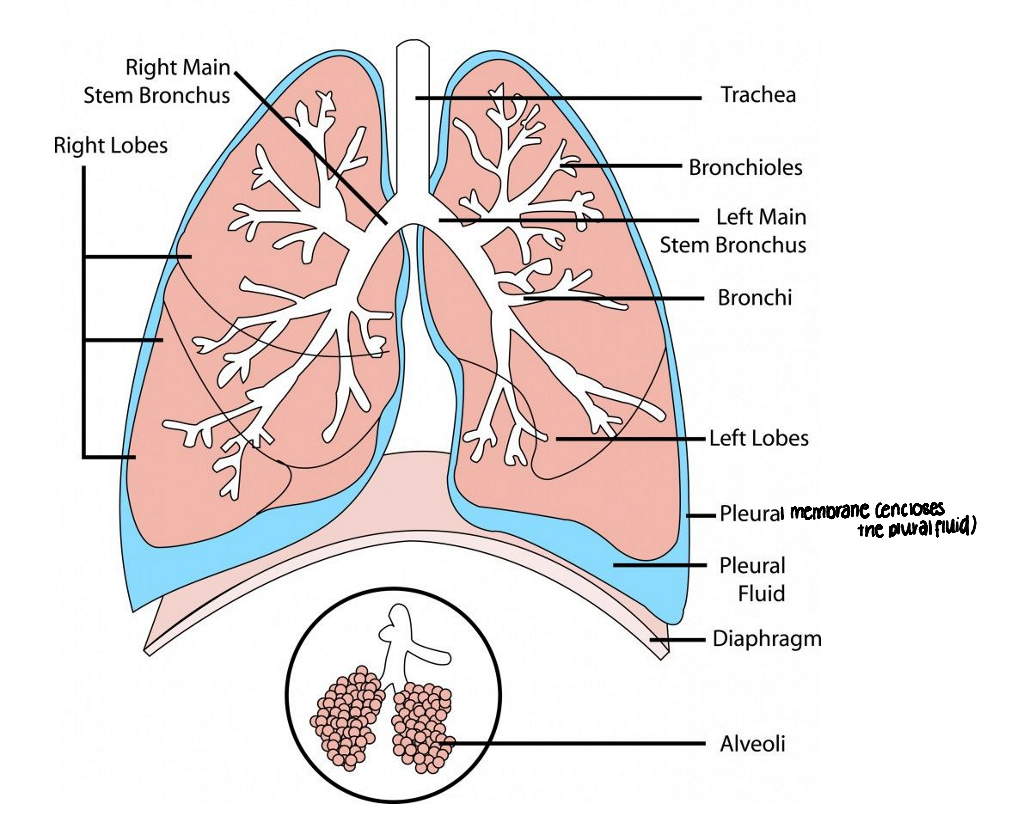
fill in the gaps to label the lungs
what are the 2 types of fish and via what does gas exchange in them happen?
Skeleton of bone (Osteichthyes)
Skeleton of cartilage (Chondrichthyes)
Gas exchange in both types of fish occurs via gills.
what are gills?
the organs of gas exchange in fish
what are the adaptions of gills to maximise gas exchange?
Thousands of lamellae on hundreds of filaments provide a large surface area
Good blood supply (large capillary network to help maintain a steep concentration gradient
Filaments and lamellae are very thin which means a short diffusion distance
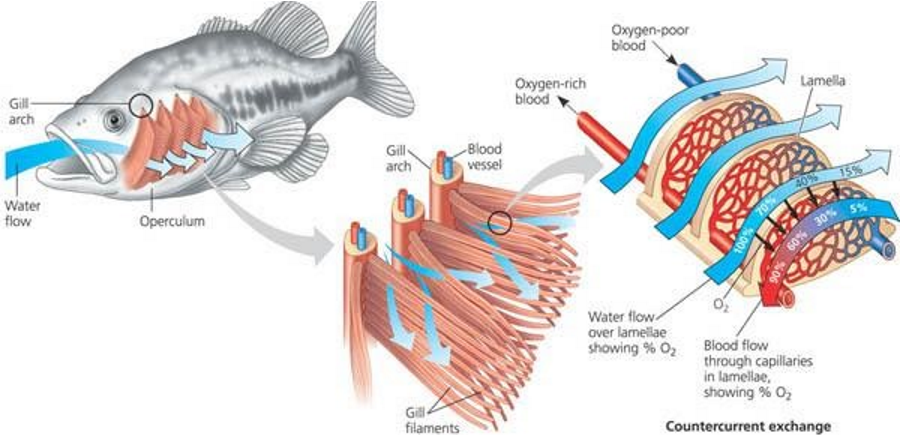
what are the structures of gills like?
There are several gill arches on either side (4 or 5)
These gill arches are protected by a structure called the operculum
The gills are very pink because of the large number of capillaries providing blood flow
The gill arches have many filaments
These filaments have lamellae over the surface
This all maximises the surface area available for gas exchange
how does ventilation happen in bony fish?
A constant movement of water over the gills happens when fish are swimming
Fish keep their mouths open and the water moves through their mouth, over the gills and out of the operculum
When they are not moving, bony fish still need water to move over their gills
how does inhalation occur in bony fish?
Mouth (buccal cavity) opens (operculum is closed)
Floor of buccal cavity increases
Pressure in buccal cavity decreases
Water moves into the mouth towards the gills
how does exhalation occur in bony fish?
Mouth closes
Floor of buccal cavity moves upwards
Volume of buccal cavity decreases
Pressure in buccal cavity increases
Water is push through the gills and out of the operculum
what are 3 ways the gills are adapted for gas exchange in fish?
Thousands of lamellae on hundreds of filaments provide a large surface area
Good blood supply (large capillary network to help maintain a steep concentration gradient
Filaments and lamellae are very thin which means a short diffusion distance
what are the structures of the gills in fish like?
There are several gill arches on either side (4 or 5)
These gill arches are protected by a structure called the operculum
The gills are very pink because of the large number of capillaries providing blood flow
The gill arches have many filaments
These filaments have lamellae over the surface
This all maximises the surface area available for gas exchange
when fish keep their mouths open and water flows in where does it go?
water moves through their mouths, over the gills and out of the operculum
how does inhalation occur in bony fish?
Mouth (buccal cavity) opens (operculum is closed)
Floor of buccal cavity increases
Pressure in buccal cavity decreases
Water moves into the mouth towards the gills
how does exhalation occur in bony fish?
Mouth closes
Floor of buccal cavity moves upwards
Volume of buccal cavity decreases
Pressure in buccal cavity increases
Water is push through the gills and out of the operculum
how is a concentration gradient maintained in fish?
As well as a good blood supply (large capillary network), bony fish have a countercurrent mechanism
This is when blood in the capillaries of the lamellae in the gills and water flowing over the gills are moving in opposite directions
This maintains a steep concentration gradient along the whole length of the lamellae
As the flow of blood is in the opposite direction to the flow of water across the lamellae, the blood is continually flowing past fresh water with a higher percentage saturation of oxygen
Therefore the steep concentration gradient is maintained across the whole length of the lamella and oxygen continues to diffuse into the blood
what does it mean when we say fish have a countercurrent mechanism?
This is when blood in the capillaries of the lamellae in the gills and water flowing over the gills are moving in opposite directions
what is Fick’s law of diffusion equation?
∝ = is proportional to

according to Fick’s law the larger the surface area the _____ the rate of diffusion
faster
according to Fick’s law the steeper the conc. gradient, the _____ the rate of diffusion
faster
according to Fick’s law the shorter the diffusion distance, the _____ the rate of diffusion
faster
what are some features of gas exchange in insects that are similar to other animals?
Large surface area
Short diffusion distance
Moist surfaces
what are some features of gas exchange in insects which is different to other animals?
Oxygen moves directly to the cells and diffuses directly into the cells
Openings called spiracles in the side of the body allow gases in and out
how does gas exchange happen in insects?
Air enters the insect through spiracles on the thorax and abdomen
Spiracle sphincters control opening and closing of spiracles
When open, oxygen enters and carbon dioxide leaves the body
Air moves from spiracles into the tracheae (air-filled tubes)
Tracheae are supported by rings of chitin to keep them open
Little/no gas exchange occurs in tracheae (chitin is impermeable)
Tracheae branch into smaller tracheoles
Tracheoles extend throughout the body to reach cells
Oxygen diffuses from tracheoles to cells
Carbon dioxide diffuses from cells into tracheoles and out the same pathway
what are spiracles (in insects)?
small holes in the side of the thorax and abdomen
what do the spiracle sphincters do (insects)?
Spiracle sphincters control whether the spiracle is open or closed
what are tracheae (in insects)?
the tubes leading away from the spiracles into the body of the insect
what is the tracheae lined with? - and what is its purpose?
Tracheae are lined with rings of chitin to keep them open
is chitin permeable or impermeable to gases?
impermeable to gases and so very little gas exchange happens in the tracheae (chitin lines the tracheae)
do tracheoles have chitin lining (insects)?
no
where does gas exchange in insects happen and why there?
tracheoles
they have no chitin lining so gas can diffuse
what are some features of tracheoles that help gas exchange (in insects)?
Very large number of tracheoles forms a large surface area
Each tracheole is a single elongated cell, so there is a short diffusion distance for gases
They are moist, so gases diffuse in and out of the cells quickly
how does gas exchange in small or less active insects differ from active insects?
air moves along the tracheal system by diffusion alone
how is diffusion of gases prevented in the terminal tracheoles in insects?
there is fluid in the terminal tracheoles which prevents diffusion of gases
how does gas exchange in active insects occur?
In active insects, which require a lot of oxygen for aerobic respiration, this means that they start respiring anaerobically
This anaerobic respiration produces lactic acid, which lowers the water potential of the cells
This means fluid moves into the cells (down the water potential gradient) and out of the tubes
Oxygen can therefore diffuse in and carbon dioxide can diffuse out
Cells start respiring aerobically
how does gas exchange in large active insects occur?
Large insects (e.g. locusts) use ventilation movements to increase the rate of gas exchange
They contain air sacs which act as a reservoir for air. The sacs are inflated and deflated by the movements of the thorax and abdomen
Ventilation movements of the thorax and abdomen mean that air is drawn into the tracheae (similarity to fish and humans) and pushed out
how does inhalation in locusts occur?
Thoracic spiracles open
Abdominal muscles relax
Volume increases
Pressure decreases
Air moves into tracheal system
how does exhalation in locusts occur?
Abdominal spiracles contract
Abdominal muscles contract
Volume decreases
Pressure increases
Air is pushed out of the tracheal system
One way movement of air means more efficient gas exchange
sheet info still to add
what do we need exchange surfaces for?
To absorb:
Oxygen for aerobic respiration
Glucose for respiration
Proteins (amino acids) for growth and repair
Fats (glycerol and fatty acids) for membranes and energy store
Water as a solute for chemical reactions
Mineral ions for water potential and enzyme action
To get rid of:
Carbon dioxde
Ammonia or urea, which contains excess nitrogen (from excess amino acids)
how can dissolved gases cross the gas exchange area?
dissolved gasses can only cross the gas exchange by diffusion
why are unicellular and some multicellular organisms able to carry out gas exchange directly across their body surface?
unicellular and multicellular organisms have a large surface area: volume ratio which means they are able to carry out gas exchange directly across their body surface
why can substances diffuse rapildy in unicellular organisms?
in unicellular organisms, the substances can diffuse rapidly from everywhere inside the cell because the distances are small
what do multicellular organisms need for gas exchange?
specialised exchange surfaces
What is a key feature of the exchange surface?
The exchange surface has a large surface area (the whole organism has a very small surface area: volume ratio).
what are 5 special features of exchange surfaces?
large surface area
thin barrier
(partially) permeable membrane
high supply of molecules to exchange surfaces
removal of molecules from the other side
moist (cells must be protected from dying out)
what is the purpose of large surface area being a feature of exchange surfaces?
The larger the area across which a substance can diffuse, the more substance can cross the surface in a given time e.g. alveoli, root hair cell, microvilli
what is the purpose of a thin barrier being a feature of exchange surfaces?
short diffusion distance
what is the purpose of (partially) permeable membrane being a feature of exchange surfaces?
allows correct molecules through
what is the purpose of high supply of molecules to exchange surfaces being a feature of exchange surfaces?
Keeps concentration gradient steep e.g. constant ventilation for gas exchange surfaces
what is the purpose of removal of molecules from the other side being a feature of exchange surfaces?
Keeps concentration gradient steep e.g. large capillary network
what is the purpose of it being most as a feature of exchange surfaces?
Dry air will dry out the cells, as water vapour will diffuse out into the air. If too much water is lost, the plasma membrane will lose its structure and the cells will die