Genetics and Heritability
 Call Kai
 Learn
Learn Practice Test
 Spaced Repetition
 Match
Match Flashcards
 Knowt Play
1/18

There's no tags or description
Looks like no tags are added yet.
Name | Mastery | Learn | Test | Matching | Spaced | Call with Kai | Chat |
|---|
No analytics yet
Send a link to your students to track their progress
19 Terms
Which and to what extent are psychological characteristics heritable?
All of them (intelligence, personality, motivations etc) BUT only partly → all show environmental influences too
When were the basic laws of gene action discovered and by who?
Mid 1800s
Gregor Mendel’s pea-plant experiments
What are the key concepts in genetics?
Organisms contain genes that code for characteristics when they reproduce
Half of the genetic potential from both parents is passed to offspring
Mendelian genetics works well for dichotomous traits influences by single genes (especially in plans) → over-simplified for complex, continuous characteristics
If genes influence a trait, then people more closely related will be more similar BUT if the environment influences a trait, then people who live together should be more similar
When are dominant traits expressed?
If the relevant gene is inherited from 1+ parent(s)
When are recessive traits expressed?
Only if the relevant gene is inherited from both parents
What experiments must be used to understand genetics in humans (and their impact on psychological traits)?
Natural experiments: MZ + DZ twins
Raised together or separately, could tease apart from the strength of genes + the effect of shared vs non-shared environment
Compare the strength of the correlations between traits in MZ + DZ
Varies the amount of genetic material that they share (50% vs 100% of segregating DNA)
Can examine the amount of environmental influence (e.g. all the reasons that MZ twins differ are environmental → measurement error)
Separates out to genetic, shared (e.g. parenting) + non-shared (everything else) → ACE model
Assumes that parenting is consistent across siblings BUT micro-environments within home
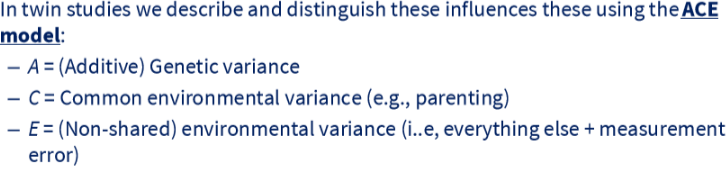
What does ‘shared environment’ refer to?
Environmental factors that actually act to make family members more similar (e.g. parenting styles)
Not environmental factors that are experienced by all members of a household (e.g. geographic proximity, society)
What does ‘non-shared environment’ refer to?
Environmental factors that act to make family members different (e.g. different educational experiences) + measurement error
Not environmental factors that aren’t shared by all members of a household
What is heritability?
The proportion of population variance that can be attributed to genetic influences/variance
Doesn’t apply to individuals → specific to populations + environmental circumstances
Is a property of a situation not a characteristic
Strong assumptions about how people mate + how genes transact with their environments
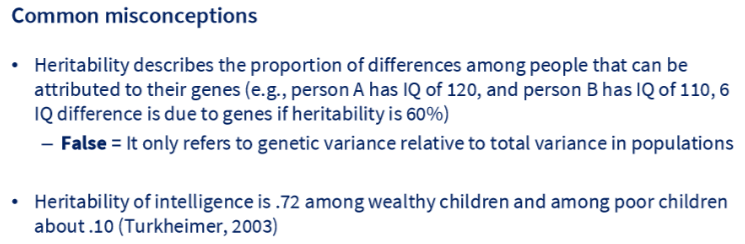
Clarifying heritability and genetic similarity
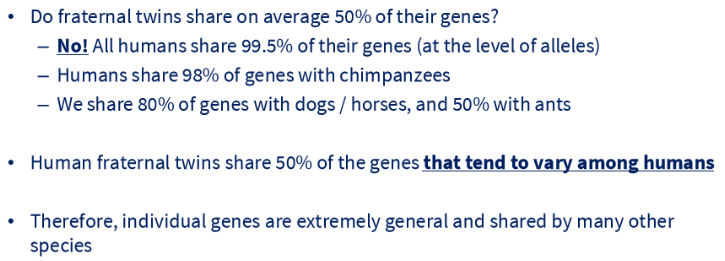
How is heritability calculated?
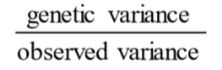
Heritability calculation example
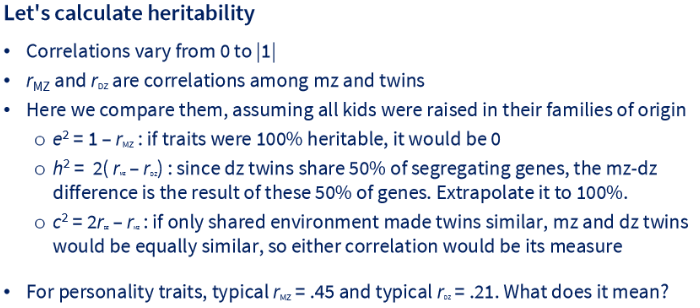
What is the range for overall heritability of many human characteristics? Where does this range come from?
0.3 - 0.6 → are consistent across population groups + environmental circumstances (+ no other kind of systematic factors play as strong a role)
Describe the change in correlation between cognitive ability and genetic relatedness
Correlation between cognitive ability of people increases with their genetic relatedness
Who developed the laws of behavioural genetics?
Turkheimer (2000) → added to by Chabris (2015)
What are the laws of behavioural genetics?
All human behavioural traits are heritable
Shared environmental influences tend to be weaker than genetic influences
Neither accounts for all variance (non-shared environmental influences + error)
A typical human trait is associated with very many genes, each of which accounts for minuscule amounts of variance
What are the implications of the laws of genetics?
Can’t assume that correlations between life circumstances + later outcomes are causal
Family environments do as much to make us different as they do to make us similar → whatever parents do similarly to their children doesn’t matter much
Environmental influences are idiosyncratic (the gloomy prospect)
They transact with genes in individual ways
There are very few direct main effects out there → we haven’t identified many specific + replicable effects of non-shared environmental influences
How are genes found within genomics?
Genome tech has improved in the last 30 years
Genome-wide association studies → scan people’s genotypes + examine the relations with their phenotypes
Can now identify specific genetic components (alleles, variants of genes)
Breakthroughs for Mendelian medical conditions )e.g. Huntington’s disease) BUT less so for psychological characteristics
What are candidate genes?
Genes that code for a specific phenotype
Decades dedicated to searching for these
Very little replicates
Genome-Wide Associations Studies are more successful
Genetic risk scores based on many thousands of genes/SNPs are more promising (your traits expected from your genes that have been in place since conception)
Explanations:
Can’t manipulate humans like we do non-humans (breeding, fostering, imposed environments)
Researchers assume alleles have direct, specific + bio effects only on certain characteristics
BUT genes code for building-block proteins very far upstream even for simple, hard-wired traits (e.g. eye colour)
Proteins can take on many functions + environment influences expressions
Born with genetic toolboxes used to make our way in the world AND these are always with us (pervasive influences)