Chinese Gardens & Qing Costume Portraits
 Call Kai
 Learn
Learn Practice Test
 Spaced Repetition
 Match
Match Flashcards
 Knowt Play
1/6

There's no tags or description
Looks like no tags are added yet.
Name | Mastery | Learn | Test | Matching | Spaced | Call with Kai |
|---|
No analytics yet
Send a link to your students to track their progress
7 Terms
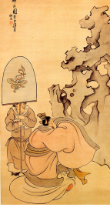
The painting below depicts the literati-scholar, Mi Fu, bowing to a rock. Why was such a high value placed on rocks by scholars of the Tang and Song? What did the ability to identify valuable rocks signify during these periods? Why did Emperor Huizong build upon this tradition in naming, painting, and writing a poem about his rock? How do later scholars view Huizong’s efforts to align with this tradition?
Social meaning, considering aristocrats wanted flashy and decadent objects. The ability to id beauty in nature was therefore the mark of a true scholar.
Huizong was trying to make the arts respectable in this way
Lion’s Grove Garden in Suzhou, Jiangsu province is a rectangular garden on approximately 2.7 acres of land. Explain two techniques that garden designers utilized to make gardens feel spacious despite the fact that it was constructed on a small urban plot.
They utilized bodies of water, and also built pavilions, halls and galleries to maximize space
How did the function of gardens shift in the Ming? What role did they play in fashioning the identity of elites?
Gardens were seen as a luxury, with tickets being sold to grant entry into them. Famous artists were commissioned to create pictures of said gardens in order to get people to come to the gardens
How did the Qing rulers visibly show the subjugation of ethnic Han Chinese populations? Name two ways.
Men had to shave their head with a long braid at the back (queue)
Women had to bind their feet
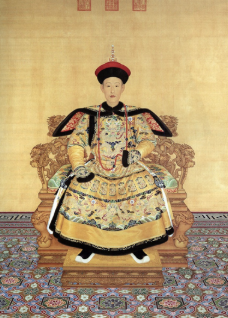
Describe the style of this work. What type of artist painted it and where was it designed to be displayed?
This is a visage portrait, with a pictorial style that rejects any depictions of physical environments, bodily movement, or facial expressions. Frontal view to display the emperors power and authority
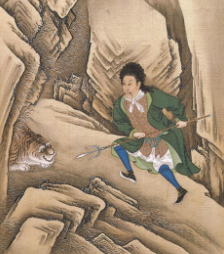
Why did the Yongzheng emperor commission “costume portraits”? How is this subgenre of painting in the Chinese tradition similar to or different from its European counterpart?
Served as something symbolic of the emperors filial piety and his transmission of power
Similar to “fancy dress”
Euro examples were more imperial than Chinese works
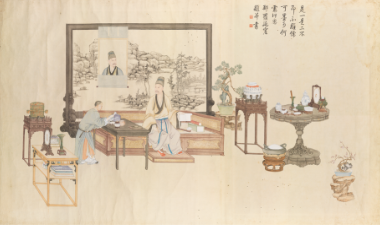
What subgenre of painting does this work belong to? What does it depict? How was it created? How does the inscription, according to Wu Hung, reinforce the sitter’s attitude towards identity in the Qing?
Costume portrait
depicts the figure in front of a landscape screen w/a portrait of themselves hanging on the wall
created via collecting art from the ming
recreated painting but the emperor replaced the figure with himself/the items with his own items
idea that the emperor’s true identity is hidden from the people/he can present himself in any way he likes
presenting as a chinese scholar