gov vocab
 Call Kai
 Learn
Learn Practice Test
 Spaced Repetition
 Match
Match Flashcards
 Knowt Play
1/91

There's no tags or description
Looks like no tags are added yet.
Name | Mastery | Learn | Test | Matching | Spaced | Call with Kai |
|---|
No analytics yet
Send a link to your students to track their progress
92 Terms
Limited government
Type of government where control is placed onto leadership and powers - use of laws that people have to obey, documents state the laws and the government cant take advantage of citizens because the power is limited
Eg:checks and balances
Natural rights
Derived from John Locke, people are born with inalienable natural rights - god given rights that cant be taken away or given away
Eg: life liberty and property
Popular sovereignty
The right to self govern. The people are the source of all government power.
Eg:we the people
Republicanism
A form of government where people elect representatives to make and carry out laws
Eg: Rome
Ratification
Signing and giving formal consent to a contract which is making it “official”
Eg: article 7 of the constitution
Factions
A group of people in within a bigger group/organization/government that have a different opinion than the people in the larger group.
Eg: dealt in federalist paper #10
Federal grants (grants in aid)
An award of money/property from the us government to fund towards peoples projects/activities that serve a purpose.
Umbrella term for all grants in a way
Eg: highway funding grants
Categorical grant
Formula and project grant are apart of the categorical grant
Specific type of grant - carrot on a stick
Having to jump through the hoops to get the money you’re applying for.
Eg:
Project grants are like UCF prosthetic program
Formula grant are like school lunch program
Block grant
Not as many hoops. Not as specific with requirements
Eg: dental screening, hearing screening, physicals,
Enumerated power
Explicitly written in the constitution
Gives direct power to the congress to regulate areas
VS implied power
Eg: power of congress to levy and collect taxes
Implied power
Powers taken by congress through deduction from expressed powers
VS enumerated power
Eg: necessary and proper clause. - elastic clause - has flexibility
Exclusive powers
Powers that are exercised by the national government by themselves.
VS concurrent powers
Eg: national governments power to coin money, make treaties with foreign states, and put taxes on imports
Concurrent powers
Powers of both the national government and states
VS exclusive powers
Eg: power to levy and collect taxes, to define crimes and set punishments for the crimes, to claim private property for public uses.
Eminent domain
Government is being able to claim private property for public use
Eg: highways/road system - with the 5th amendment
Checks and balances
Ensures that no single branch has an overpowering amount of power.
One branch can check the other branches.
Eg:
Legislative branch: can override presidential vetoes, can propose constitutional amendments
Executive branch: can veto legislation, can nominate federal judges
Judicial branch: can declare laws unconstitutional, can declare executive actions unconstitutional
Formal amendment process
Formal change in the US constitution involving 2 stages of proposal then ratification.
Eg: step 1 the amendment is proposed. Proposed by congress by a 2/3 vote in both houses.
Leaving to step 2 the amendment is ratified. Ratified by the state legislatures of ¾ (38) of the states.
Division of powers
System of federalism. The federal/national government is on top with the constitution. And the state and local governments are below. The state charters cant negate the national constitution.
Eg: vertical construct
Separation of powers
The seperation of 3 branches using checks and balances to keep them separate but equal. Legislative, executive, and judicial.
Eg: horizontal construct
Federalist
In favor of the constitution
Focused on the weakness of the articles and a strong government was needed
Eg: madison, Hamilton, jay
Anti-Federalist
Led by Henry, Richard Henry lee, George mason, Samuel Adam’s
Opposed the constitution
Wanted strong state governments and not a strong national government.
Eg: Henry, Richard Henry lee, George mason, Samuel Adam’s
Elite democracy
Model where small well educated wealthy people hold political powers. Which limits the citizens roles in choosing between competitive leaders.
Only a few people are representing everyone
Eg: the electoral college
Participatory democracy
Citizens are directly engages in political decision making. Citizens should actively and directly control all aspects of their lives
Everyone has a voice, everyone can run for office etc.
Eg: town hall(town meeting), ballots
Pluralist democracy
Citizen membership in groups is the key to political power.
Interest groups and how they affect those that are running the government
Eg: US interest group system
Centralized government (unitary)
Political system where power is concentrated in a single national authority.
Not shared with regional bodies
Eg: Iran/china
Another name for unitary government
Decentralized government (federal)
Body of government that shifts power/authority/resources from central governments to lower bodies like regional/local authorities. Local governments can also have power
Eg: USA
Federal
State sovereignty
For local units of government in the USA have sovereignty. Each state holds governing power. They can manage health, education, law enforcement etc.
Eg: individual us states creating their own laws on : marijuana, education, gun control.
10th amendment gives the states the ability for this.
Mandate
Legislature gives an official order to the local communities to do something but its UNFUNDED
Eg: schools need to keep the doors locked but with no more funding.
minimum wage / ADA - American disabilities act
Extradition
When you commit a crime and flee to another state, every state has an agreement to help get the fugitive back for prosecution.
Eg:Article IV - extradition clause
Impeachment
The process where a legislative body presses charges against a public official due to the officials misconduct.
Needs the house votes to accept the charges for the impeachment to go through.
Eg:House of Representatives - creates a committee and brings charges and collect evidence, then the house votes for impeachment. 2/3rds vote
After the 2/3rds vote it goes to the senate and they go to trial. and then they vote to convict 2/3s
Discretionary spending
Funds that congress has to formally approve when they want to spend money on whatever’s out there.
Eg: national Defense, education, transportation
Mandatory spending
Spending that’s REQUIRED by laws
Eg: social security, Medicaid, Medicare.
Constituency (2)
The voters or residents in a district represented by an elective officer
Eg: local governments
Partisan (2)
Vs bipartisan
Makes it very difficult to compromise or pass laws
PART isan = apart because they cant make a compromise
Eg: vote where all democrats vote no and all republicans vote yes based on their ideaology
Divided government(2)
One political party controls the presidency while another party controls 1/both houses of congress.
Eg: Ronald Regan had a democratic house
Bipartisan (2)
Vs partisan
Able to reach a bipartisan agreement which is making a compromise
Eg: foreign policy
Discharge position(2)
A means of bringing a bill out of committee and to the floor for consideration without a report from the committee by discharging the committee from further consideration of a bill or resolution
Eg: Legislative action
Veto(2)
The power of the president to reject legislation passed by congress. Congress can override with a 2/3 majority
Eg: Presidential veto
Pocket veto(2)
IF the president does it assign a bill within 10 days and congress adjourns during that time, the bill dies and congress cannot override
Eg: Barack Obama used a pocket veto on interstate recognition of notarizations act
Executive order(2)
Directs international operations in the us government. Issued by just the president
Not a law but an order
Vs executive agreement
Eg: emancipation proclamation
Executive agreements(2)
International agreements made with foreign nations
Vs executive order
Eg: NAFTA
Lame duck(2)
20th amendment.
An elected official (president/member of congress) that holds office during period of election and inauguration of the next. They have less influence because it’s a transition period but they can use this time period to pass certain controversial legislation or issues.
Eg: john Adam’s appointed federalist judges before Thomas Jefferson took office - midnight judges
Congressional term(2)
Vs congressional session
2 years and numbered consecutively where a specific congress serves
Eg: todays is the 119th congress (1/3/25)
Congressional session(2)
Vs congressional term
1 years term.
Time when they’re actually working. Adjourning and convening.
Has recess
Eg: 28 in history both houses -Truman’s in 1948 last one
Presidential succession(2)
The order of success for the president if something were to happen to the president.
Eg: 25th amendment
Reapportionment act of 1929(2)
States that the house size is permanent at 435
After each census the seats will be determined for each state
The president sends plans to congress
The house can reject or accept
Eg: 1911 house reapportionment act
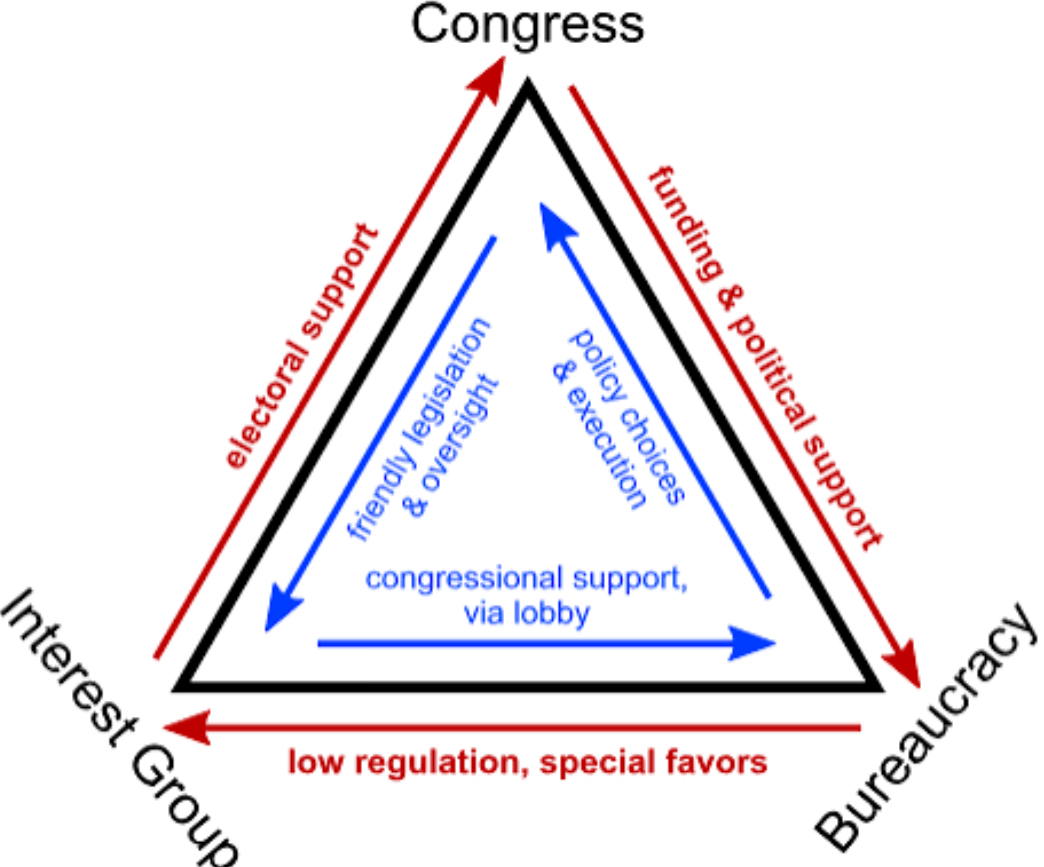
Iron triangle(2)
Powerful mutual beneficial long term alliance with congressional committees
Eg: see picture
Government gridlock(2)
Situation that comes up when legislation faces difficulties in being passed due to different party controls in the legislature or the executive
Eg: budget shutdowns and debt ceiling
War powers act 1973(2)
Helped reserve the precedent set by the fund of Tonkin resolution
Gave tge president sweeping powers in Vietnam
Eg: Persian gulf war
Bully pulpit(2)
Conspicuous position that provides an opportunity to speak out and be listened to
Coined by Theodore Roosevelt - referred to his office as a bully pulpit
Eg: presidents state of the union address
Civil service(2)
Approximately 2.8 million civil servant jobs are filled in the executive legislative and judicial branches
Administer government policies
Eg: police officers
Bureaucracy(2)
Administrative body of appointed officials
A way to administratively organize large numbers of people who need to work together
Eg: EPA
Public policy(2)
Course of government action/inaction in response to public problems
Associated with formally approved policy goals and means
Eg: clean air regulations
Civil liberties (3)
Vs civil rights
The bill of rights
Legal constitutional protection against government
Eg: freedom of speech
Civil rights (3)
Vs civil liberties
14th amendment
What the government has to do to ensure equal protections
Eg:right to vote
Lemon test (3)
Ruled that state funding for religious schools violated the first amendment
Eg: school sponsored prayer (invalidated)
Slander (3)
False spoke statements that hurts someone’s reputation
Vs libel
Eg: false accusations of cri,e
Libel (3)
Written false statement that hurts someone’s reputation
Vs slander
Eg: a fake google review
Secular (3)
Used to distinguish a belief/position thats not religious.
Eg: public school
Parochial (3)
Related to church
Eg: religious school
Selective incorporation (3)
Applying part of the amendment to the state
Eg: right to bear arms
Total incorporation (3)
Apply the amendment to the state. The entire time
Eg: Adam’s on v California 1947
Prior restraint (3)
Judicial suppression of material that would be published or broadcast on the grounds that is libelous or harmful.
Eg: near v Minnesota
infringement (3)
A violation of a right
Eg: copyright/trademark
Affirmative action (3)
Procedures designed to eliminate unlawful discrimination
Eg: diverse hiring panels
De facto (3) SEGREGATION
By fact
It exists by customs regardless of how it is meant to be. Something in practice
Eg:2. People who aren’t legally married but share a home and assets
De jure (3) SEGREGATION
By law
Something that exists as a result of a law or is recognized by a law.
Eg: Jim Crow laws
Wall of separation (3)
Separation of church and state
Eg: McCollum v board of education
Social movement (3)
Organized and collective efforts from citizens to make an influence
Eg: civil rights movement
Social order (3)
Structured behaviors and norms that allow for a society to function
Eg: legal system/law enforcement
Exclusionary rule (3)
Prevents the government from using evidence that was obtained violating the 4th amendment of unreasonable searches
Eg: warrantless home search
Defamation (3)
False statement presented as a fact that hurts someone’s reputation
Eg: libel or slander
Render (3)
To submit deliver provide or officially issue something
Eg: rendering aid
Symbolic speech (3)
Nonverbal, no written forms of communication
Eg: armbands or sit ins
Counsel (3)
Lawyers who provide legal advice and representation
Eg: FDA
Political party
Major party
Minor party
Straight ticket voting
Voters that support the same party every election
Split ticket voting
Voters that support different parties every election
Primary election
Blanket primary
People can vote for any candidate for whatever party and the last one standing with the most votes goes to the general election
Closed primary
Only people who are declared worth members can vote
Open primary
Any qualified voter can vote
Eg: blanket primary
Political efficacy (4)
Does your vote actually count. The higher the politics, efficacy the more likely someone is to be involved in politics
Compulsory voting (4)
You must vote and you’re forced to
Political party system (4)
One party system (4)
One major pp voters have no choice
Eg communism with North Korea
Two party system (4)
Two major political parties that control the political agenda. Eg: is with democrats and republicans
Multi party system (4)
3+ strong pops fighting for gov control and they have to work together in coalition to work together to run gov
Eg Germany
PAC - political action committee (4)
Donating money and supporting certain political candidates and parties
Super pac (4)
Cannot directly donate money to the candidate they need to invest funds in other sctivities that advertise against a political candidate