W9: Sex, gender, culture & personality
 Call Kai
 Learn
Learn Practice Test
 Spaced Repetition
 Match
Match Flashcards
 Knowt Play
1/47

There's no tags or description
Looks like no tags are added yet.
Name | Mastery | Learn | Test | Matching | Spaced | Call with Kai |
|---|
No analytics yet
Send a link to your students to track their progress
48 Terms
What did the study of sex differences look like across history?
Before 1973: little attention to sex differences, mainly studied the male sex
1974: reviewed differences in abilities (verbal, math, spatial rotation) and aggression
Post 1974: requests to report sex differences, including women participants
What is Effect size?
Magnitude of relationship/difference between variables/groups in standard deviation units
What do we use to measure effect size?
Cohen’s d
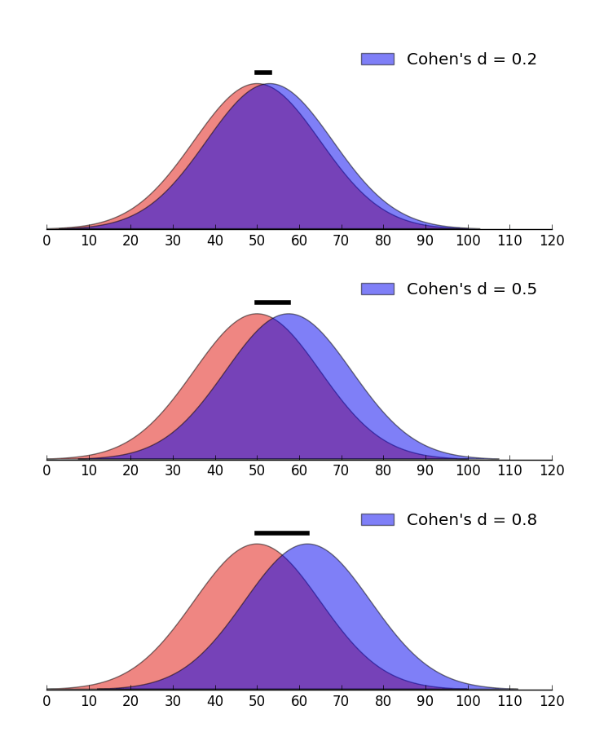
What is the numerical scale of cohen’s d?
Small: 0.20
Medium: 0.50
Large: 0.80
What are the 2 perspectives on sex differences?
Minimalist | Maximalist |
Small sex differences | Small to large differences |
No practical importance | Large practical importance (even for small differences) |
How do you interpret the cohen’s d score?
Positive score → men score higher than women (men is better)
Negative score → men score lower than women (women is better)
In terms of temperament, what is the difference in what women vs men scored higher in?
Women (IP) | Men (ISP) |
|
|
How big is the sex difference in terms of extraversion?
Small difference (d = 0.15 > men slightly higher)
How do women and men display extraversion differently?
Women: more socially warm and gregarious
Men: more assertive and thrill-seeking
What are 2 observed behavioural patterns that explains men’s higher assertiveness?
Interrupting conversations more frequently
Gravitating toward power-seeking behaviour
How big is the sex difference in terms of agreeableness?
Moderate difference (d = -0.32 > women higher)
How do women and men display agreeableness differently?
Women: more empathetic and caring
Men: more aggressive
What are 2 observed behavioural patterns that explains women’s higher agreeableness?
Prefer cooperation
Smile more
Why are women better at inhibiting behaviour when there are negative consequences?
They are much more sensitive to punishment, while men are more inclined to take risks, and be oblivious to the possible punishments
Which type of aggression do women still engage in?
Relational aggression - verbal insults, gossips
(rather than physical confrontation)
Is there sex difference for relational aggression? Why?
No, because it does not require any physical advantage
How big is the sex difference in terms of conscientiousness?
Very small (d = -0.14 > women slightly higher)
What is women better in in terms of conscientiousness?
Women are more orderly than men
How big is the sex difference in terms of emotional stability?
Big (d = -0.49) (biggest among all)
How do women display emotional stability differently from men?
Women have much lower emotional stability; more anxious and very much more fearful (<-1)
How big is the sex difference in terms of intellect-openness?
Not much difference (d = -0.07)
What are the sex differences in self-esteem?
Men have slightly higher SE than women (d = 0.21)
What factor does that depend on?
Age of participants
How does the SE difference vary according to age?
During mid to late teens: gap widens and cohen’s d value increases (men score higher)
Adulthood: gap narrows and cohen’s d value decreases to close to 0 value (women’s score goes up)
What explains the shift in women’s SE?
During mid to late teens is when women hit puberty and start to compare themselves to societal expectations of eg. weight, appearance → drop in SE
What are the sex differences in people-things dimension/nature of vocational interests?
Women: more interested in people (empathising)
Men: more interested in things (systemising)
How were masculinity and femininity described in the 1930s vs 1970s?
1930s
1970s
M&F as opposite ends of one scale (high on one means low on the other)
M&F are independent dimensions (can be low on both or high on both)
Low on both: undifferentiated
High on both: androgynous
What characteristics are used to assess masculinity and femininity?
Masculinity: assertiveness, boldness, dominance, self-sufficiency and instrumentality/agency (5)
Femininity: nurturance, expression of emotions and empathy (3)
What are the 2 newer conceptualisations of sex roles?
Spence’s measure of instrumentality and expressiveness
Bem’s measure of gender schemas
What are 3 characteristics of instrumentality? (WCI)
Working with objects
Completing tasks in a direct fashion
Independence and self-sufficiency
What is expressiveness?
How easily one expresses his/her emotions
How does this help in supporting M&F as two independent dimensions?
Since instrumentality = masculinity, expressiveness = femininity, individuals can be high on both, low on both, or any combination
What are gender schemas?
Cognitive orientations that lead individuals to process social information based on sex-linked associations
How does this support the idea that M&F are subjective?
It is not just about the traits someone has, but how much people use gender as a lens for judgement
What is ideal?
To be gender-aschematic; not be biased by gender at all in processing social information (and look at personality, skill etc)
What are the 3 categories of gender stereotypes? (CAB)
Cognitive
Affective (unconscious)
Behavioural
What are the 4 theories to explain sex differences? (SSHE)
Socialisation theory
Social role theory
Hormonal theories
Evolutionary theory
What does the socialisation theory say about how sex differences are formed?
Formed from reinforcement by parents, teachers and media (society) of boys being “masculine” and girls being “feminine”
What is another theory that supports the socialisation theory?
Bandura’s social learning theory: boys and girls learn by observing behaviours of others of their own sex
What are 2 limitations of this theory?
Does not explain the origins of differential parental socialisation; “where does it start from?”
It is not only parents who can affect children’s behaviour, children can also affect parents’ behaviour
What does the social role theory say about how sex differences are formed?
As men and women are distributed into different occupational and family roles traditionally
What are 2 limitations of this theory?
Does not explain the origins of differential social roles
Does not explain why women and men accepted these roles passively
What do hormonal theories say about how sex differences are formed?
Physiological differences cause boys and girls to diverge across development
What do men have more of than women following puberty? And what does that contribute?
Men typically have 10x more testosterones than women, which contribute to
Aggression
Dominance
Career choice
Sexual desire (also in women)
What are the 3 limitations of these theories?
Does not explain the origins of why men and women are assigned different testosterones levels
No prove that differences in testosterones levels lead to sex differences in personality (correlation ≠ causation)
The correlation is bi-directional (A>B & B>A)
What do evolutionary theories say about how sex differences are formed?
Men and women take on different adaptive problems that needs to be solved for survival and reproduction
What is a limitation of this theory?
Does not take into account within-sex differences
What answers do each theory provide answers for?
Socialisation, social roles, and hormonal theories: HOW the sexes differ (proximal mechanism)
Evolutionary theory: WHY the sexes differ (distal mechanism)