Compaction & state variables [Lecture
 Call Kai
 Learn
Learn Practice Test
 Spaced Repetition
 Match
Match Flashcards
 Knowt Play
1/25

There's no tags or description
Looks like no tags are added yet.
Name | Mastery | Learn | Test | Matching | Spaced | Call with Kai |
|---|
No analytics yet
Send a link to your students to track their progress
26 Terms
Engineering use chart
Soil classification system
Particle size data
Plasticity data
→ should only be used for general guidance or preliminary assessment
Main scalar parameter used to quantify clays
Sr=Vw/Vv=wGs/e
Main scalar parameter used to quantify mixtures
Relative compaction
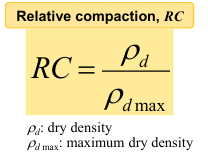
Main scalar parameter used to quantify sands
Relative density
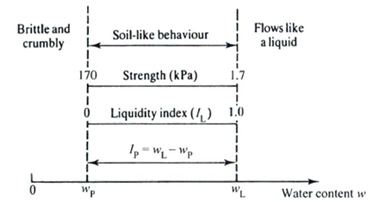
Clay strength at liquid limit and plastic limit
Dry density
Ms/V
Porosity
n=Vv/V=(e/(1+e))
Specific volume
v=V/Vs=(1+Vv/Vs)=(1+e)
Mixtures dry density increases/decreases with void ratio?
decreases
pd=0 e=infinity
pd min → emax
pd → e
pd max → emin
Relative compaction spans from
0 to 100
between 80 & 100 → between emax and emin
Compaction
= process of increasing the dry density of soil by reducing the volume of air
Partially saturated soils
Soil densification through application of external loads and mechanical mixing
Reduction in total volume through removal of air
Can be done through mixing
Consolidation
Saturated soils (Vv=Vw)
Assume solid particles are incompressible
Soil densification through application of external loads
Reduction in total volume through removal of water
Soil compaction effects
Improves soil properties
Increase stiffness (reduce settlement)
Increase strength (increase bearing capacity, liquefaction, resistance, etc.)
Reduce permeability (impermeable layer)
Compacted soil examples
retaining backwall fill
road embankment
earth dams
offshore pipeline backfills
Field & lab compaction methods for fine-grained mixtures
Static load/pressure → ok or ineffective
Kneading
Impact
Vibration → ineffective
Field & lab compaction methods for coarse-grained mixtures
Static load/pressure → ok or ineffective
Kneading → ok or ineffective
Impact → ineffective
Vibration
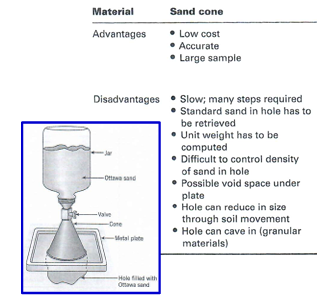
Sand cone test (field)
1. Calibrate device/sand
2. Choose testing spot (representative, flat)
3. Prepare testing location (fix base plate)
4. Dig hole and collect soil (keep moisture)
5. Place and open sand cone
6. Close valve and measure final weight
7. Calculate bulk and dry soil densities
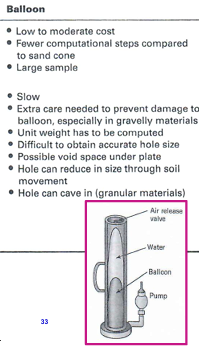
Balloon test (field)
1. Choose testing spot (representative, flat)
2. Prepare testing location (fix base plate)
3. Adjust balloon pump and take ‘zero’ measurement
4. Dig hole and collect soil (keep moisture)
5. Adjust balloon pump and take volume measure
6. Calculate bulk and dry soil densities
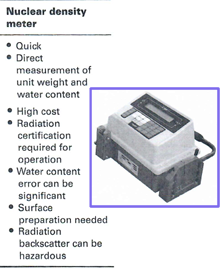
Nuclear density test (field)
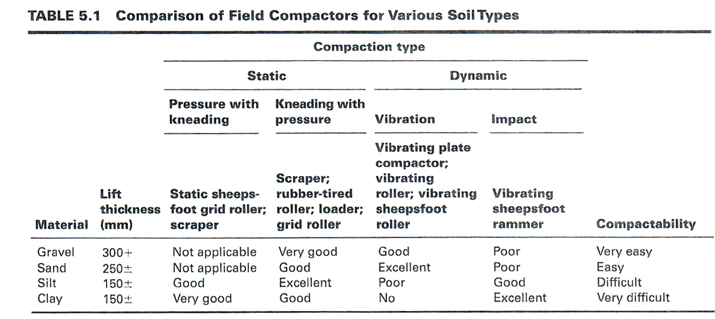
Detailed comparison of field compactors
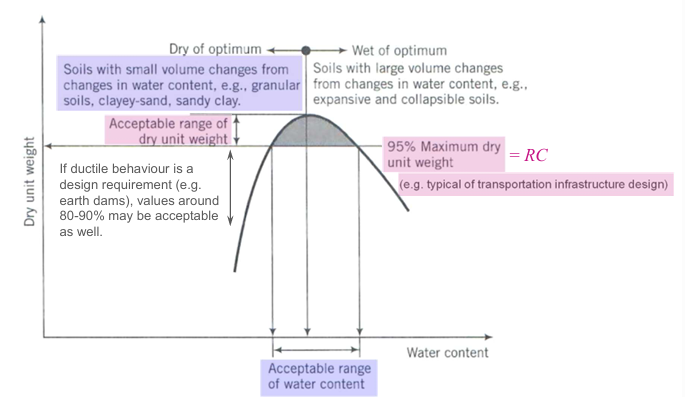
Optimum water content
at maximum dry density
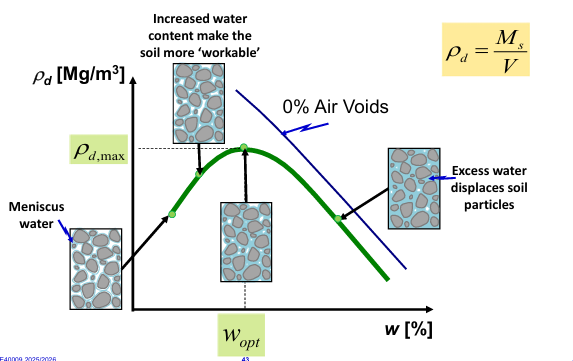
Proctor compaction test
manually or mechanically
add water
mix and incorporate water
fill mold and separate each vertical slice
weight part of compacted soil
dry it and weigh again to find dry density
start from low w
minimum of 5 samples
calculate rhod
plot compaction curve
establish wopt and rhod
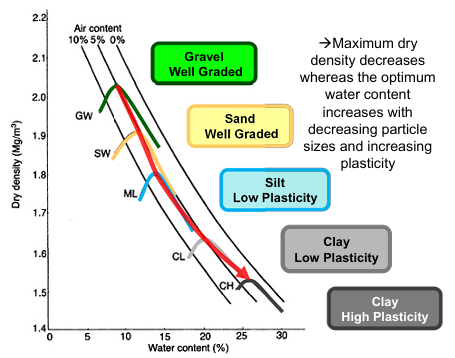
Effect of soil type on max dry density
decreasing particles sizes = increasing plasticity
→ max dry density decreases
→ optimum water content increases
Effect of compactive effort on max dry density
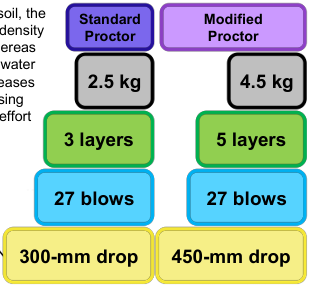
increasing compaction effort
→ max dry density increases
→ optimum water content decreases
(standard proctor vs modified proctor)
Standard proctor vs modified proctor
Typical field compaction specifications
Dry of optimum
soils w/ small volume changes from change in wc (granular soils for ex) → use where you need higher strength
Wet of optimum
soils w/ large volume changes from changes in wc (expansive & collapsible soils for ex) → use where you want to stop water flow