Midterm 1 practice
 Call Kai
 Learn
Learn Practice Test
 Spaced Repetition
 Match
Match Flashcards
 Knowt Play
1/48

There's no tags or description
Looks like no tags are added yet.
Name | Mastery | Learn | Test | Matching | Spaced | Call with Kai |
|---|
No analytics yet
Send a link to your students to track their progress
49 Terms
Which of the following is true about plasma membranes?
A) All cells have a plasma membrane
B) Plant cells and animal cells have a plasma membrane, but bacterial cells do not
C) Only animal cells have a plasma membrane
D) Plant cells and bacterial cells have a plasma membrane, but animal cells do not
A) All cells have a plasma membrane, which serves as a barrier and regulates the movement of substances in and out of the cell.
Key mistake animal cells dont have a cell wall but yes cell membrane
Which of the following classical Kingdoms contained primarily unicellular prokaryotic cells?
Monera
Which of the following are involved with movement and division of the cytoplasm?
A) Intermediate filaments
B) Microtubules
C) Microfilaments
c) microfilaments
Which of the following is true of autotrophs?
A) They obtain energy from inorganic molecules (SO4)
B) They obtain carbon from the consumption of organic molecules synthesized by other organisms
C) They obtain energy from the consumption of organic molecules synthesized by other organisms
D) They obtain carbon from the absorption of solar energy
E) They obtain energy from the absorption of solar energy
F) They obtain carbon from inorganic molecules (CO2)
F) They obtain carbon from inorganic molecules (CO2)
If a reaction has a negative enthalpy change, this means that:
the reaction releases heat to the surroundings, indicating it is exothermic.
It is often stated that the phosphate bonds in ATP are “high energy,” but in fact, they are not notably high in energy. Rather, they are easy to break, and the ∆G of hydrolysis is a “useful” quantity of energy. What makes the phosphate bonds easy to break?
A)
High acidity attacks bonds between amino acids
B)
Positive charges on amino groups repel each other
C)
They are close to the destabilizing nitrogenous base adenosine
D)
High alkalinity attacks bonds between phosphate groups
E)
Negative charges on phosphate groups repel each other
E) Negative charges on phosphate groups repel each other
Which of the following systems has the higher entropy: a cell with a hundred individual amino acids or a cell with one polypeptide that is 100 amino acids long?
A cell with a hundred individual amino acids
What does it mean to say a system has a ∆G equal to zero?
B)
The system is at equilibrium
Olives may be preserved in brine, which is a 20-30% salt solution. How does this method prevent contamination (spoiling) by microorganisms
Bacteria can't survive in a hypertonic solution because their cytoplasm loses water
An unsaturated fatty acid contains:
one or more double bonds between carbon atoms.
When referring to membrane glycolipids and glycoproteins, what does the prefix “glyco-” indicate?
Polar carbohydrate groups that are attached to the molecules
How are membranes able to stay fluid at very cold environmental temperatures?
A)
By increasing the proportion of unsaturated phospholipids in the membrane
B)
By increasing the proportion of saturated phospholipids in the membrane
C)
By increasing the proportion of sterol molecules in the membrane
D)
Both A and C
E)
Both B and C
D
A biologist working in a lab adds a compound to a solution that contains an enzyme and substrate. This compound binds to the enzyme and decreases the rate at which the enzyme converts substrate to product. This decrease in enzyme activity persists even if the concentration of substrate in the reaction mix is increased. Therefore, which of the following is true of the compound?
It is a non-competitive inhibitor.
What is the difference between a "polypeptide" and a "protein"?
A polypeptide is a linear chain of amino acids; a protein is a polypeptide that has folded into a functional three-dimensional shape
The consequence of a protein becoming denatured is:
inactivation
Imagine that several atoms bond to form a carbohydrate. Which of the following statements is true regarding the universe after this carbohydrate forms?
A)
The energy of the universe increases
B)
The energy of the universe decreases
C)
The entropy of the universe increases
D)
The entropy of the universe decreases
E)
A and C
F)
B and D
The correct answer is C) The entropy of the universe increases. This happens because the formation of a carbohydrate from several atoms increases the disorder in the system, leading to an overall increase in entropy.
Coupled reactions ....
Question options:
A)
Do not require an enzyme
B)
Is when the product of one reaction is used as the reactant in a subsequent reaction
C)
Are reactions in which two things are happening at the same time
D)
Are two reactions which happen one after the other
c ?
For a cell to maintain a high degree of organization, what must it constantly do?
Increase the entropy in the surroundings
Chloroplasts are thought to have evolved from:
photosynthetic bacteria.
You have isolated a bacterium and have determined that it obtains energy by breaking down carbohydrates, and gets carbon from the same carbohydrates. How would you classify this organism?
Chemoorganoheterotroph
Which of the following features exist in eukaryotic cells, but not in prokaryotic cells?
internal membrane-bound organelles
How are the membranes of animal cells in winter able to remain fluid when the weather becomes extremely cold?
They incorporate more unsaturated fatty acids and cholesterol molecules (sterols)
A protein that is temporarily associated with one side of a biological membrane is a(n):
peripheral protein
Amino acid R (side chains) groups with what characteristic(s) do not dissolve in water?
Non-polar or uncharged atoms
Which of the following best describes primary structure in proteins?
A)
It is the sequence of amino acids in the complete protein
B)
It is the number of amino acids present in the complete protein
C)
It is the number of α-helices and β-sheets in the complete protein
D)
It is the number of peptide bonds in the complete protein
A) It is the sequence of amino acids in the complete protein
Which of the following statements about allosteric enzymes is true?
Allosteric enzymes have a binding site not the active site for inhibitor/activator molecules
How might an enzyme inhibitor slow down the action of an enzyme without binding to the active site?
Binding the enzyme and changing its shape
What do mitochondria and chloroplasts have in common?
Both contain a circular DNA molecule
Which of the following is true of heterotrophs
They obtain carbon from the consumption of organic molecules synthesized by other organisms
Which of the following features do Bacteria have in common with all Archaea but not with any Eukarya?
absence of nucleus
Mitochondria, like prokaryotic cells, replicate by:
binary fission
A cell wanting to move fructose ( large polar)across a lipid bilayer, with (down) its concentration gradient, would use:
a protein carrierthat facilitates passive transport.
A cell membrane with a high concentration of sterols will be efficient in (choose all that apply):
Reducing viscosity in cold environments
Reducing fluidity in hot environments
What is responsible for the selective permeability of a cell membrane?
hydrophobic region formed by phospholipid tails
A reaction took place at 322K. ∆G was -20.5 kJ/mol and ∆Ssystem was -10.5 J/molK. Is the reaction endergonic or exergonic?
exergonic, as ∆G is negative.
When a molecule that is similar in shape to the substrate binds to the active site of an enzyme and reduces that enzyme's activity, this is known as:
Competitive inhibition
What does it mean when an enzyme has an allosteric activator?
The product of the enzyme, or another downstream product, will bind to the enzyme at a site other than the active site and stimulate enzyme activity
Proteins are composed of _____ monomers.
amino acid
A "polypeptide" is a polymer of amino acids that consist of _____ amino acids.
>10
According to the fluid mosaic model of cell membranes, which of the following statements about membrane phospholipid molecules is true?
A)
They have hydrophilic tails in the interior of the membrane
B)
They occur in an uninterrupted bilayer with membrane proteins restricted to each side of the membrane
C)
They are free to depart from the membrane and dissolve in the surrounding solution
D)
They can move laterally along the plane of the membrane
D) They can move laterally along the plane of the membrane
Which one of the following types of fatty acids would be likely to participate in the highest number of van der Waals forces with other fatty acids? Fatty acids with:
A)
Long tails and low saturation
B)
Short tails and low saturation
C)
Short tails and high saturation
D)
Long tails and high saturation
D) Long tails and high saturaztion
For a reaction to be endergonic:
Delta G >0
When polymerization of a protein is complete, but the protein is still completely linear, what is the highest level of structure that has been completed?
Primary structure
What makes a reaction exothermic?
A)
The products have less kinetic and potential energy than the reactants
B)
Heat energy was created during the reaction
C)
The products have more kinetic and potential energy than the reactants
D)
The products have less free energy than the reactants
E)
The products have more free energy than the reactants
A) The products have less kinetic and potential energy than the reactants
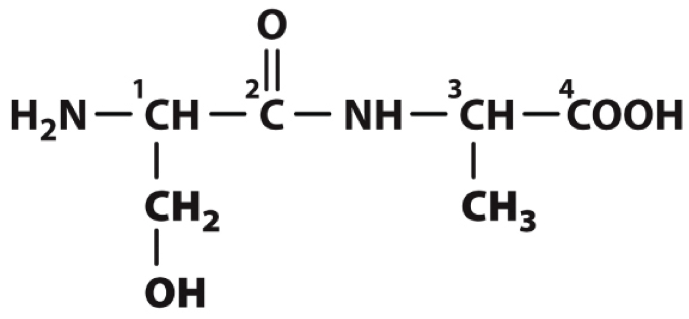
The structural formula below is of two amino acids joined together to form a dipeptide. The carbons in backbone of this dipeptide are numbered 1 through 4. Which of the carbons is attached to a hydrophilic R group?
Carbon 2
An exothermic chemical reaction converts reactant molecule "A" into product molecule "B" within a cell. What type of system is this?
Open system
In an internal combustion engine, only about 20% of the energy stored in the chemical bonds of gasoline molecules is transformed into mechanical (kinetic) energy. What happens to the other 80%?
It is lost as heat energy.
Which of the following is a difference between secondary active transport and facilitated diffusion?
A)
Secondary active transport involves transport proteins and facilitated diffusion does not
B)
Secondary active transport requires a cellular energy source and facilitated diffusion does not
C)
Facilitated diffusion involves transport proteins and secondary active transport does not
D)
Facilitated diffusion moves solutes against (up) a concentration gradient and secondary active transport does not
E)
Secondary active transport directly requires energy from ATP and facilitated diffusion does not
The correct answer is B) Secondary active transport requires a cellular energy source and facilitated diffusion does not.