APCSP.Max Vocabulary Review
 Multiple Choice & FRQ
 Call Kai
1/190

Earn XP
Description and Tags
191 Terms
RGB(255,255,255)
White
Algorithm
A precise sequence of instructions for processes that can be executed by a computer
Function
A piece of code that you can easily call over and over again.
API
a collection of commands made available to a programmer. Also, an interface for two programs to communicate together.
Documentation
a description of the behavior of a command, function, library, API, etc.
Library
a collection of commands / functions, typically with a shared purpose
Parameter
An extra piece of information that you pass to the function to customize it for a specific need
For Loop
A particular kind of looping construct provided in many languages. Typically, a for loop defines a counting variable that is checked and incremented on each iteration in order to loop a specific number of times.
Loop
The action of doing something over and over again.

Byte
technical term for 8 bits of data

Kilobyte (KB)
1024 bytes

Megabyte (MB)
1,024 kilobytes

Gigabyte (GB)
1,024 megabytes
Terabyte (TB)
1,024 gigabytes

Petabyte (PB)
1,024 terabytes

.bmp
(bitmap image file or bitmap) is a raster graphics image file format used to store digital images.

Heuristic
a problem solving approach (algorithm) to find a satisfactory solution where finding an optimal or exact solution is impractical or impossible.

Image
A type of data used for graphics or pictures.

Metadata
Data that describes other data. For example, a digital image my include metadata that describe the size of the image, number of colors, or resolution.

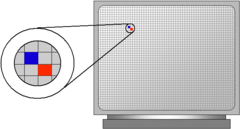
Pixel
Short for "picture element" it is the fundamental unit of a digital image, typically a tiny square or dot which contains a single point of color of a larger image.
Hexadecimal Number System
A number system consisting of 16 distinct symbols — 0-9 and A-F — which can occur in each place value.

Lossless
A compression scheme in which every bit of the original data can be recovered from the compressed file.

Lossy
A compression scheme in which "useless" or less-than-totally-necessary information is thrown out in order to reduce the size of the data. The eliminated data is unrecoverable.

RGB
the color model that uses varying intensities of (R)ed, (G)reen, and (B)lue light added together in order to reproduce a broad array of colors.

RBG Intensities
a 256-range (or 8-bit range) of values from light to dark on each of the three color channels (R,G,B)

file extensions
the endings of file names that indicate to the computer the format for how the underlying bits are organized.

Computationally Hard Problem
A problem that can not be solved in a reasonable amount of time. Heuristics are often used to create an approximate or good enough solution.
#FF0000
Red represented RGB in 32Bit Hex
#00FF00
Green represented RGB in 32Bit Hex
#0000FF
Blue represented RGB in 32Bit Hex
#000000
Black represented RGB in 32Bit Hex
#FFFFFF
White represented RGB in 32Bit Hex
Innovation
A novel or improved idea, device, product, etc. or the development thereof

Caesar Cipher
a technique for encryption that shifts the alphabet by some number of characters

Cipher
the generic term for a technique (or algorithm) that performs encryption

Cracking encryption
When you attempt to decode a secret message without knowing all the specifics of the cipher.
Decryption
a process that reverses encryption, taking a secret message and reproducing the original plain text
Encryption
a process of encoding messages to keep them secret, so only "authorized" parties can read it.
Random Substitution Cipher
an encryption technique that maps each letter of the alphabet to a chosen other letters of the alphabet.
Vigenère cipher
a method of encrypting text by applying a series of alphabetical shifts based on the letters of a keyword.

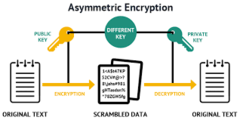
asymmetric encryption
used in public key encryption, it is scheme in which the key to encrypt data is different from the key to decrypt.
modulo
a mathematical operation that returns the remainder after integer division.

Public Key Encryption
Used prevalently on the web, it allows for secure messages to be sent between parties without having to agree on, or share, a secret key. It uses an asymmetric encryption scheme in which the encryption key is made public, but the decryption key is kept private.

Hypothesis
A proposed explanation for some phenomenon used as the basis for further investigation.
Search Trends
Comparison of the popularity of topical queries in an online search engine as they relate to time.
Pivot Table
The name of the tool used by most spreadsheet programs to create a summary table.

README
A document providing background information about a dataset.
CSV
Abbreviation of "comma-separated values," this is a widely-used format for storing data.

Raw data
The original data as it was collected.
Summary table
A table of aggregate information about a dataset (e.g., the average, sum, count of some values).
Filter
tool/technique using dynamic parameters for reducing a data set to viewing only similar items in a row or column.

Aggregation
A computation in which rows from a data set are grouped together and used to compute a single value of more significant meaning or measurement. Common aggregations include: Average, Count, Sum, Max, Median, etc.
HEX: F
The number 15
BIN: 1110
The number 14
DEC: 13
The number 13
prototype
A preliminary sketch of an idea or model for something new. It's the original drawing from which something real might be built or created.
binary question
a question where there are only two possible answers

binary message
a message that can have only one of two values
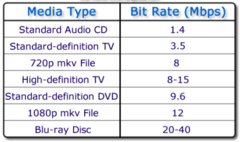
bit rate
the number of bits that are conveyed or processed per unit of time.
protocol
A set of rules governing the exchange or transmission of data between devices.

ASCIII
The universally recognized raw text format that any computer can understand
American Standard Code for Information Interchange
What does ASCII stand for? (cap first letter)
code
(slang) to write instructions for a computer
request for comments
documents how standards and protocols are defined -- Published for all to see
router
a computer which receives messages traveling across a network and redirects them towards their intended destination based on the addressing information included with the message.
redundancy
repetition of information or the inclusion of additional information to reduce errors in transmission.
domain name service
DNS stands for...

uniform resource locator
URL stands for...

HTTP
the protocol used for transmitting web pages over the internet

hypertext transfer protocol
HTTP stands for...
TCP
provides reliable, ordered and error checked delivery of a stream of packets in the internet
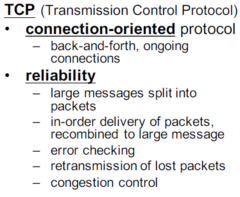
transmission control protocol
TCP stands for...
URL
an easy to remember address for calling a web page
IP address
A number assigned to any item that is connected to the internet

net neutrality
the principle that all Internet traffic should be treated equally by Internet Service Providers
octal
The octal number system is base 8, using only digits 0 through 7.
decimal
Traditional number system using digits 0-9.
iterative innovation
Incremental or small improvement to an item
novel innovation
Improvement that is new, creative and has not been done before "outside the box thinking."
iteration
repeating a process - in computer science this term often implies each repetition comes closer to an end point or final answer.
Vint Cerf
Internet pioneer who believed the Internet should be free and available to everyone

higher lower
__________ level protocols use _______ levels without needing to understand precisely how they work. (space between each term)
lower higher
_________ level protocols guarantee __________ level protocols will function without stating specifically how this will be accomplished.
Creative Commons
one of several public copyright licenses that enable the free distribution of an otherwise copyrighted work. A CC license is used when an author wants to give people the right to share, use, and build upon a work that they have created.

High Level Programming Language
A programming language that enables a programmer to write programs that are more or less independent of a particular type of computer. Such languages are considered high-level because they are closer to human languages and further from machine languages. Examples: JavaScript, Java, FORTRAN
Low Level Programming Language
A programming language that provides little or no abstraction from a computer's instruction set architecture—commands or functions in the language map closely to processor instructions. Generally this refers to either machine code or assembly language.
Fault tolerant network
The ability to route around broken servers on the internet.
Binary Code
Representation of computer processor instructions using any two-symbol system, but often the numbers 0 and 1.
==
(sometimes read: "equal equal") equality operator; used to compare two values, and returns a Boolean (true/false). Avoid confusion with the assignment operator "=",
Global Variable
A variable whose scope is "global" to the program, it can be used and updated by any part of the code. Its global scope is typically derived from the variable being declared (created) outside of any function, object, or method.
If Statement
The common programming structure that implements "conditional statements".
Callback function
a function specified as part of an event listener; it is written by the programmer but called by the system as the result of an event trigger.
Event
An action that causes something to happen.
UI Elements
onscreen objects, like buttons, images, text boxes, pull down menus, screens and so on.
User Interface
The visual elements of an program through which a user controls or communications the application. Often abbreviated UI.
Data Type
(ex: Number, Boolean, or String) a value's property that dictates how the computer will interpret it. For example 7+5 is interpreted differently from "7"+"5"
Expression
Any valid unit of code that resolves to a value.
Variable
A placeholder for a piece of information that can change.
Debugging
Finding and fixing problems in your algorithm or program.
conditionals
statements that run under only certain conditions