Parasitology: Introduction, Specimens, & Examination
 Call Kai
 Learn
Learn Practice Test
 Spaced Repetition
 Match
Match Flashcards
 Knowt Play
1/21

There's no tags or description
Looks like no tags are added yet.
Name | Mastery | Learn | Test | Matching | Spaced | Call with Kai |
|---|
No analytics yet
Send a link to your students to track their progress
22 Terms
facultative parasites
parasites that can exist as a parasite AND on its own
accidental/incidental host
a host that the parasite usually does not use as a reservoir
definitive host
the host where the adult and sexual stages of the parasite develop and reproduce
intermediate host
larval or asexual reproductive phases occur in these hosts (parasite can then transfer to definitive host)
vector
arthropods or other carriers of a parasite that serves as a mode of transmission to the host
ectoparasites vs. endoparasites
ectoparasites
lives on or outside of the body (ticks, lice, or fleas)
endoparasites
lives within the host (intestinal worms or Plasmodium)
What is looked for in stool specimens for parasites?
eggs or larva
What should be avoided when collecting stool for testing?
collection after radiologic procedures with barium
contact with urine
collection if the patient takes certain medications (mineral oils, bismuth, antidiarrheals, antimalarials, antibiotics)
A minimum of ___ specimens should be collected over a ___ day period for parasitic testing.
3, 10
What happens to a portion of the stool specimen when received in the lab?
it is placed in a preservative such as polyvinyl alcohol (PVA)
or refrigerated for up to 4 hours before examination
When should formed stool and liquid stool be examined?
formed
within 2-3 hours of collection
best for observing amoeba cysts and flagellates
liquid
within 30 minutes of collection
tends to contain trophozoites of amoeba and flagellates
What is used to prepare direct wet mounts for stool specimens?
saline
detects motile amoebas and flagellates
can also detect helminth eggs, larvae, and protozoan cysts
iodine
highlights internal structures
detects protozoan cysts (shows yellow cytoplasm)
glycogen inclusions dye brown
What are the two types of concentration methods of stool specimens for concentrating parasitic elements?
floatation
zinc sulfate separates cysts and eggs, which floats to the top and are skimmed off
provides a clean concentrate, but certain eggs and protozoa do not float
sedimentation
formalin ether is used
parasites are freed from the stool and are sedimented by centrifugation (eggs, protozoa, and larvae)
Why are permanently stained mounts used in the lab?
to keep a permanent record of the organisms identified
slides are fixed with Schaudinn’s fixative or PVA
merthiolate-iodine-formalin (MIF) stain
combination preservative, fixative, and stain for parasitic specimens
trichrome stain (Wheatley adaptation)
used for fresh and PVA-preserved stool
shows blue-green cytoplasm and red-purple nuclei
eggs and larvae appear red
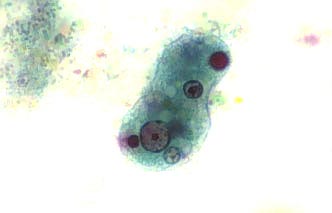
iron hematoxylin stain
used for fresh and PVA material
parasites and background material stain gray-blue and nuclei stain black
modified acid fast stain
used for identifying coccidia-like organisms like cyclospora
enhances the detection of oocysts (they appear magenta)
Blood specimens are collected in ___ consecutive days at ___ hour intervals.
3, 6-18
Blood specimens are stained with
Giemsa or Wright stain
When are thick smears and thin smears made with blood specimens?
thick smears
screening for parasites at 100x (for detecting microfilaria)
1000x used for screening for Plasmodium sp. and Babesia
not fixed - cells lyse on the slide
thin smears
fixed and stained
prepared when thick smear screens are positive
Which identification methods are used to diagnose parasitic infections?
direct antigen detection
EIA, DFA, and immunochromatogenic assays
molecular testing
PCR (good for speciating Plasmodium)
Multiplex PCR