Vertebra
 Call Kai
 Learn
Learn Practice Test
 Spaced Repetition
 Match
Match Flashcards
 Knowt Play
1/30

There's no tags or description
Looks like no tags are added yet.
Name | Mastery | Learn | Test | Matching | Spaced | Call with Kai |
|---|
No analytics yet
Send a link to your students to track their progress
31 Terms
Function of the vertebral column
Transmit weight of trunk to lower limbs
surround and protect spinal coord
What are the sections and how many bones
Cervical Vertebrae (7)
Thoracic Vertebrae (12)
Lumbar Vertebrae (5)
Sacrum (fused)
Coccyx (fused)
Reason for curvature and which way do each section curve
Increase resilience and flexibility of spinethe
Cervical and lumbar → concave posteriorly
Thoracic and sacral → convex posteriorly (concave anteriorly forward)
Scoliosis
abnormal lateral curvature (left or right)
Kyphosis
hunchback - exaggerated thoracic curve
Lordosis
swayback - excessive lumbar curve
Anterior longitudinal ligament
Strong and thick going from neck to sacrum in the front
Prevents hyperextension/ leaning back
Posterior longitudinal ligament
narrow and weak going from neck to sacrum in the back
Prevent forward flexion - leaning forward
Ligamentum Flavum
connect adjacent vertebrae - type of short ligament
Short ligament
Connect vertebra to those above and below
General structure includes (4 things)
Body/Centrum, vertebral arch, vertebral foramina, intervertebral foramina

Body/Centrum - bears the weight
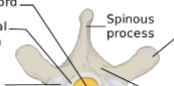
Vertebral arch - top part that helps surround vertebral foramen
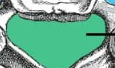
Vertebral foramina - passage for spinal cord

Intervertebral foramina - opening between adjacent vertebrae (up and down) where spinal nerves leave
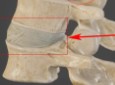
intervertebral discs - cushionlike pads
Two parts of the intervertebral disc
Nucleus pulposus - gel like inside → elasticity and compressive
Anulus fibrosus - outer collagen and fibrocartilage → prevent expansion of inside
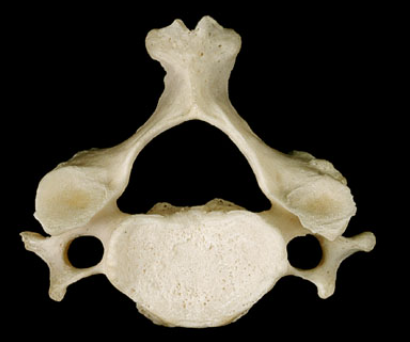
Cervical vertebra (C1-C7)
Bifid
Has transverse foramen in tranverse process (the two wholes on the sides)
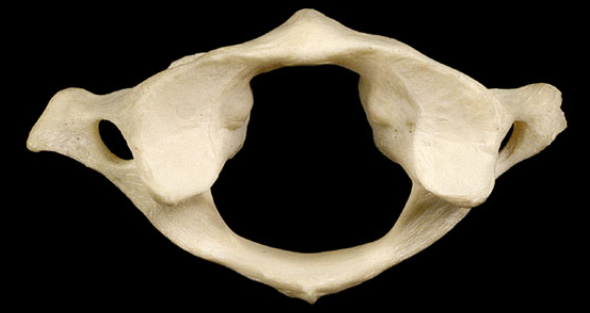
Atlas (C1)
no body
connect to occipital condyle - support skull
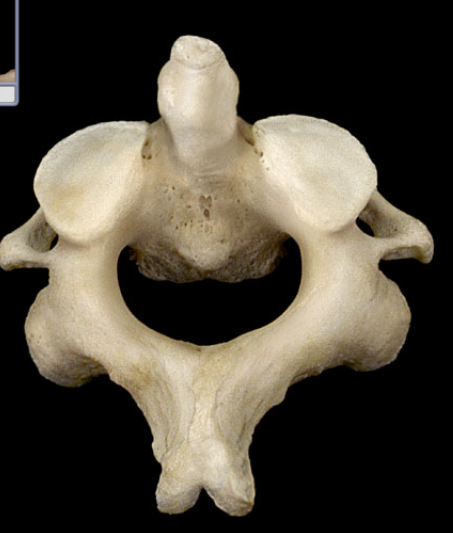
Axis (C2) - has dens → middle thing on top → missing body of Atlas
Which bone is yes movement
atlas
Which bone is no movement
axis
What is missing between atlas and axis
Intervertebral disc
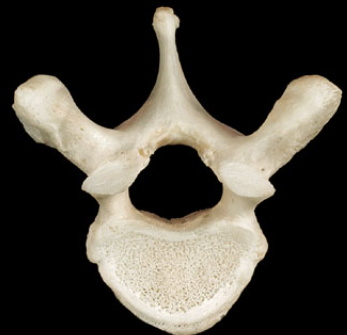
Thoracic vertebrae (T1-T12)
articulate with ribs
long spinous processes (that middle spike)
Circuluar vertebral foramen
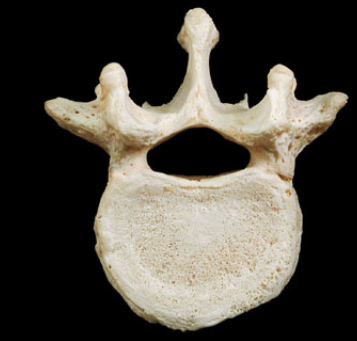
Lumbar vertebrae (L1-L5)
hatchet shape spinous processes
which vertebra handles the most stress, largest
lumbar vertebrae
which region can rotate and which region can’t
thoracic region can and lumbar vertebrae can’t
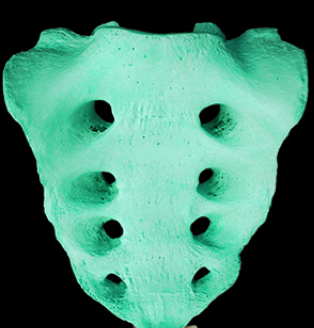
Sacrum (S1-S5)
5 fused vertebrae
which region Forms posterior pelvis + articulate with hip bone
sacrum
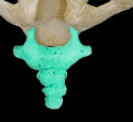
Coccyx
Tail bone
3-5 fused vertebrae
Where do spinal nerves leave
intervertebral foramen