ENGLISH LANGUAGE PAPER 2 VOCABULARLY
 Call Kai
 Learn
Learn Practice Test
 Spaced Repetition
 Match
Match Flashcards
 Knowt Play
1/81

There's no tags or description
Looks like no tags are added yet.
Name | Mastery | Learn | Test | Matching | Spaced | Call with Kai |
|---|
No analytics yet
Send a link to your students to track their progress
82 Terms
A chart of when you would expect a child to achieve basic competence of each skill:
Understanding speech
Speaking
Reading
Writing
Pragmatics
The variation in meaning depending on context
Discourse
Extended texts (both written and spoken) in their contexts
Graphology
The writing system and the presentation of language
Phonetics
The speech sounds of a language
Phonology
The distribution of speech sounds
Prosody
The stress and intonation patterns of speech
Lexis
The vocabulary of a language and semantics (meaning) including social and historical variation
Syntax
The relationships between words in a sentence
Morphology
The structure of words (word formation)
Semantics
The meaning of a word, phrase or text
SPOKEN DEVELOPMENT
Phonology, morphology, lexis
Phonology - the development and acquisition of a sound system
Morphology - how children understand the structure of words
Lexis - the development and extension of vocabulary
SPOKEN DEVELOPMENT
Semantics, syntax, discourse/pragmatics
Semantics - how children understand the meanings of words
Syntax - the types of structures used by children at various stages in their development and how children start to form larger structures
Discourse/pragmatics - the way children talk to adults and the way adults talk to children, the development of interactive skills.
WRITTEN DEVELOPMENT
Summary
The transition from speech to writing and the use of drawings, gestures and writing to create meaning
Early forms of writing such as drawing, scribbling, letter-like forms and random letters.
WRITTEN DEVELOPMENT
Graphology, orthography and morphology
Graphology - the development of letter forms, capital letters, directionality and linearity.
Orthography - the link between sounds, letters and early spelling
Morphology - the effect of learned reading strategies on spelling
WRITTEN DEVELOPMENT
Lexis, syntax, discourse
Lexis - vocabulary choices
Syntax - sentence structures
Discourse - the development of narrative and descriptive skills
Language and Interaction:
Language is the interaction between the caregiver and the baby, they have a close, intimate bind. Babies are born recognising their mother’s voice.
Still Face Theory and The Word Gap:
Learning language requires interaction. There is disengagement without interaction.
Parental interaction causes more words
Professional families use more words - babies know over 1000 words
Poverty families use less words - babies know only 200 words
Language and Neurology:
Neurological development depends on words, language builds neural paths.
Language exposure leads to vocabulary development.
Language nutrition - language is essential for brain development.
Language and Literacy:
‘Learning to read or reading to learn’ - reading can affect educational success. Literacy can improve life expectancy.
Graph of children’s spoken development:
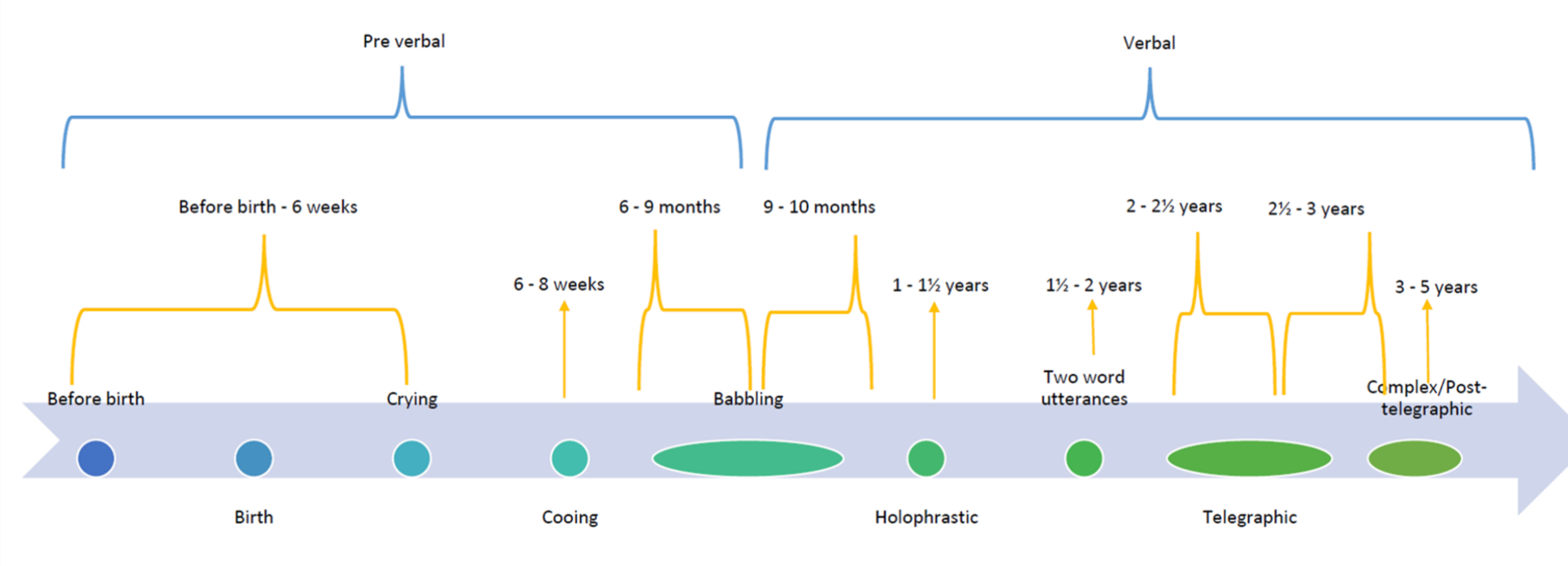
Pace of development in children:
Children do NOT develop at the same pace.
They DO pass through the same stages of development, and there is a universal pattern of development regardless of the language being aquired.
Before Birth:
There is evidence to suggest that even in the womb growing babies acclimatise to the sounds of their native language.
Mehler 1984: newborn French babies were able to distinguish French from other languages.
Pre-verbal stage:
First few weeks - the baby expresses themself vocally though crying.
Signals hunger, distress or pleasure.
Instinctive noises - not a language.
Cooing:
Starts from 6-8 weeks.
Open mouth vowel sounds eg ‘ooh’ or ‘aah’ (monophthongisation)
Baby develops increasing control over their vocal cords.
Babbling:
Most important stage in the first year.
From 6-9 months
Sounds begun to resemble adult sounds more closely
Combination of vowels and consonants - eg ‘ma’ ’pa’ ‘da’
Bilabial sounds most common eg ‘p’ and ‘b’
Repetition of these sounds = reduplicated monosyllables eg ‘googoo’ ‘gaga’
These sounds have no meaning but the baby makes far more noise than before. They exercise and experiment with articulators - parts of the body that make sounds.
Vowels vs Consonants:
Vowels - no constriction of airflow
Consonants - constriction of airflow
Phoneme
The smallest element of sound of a language that displays contrast and hence changes meaning or function of a word, eg initial sounds in ‘Ban’ and ‘Dan’
ENGLISH HAS 44 PHONEMES
Phoneme Expansion:
During babbling the number of different phones produced increases - expands
Phoneme Contraction + evidence
9-10 months. Number of phonemes produced reduces - contracts- to those in the native language.
Child discards sounds not required.
The noises made by children of different nationalities start to sound different.
Native adults have successfully identified babies from their own country
Intonation:
Patterns of intonation begin to resemble speech
Variations in rhythm/emphasis suggest greeting or calling
Common: rising intonation at the end of utterances
Gestures
Although they do not yet have the power of speech, the desire to communicate is indicated through gesture eg point at something f and use facial expressions ‘What’s that?’
Beginnings of development of pragmatics eg understanding that social context affects meanings - paralinguistic features and non-verbal communication.
Understanding:
Although they do not yet have the power of speech, they might understand the meanings if certain words.
Common: names, ‘no’ and ‘bye bye’
Word recognition -usually evident by the end of first year
Words:
‘A stretch of sounds that expresses a concept’ - Pinker
Sounds that relates to an object in the world.
But it is only when the sound is related directly or consistently that it is a real word.
Referent
A person or object in the real world to which a sound consistently relates.
Words and their system:
Words have to be memorised because they cannot be generated by rules.
They are part of a system of language that uses rules and memory to create meanings.
Words have to be learnt from scratch because there is no obvious link between most words and their referent.
But words meanings have something like a rule-governed system underlying them eg tense, plurals etc
Proto-words
Sounds that resemble actual words but are not consistently applied to their referents.
Typical qualities of first words
Bilabial
Interactive
Concrete or proper nouns - sensory, stimuli, easily understandable.
Number of words learnt at
18 months, 2 years and 3 years
18 months - 50 words they can say although they will understand many more than this!
2 years - 200 words
3 years - 2000 words
They learn an average of 10 new words a day!
Categories of first words: NELSON
Naming - usually nouns. These are most common and the largest category, make up 60% of children’s first 50 words
Action - usually verbs
Social - interaction eg ‘hi’
Modifying - adverbs, adjectives, possessive pronouns, determiners etc
What is the impact on context and environment on first words?
Variation in first words depends on environment, may differ due to context. Eg child in the city - ‘car’ ‘shop’ child in the countryside ‘tractor’ ‘field’.
Referential vs Expressive children
Referential - early words are largely nouns
Expressive - early words are largely action or social
Holophrase
A one word utterance that is used to communicate more than the one word on its own eg ‘joo’ - juice could refer to labelling, reaction, request etc
Holophrastic stage
The one word communication stage.
It is only when the children move onto the two word stage and behind that holophrases die out.
Over extension
Children often extend the meanings of words until their vocabulary is sufficient to express a wider range of concepts. e.g. referring to all round fruit as ‘apple’. This is very common.
Under extension
Children often narrow the definition of word’s meanings. e.g. another child’s teddy bear may not be labelled as ‘teddy bear’.
Rescorla: Types of over extension
CATEGORICAL OVER EXTENSION
Children often extend a label to other things that belong in a similar category. e.g. using ‘apple’ to describe all other fruit. This is the most common form of over extension.
It is only when a child has picked up other objects within the category that the overextensions start to disappear
Rescorla: Types of over extension
ANALOGICAL OVER EXTENSION
This is related more to the perception and function of an object. e.g. a scarf is called a ‘cat’ when a child strokes it.
Rescorla: Types of over extension
MISMATCH STATEMENTS
These are statements that convey some form of abstract information. e.g. doll when referring to an empty cot.
This may appear to be a complete mislabelling of the object, but it actually links to the fact that the doll is usually found in the cot.
When are semantic error such as over and under extension most frequently found? How else can children understand what words they don’t know mean?
These semantic errors are far less frequent in naming than in understanding. e.g. a child might refer to several different animals as ‘dog’ but will often be able to identify a dog when shown pictures of those same different animals.
Children have been shown to understand new words by working out what they DON’T mean, in order to determine what they DO.
Aitchison’s 3 stages for how children acquire words and their meanings:
LABELLING
Associating sounds with objects in the world around the child
Linking words to things
Understanding the concept of labels.
Aitchison’s 3 stages for how children acquire words and their meanings:
PACKAGING
This is the stage during which over and under extensions are most frequent
Starting to explore the extent of the label
Aitchison’s 3 stages for how children acquire words and their meanings:
NETWORK BUILDING
Making connections between the labels developed
Understanding similarities/opposites and relationships/ contrasts
Aitchison’s 3 stages for how children acquire words and their meanings:
EXAMPLE:
Labelling - attaching the label ‘cat’ to a particular animal
Packaging - establishing what makes this animal a cat as opposed to a bird. e.g. fur, size etc
Network Building - Making connections between ‘cat’ as a label and ‘cat’ as a type of animal
Order of vowel and consonant acquisition:
The order in which vowels and consonants are acquired varies from child to child. Sometimes children will appear to have mastered a sound in one words, but then not in another.
General trends in vowel and consonant acquisition
2.5 years - all vowels and 2/3 consonants acquired
4 years - difficulty with only a few consonants
7 years - confident use
What is the effect of the position of consonants and frequency on language acquisition?
Position of consonants - consonants are first used correctly at the beginnings of words. Consonants at the end of words presents more difficulty - e.g. ‘Push’ vs ‘riP’
Generally sounds which occur frequently in a large number of words will be acquired before sounds that occur less frequently.
PHONEMIC SIMPLIFICATION:
Deletion
Final consonants may be dropped e.g. ‘walkin’
Unstressed syllables are often deleted e.g. ‘nana’
Consonants clusters are reduced e.g. ‘ky’
PHONEMIC SIMPLIFICATION:
Substitution
Easier sounds are substituted for harder ones.
EASIER CONSONANTS - Bilabial - /b/p/m/v/f/ Plosives - /b/p/t/d/k/g/
HARDER CONSONANTS - Affricates - /ch/g/ Fricatives - /f/v/th/th/s/z/sh/zj/h Dental - /th/th/ Approximants - /r/
PHONEMIC SIMPLIFICATION
Assimilation:
Substituting for a sound already in the word eg ‘babbit’
Berko and Brown
The Fís Phenomenon:
Children understand what they are trying to say before they can actually say it - comprehension appears before application
Child: fis
Adult: is that your fis
Child: no it’s my fis
Adult: oh it’s your fish
Child: yes my fis
Children with indistinguishable pronunciation of mouse/mouth, card/cart and jug/duck could point to the corresponding picture in a comprehension task.
Intonation and Phonology
As a child grows older, a wide range of meanings is expressed through intonation. E.g. ‘my car’ vs ‘MY car’
Although intonation patterns can be reproduced from an early age, understanding of their meaning is still developing into the teenage years
Cruttenden 1974
Football results
Intonation used in the first teams score enabled adults to accurately predict home win, away win or draw.
Children were largely unsuccessful and older children were significantly less successful than the adults.
Recasting
When a caregiver repeats something in a more developed or standard way - to model language rather than correct it.
Morpheme
Smallest unit of grammatical meaning. E.g. ‘talk’ and ‘ing’
Free morphemes
These are morphemes that can carry meaning on their own. Children therefore acquire these first before adding bound morphemes e.g. ‘cat’.
Bound morphemes
These can only carry meaning when combined with a free morpheme. Two of the most common and therefore quickest to acquire are the present regular tense ending ‘ed’ and the plural ‘s’.
How does a child’s ability to learn and apply bound morphemes support Chomsky’s theory?
A child’s ability to learn and apply bound morphemes demonstrates that their language development involves more than simple imitation.
This supports Chomsky’s idea that a children possess a universal grammar, especially when they apply rules through overgeneralisation.
VIRTUOUS ERROS - ROGER BROWN
What do Virtuous Errors show?
A child’s errors actually increase once their deductive processes improve and they make virtuous errors.
E.g. a child applies the regular past tense ending ‘ed’ to an irregular verb e.g. ‘I swimmed’
This is virtuous because it signals that they did not simply copy words, instead they have learned a rule and then overgeneralised it instinctively. They haven’t grasped exceptions yet.
They understand the basic grammar rules of their native language.
Inflection Bound Morphemes + examples:
They change the grammar of a word without changing its word class or meaning
Progressive verb endings e.g. ‘ing’
Prepositions ‘on’
Plural endings ‘s’
Possessives ‘s’
Determiners ‘the’
Regular past tense endings ‘Ed’
3rd person singular regular present tense ‘s’
Derivational bound morphemes + examples:
Change the word class or meaning of a word
E.g. ‘help’ - ‘helpFUL’, ‘helpLESS’ ‘UNhelpFUL’ these are bound derivational morphemes.
The Wug Test - JEAN BERKO
Tests children’s use of the plural ‘s’.
When faced with an image of an imaginary animal called a ‘wug’ children tended to create the plural ‘wugs’ instinctively.
AFFIXATION
Conversion, compounding and what it shows:
When children instinctively apply beginnings (prefixes) or endings (suffixes) to words to create new ones e.g. ‘jammy”
CONVERSION which is using a word as a different word class eg ‘I JAMMED the bread’
COMPOUNDING which is joining words together into new combinations eg ‘horsey-man’.
These are not imitated, they demonstrate that the child has learned how words are used together grammatically and are playing with new word formations.
Two word stage
Stage where children are able to put two words together and rapidly increase their range of communication.
Common word combinations
Subject+verb, subject+object, verb+object, adverb+verb, noun+noun etc
Lexical words
Words that make sense on their own. Only or the majority of the time appear in the holophrastic, two words or telegraphic stages.
E.g.
Nouns - subjects or objects
Verbs - main verbs
Key modifiers - adverbs, possessive determiners, adjectives
Pivot words - George Bruine
Describes children’s pattern of using key certain words in two word utterances. These combine with open words e.g. “allgone milk” with “alllgone” as a pivot word.
Telegraphic stage
Utterances with three or more words where lexical words are used while grammatical word are not.
Lexical words include
Nouns - subjects and objects
Verbs - main verbs
Pronouns
Modifiers - adjectives, adverbs and some determiners e.g. ‘the’
Post-Telegraphic stage
Stages in a child’s development when grammatical words appear and clauses begun to be linked together with conjunctions. Adding greater complexity to a child’s expression.
Grammatical words
Include
Conjunctions - and, but
Prepositions - with, in
Auxiliary verbs - am, have been, will
Modal verbs - could, should
Determiners - the
Questions - Bellugi and McNeill:
Stages that children progress through as they apply rules and develop the creation of questions:
Use of intonation at the end of an utterance to signal a question.
Use of question words e.g. ‘why?’ ‘What?’
Manipulation of word structure - syntax - to create longer and more detailed questions e.g. ‘Could I please have?’
Negative formation - Cristal
The 6 stages:
Using negative words on their own - ‘no’
Combining a negative word with other words, usually at the beginning of an utterance - ‘no bed’
Using the negative in the middle of an utterance - ‘me no want’
Increased accuracy of negative words - ‘I don’t want it’
Increased complexity or range of negative words - ‘It hasn’t got better’
Implying a negative - ‘It might be better if.’
Gestalt expressions:
Children are prone to use Gestalt expression in the early stages.
These are expressions which group words together into unsegmented chunks e.g.’wassat’
Because children in these stages have not developed reading yet, they do not always acknowledge that linked sounds belong to separate words.
This is because adults often use elision for such expressions e.g. ‘innit’