Performance Management (W9)
 Call Kai
 Learn
Learn Practice Test
 Spaced Repetition
 Match
Match Flashcards
 Knowt Play
1/56

There's no tags or description
Looks like no tags are added yet.
Name | Mastery | Learn | Test | Matching | Spaced | Call with Kai |
|---|
No analytics yet
Send a link to your students to track their progress
57 Terms
What do we mean by performance?
Defined as a complex, multidimensional construct that combines employee behaviours such as effort and initiative, and collaboration with tangible outcomes such as productivity, quality, and achievement of objectives.
It is not just about meeting or exceeding targets
It is about the quality of work and the behaviours used to achieve it
It is a multidimensional, complex construct (Campbell,1990)
What are the 2 ways in which performance can be interpreted?
Satisfying/reaching requirements
Exceeding requirements/ excellence
What does performance also involve?
“Getting things right”/doing the job well
Task proficiency- performing core duties correctly
Consistency and reliability- doing the job well over time
Efficiency and quality- completing work effectively with minimal errors
what did Campbell (1990) say about performance?
Performance is a complex,multidimensional construct.
Campbell argued that performance consists of several different behavioural components not just outcomes.
How can we define performance management
It is a strategic,integrated approach that consists of a set of holistic practices such as setting goals/objectives, monitoring performance, providing feedback/revaluation where organisational success is achieved through the alignment of individual objectives with organisation objectives.
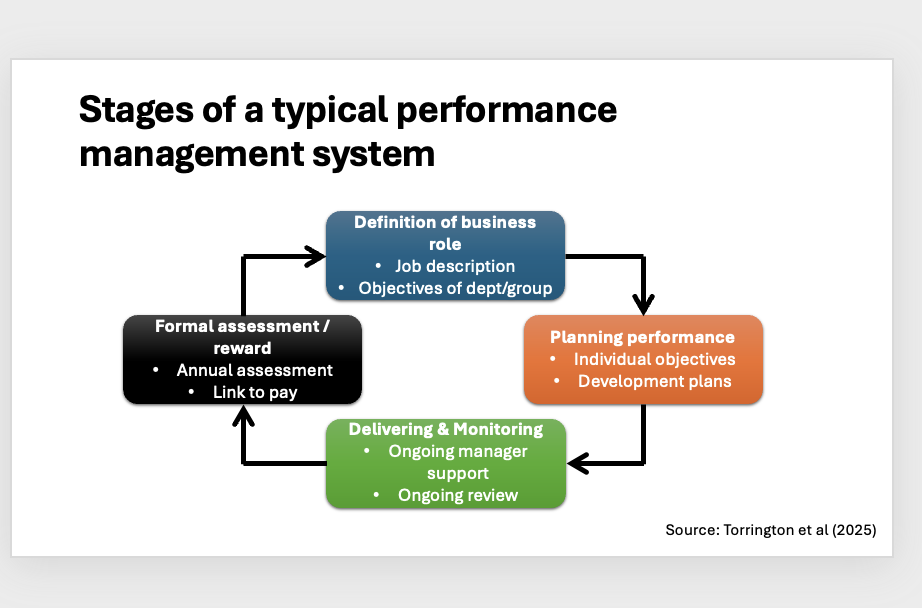
What are the stages of a typical performance management system?
What is the central idea of goal setting theory (locke,1968)?
Specific and challenging goals lead to higher levels of performance than vague or easy goals.
How important is goal setting to performance management?
Goal setting is a key foundation of performance management.
What did Latham and Locke (1979) say about goal setting theory?
Pursuing goals motivates superior performance through clear goals providing direction and purpose and challenging but achievable targets
Employees will change/adapt behaviour to achieve goals (if they are realistic)
Feedback improves motivation
Rewards and recognition reinforce effort
How easy is it actually to set goals?
We may not be able to set clear goals
Objectives may be numerous or diverse
Strategy and therefore goals need to be dynamic
Individual vs team tensions
Encourages a short term focus
Why do performance management systems rely heavily on goal setting theory?
Because it suggests that, clear challenging goals align with employee behaviour organisational objectives and motivate higher performance.
Goal setting works as a motivational mechanism that links organisational strategy to individual behaviour and performance.
What happens if we can set clear/specific,challenging goals
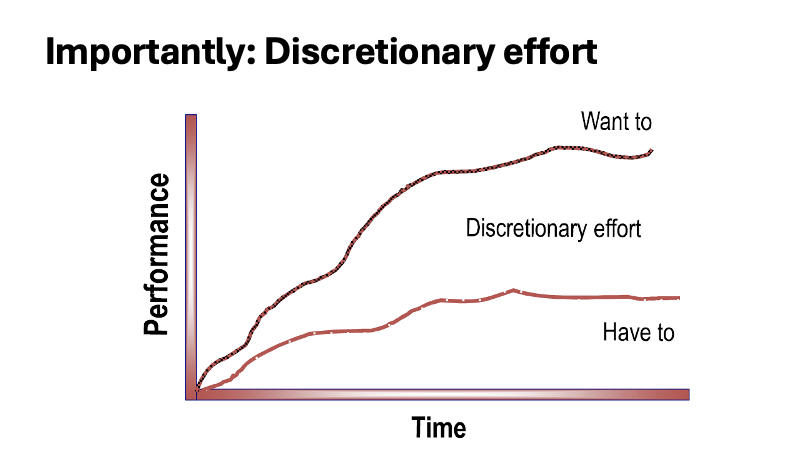
Increased discretionary effort
This is because clear goals help people understand why their work matters
Clear goals provide focus and direction, people know exactly what they are aiming for
Clear goals provide motivation through challenge
Why does performance management go wrong?
Poorly set goals- they are unclear, too vague or unrealistic
Overemphasis on measurement
Bias and subjectivity- managers may favour certain employees
Infrequent feedback
Managers may lack the appropriate skills
Should Performance Management systems require adaptation to the new world of work?
YES
Work is more flexible and remote
work is faster and more dynamic- need for continuous feedback
Modern work is more collaborative than individual
What are the challenges when it comes to performance management?
Inconsistent evaluation standards- different managers may judge performance differently
Bias in appraisals- personal bias can influence ratings no matter good or bad
Maintaining legitimate oversight/control
Unclear or poorly defined objectives- Employees may not know what ‘good’ performance looks like
Lack of regular feedback
Employee resistance
Poor manager training
What is the definition for performance appraisal?
Performance reviews aim to inform administrative decisions (such as pay, bonuses, promotions or redundancy) and/or to support professional growth.
It is concerned with the assessment or measurement of performance.
What are the objectives of performance appraisal?
Part of the planning and control function
Monitor performance
Motivate improvement
Clarify where an employee “contributes”
Assess areas for learning and development
Standardise employee feedback
Provide a basis for pay/progression decisions
What are the criticisms of traditional methods of performance appraisal?
In a fast moving world is it appropriate to discuss performance once or twice a year?
Goal setting is valuable but must not be one size fits all
Considerable variability in quality of appraisal discussions and feedback given
Perceived fairness of process/system is vital
How do we manage underperformance?
Identifying what the performance “gap” is
Communicating performance standarda
Comparing “actual” and “planned” performance
Applying corrective action
Recognise that an organisation can depend on its “average” performers
Is performance appraisal the same as performance management?
NO
it is part of performance management but it is NOT the same thing
how did armstrong define performance management?
It is a strategic and integrated approach
improves the performance of people in the organisations by developing the capabilities of teams and individual contributors.
Summarise briefly the term performance.
It is a complex combination of behaviours and outcomes, involving meeting and exceeding job requirements, and cannot always be fully quantified.
Is performance management a single activity?
NO, it is a holistic set of practices. Which includes setting objectives, monitoring performance, providing feedback and linking outcomes to rewards
Explain goal setting. (first step of holistic practices)
Organizations set individual and team objectives aligned with overall business strategy
Ensures employees are working toward shared organizational goals
How does performance management show improvement?
It focuses on continuous development, not just evaluation.
Highlighting weaknesses and where to improve them
Training and coaching is required
With performance management are employees held responsible for their performance?
Yes, depending on results, there may be:
Rewards for strong performance
Support or improvement plans for underperformance
Disciplinary action if performance does not improve
What are the core principles of the goal setting theory?
Specific goals improve focus and clarity- Employees know what they are trying to achieve and what to prioritise
Challenging but realistic goals increase effort and persistence- they require individuals to work harder while maintaining belief in success
How does goal setting motivate performance?
Directs behaviour as it tells employees what to do and what to prioritise, provides a sense of purpose and focus
Encourages effort and persistence as challenging goals push employees to work harder and stay committed
Drives behavioural change as employees adapt their behaviour to meet goals
Links individual and organisational goals - organisational goals are translated into individual targets
What are some examples of how employees may adapt their behaviour when it comes to goal setting theory (Locke,1960)
Develop new skills
Improve communication
Collaborate more effectively
Improve time management
What are the strengths of goal setting?
Improves the motivation and productivity of employees- having a specific target makes it easier to stay motivated
Provides clear direction - goals give you a target to aim for which helps focus your time.
Improves performance- people perform better with specific, challenging goals
Makes progress measurable- clear goals let you track performance
Boosts confidence and satisfaction- achieving goals boosts confidence and sense of accomplishment
What are the limitations of goal setting?
Not all performance is easily measurable; there may be difficulty in setting clear goals
Multiple and diverse objectives- can reduce clarity leading to confusion over priorities
Individual vs team tensions- creates misalignment between objectives
Overly rigid goals may reduce creativity and flexibility
Unrealistic goals can demotivate employees
May encourage short term focus over long term development
is goal setting a short term or long term focus?
May encourage short-term focus over long-term development
How can we address and work on the limitations caused by goal setting?
Combine goals with regular feedback - use continuous feedback instead of only end-of-year reviews
Ensure goals are realistic and flexible - unrealistic goals reduce motivation
Involve employees in goal setting- increases ownership and motivation
Use a mix of quantitative and qualitative goals
What have critics said about performance management?
Bias- manager evaluations can be influenced by personal bias leading to unfair ratings
Annual reviews are outdated- too infrequent in fast changing work environments
Demotivation- performance reviews can feel stressful, judgemental or like a tick box exercise
Damages trust- employees may feel as if they are being constantly judged
excessive control
It should shift toward continuous feedback, coaching and development-focused systems instead.
What are the arguments for performance management?
Aligns individual goals with organisational strategy, improving organisational performance (aka goal setting theory)
Provides clarity and direction as employees know what is expected of them, improving focus and efficiency
Enhances motivation and effort as feedback + rewards drive effort
Supports employee development - identifies skill gaps and provides continuous feedback, encourages training and learning
Encourages behavioural adaptability
What are the arguments against performance management?
Bias and subjectivity- managers may introduce bias into evaluation leading to inconsistent or inaccurate assessments
Demotivation of employees- performance management can feel like constant criticism or evaluation
Resistance from employees as they may perceive it as control rather than support
Tensions between individual objectives and team objectives
Often poorly implemented- seen as a tick box exercise, may be lack of manager training
What are the problems with performance appraisal interviews?
Subjective and bias as managers may be influenced by personal relationships
One off and infrequent
Employees may feel judged rather than supported
Poor quality feedback as managers may not be trained properly
What are the reasons for underperformance?
A lack of skills or knowledge
Personal problems (health or relationship issues)
Poor engagement, commitment or motivation
How is communication a challenge for performance management?
There must be a clear 2 way communication between managers and employees.
Objectives may not be clearly explained
Feedback may be unclear, inconsistent or too frequent
Employees may not understand expectations or how they are being evaluated
How can managers combat poor communication?
Clear objectives (SMART objectives)
Continuous feedback (regular reviews instead of annual)
Healthy working environment where employees feel like they can ask questions and respond
How is maintaining legitimate oversight seen as a challenge to performance management?
Managers need to monitor and control performance appropriately, but in a way that is seen as fair and justified.
too much management- micromanagement
too little monitoring- loss of control
employees may feel distrusted or surveiled
Explain what is monitoring in performance management?
Continuously measuring and comparing actual performance against targets using appropriate metrics, enabling managers to identify deviations and take corrective action.
Measuring performance using KPIs and targets
Compare actual results with set targets
Must occur continuously
Why is monitoring important?
Because it tracks progress toward goals and ensures employees stay on target.
This means managers can identify problems and provide timely feedback
Employees can then adjust their behaviour before poor performance becomes serious
What are the potential issues that could arise from monitoring?
Too much monitoring- micromanagement/stress/demotivation
Too little- loss of control
What is feedback?
Feedback is the communication of performance information to employees, aimed at reinforcing good performance and improving weak performance.
Why is feedback important in performance management?
Motivates employees
Helps improve future performance
Builds understanding and clarity
What are the potential issues that come from feedback?
Poor quality or vague feedback- makes it hard to improve if you don’t know how
Too infrequent- if feedback happens annually it becomes outdated
Too negative - reduces morale
Bias- feedback may reflect personal opinions
Why must performance management be adapted to the “new world of work”
Work is more flexible and remote
Work is faster and constantly changing
Work is more collaborative than individual based
Should we totally remove performance management in the new world of work?
NO, as the core principles of performance management remain essential, meaning adaptation rather than complete replacement is necessary.
Organisations still need accountability
Ensures employees’ work supports wider strategy
Pay,promotion and incentives often rely on performance information
How effective is performance management?
Only effective to the extent that it is implemented as a meaningful and continuous process rather than a bureaucratic tick box exercise. When organisations rely on rigid, annual appraisal systems, performance management becomes ineffective as goals and organisational priorities evolve throughout the year. Therefore continuous feedback and adaptive goal setting are essential for maintaining its relevance and effectiveness.
If clear goals are linked to rewards or recognition are employees willing to go above and beyond?
YES, they are willing to go beyond expectations.
When setting goals do they only improve focus?
NO, they don’t just improve focus they direct effort toward relevant tasks & increase persistence.
goals ensure employee behaviour matches company strategy, is the statement true or false?
TRUE
What makes performance related pay work well?
Rewards high performers
Can motivate effort and productivity
What makes performance related pay break down?
Measuring “performance” is often subjective or biased
Can encourage short term thinking or unhealthy competition
Employees may only focus on certain tasks and not others
How do we structure each paragraph for the essay?
Provide a balanced argument for each paragraph
When discussing points for performance management also give a critique
do we add conditions in our essay?