cognitive development and sociocultural approaches
 Call Kai
 Learn
Learn Practice Test
 Spaced Repetition
 Match
Match Flashcards
 Knowt Play
1/59

There's no tags or description
Looks like no tags are added yet.
Name | Mastery | Learn | Test | Matching | Spaced | Call with Kai |
|---|
No analytics yet
Send a link to your students to track their progress
60 Terms
what is learning
A relatively permanent change in an indivs behaviour
Changes in the amount or type of knowledge we have or the way in which we reason with the world
Dif theories place different emphasis on the indiv or the context
what is cognition
Cognitive psychology is dedicated to examining how people think
Cognitive processes include thinking, knowing, remembering, judging, and problem solving
how do we learn
Different theories attempt to explain how we learn
Different approaches in developmental psychology use different techniques to understand processes of learning and cognition
explain cognitive development
Mental processes of knowing, including aspects such as awareness, perception, reasoning and judgement
Mental processes that include memory, producing and understanding language, learning, reasoning, problem solving, thinking
who is jean piaget
1896-1980
Born in switzerland
Avid reader with wide interests - biology, philosophy, psychoanalysis
By the early 1960s Piaget’s theory of cognitive development dominated the study of child development
1969 - given APA distinguished scientific contribution award
whats piagests infleunces in early biology
P gained a phd for his study of mollusks
Can mollusks accommodate to a new environment
They did adapt
They reproduced and P argued that the accommodation changed the internal structure of the mollusks, and this change was passed down to the next generation
Biological theory is prominent in P studies of children
explain the connection between piaget and genetic epistomolgy
Interested in genetic epistemology, how do we come to know something
Experimental epistemologist - rejected the armchair approach for empirical data
Knowledge is a process rather than a state
Believes is ‘readiness’ kids can only learn something when ready
explain the connection between piaget and constructivism
The fundamental problem with the behaviourist approach was that it characterised learning as passive
Constructivist approaches - we construct new understandings of the world based on what we already know
Children construct their own knowledge
Actively select and interp info
Active agents and ‘little scientists’ - influences on early education ‘sand’ , ‘water’, exploration
explain the connection between piaget and structuralism
Set of mental operations underlie thinking
Infants cognitive structures are ‘schemes’
Scheme is a basic unit of understanding
Cognitive structure that form the basis of organising actions and mental representation so that we can understand and act upon the environment
what methodology did piaget use
observation
classification
clinical method
interested in mistakes
manipulation of objects
experiments
baby diaries
what are the three basic schemes babies are born with
sucking, looking and grasping.
reflective actions that can be performed on objects
explain scheme development
Action schemes we are equipped with at birth develop and multiple
Descendants of early schemes come to form intelligent through processes
schemes adapt and evolve
Schemes may be coordinated or brought together to perform complex actions
what are piagets key conceppts
Equilibrium - disequilibrium/adaptation - equilibrium
Assimilation - the process whereby a new idea is understood in terms of schemata that child already possesses
Assimilation is applying an existing scheme to a novel task
Accommodation is modifying a scheme to adapt to a new application
explain equilibrium - disequilibrium / adaption - equilibrium
E.g child says dog in front of family and everyone claps and awards behaviour as they've gotten it right (child enter equilibrium) the behaviour is continued in front of other adults who award this behaviour (maintaining equilibrium) child knows what a dog is but may not know what animals are not dogs, so again they may now call a sheep a dog, expecting to be rewarded but when they are not they enter a state of disequilibrium.
what are the stages of piagets cog development
Sensorimotor
Preoperational
Concrete operations
Formal operations
what are piagets understanding of cog development
Each stage allows a different form of interaction between child/environment
Stages must proceed in a linear order
Stages are universal
Regression is impossible
There are variations in age where stages are expected to be entered and left (like Freud)
Child develops more sophisticated ways of thinking mainly as a consequence of maturation
explain the sensorimotor period
Infants understand the world through their overt physical actions
Move from simple reflexes through several steps to an organised set of schemas
Gain Object permanence - understand that an object still exists even when they cannot see it
explain the preoperational (1)
Roughly 2-7 years
Dominated by Egocentrism - inability to decentre (see the world from strictly your perspective)
‘Collective monologue’ of the playground (they turn take and speak but often not on the same topic)
explain preoperational (2)
Three mountains task (famous experiment of egocentrism)
explain the preoperational (3)
Difficulty with conservation e.g. if a liquid is poured into a glass where it looks like a larger volume they will believe there is more liquid in this glass
preopertional (4)
Semilogical reasoning, they may know what the answer is but now why
explain the concrete operational stage
Once moves past preoperational they move to concrete operational
Logical
Can conserve
Egocentrism shifts
Concrete objects predominate
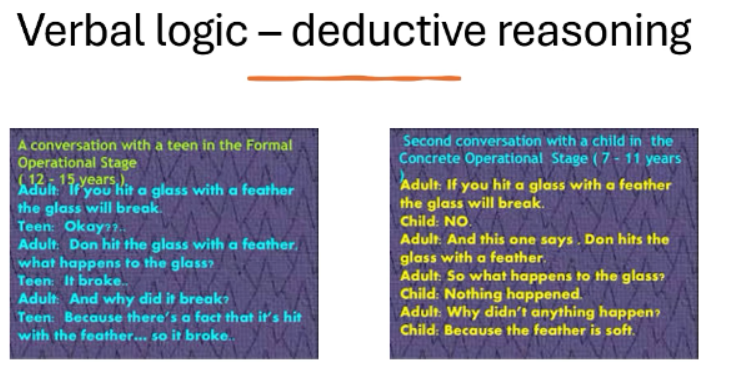
But - difficulty with purely verbal logical statements
Theres a movement away and a new understanding thats there verbal logic that does marry with the real world
image to help understand verbal logic - deductive reasoning
explain the formal operational stage
Mental operations are no longer limited to concrete objects
Can Apply purely verbal or logical statements
Understand what is possible aswell as real
What's in the future as well as present
what are piagets stages of moral development
Stage 1 - moral realism
Stage 2 - moral relativism
explain moral realism
judgements made in the view of the act’s consequence
explain moral relativism
judgements made in view of the actor’s intention
who built on piaget’s model
kohlberg
in what area did kohlberg build on piagets model
moral development
what levels did kohlberg add to moral development
preconventional level - avoid punishment, get rewarded
convetional level - conform to majority norms
post conventional level - indiv. principls of conscience, percpetion of laws based in a social contract
what did piaget believe the role of teaching was
Horticulture analogy
Provide rich, stimulating and supportive environment
Excessive pruning?
Direct instruction can inhibit child’s understanding if it gets in the way of their own exploration
Emphasis on learning to the exclusion of teaching
how has the role of tecahing been applied
Kamil (1994-2004 see wood et al)
Children need to rediscover and reinvent mathematical principles for themselves
Mathematical procedures taught to children inhibit their ability to rediscover and reinvent
Teaching adult conventions can be counterproductive as children are forced to reject their own ways of learning
give an example of the limitation of teaching
classroom maths
Children's preference is to add columns from left to right
Adult procedure is the opposite
Children’s first methods are inefficient, but if they are free to do their own thinking, they invent increasingly efficient procedures
outline the addition experiment
US classroom 8- year old kids
2 conditions - taught adult standard procedures/ encouraged to develop own approaches
Vertical sum tests - no significant difference
Horizontal presentation (more familiar to children)
Results - 45% and 12%
This supports piaget horticulture analysis
what did stafford 2004 do
evaluated the piagetian approaches
what 2 approaches did stafford 2004 evaluate and what did he find
piagetian reasoning task lll pendulum
tradiitional methode clinique
found concurrent validity acorss both tests
what are limitations of piagets techniques
indiv, dif.
Some indivs produced disparate performances across the two setting
PRT lll test conducive to social distractions - ‘she was almost entirely distracted by her male neighbour’
Methode clinique interactive testing situation - ‘his teacher reported that he seemed to experience some difficulty relating to people on a one to one basis’
what are general limitations of piaget
Issues of universalism (he worked with mostly european middle class kids)
Lack of emphasis on social and emotional aspects of development (complete focus on the cognitive)
Underestimation of children's abilities (Donaldson 1984) the three mountains task has been repeated since by other psychologists and they argue if the framing of the questioning is changed slightly, children are not as egocentric as originally believed
Methodological barriers - Piaget’s reporting of his experiments is frustrating to contemporary psychologists - absence of N and demographics
who was Lev Vygotsky
1896-1934
Began working in institute of psychology moscow in 1924
However he drew interest and aligned more with western writers
This was viewed as suspicious and in the 1930s the russian gov accused him of being bourgeoise psychologist
In 1934 he published ‘thought and language’ in russia
But he was blacklisted and after his death between 1936 and 1956 his publications were banned in russia
His work was not available in english until 1962
what was the socio-political landscape like during vygotsky life
Construction of new socialist state
Russian revolution - great social upheaval
Marxism
New soviet view each person was responsible for the hole of society ( pretty durkheim view)
Aligning with marxist theory Vygotsky saw society as having an important influence on the development of the child’s mind
what was the psychological landscape of the 1920s
3 major groups of psychologists in Soviet Union when Vygotsky began his work
Dominant behaviourist group led by Pavlov
Small, non-influential group led by Chelpanov focussing on consciousness
Group led by Kornilov who argues for a synthesis of the two perspectives
what was vygotskys perspective
He rejected all three perspectives
Pavlov’s behaviourism and the introspective psychology championed by Chelpanov both retained the conceptual isolation of mind and behaviour (psychoanalysis too focused on internal processes, behaviourism ignores the individual person instead focuses on social environment as what dictates behaviour) - rene descartes
Kornilov’s attempt to synthesise relied on old concepts
V insisted that a new system of concepts be developed
how was vygotsky influenced by piaget
He was influenced by P but Vs sociocultural theory differed and placed more emphasis on the social
how did vygotsky understand the learning process
For V learning processes cant just be understood by the internality of the individual or just the context
He believed the unit of analysis is the person in action with the context
how did vygotsky understand the indiv and the environment
V emphasised the interrelated roles of the indiv and the social world
Should not separate an event into elements that no longer function as the whole
Impossible to render any domain accessible without reference to another
what research methods did vygostky use
Child-in-activity-in-cultural-context as a unit of study
V and colleagues observed kids activity in a number of experiments in different local cultures
Placed learners in problem solving situations that were above their natural capacities
Provided coloured cards or pictures
Studied the ways learners of different ages struggled or successfully used these aids
Documented changes in learner activity and cognitive functioning
what theory did vygitsky develop
socio-cultural theory
how did vygotsky develop the socio-cultural theory
Dialectical approach - combination of biological and social processes
Higher mental functions and goal directed thought
Any higher mental function was external and social before it was internal (piaget swung in other direction, internal before external for V its always external)
what functions did vygotsky use to conceptualise the mind into
general gentic law
mediated mind
sociocultural tools (the importance of language)
speech and behaviour
zone of proximal development
explain general genetic law
Any function in the child’s development appears twice or on two planes
It appears first between people as an intermental (between minds) category and the within the child as an intramental (within mind) activity
explain the mediated mind
Fundamental premise in sociocultural approaches- human mind is mediated
Humans do not act directly on the physical world but rely on tools and labour activity
Symbolic tools or signs to mediate and regulate our relationships with others
Tools are artefacts created by human cultures over time, passed on generationally
Arithmetic systems, music, art, language (habitus, cultural capital)
ecplain sociocultural tools (the importance of language)
The infant is social and through interaction has a growing awareness of the self and capacity for reflection
Development from the social to the individual through language, discussion and argument become internalised
Language is a tool of thought (and used for problem solving)
With older children, this train of thought would be internalised rather than spoken out loud
explain speech and behaviour
Speech and behaviour interact dynamically and change in relation to development
First speech accompanies action e.g. learning to count
Then speech precedes (goes before) action
The speech displaces action
Speech assumes the planning function
explain the zone of proximal development (ZPD)
V argues that the economic collectivist principle of shared goods runs parallel to socially shared cognition
Adults are responsible for sharing knowledge with children
Zone of proximal development (ZPD) - the difference between what the child can achieve alone and what can be achieved with the help of more knowledgeable others (opposite of horticulture analogy)
Child as an active speaker of knowledge - not a passive receiver (unlike behaviourism)
Learning the zone is possible because of intersubjectivity (through interaction with others and tools)
what is the name of freunds 1990 relevant study
the doll house experiment
outline the doll house experiment
Puppet moving house
Arrangement of furniture into different rooms
There was a practice phase where:
Group 1 = mother supports child throughout the activity
Group 2 = child works alone but experimenter shows correct answer at the end
After the post - test - phase = children in group 1 performed better
Supporting the premise of the ZPD
what is the apprenticeship model
The ZPD is still used today, seen often in group work e.g. mixed ability group
The child’s knowledge develops through guidance - scaffolding - adults guidance scaffolds the childs development and learning, without scaffolding building a house is much harder (jerome bruner)
Development as an apprenticeship (jean lave)
Building bridges between the child’s present abilities and new skills (barbara rogoff)
Construction of knowledge is seen as a fundamentally social activity - a co-construction
Intermental (between minds) - intramental (within mind) (all learning begins in the instrumental plane and then moves to the intramental plane)
why did vygotsky place such a large importance on culture
Thinking is always social and reflects the dyads (containing two elements) culture
Culture flows through adults to children
Cultures have different tools (language)
Cultural contexts e.g. global, local, family, school religion, beliefs, values, knowledges, physical and historical influences
outline key strengths of vygotsky
Attention to social-cultural context
Broader sociohistorical context development
Fluid boundary between self and others (learning is relational)
Specific processes between child and setting - joint operation of forces in the child and in the environment
Integration of learning and development - learning drives development
Sensitivity to the diversity of development - rejects universalism- differences within and between cultures
outline key weaknesses of vygotsky
Ambiguity in some of the work - early death - prevented refinement
Working on the edge of disciplines
Translations difficulties and truncation - references to marx were expunged from the first english language translation
V of the 1970s in the west was not the V of the 1920s and 30s in soviet union (global, political and developmental landscapes changing, he was fitted in much later when his theories aligned better)