WA&M Exam 2
 Call Kai
 Learn
Learn Practice Test
 Spaced Repetition
 Match
Match Flashcards
 Knowt Play
1/77

There's no tags or description
Looks like no tags are added yet.
Name | Mastery | Learn | Test | Matching | Spaced | Call with Kai |
|---|
No analytics yet
Send a link to your students to track their progress
78 Terms
Work motivation research
This discipline tries to explain why people choose to work, how hard they work, and hoe long they persist.
Definition of motivation
Factors or events that energize, channel, and sustain human behavior over time.
Definition of Work Motivation
A set of energetic forces that originate both within as well as beyond an individual’s being, to initiate work-related behaviors, and to determine its form, direction, intensity, and duration.
What motivation influences
Direction (what people choose to do)
Intensity (how hard they try)
Persistence (how long they continue)
Important characteristics of work motivation
Focuses on work behaviors
Motivation itself is not directly observable
We infer motivation from, behavior
Content-Based Approaches of Motivation
Specify the psychological, traits, motives, tendencies, and orientations. Resides within people (inherent/internal factors or acquired factors).
These theories explain internal factors that drive motivation.
—
Key factors:
Motivation originates within the individual
Psychological traits, motives, and orientations shape behavior
These factors create stable preferences for certain goals and actions
—
Need fulfillment: Basic needs necessary for human survival and growth
Intrinsic motivation: Innate psychological needs for autonomy, competence, relatedness
Justice motives: universal desire for fairness
Personality traits
Learning goal orientation
—
Maslow’s needs hierarchy
Self-detemination theory
Equity theory
Context-Based Approaches of Motivation
Focus on features of the environment. In some situations, people feel more (less) motivated
Extrinsic rewards
Task and job characteristics
Group- and team-level influences
—
Job characteristics theory
Job crafting
Process-Based Approaches of Motivation
2 interdependent subsystems: a system governing goal selection and a system governing goal enactment. Goal setting processes increasing motivation.
Expectancy theory
Theory of planned behavior
Self-regulation
Goal setting theory
Need-Based Theories
People are motivated to obtain what they need.
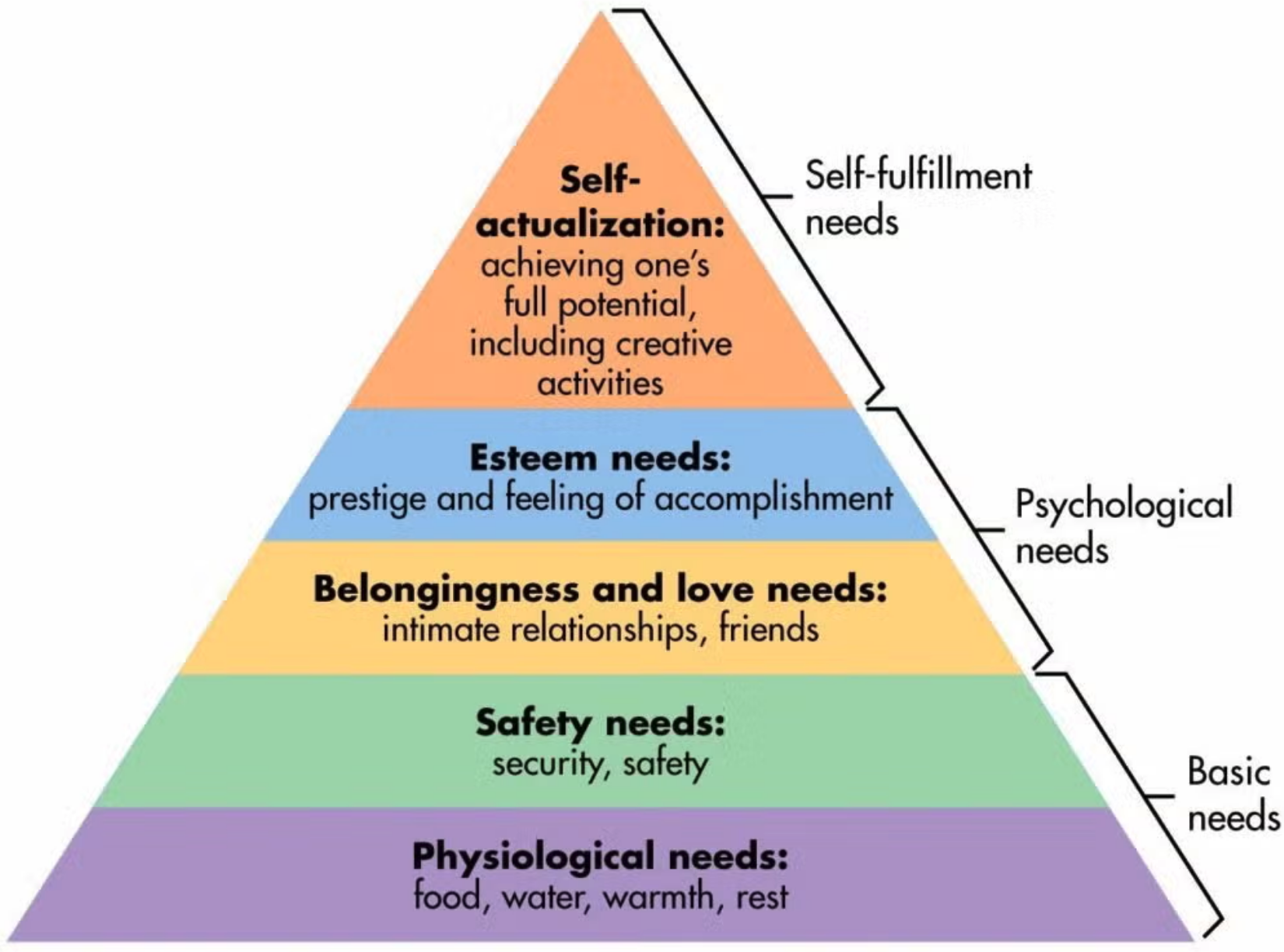
Maslow’s Needs Hierarchy
Universal need-based theory to explain the motivation of purpose-driven behaviors in terms of several needs
Physiological, safety, love, and belonging, esteem, and self-actualization
Rigid progression up the hierarchy beginning with basic needs is most often proposed: prior levels need to be fulfilled before striving for the next need level (however, this is not entirely true)
Although research has not fully supported this hierarchy, the value of this theory is highlighted
ERG Theory
Need-based theory
Focuses on existence, relatedness, and growth needs (compressing Maslow’s 5 levels).
No strict hierarchical progression is built into this model
Research has not strongly supported this explanation of motivation, but ERG has led to additional theories based on need satisfaction
Need for Achievement Theory
Need-based theory
Focuses on the single need for achievement that arises in people’s goal-directed behaviors. Only focuses on self-actualization.
A a personality characteristic, this need appears to influence personal motivation at work and within society
This theory’s specificity makes it more easily applicable within organizations than other need theories
Self-Determination Theory (SDT)
Need-based theory (content-based theory)
An organismic theory suggesting that people inherently strive for growth and their fullest potential
Involves several smaller motivational theories associated with intrinsic personal motivation
Focuses on the degree to which an individual’s behavior is self-motivated and self-determined
Acquiring the 3 basic needs determines motivation
Competence
One of the 3 basic needs according to the Self-determination theory (SDT)
Feeling effective in dealing with environment/activities
Autonomy
One of the 3 basic needs according to the Self-determination theory (SDT)
Having a choice, being able to control the course of own life
Relatedness
One of the 3 basic needs according to the Self-determination theory (SDT)
Feeling connected to others, sense of belonging
Equity Theory
Content-based theory
Based on ideas from social exchange theory
Employees evaluate fairness in the workplace
Comparing ratios:
Personal outcomes/inputs : Others’ outcomes/inputs
Motivation is influenced by perceived fairness
Social Exchange Theory
Assumptions:
Humans tend to seek out rewards and avoid punishments
Individuals begin an interaction to gain maximum profit with minimal cost
Individuals tend to calculate the profit and cost before engaging
Individuals know that this “payoff” ill vary from person to person, as well as with the same person over time
Take the benefits and subtract the costs in order to determine how much a relationship is worth.
Equity (as part of equity theory)
Equity: When your ratio is equal to the ratios of other similar workers
Inequity (as part of equity theory)
Develops when there is a discrepancy
Underpayment — You receive less relative to your inputs → anger, frustration (strongly supported)
Overpayment — You receive more than others → guilt (less consistently supported → people don’t always feel guilt or adjust their behavior; self-serving bias)
Equity Theory
Workers are motivated to resolve discrepancies via multiple strategies:
Increase outcomes
Reduce inputs
Adjust perceptions
Change comparative standard
Withdraw from the exchange
People are not only motivated by need fulfillment and intrinsic drive, but also based on social comparisons.
An employee experiencing overpayment may use the same basic strategies (but people can also be greedy).
Theory shows that motivation is influenced by fairness; employees are motivated not only by needs rewards but also by social comparisons.
Trait-Based Motives
Some motivation theories focus on stable individual differences that influence motivation.
Examples:
Motives
Achievement motive — desire to accomplish difficult tasks and achieve high standards of excellence
Power motive
Affiliation motive
Personality traits
Big 5
Core self-evaluations
Motivational orientations — individuals differ in how they approach goals
Regulatory focus theory — promotion focus, prevention focus
Goal orientation
Promotion Focus (Regulatory Focus Theory)
“I want to achieve the best possible outcome.” “I want to do my best.”
Focus on growth, achievement, and advancement
Motivated by: hopes, aspirations, gains
Typical behavior: pursuing opportunities; taking risks to achieve success
Prevention Focus (Regulatory Focus Theory)
“I want to make sure nothing goes wrong.” “I don’t want to fail.”
Focus on security, responsibility, and avoiding losses
Motivated by: duties, obligations, avoiding mistakes
Typical behavior: being cautious, trying to prevent failure
Learning Goal Orientation (LGO)
Focus on developing competence and mastering new skills. Wanting to do well based on a passion to learn.
People with high LGO tend to:
Use more metacognitive strategies
Be more motivated to learn
Set higher goals
Show greater engagement and persistence
Performance Goal Orientation (PGO)
Focus on demonstrating high ability and gaining favorable evaluations from others
Context-Oriented Theories
Focus on features of the environment that affect motivation and performance, not dispositional factors.
Extrinsic rewards
Task and Job Characteristics (job characteristics theory)
Group- and team-level influences (ex — group loafing, climate, team cohesion, shared team identity, affective commitment, etc.)
Job Characteristics Theory
Job-based theory
Characteristics of a person’ job are key motivational influences on behavior within organizations
Core job dimensions of skill variety, task identity, task significance, autonomy, and feedback
Linked to critical psychological states (experienced meaningfulness, responsibility, knowledge of results)
One’s growth-need strength moderates the relationship between dimensions and psychological states and then outcomes
Parts of this theory have been useful
Process-Based Approaches
Views motivation as comprised of two interdependent subsystems: a system governing goal selection and a system governing goal enactment
Expectancy theory
theory of planned behavior
Self-regulation
Goal setting theory
In organizations, fairness influences:
Motivation
Trust in management
Employee attitudes and behaviors
How do employees judge fairness?
Based on employee perceptions, not objective rules
Key characteristics of justice perceptions:
Fairness perceptions are often subjective and context-dependent
Justice perceptions are based on social comparisons
Injustice is more salient than justice
Fairness perceptions can be egocentric and self-serving
Individuals tend to perceive outcomes that benefit themselves as more fair
Organizational Justice
Overall perception of what is fair in the workplace
Distributive Justice
Perceived fairness of outcomes (how much outcomes are fairly distributed)
Process determining outcome distributions:
Procedural
Interactional
Interpersonal
Informational
Procedural Justice
Perceived fairness of process used to determine outcomes (fairness in process)
Interactional Justice
Perceived degree to which one is treated with dignity and respect
Are there opportunities to form social relationships?
Informational Justice
Perceived fairness, truthfulness, and adequacy of explanations provided regarding decisions or procedures
Work Behavior Outcomes of Organizational Justice
Work Behavior
Higher task performance
More OCBs
Fewer CWBs
Different justice dimensions show slightly different patterns
Outcomes of Distributive and Procedural Justice
More strongly related to task performance
Outcomes of Interpersonal and Informational Justice
More strongly related to OCB
Psychological Outcomes of Organizational Justice
Trust in management
Organizational Identification
Emotional reactions such as anger, guilt, and pride
These reactions can influence behaviors such as turnover intentions, engagement, and cooperation
Outcomes of Organizational Justice: Employee Well-Being and Health
Unfariness linked to:
Burnout
Stress
Mental health problems
Negative emotional states
Organizational Practices that Promote Fairness (5 types)
Address the root causes of perceived justice
Provide opportunities for employee voice
Allow managerial discretion
Build a fair organizational climate
Justice is context dependent
Organizational Practices that Promote Fairness: Address the Root Causes of Perceived Injustice
Managers should focus on identifying an correcting the underlying sources of unfairness, rather than only reacting to employee complaints. Remove the source of injustice
Organizational Practices that Promote Fairness: Provide Opportunities for Employee Voice
Allowing employees to express concern or frustrations can reduce retaliation and negative reactions after unfair treatment
Organizational Practices that Promote Fairness: Allow Managerial Discretion
Strict rules do not always guarantee fairness. Managers who rely only on formal rules may behave less fairly than those who are able to exercise judgement and moral reasoning in their decisions. Increase autonomy
Organizational Practices that Promote Fairness: Build a Fair Organization Climate
Justice Climate: Shared perceptions of fairness within teams
Organizations can promote justice by:
Encouraging fair treatment across teams
Fostering respectful relationships among coworkers
Establishing transparent communication practices
Justice perceptions often develop collectively within teams, not only through individual experiences
Organizational Practices that Promote Fairness: Justice is Context Dependent
Employees from different cultures, teams, or work environments may evaluate fairness differently
Managers should therefore consider context and cultural expectations when designing fairness practices
Training as a Justice Practice
Fairness can be strengthened through training when organizations help employees practice justice in real situations
Effective elements of procedural justice training
Focus on concrete behavioral principles (voice, neutrality, respect, trustworthiness)
Use role plays and realistic scenarios so employees can practice difficult interactions
Allow employees to express frustrations first before introducing fairness principles
Provide simple reminders after training (e.g., follow-up messages, pocket guides)
Align managers with the same training goals
Training Outcomes
Job satisfaction improved
Prosocial attitudes improved
Burnout did not increase
Justice & Culture: Justice perceptions tend to be especially important in countries characterized by:
Effective fairness practices may differ across cultures
Individualism: competitive pay and rewards for individual performance
Femininity: Work-life balance and social recognition
Uncertainty avoidance: fixed compensation and employee participation
Low power distance: ethical leadership and transparent treatment
Organizational Withdrawal
A higher-order construct represented by two behavioral families:
Work withdrawal (lateness, absence, etc.)
Job withdrawal (turnover, early retirement, and choosing to be laid off / voluntary turnover)
Why are withdrawal behaviors a serious organizational issue?
Lost work time
Lower productivity
Overtime or replacement costs (recruitment and training costs)
Increased workload for coworkers
Delays in coordination
Reduced service quality
Lower concentration and effort
Loss of organizational knowledge
Negative signals to coworkers
Withdrawal behaviors may spread socially
5 Potential Models of Withdrawal Behaviors: Independent Forms
Lateness, absenteeism, and turnover have no relationship (not very convincing)
5 Potential Models of Withdrawal Behaviors: Compensatory Forms
Lateness, absenteeism, and turnover have negative correlations. Some work attitudes (such as job dissatisfaction) cause those behaviors but if the person selects one behavior (e.g., lateness), the person does not take the other behaviors (i.e., absenteeism and turnover). (not very convincing)
5 Potential Models of Withdrawal Behaviors: Alternate Forms
Similar negative attitudes may produce different withdrawal behaviors. The specific behavior depends on situational constraints and opportunities (3rd variable)
Examples:
Weak labor market → less turnover
Generous sick leave policy → more absence
5 Potential Models of Withdrawal Behaviors: Spillover Model
Lateness, absenteeism, and turnover are related but does not specify a temporal ordering between them. Claims less occurrence is random but doesn’t seem true
5 Potential Models of Withdrawal Behaviors: Progression of Withdrawal Model
Withdrawal behaviors show small to moderate correlations. They seem to represent a shared withdrawal process
Lateness, absenteeism, and turnover are related and there is a temporal ordering between them. When levels of lateness increases, absenteeism will occur, and then turnover will occur
Lateness → absenteeism → turnover
Most supported model, lateness/absenteeism/turnover follows a strict order
Employee-organization loyalty is weaker than before
Even satisfied employees may leave after an unexpected shock (unfolding model)
Absenteeism
Withdrawal behavior
A lack of physical presence
Cost for organization — loss of production
Presenteeism
Going to work while ill
Attending work while not at full capacity to work can decrease productivity and/or increase other poor behaviors
Cost for organization — less productivity
Factors that Lead to Absenteeism and Presenteeism
Organizational factors: work hours, conflict, support, etc.
Individual factors: job satisfaction, organizational commitment, stress, etc.
Specific health problems
Socio-demographic indicators: gender, age, marital status, children
Past Studies on Turnover
Assumed job satisfaction and organizational commitment most strongly influenced turnover
Low job satisfaction → intention to quit → turnover
Realistic job previews (RJPs) can help minimize decreased job satisfaction
Price’s taxonomy: a broad range of turnover determinants including workplace, labor market, community and occupational drivers
Functional turnover (vs. dysfunctional turnover): “good” vs. “bad” turnover; turnover is not always negative
Contemporary Perspectives on Turnover
Traditional turnover research focused on why individuals decide to leave. More recent research shows that turnover is often less predictable and more socially embedded
Turnover without leaving (e.g., quiet quitting)
Different types of staying (enthusiastic stayer vs. reluctant stayer)
Sudden turnover (unfolding model)
Turnover contagion
Collective turnover
Contemporary Perspectives on Turnover: Turnover Without Leaving
Quiet quitting
Employees do not resign, they reduce discretionary effort
Formal retention does not always mean real engagement
Contemporary Perspectives on Turnover: Different Types of Staying
Enthusiastic stayer vs. reluctant stayer (unmotivated and unengaged. wants to leave but can’t)
Some stay because they are committed
Some stay because leaving is difficult
Some stay because of social or family ties
Contemporary Perspectives on Turnover: Unfolding Model
Employees don’t always leave through a slow dissatisfaction process (traditionally believed to be that way)
Employees may leave suddenly → Shock: An even that causes employees to reconsider staying
Examples:
Conflict with a supervisor
Unfair treatment
Spouse relocation
A shock is not always negative
A better job offer
Family-related reasons
“Unfolding”: The decision process unfolds differently depending on the trigger
Employees may follow different paths to turnover
The model represents multiple turnover patterns
Steps of the Unfolding Model
Shock: A specific even that triggers employees to reconsider staying in the organization (organizational, personal, or external)
Script: A preexisting plan of action for how to respond to a situation based on past experience, observation, or social expectations
Image Violation: A perception that the current situation no longer matches one’s values, goals, or expectations
Satisfaction: A gradual decline in job satisfaction when the job no longer provides desired benefits (e.g., intellectual, emotional, or financial)
Search: The process of looking for alternative jobs and evaluating available options
Decision Paths in the Unfolding Model
A shock triggers an already planned decision to leave
A shock causes a strong value mismatch and immediate quitting
A shock leads employees to compare options before leaving (takes more time to leave)
Dissatisfaction builds over time and leads to quitting (no shock); older perspective of turnover
Dissatisfaction builds over time, followed by job search and quitting (no shock); older perspective of turnover
Contemporary Perspectives on Turnover: Turnover Contagion
Turnover is not only an individual decision but also a social and organizational phenomenon
One employee’s departure can increase quitting among coworkers
Employees observe others leaving and reassess their own situation
Social information and uncertainty reduction play important roles
Example: A respected coworker leaves, and other begin to consider leaving too
Contemporary Perspectives on Turnover: Collective Turnover
Turnover is not only an individual decision but also a social and organizational phenomenon
Turnover can accumulate at the team or unit level
High collective turnover may disrupt coordination and performance
The effects of beyond individual costs
Example: A department loses several employees within a short period
Job Embeddedness