S7: Organism-sediment interactions and benthic succession
 Call Kai
 Learn
Learn Practice Test
 Spaced Repetition
 Match
Match Flashcards
 Knowt Play
1/79

There's no tags or description
Looks like no tags are added yet.
Name | Mastery | Learn | Test | Matching | Spaced | Call with Kai |
|---|
No analytics yet
Send a link to your students to track their progress
80 Terms
What is observed at Cape Cod Bay for organism-sediment interactions?
Sea cucumber (holothurian Molpadia oolitica) produces irregular bottom topography
silt-clay intensively reworked by them (deposit feeders) (fewer suspension feeders)
→ at transition in fauna from inshore sand to deeper water muds
What does Molpadia oolitica do?
Forms cone-shaped faecal mounds that allows:
• high densities of Euchone stabilise there
• intercone depressions
What is sediment resuspension?
Biologically controlled by deposit feeders f
start sediment influx to the floor, then resuspended and cycled to the bioturbated surface
What is the biodeposition cycle?
Invertebrates movement drives this
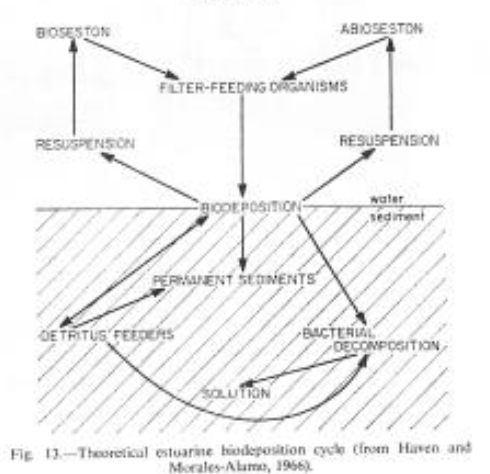
How do fauna influence the sediment
Organism –> sediment –>fluid –> chemical interactions
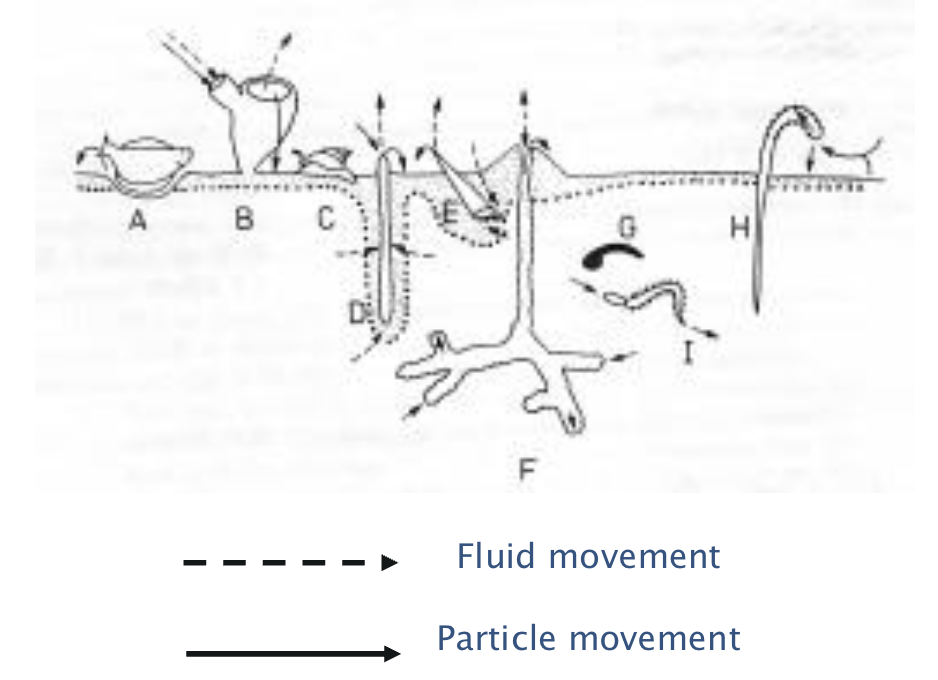
What does tube worm do to intertidal sediments?
Vertically rework sediments and change the vertical distribution of particle size
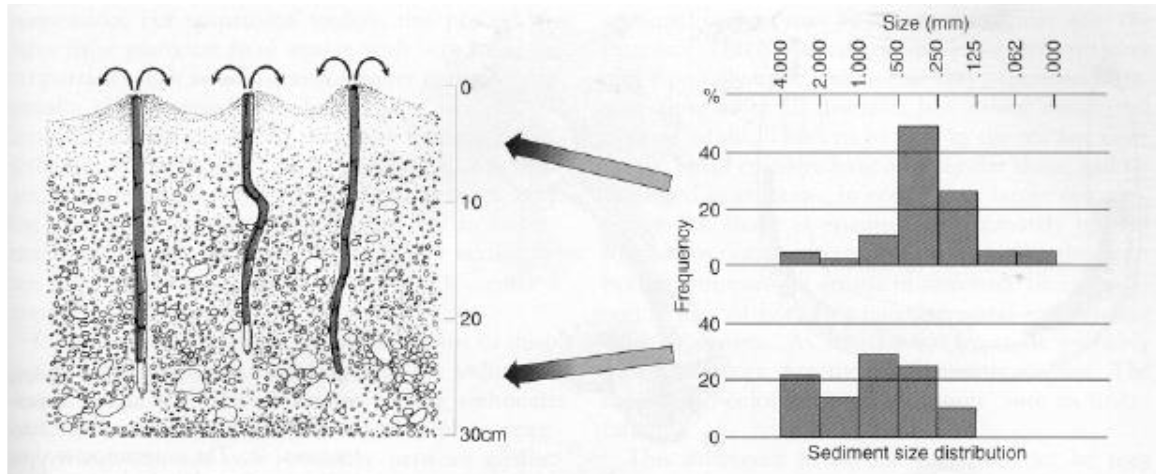
How infauna influence physical, chemical and biological parameters?
Disturbance influence organism reaction….
How physical, chemical and biological parameters influence the infauna?
Tidal sequence
Day and night intervals
influence behaviour
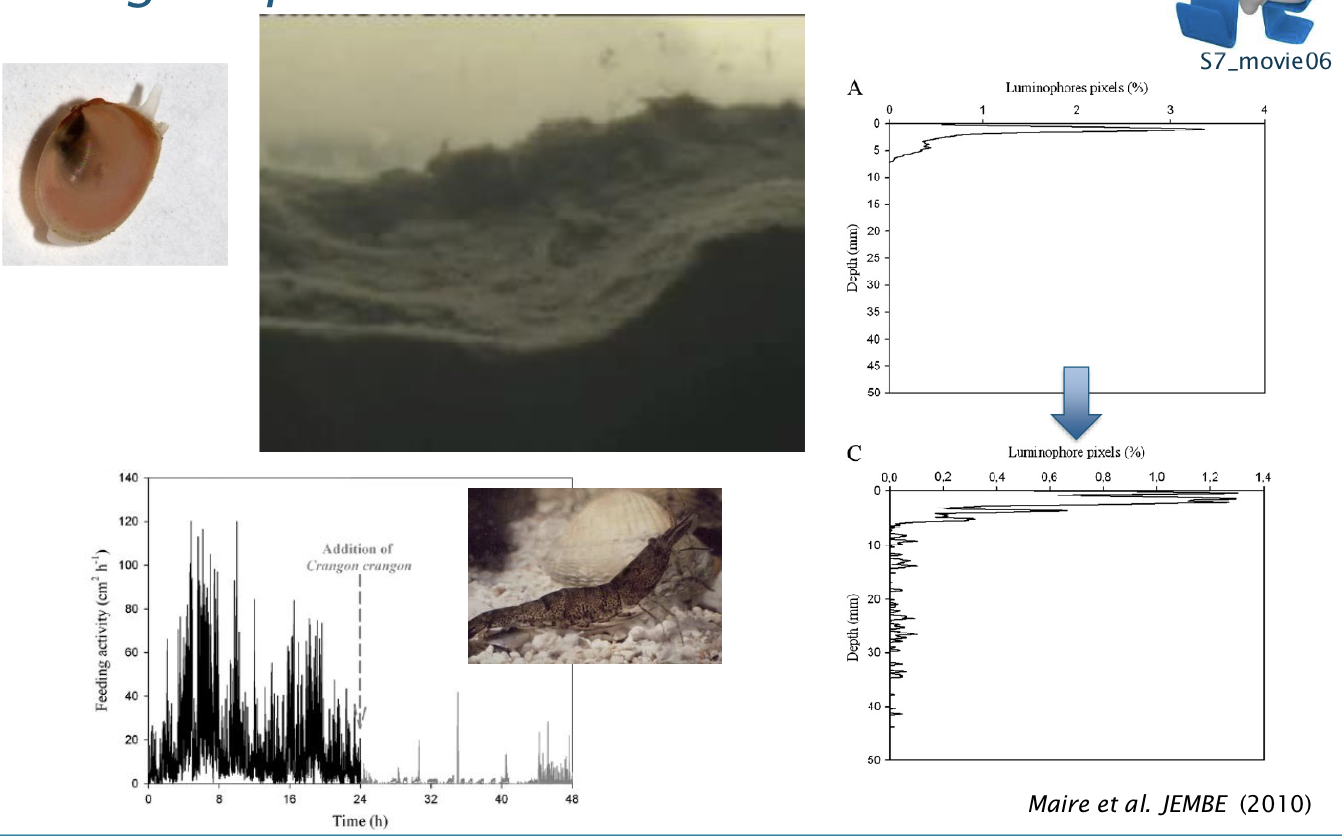
How infauna influence physical, chemical and biological parameters? (krangon shrimp and siphon tubes)
Presence of a predator
For mollusk:
Feeding activity increase when waters in (without krangon)
Feed activity drops when krangon APPEARS
John Gray on organism-sediment relations
Attempted to relate individuals, populations and communities to sediments
1. Selection by larvae or adults of suitable sites
2. Population modifies sediment, in turn leading to temporal and spatial changes in the population
=> both lead to an organism-sediment couple
Conclusion on John Gray on organisms sediment relations
Environment controls viewpoint
Community structure can be related loosely to the sediment composition,
But its exact constitution may be radically altered by interactions between organisms and sediment
Donald Rhodes on organism-sediment relations
Was influenced by in situ observations of fauna, invented SPI
emphasize post-sediment processes
Ecological significance of OSI
A community must be composed of species which interact with each other
and the environment and a community has,=>
therefore, an ecological basis (gray viewpoint)
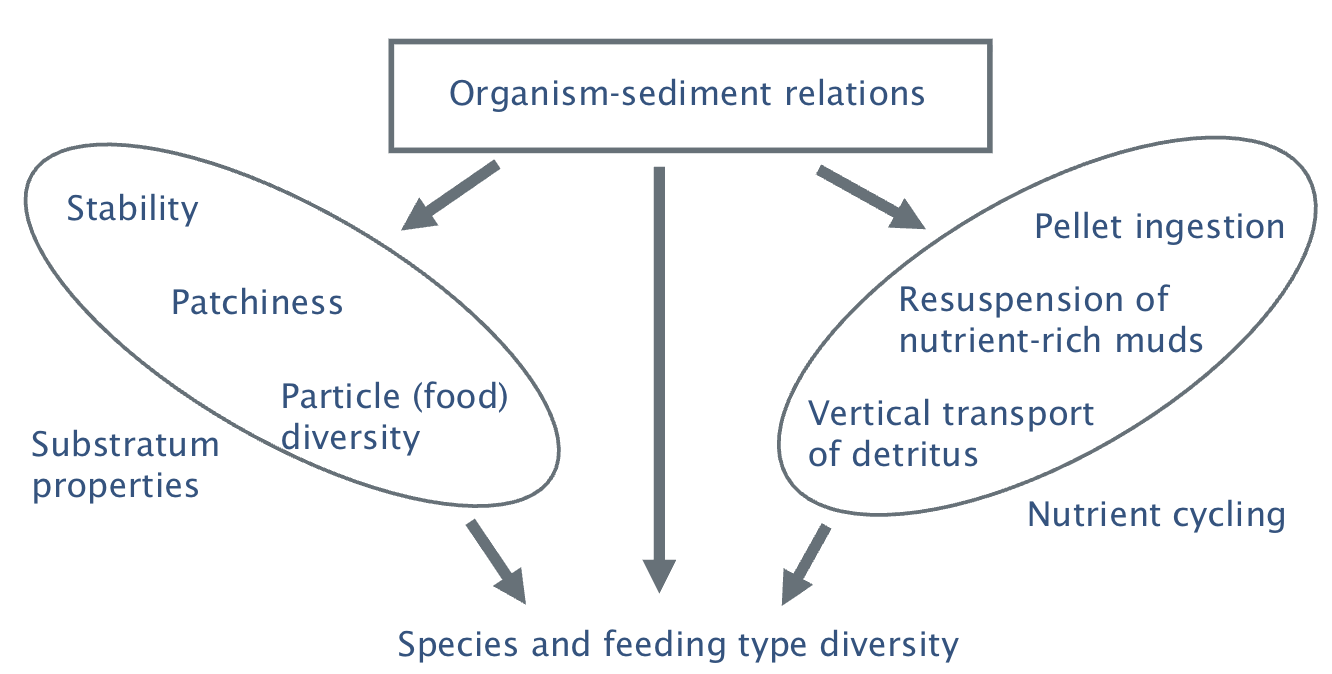
Evidence from environmental gradients
Sequence of communities: Transition from multiple species → 1or2 species
in polluted estuaries in the Skagerak-Baltic region
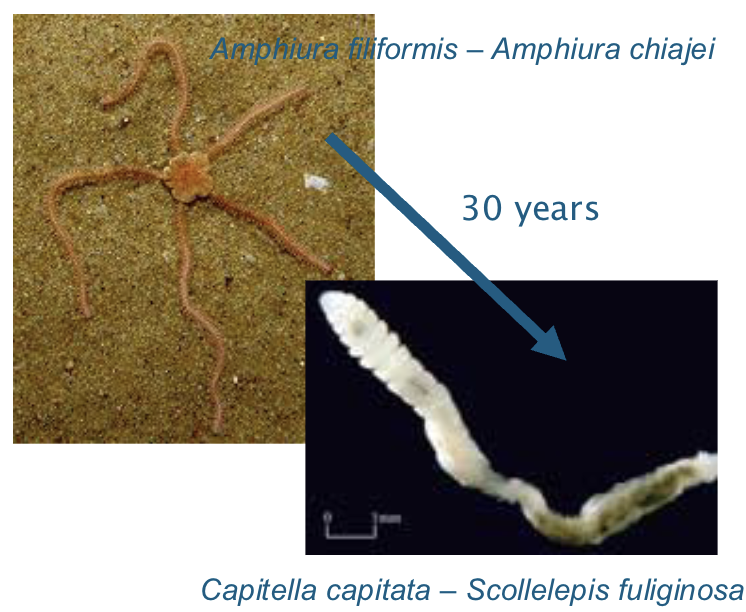
What SAB curve shows?
Species-abundance-biomass curves:
Changes along a gradient of organic enrichment (decreasing)
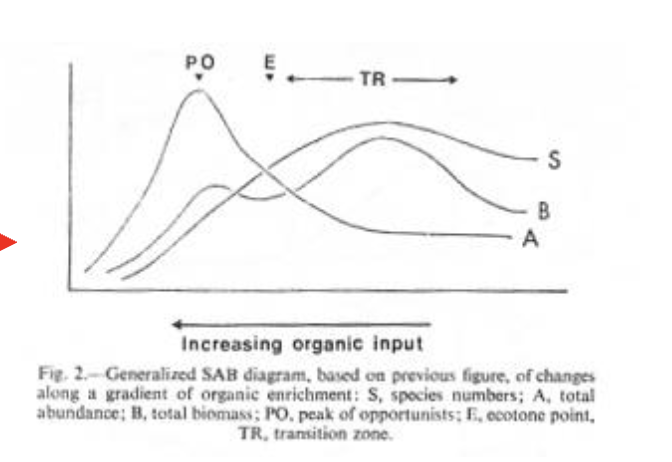
Species distribution in more/less enriched areas
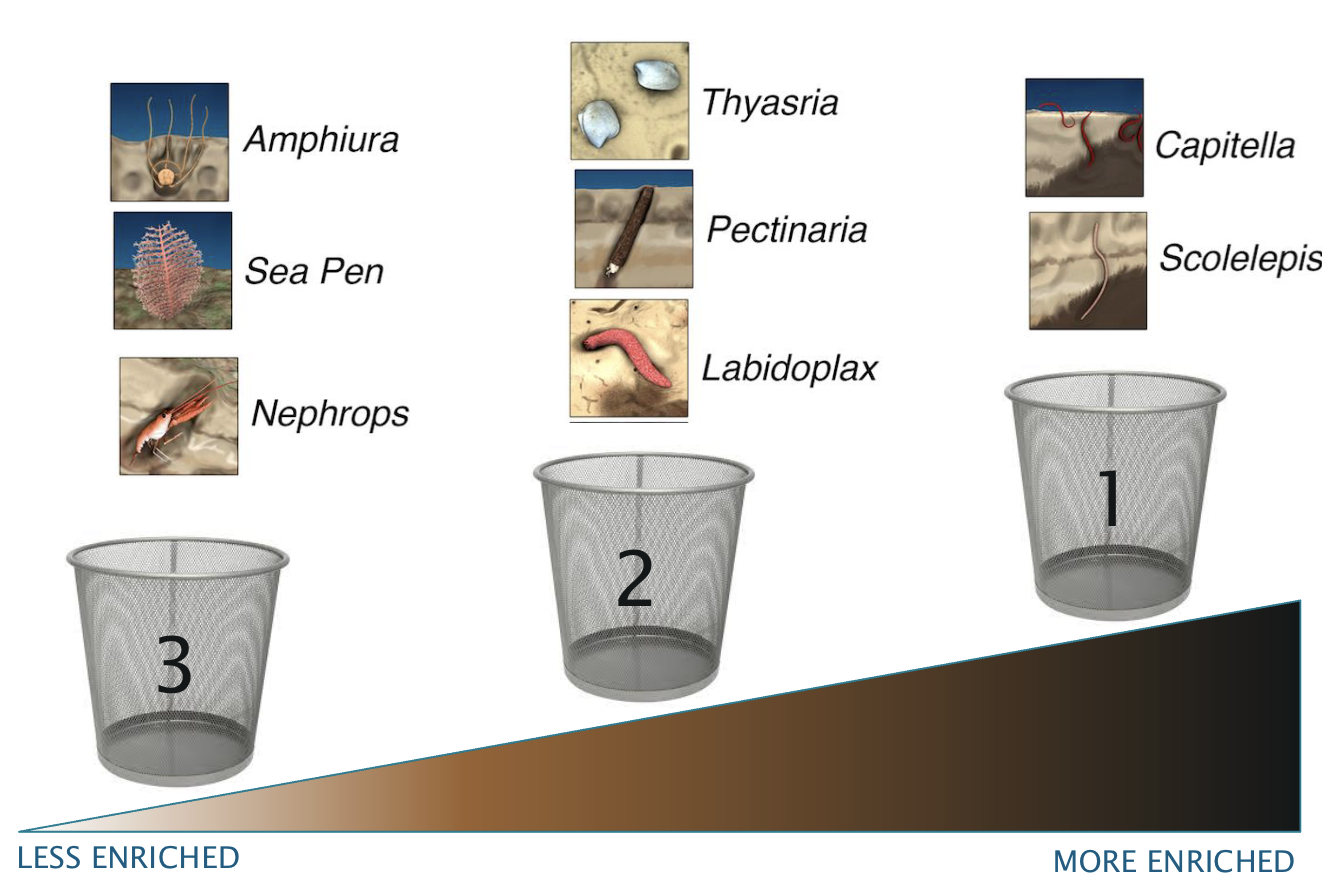
What is Pearson-Rosenberg model of succession?
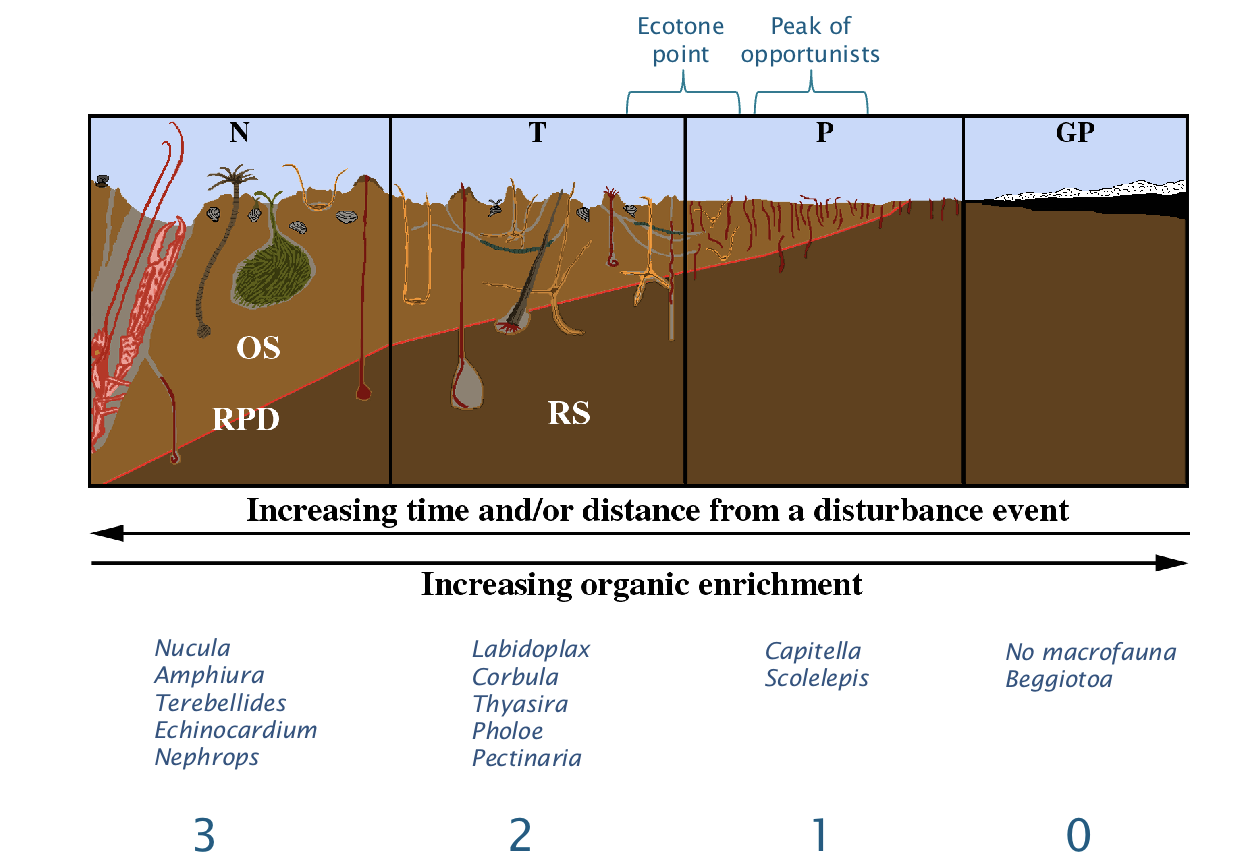
Rhodes physical disturbance gradients
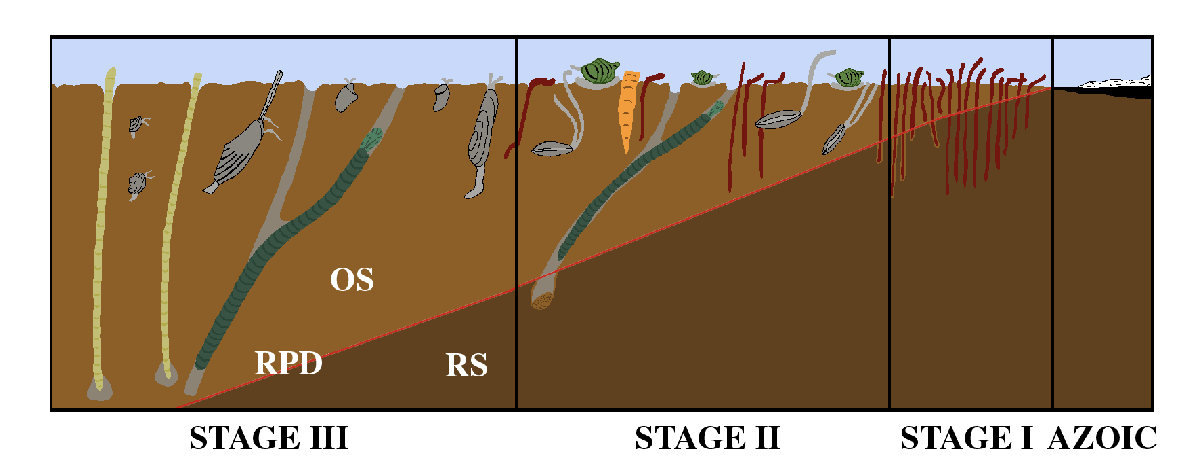
Baltic succesion
Climax → transition → opportunistic
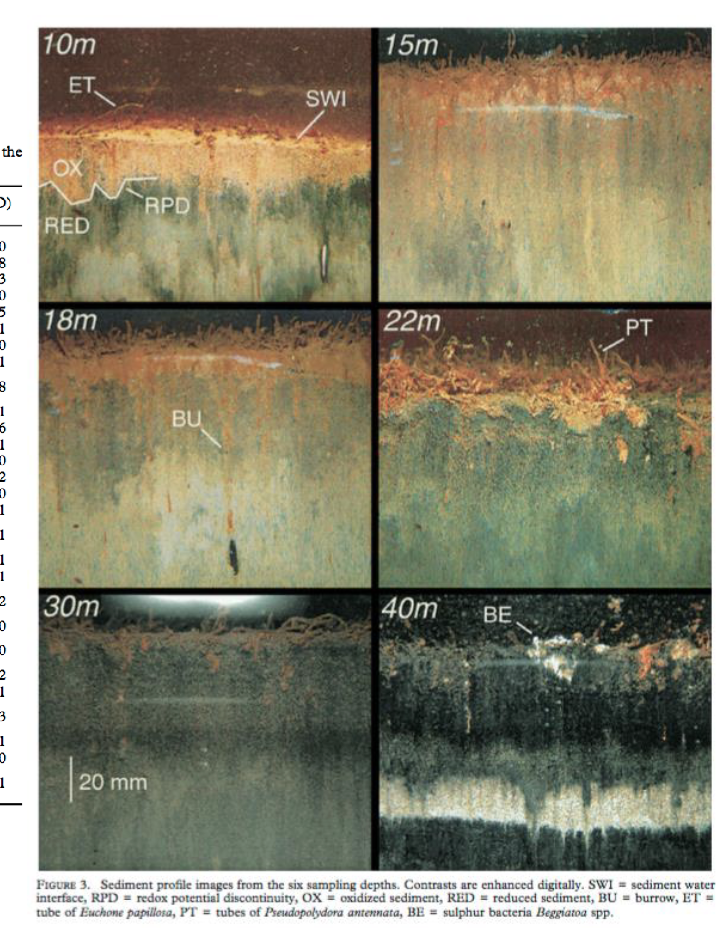
Hypoxia associated succesion
Oxygen loss in seafloor
oxygen depletes as it goes deeper
(orange → black (microbial mat forms)
=> recover after the winter of water mixing → succession
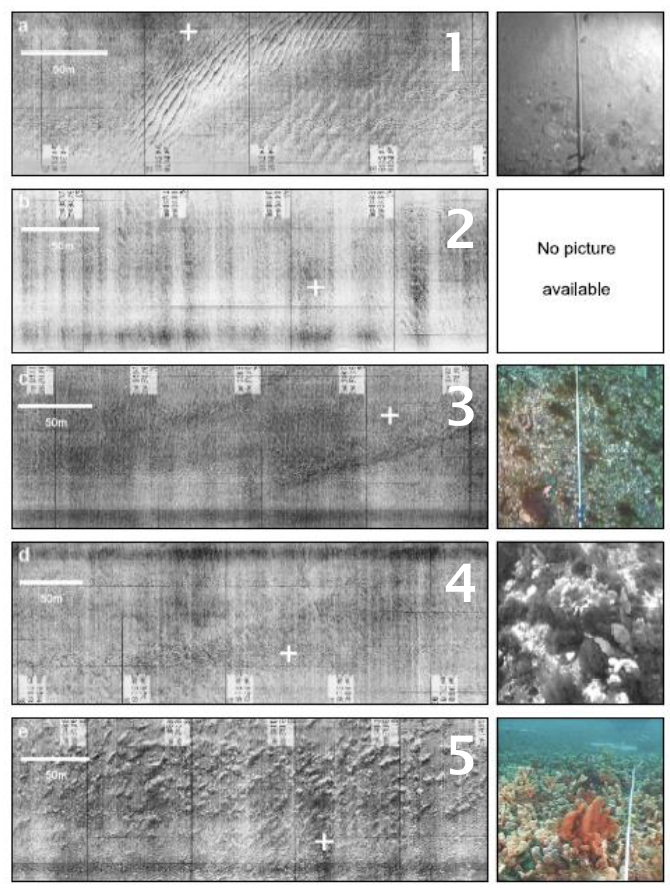
More fishing → fauna + sediment loss
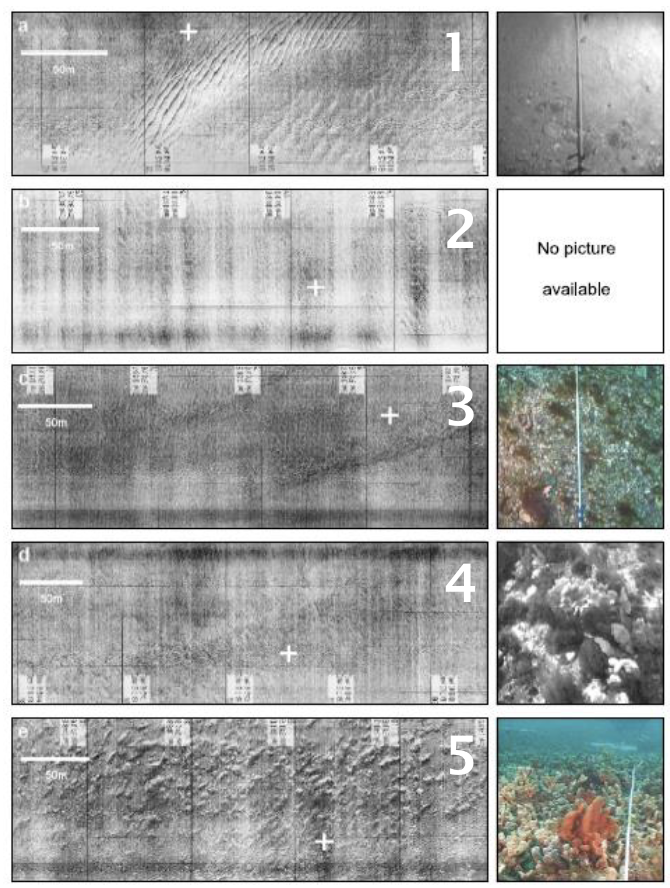
Cranfield et al.’s biogenic habitat regeneration model
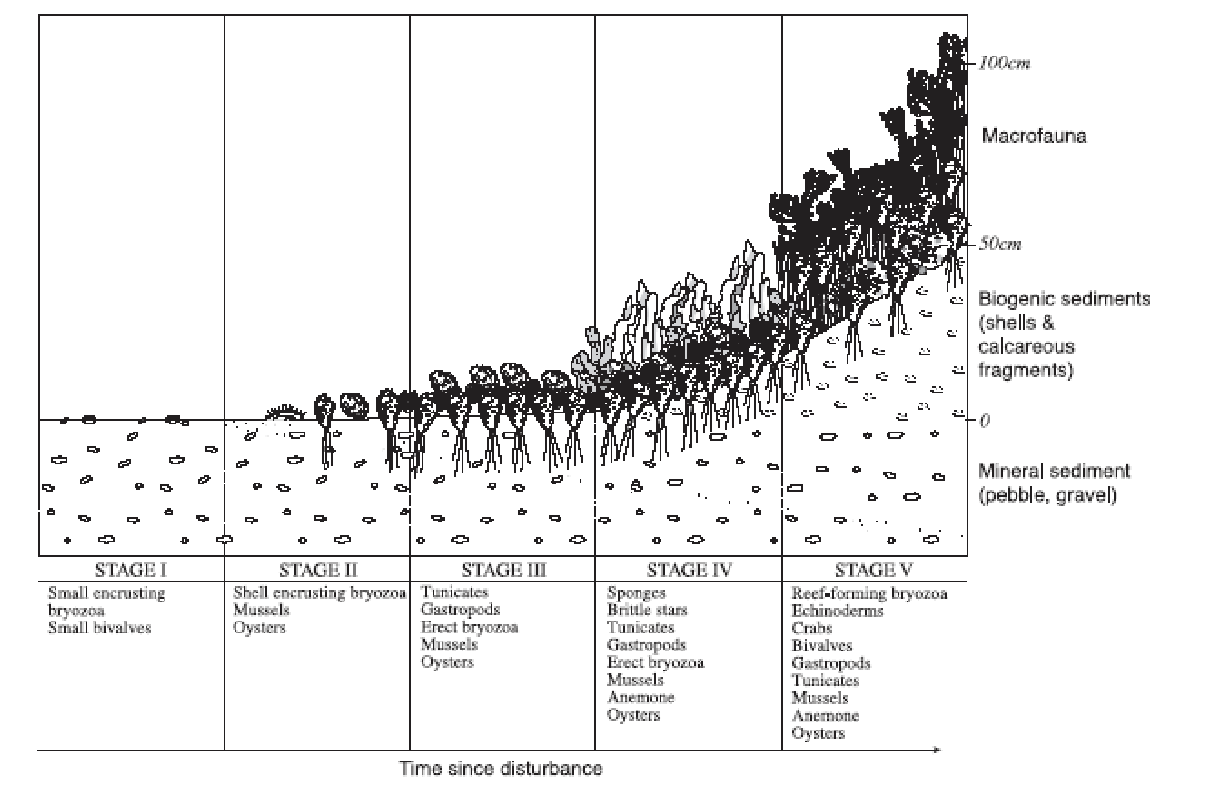
Soster & McCall’s model for Western Lake Eerie
(freshwater analogue)
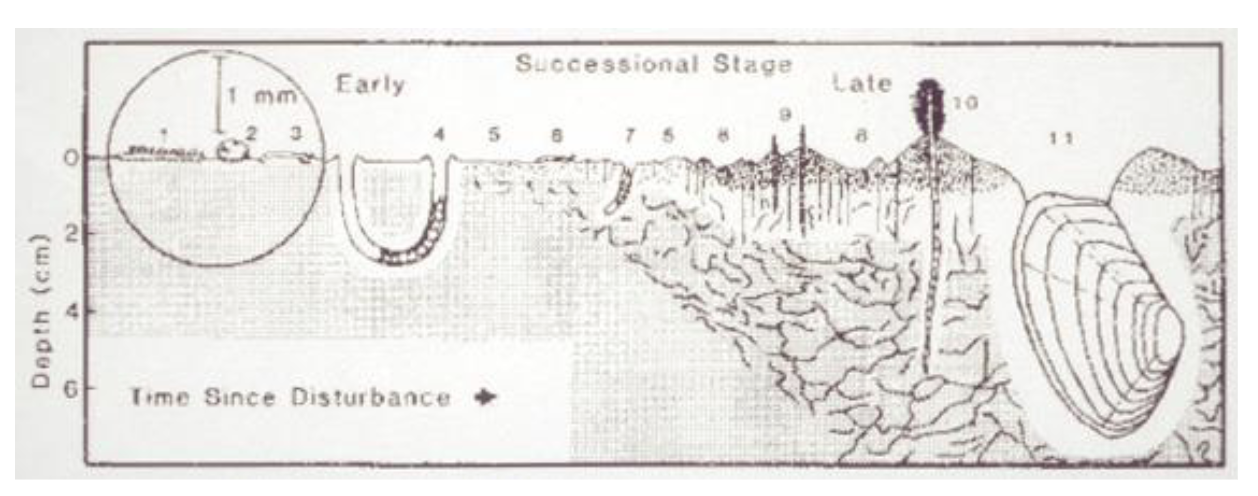
OSI - issues
OSI relationships tend to be more variable than traditionally reported (not as distinctive as seen)
multiple variables correlate with sediment type
is sediment type/ coloners drives relationships
→ paradigms of succession are derived from limited
experimentation or correlative field sampling + clearly are inadequate as explanations or predictive tools
How do organisms change the chemistry and physical character of the sediment
Through burrowing and feeding activities
What did Rhoads focus on in his 1974 paper compared to Gray’s 1974 paper
Rhoads focused on the modification of sediment properties by organisms through differences in feeding modes and species behaviour
Gray focused on substratum selection strategies and argued that the environment modifies the assemblage through post survival mechanisms
According to Rhoads (1974), what is the net result of organism-sediment relations?
The formation of an infaunal assemblage that reflects the interactions between temporal, environmental, and biological variation.
What was Gray’s rationale based on
Physical stimuli
Chemical stimuli
Biological stimuli
What tool did Don Rhoads use to make direct in situ observations of fauna and their relations with sediment?
An interface camera (later known as Sentiment Profile Imaging, or SPI).
In multiple-choice experiments, what sediment particle size preference did the polychaete Protodrilus show?
Particles >0.25\,mm.
What condition is required for the tube-building polychaete Polydora ciliata to metamorphose?
Particles must be finer than 250μm.
According to Meadows (1964), what happened to sediment attractiveness for Corophium spp. when the biofilm was removed?
The sediment became unattractive to the mud shrimp.
What was the depth range of the seven stations sampled by Young and Rhoads (1971) in Cape Cod Bay?
Between 12m and 42m.
What did Young and Rhoads (1971) document in Cape Cod Bay
A transition in fauna from inshore sand to deeper water muds
There was intensive reworking by deposit feeders
The irregular bottom topography
Which holothurian was identified as the cause of irregular bottom topography in Cape Cod Bay?
Molpadia oolitica.
What was Station 1518
34 m deep
mud-bottom in the centre of Cape Cod Bay
What specific topographic feature is formed by Molpadia oolitica that provides a stable surface for suspension feeders?
Cone-shaped faecal mounds.
Which three species notably colonize the stable surfaces provided by Molpadia oolitica faecal cones?
Euchone incolor (polychaete),
Aeginina longicornis (amphipod),
Thyasira gouldi (bivalve).
Pearson and Rosenberg (1976) studied the influence of effluents from which industry on fjordic systems?
Cellulose industries (pulp mills).
What did Pearson and Rosenberg (1976)’s observations suggest
Suggested that benthic organic enrichment caused a predictable and sequential change in the characteristics of the resident macrofauna and associated sedimentary environment
What was the daily waste water discharge of the sulphite pulp mill at Munkedal before July 1966?
55,000m3day−1.
What did Pearson & Rosenberg, 1978’s species abundance biomass curves summarise
The changes in basic faunal parameters taken along gradients or organic enrichment from 5 different locations.
Sediments near the discharge point are devoid of benthic macrofauna
As you move further away, the first species to be encountered tended to be small and few then, some short distance away, community abundances rise and then fall dramatically
Species richness and abundance begin to increase towards the ecotone point
After the ecotone point, as the environment becomes less polluted the community tends to transition towards the composition of unpolluted environment
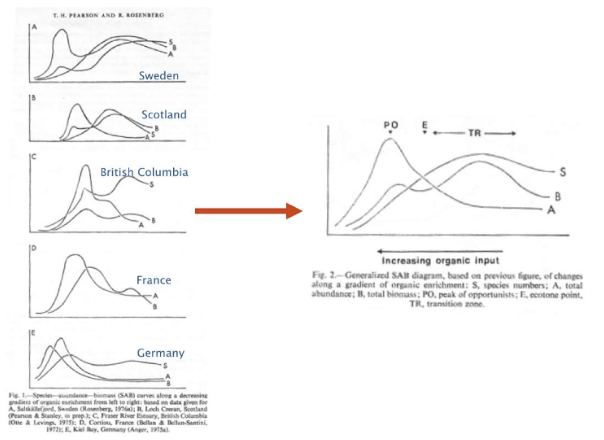
How did Pearson and Rosenberg (1978) describe the 'ecotone point' in a successional gradient?
A transitional zone poor in species richness, biomass, and abundance.
What was the 1st scenario presented by Pearson and Rosenberg (1978) from their data on species succession in relation to increasing organic input
The first scenario represents a heavily organically enriched location where there is poor flushing capacity and all oxygen is used up by microbial decomposition processes that are overwhelmed
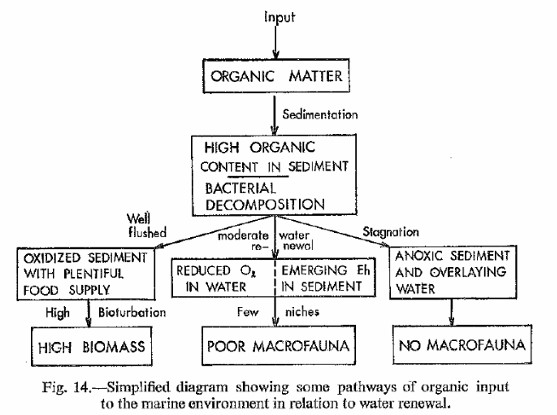
What was the 2nd scenario presented by Pearson and Rosenberg (1978) from their data on species succession in relation to increasing organic input?
The second scenario has some exchange of water but oxygen consumption remains high, reducing the oxidised depth of sediment
What was the 3rd scenario presented by Pearson and Rosenberg (1978) from their data on species succession in relation to increasing organic input?
Lots of O2 and water exchange
and Organic matter spread over a wide area
→ Allows mature faunal assemblages to develop
Where did Rhoads and colleagues (1978) investigate the impacts of dredge spoil disposal?
Long Island Sound, New York.
What was Rhoads (1978)’s conclusion
Physical disturbances and organic pollution have similar effects on faunal composition
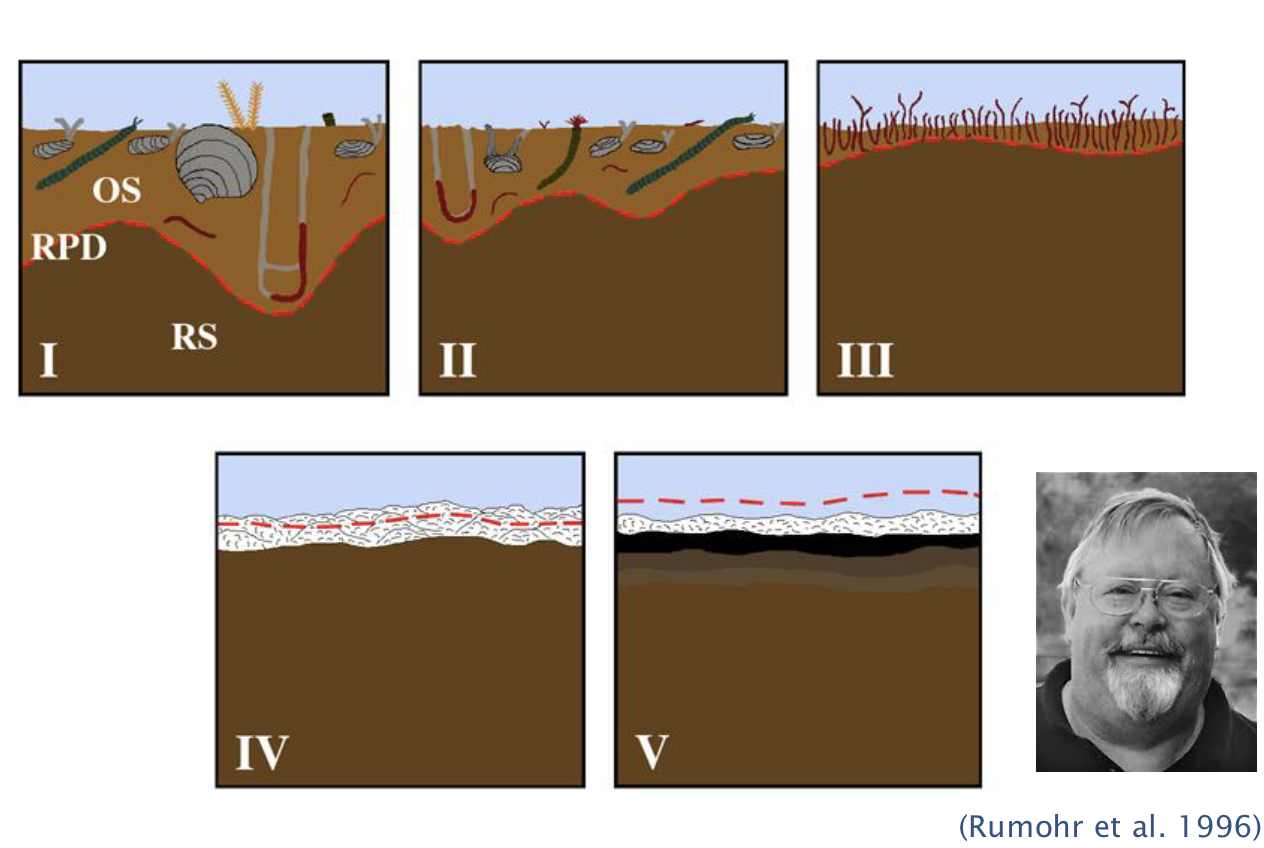
How many additional stages did Rumohr et al. (1996) add to the successional model for the Baltic Sea?
Two additional stages (Stage IV and Stage V).
What is the Pearson-Rosenberg model of benthic succession?
As you move away from disturbance zone in 4 stages
Anoxic zone
Polluted zone
Transition zone
Highly diverse zone
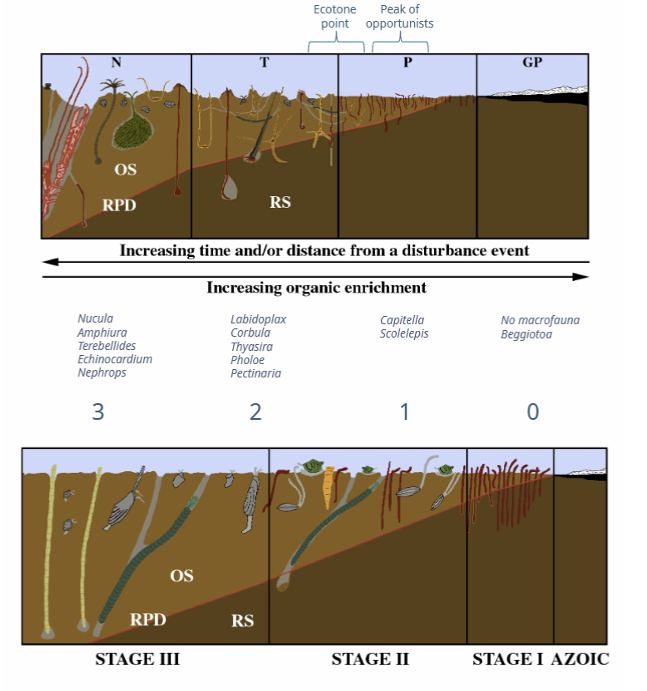
What characterizes Stage IV in the Rumohr et al. (1996) model?
Longer periods of anoxia and the formation of bacterial mats (Beggiatoa spp.) at the sediment surface.
According to the Rumohr et al. (1996) model, what causes the lamination of sediment in Stage V?
A lack of bioturbation due to long-term (years-decades) hypoxia.
What is the 1st stage of Rumohr et al (1996)’ model of benthic succession
A climax-community dominated by deep-burrowing species and a deep RPD layer
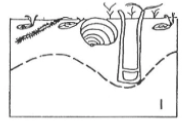
What is the 2nd stage of Rumohr et al (1996)’ model of benthic succession
Frist signs of stress, strong fluctuations, disappearance of echinoderms, decreasing species richness, increasing productivity and biomass, and elevated RPD layer
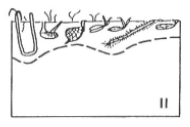
What is the 3rd stage of Rumohr et al (1996)’ model of benthic succession
Dominated by small polychaete worms
RPD layer close to the sediment/water boundary layer.
At this stage, limited, more or less regular events of hypoxia may occur
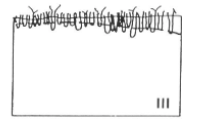
What is the 4th stage of Rumohr et al (1996)’ model of benthic succession
Long periods of hypoxia and formation of bacterial mats at the sediment surface
→ with no permanent benthic macrofauna but sometimes with vagile epifauna
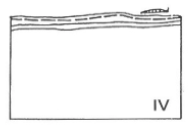
What is the 5th stage of Rumohr et al (1996)’ model of benthic succession
Complete absence of benthic communities → due to long-term anoxia
→ increased sedimentation rates and lack of bioturbation
Lead to lamination of sediments and accumulation of organic material, nutrients and also pollutants.
Sometimes vagile epifauna, when the bottom water is oxic
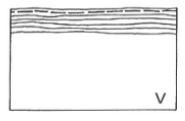
What is the definition of the Redox Potential Discontinuity (RPD)?
The transition zone separating the surficial aerobic sediment from the underlying anaerobic basement.
What is stage -1 of the RPD
The complete breakdown of the macrobenthic community due to long-term hypoxia
→ resulting in lamination of the sediment through lack of bioturbation.
No sedimentary redox discontinuity as the boundary between negatively and positively conditioned sediment may lie in the water column at some distance above the sediment surface
What is stage 0 of the RPD
Characterised by longer periods of anoxia and the formation of bacterial mats at the sediment surface.
The RPD layer is at the sediment/water interface, and macrofauna is generally lacking
What is stage 1 of the RPD
The sediment content of labile organic matter has declined and the formerly anoxic or hypoxic sediment has given way to oxic conditions in the uppermost layers of the profile
What is the bioturbation of the RPD
Significantly modify the physical, chemical and biological nature of the deposit.
The formation of holes, tubes and burrows
Biologically mediated circulation and incorporation of oxygenated water into the sediment serve to stimulate aerobic microbial breakdown of organic material
Increase the depth of oxygenated sediment
What is the Peak of the opportunists of the RPD
First species to be encountered tended to be small and few
Then, some short distance away, community abundances rise and then fall dramatically (peak of opportunistics)
What is the ecotone point of the RPD
Species richness and abundance begin to increase towards the ecotone point, a transitional zone poor in species richness, biomass and abundance.
→ After the ecotone point, (environment becomes less polluted)
The community tends to transition towards the composition of the unpolluted environment
What is stage 2 of the RPD
Bioturbation allows further colonisation of a greater variety of species and the macrofaunal assemblage enters a ‘transitory’ phase of succession
(Like previous stage) Physical and chemical properties of the sediment are further modified by the new infaunal dominants and additional species take hold that are unfavourable for ‘pioneer’ population persistence.
What is stage 3 of the RPD
A more complicated and persistent faunal assemblage forms and evolves towards a 'normal' or ‘equilibrium’ or ‘climax’ community status.
Sediments at ‘equilibrium’ are characterised by “burrow complexes of large species such as Nephrops norvegicus, Brissopsis lyifera, and Scalibregma inflatum intermingled with smaller tube dwelling and burrowing species”
→ that together depress and maintain the RPD at depths in excess of 10 cm
The taxa belonging to this sere typically have larger body sizes, longer life spans, a large assimilative capacity, and a wider range of functional types than the taxa of earlier successional series.
Which 'opportunistic' polychaete species are typically found in Stage 1 of succession following organic enrichment?
Capitella spp. and Polydora spp.
In the context of Succession Stage 2, which bivalve genera are considered part of the transitory sere?
Thyasira spp. and Corbula spp.
According to Pearson and Rosenberg (1978), at what depth do equilibrium (Stage 3) communities maintain the RPD?
At depths in excess of 10cm.
Which large burrowing species are characteristic of a 'normal' or 'climax' community status in Stage 3?
Nephrops norvegicus, Brissopsis lyifera, and Scalibregma inflatum.
What did Snelgrove and Butman (1994) conclude about using grain size as a predictor for organism distribution?
It is likely a poor predictor because of its collinearity with other variables like hydrodynamics and larval supply.
What were the 5 successional stages identified in biogenic reef succession (By Cranfield et al (2004))
Small encrusting bryozoans and small bivalves adapted to life in loose unstable sediment
Mussel Modiolus settle and begin to stabilise sediment with byssus threads. Some ascidians (tunicate sea squirts) and oysters begin to settle
Density of mussels, tunicates and oysters increases. Enhances sediment stabilisation
and 5. Sponges, errant polychaetes etc. begin to move in, assemblage becomes more complex.
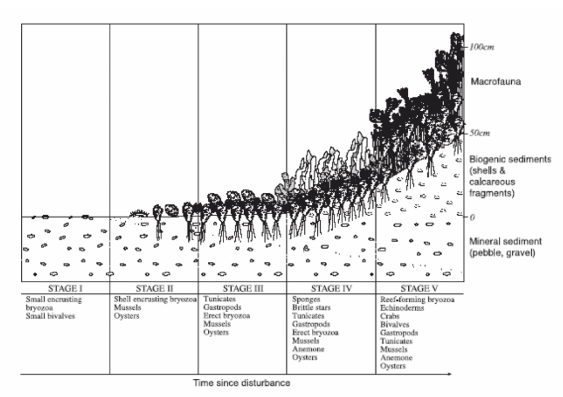
Species in 3 stages of fauna
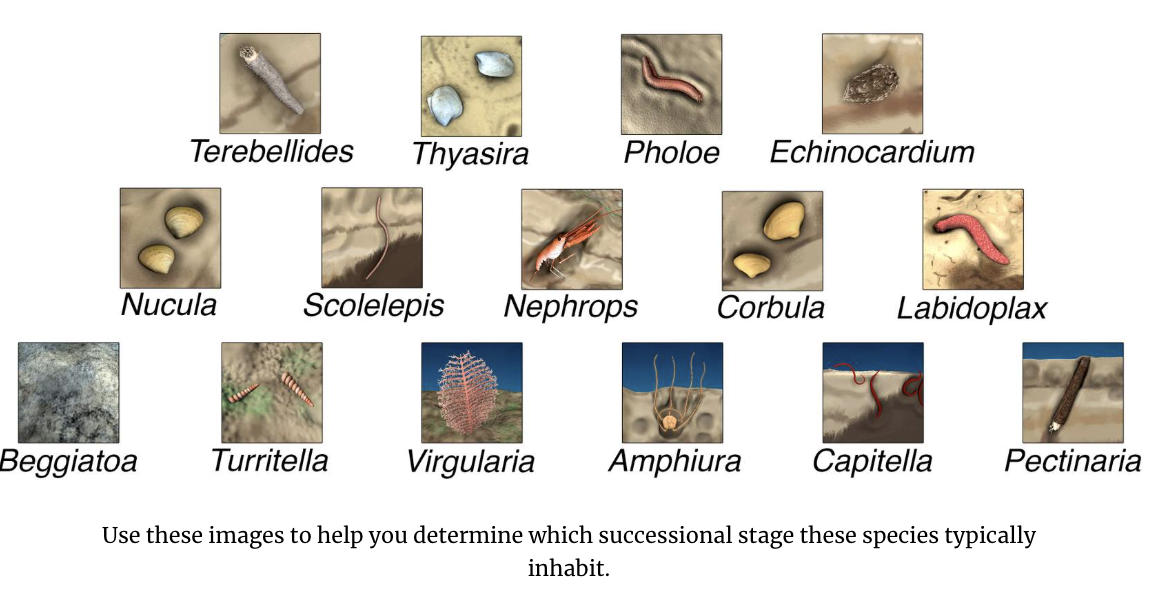
How did Ralph Gordon Johnson describe the benthic community in his 1972 report?
As a "temporal mosaic" where parts are at different stages of succession and represent "relics of former disasters."
What percentage of variation in species abundance did Zajac (2001) find was explained by local sediment conditions?
<40%.
What did Gray (1974) argue was radically altered by interactions between organisms and sediment?
The exact constitution of community structure.
In the Rumohr et al. (1996) model, what happens to the numbering of sequential stages relative to the Pearson-Rosenberg model?
The numbering is reversed.
How many tonnes was the filtered dry substance discharge of the pulp mill at Munkedal before its closure?
25tonnesday−1.
According to Rhoads (1974), bioturbation is a first-order process for understanding WHICH geochemical gradients?
Redox and pH gradients.
Which species is a 'conveyor belt' polychaete characteristic of Stage 2 succession?
Scoloplos spp. (also Amphictene spp. or Clymenella spp.).