Endterm
 Call Kai
 Learn
Learn Practice Test
 Spaced Repetition
 Match
Match Flashcards
 Knowt Play
1/29

There's no tags or description
Looks like no tags are added yet.
Name | Mastery | Learn | Test | Matching | Spaced | Call with Kai |
|---|
No analytics yet
Send a link to your students to track their progress
30 Terms
Finis operis
The intrinsic proximate end of a moral act
The objective meaning of the act itself—what the act is by its nature, regardless of intention.
Finis operantis
The subjective remote purpose of the agent
Ignorantia afectata
deliberately avoiding knowledge to remain "innocent" of a prohibition
A form of ignorance where a person deliberately avoids knowing the truth in order to justify a wrong action.
Antecedent passion
Emotional surges that occur before the mind can deliberate.
Consequent passion
Emotions that are intentionally fostered to help perform an act.
An emotion that is intentionally encouraged or allowed after a decision is made to carry out an act.
It increases moral responsibility because the person uses emotion to support the action
Sacrilege
A circumstance that changes the species of an act
Voluntarium in causa
A principle stating that a person is responsible for actions caused by a condition they freely created.
Specifying circumstance
A type of circumstance that changes the moral nature (species) of an act, not just its degree.
Invincible ignorance
Ignorance that a person cannot overcome despite reasonable effort. This completely excuses moral responsibility because the person had no way of knowing.
Bonum ex integra causa, malum ex quocumque defectu
“Good comes from a complete set of right conditions; evil comes from any defect.” An act is good only if object, intention, and circumstances are all good. If even one is wrong → the act is evil.
Internal commanded act
An act where the will commands an internal faculty (like thinking, imagining, or remembering).
Formal cooperation in evil
Helping in another person’s wrongdoing by sharing their bad intention. This is always morally wrong, even if the outcome seems good
Acute humans
an action that proceeds from the simultaneous co-presence of intellectual advertence and free consent of the will.
Advertentia
The intellect's actual apprehension of the act's moral character at the moment of performance. It is necessary but not sufficient for full imputability.
Actus hominis
These are behaviors performed by a human being that lack one or both of the faculties mentioned above (intellect and will).
Perfect voluntariness
When the agent acts with full knowledge and full consent.
Imperfect voluntariness
Occurs when there is a partial loss of advertence or consent (e.g., acting under grave fear or mild fatigue).
Voluntarium in causa
A principle addressing situations where an agent lacks direct control at the moment of an act but is responsible because they freely produced the cause of that state (e.g., a person who drinks alcohol knowing they become aggressive is responsible for actions taken while intoxicated
Intrinsice malum
Acts whose moral object is constitutively disordered (e.g., torture, deliberate misrepresentation of truth). No good intention or circumstance can ever make these acts good.
Malum quia prohibitum
Acts that are evil only because they are prohibited by a specific law or authority.
Moral indifference
Abstractly, some act-types (like walking) are indifferent; however, in concrete life, acts are almost always qualified by intention and circumstance
Principle of double affect
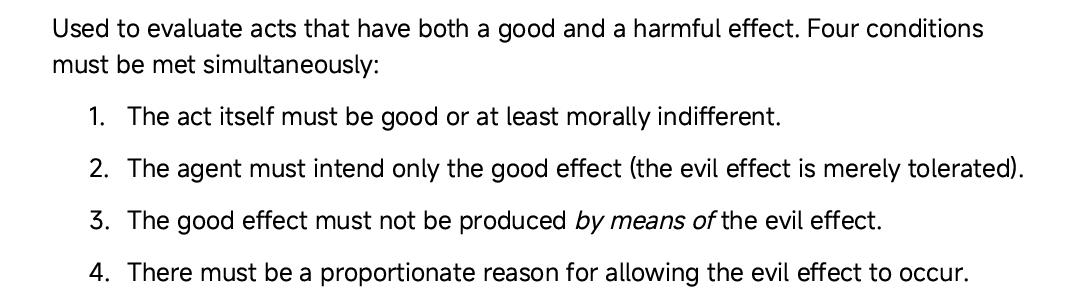
Principle of totality
Used primarily in biomedical ethics. It justifies the sacrifice of a part of the body (e.g., amputation of a gangrenous limb) for the health and preservation of the whole body. It does not allow for the removal of healthy organs that do not threaten the whole
Formal cooperation
The cooperator shares in the wrongful intention of the principal actor. This is unconditionally impermissible.
Material cooperation
The cooperator performs an act that facilitates the sin of another without sharing the evil intention

Elicited
Acts immediately produced by the will (intending, choosing).
Commanded
Acts the will directs other powers to perform (internal cognitive acts or external physical acts).
Ordo amoris
An Augustinian concept suggesting that intentions are expressions of an agent’s overall dispositional orientation (ordered or disordered love).
Ommissions
A failure to act is morally evil only if the agent had a duty to act, the capacity to act, freely chose not to act, and the omission caused harm.
Double vol
Occurs when an agent wills both the act's object and the problematic circumstances surrounding it.