Properties of Travelling Waves (reflection, refraction, diffraction, interference)
 Call Kai
 Learn
Learn Practice Test
 Spaced Repetition
 Match
Match Flashcards
 Knowt Play
1/16

There's no tags or description
Looks like no tags are added yet.
Name | Mastery | Learn | Test | Matching | Spaced | Call with Kai |
|---|
No analytics yet
Send a link to your students to track their progress
17 Terms
What are travelling waves?
Aka continuing waves
A wave that moves through a medium or space, transporting energy from one location to another
What is are the laws of reflection?
The laws of reflection state:
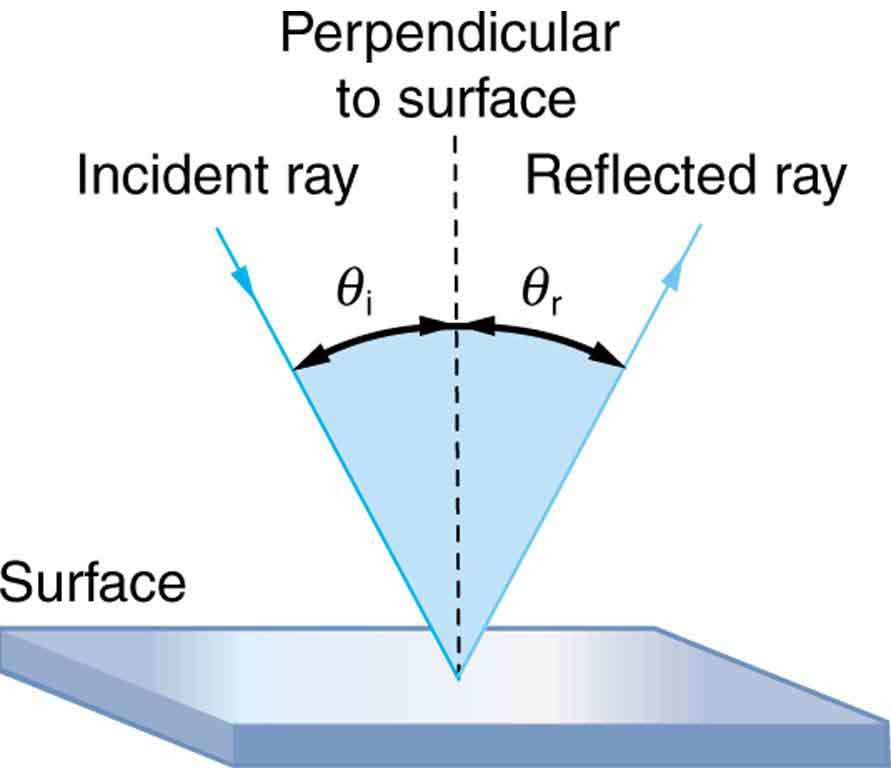
The angle of incidence equals the angle reflection
The incident ray, reflected ray, and the normal lie in the same plane
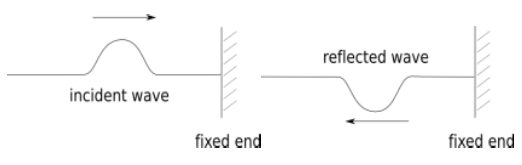
What is fixed end reflection?
The wave is inverted
Note: a thick string attached to a thin string acts as a fixed end
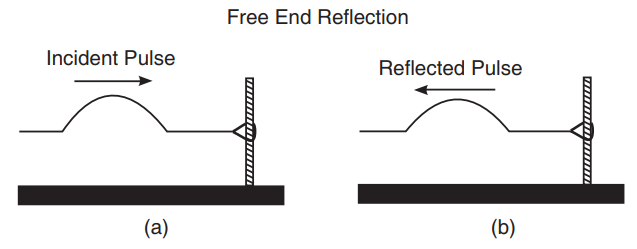
What is free end reflection
The wave is the same.
Note: a thin string attached to a thick string acts as a free end
What is refraction?
Refraction occurs when a ray bends when it passes from one medium to another (similarly to reflection) resulting in changes in the speed of light.
What is the index of refraction?
n = c / v
*the index of refraction is unitless
where c is the speed of light in a vacuum (3×10⁸ ms-1) and v is the speed of light in the medium.
When does light travel slow?
Light slows down when passing into a more optically dense medium
The angle of refraction bends toward the normal (smaller)
When does light travel fast?
Light speeds up when going from a denser to a less dense medium
The angle of refraction bends away from the normal (further, fatter)
What are wavefronts?
Equally spaced lines that represent in phase points on a wave
The wavefronts are always perpendicular to the ray
The gap between wavefronts represent the wave length
Come in different shapes depending on the movement of the wave
What is snell’s law?
n1sinθ1 = n2sinθ2
What is the critical angle?
The critical angle is the angle of incidence which results in the refracted angle being on the boundary at exactly 90 degrees
Occurs only when light travels from more optically dense medium to a less optically dense medium.
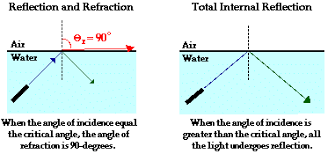
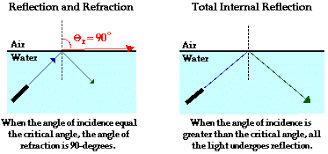
What is total internal reflection?
When the angle of incidence exceeds the critical angle, resulting in an angle of reflection instead of an angle of refraction
Occurs only when light travels from a more optically dense medium to a less optically dense medium.
What is diffraction?
Diffraction is the bending and spreading of waves as they encounter an obstacle or pass through an opening.
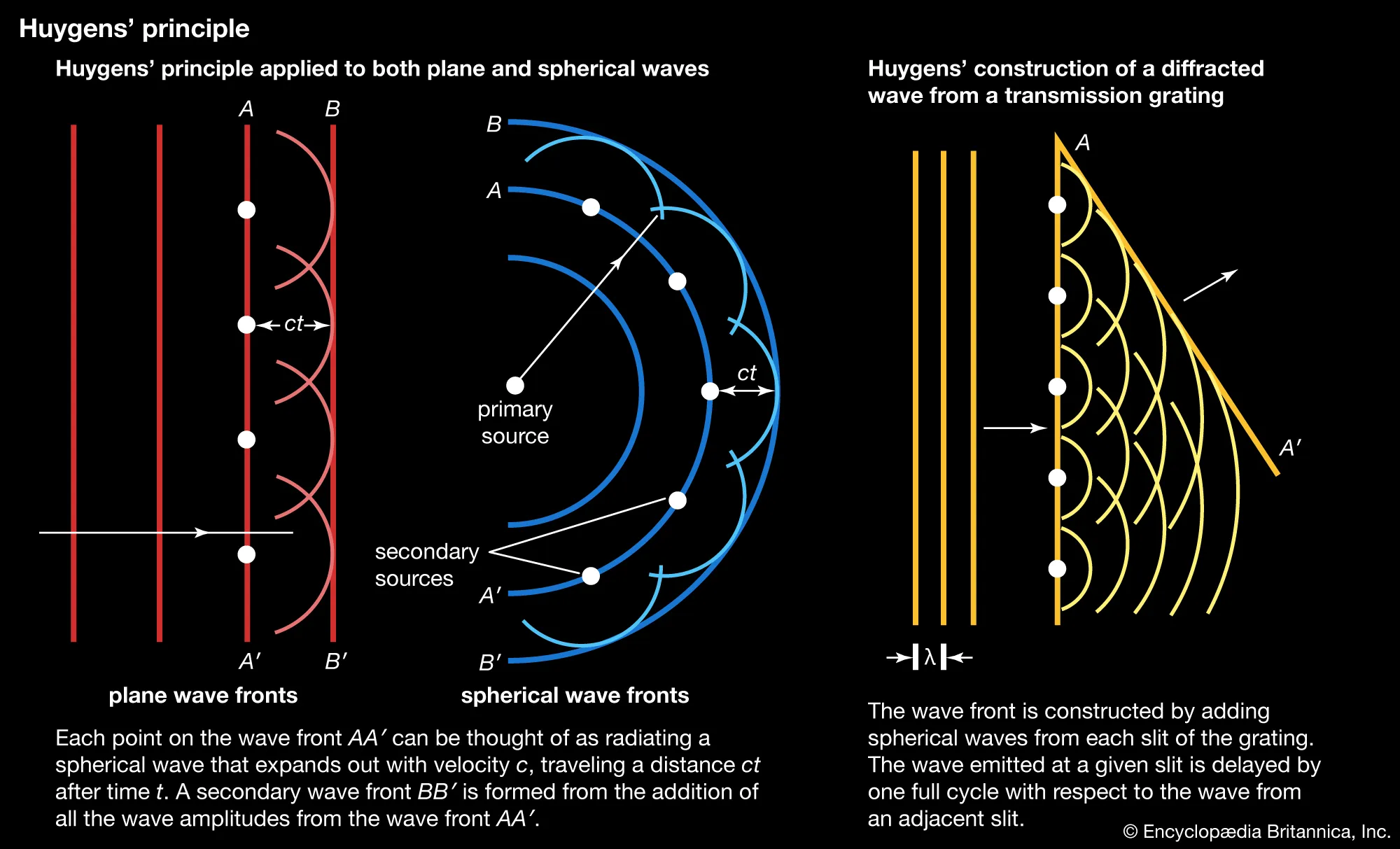
What is Huygens’ Principle?
States that every point on a wave front is a source for a new wavelet. The new wave front is the tangential surface to all the wavelets.
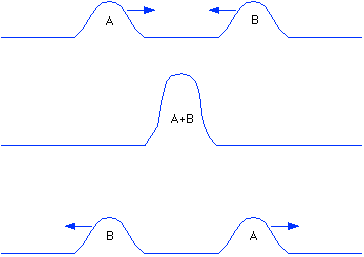
What is superposition? (3)
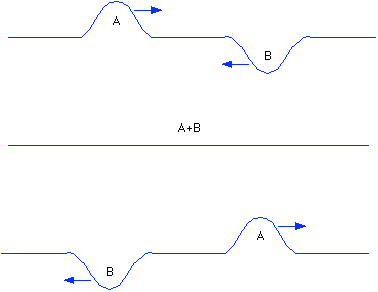
Superposition is when waves are in the same physical location in the medium they move through.
Amplitudes add together
Once the waves move through each other, they continue to move in the direction they were travelling in originally
What is constructive interference?
When two amplitudes in the same direction add to produce a larger amplitude.
What is destructive interference?
When two amplitudes in the opposite direction cancel each other out to produce a smaller amplitude or no amplitude.