PLP 120 Exam I
0.0(0)
Studied by 4 people View linked note
 Call Kai
 Learn
Learn Practice Test
 Spaced Repetition
 Match
Match Flashcards
 Knowt Play
Card Sorting
1/58

There's no tags or description
Looks like no tags are added yet.
Last updated 11:13 PM on 4/26/23
Name | Mastery | Learn | Test | Matching | Spaced | Call with Kai |
|---|
No analytics yet
Send a link to your students to track their progress
59 Terms
1
New cards
plant disease
injurious, causing harm by disrupting normal physiological processes
2
New cards
plant diseases are a result of ___
persistent or semi-persistent irritation, generally progressive
3
New cards
plant diseases are caused by ___
biotic (infectious) agents or abiotic factors that reduce the economic or aesthetic value
4
New cards
plant disease results in ___
abnormality in structure or function of a plant
5
New cards
seprophyte
acquires nutrients from dead organic material; decomposer
6
New cards
parasite
acquires nutrients from a living organism (lives in or on a living organism)
7
New cards
facultative xyz
they can be xyz but they don’t prefer to be
8
New cards
biotrophic
completes entire life cycle on a living host, lives and multiples only on another living organism, obligate parasite
9
New cards
necrotrophic
pathogen kills host cells using toxins or enzymes and obtains energy from them, facultative parasite/facultate saphrophyte
10
New cards
hemibiotrophic
first obtains nutrients from living cells in biotrophic phase then switches to necrotrophic phase and obtains nutrients from dead plant tissue, facultative saphrophyte
11
New cards
what are the three things in the plant disease triangle and what do they mean
host, pathogen, and environment; plant disease results when these three components interact
12
New cards
infection court
a site in or on a host plant where infection can occur ie a natural opening (stomata), wound, direct penetration
13
New cards
describe the steps of a basic disease cycle
1. dispersal of primary inoculum- movement from plant to plant
2. deposition
3. penetration
4. infection- pathogen establishes relationship where it obtains nutrients from host plant
5. colonization- pathogen spreads throughout host tissue
6. reproduction- pathogen produces new infectious units
7. survival- overwintering, persistence when preferred host/tissue is absent
14
New cards
which pathogen caused late blight/irish potato famine
Phytophthora infestans
15
New cards
Which pathogen caused coffee rust and where
Hemileia vastatrix, Sri Lanka
16
New cards
basic facts about bacteria
prokaryotes
single cellular
small 0.6 to 3.5 micrometers
lack well defined organelles
chromosomal DNA not organized into a nucleus
chromosomal DNA is closed circular
often contain plasmids
single cellular
small 0.6 to 3.5 micrometers
lack well defined organelles
chromosomal DNA not organized into a nucleus
chromosomal DNA is closed circular
often contain plasmids
17
New cards
majority of known plant pathogenic bacteria are _____ __ (their preference for nutrient absorption)
facultative saprophytes
18
New cards
T/F majority of plant pathogenic bacteria are easy to culture on artificial media
true
19
New cards
possible advantageous traits carried on bacterial plasmid (extra chromosomal DNA)
antibiotic resistance, virulence factors, genes for production of a certain metabolic enzyme, ie copper resistance in Pseudomonas syringae pv. tomato
20
New cards
what is the shape of most bacterial plant pathogens?
rod (bacilliform)
21
New cards
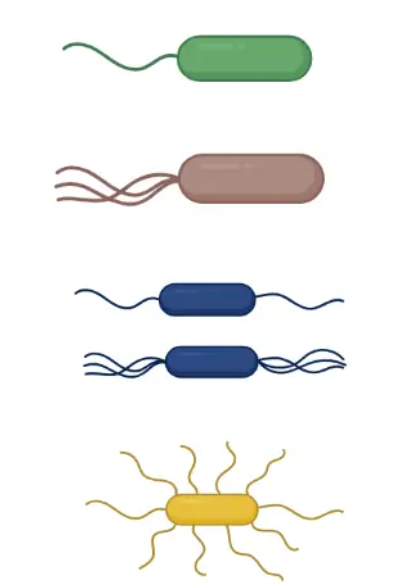
monotrichous polar, lophotrichous, amphitrichous, peritrichous
22
New cards
most plant pathogenic bacteria are __ (what type of cell wall?)
gram-negative: thin layer of peptidoglycan surrounded by periplasmic space and plasma membrane, stains pink with counterstain Safranin
23
New cards
briefly describe the method through which bacteria reproduce and one reason why this method of reproduction might be beneficial to a plant pathogenic lifestyle?
binary fission:
asexual reproduction
can divide as rapidly as every 20 minutes
produces two identical daughter cells
strongly influenced by their environment
allows pathogen to colonize very quickly and then spread to other plants
asexual reproduction
can divide as rapidly as every 20 minutes
produces two identical daughter cells
strongly influenced by their environment
allows pathogen to colonize very quickly and then spread to other plants
24
New cards
methods through which genetic variation are introduced into bacterial populations
mutations and selection
bacteria are haploid so mutations always get expressed
bacteria are haploid so mutations always get expressed
25
New cards
3 types of lateral/horizontal gene transfer
conjugation- transfer from donor to recipient through cell-cell contact (pilus=bridge), often between 2 related species
transformation- bacteria takes up foreign DNA from the environment ie dead bacteria, random
transduction- bacteriophage (bacteria-infecting virus) picks up bacterial DNA while replicating in 1 bacterium and transfers it to a second
transformation- bacteria takes up foreign DNA from the environment ie dead bacteria, random
transduction- bacteriophage (bacteria-infecting virus) picks up bacterial DNA while replicating in 1 bacterium and transfers it to a second
26
New cards
phylum containing important plant pathogenic bacteria
proteobacteria (gram -)
actinobacteria (gram +)
tenericutes (no cell wall)
actinobacteria (gram +)
tenericutes (no cell wall)
27
New cards
which 2 bacterial species are gram +
Clavibacter spp.- potato ring rot, bacterial canker of tomatoes and wilting maize, wheat and alfalfa
Streptomyces spp.- scabs in potato and other root crops
Streptomyces spp.- scabs in potato and other root crops
28
New cards
Erwinia spp., Dickeya spp., Pectobacterium spp.
rods, peritrichous flagella, gram -, facultative anaerobes, wilts/blights/soft rots
29
New cards
Pseudomonas spp.
rods, polar flagella, gram -, some fluoresce under UV light (because they secrete ciderophores that chelate iron and then glow under UV), leaf spots/galls/cankers
30
New cards
Xanthomonas spp.
rods, single polar flagellum, gram -, slimy, yellow colonies on media, mostly cause leaf spots and some rots/wilts
31
New cards
Agrobacterium spp.
rods, few circumthecal flagella, gram -, soil and rhizosphere inhabitants, can survive for long periods of time without plant debris, cause growth abnormalities (galls, root proliferation)
32
New cards
Clavibacter spp.
rods, nomotile (no flagella), gram +, cankers/wilts/ring rot
33
New cards
Streptomyces spp.
filalmentous, gram +, small/dry/granular colonies on media, spore-forming, soil inhabitant (so crop rotation doesn’t work well as management technique), scab diseases
34
New cards
pathovar vs race
pathovar- differentiates bacteria that belong to the same species but infect different host plant species
race- differentiates bacteria that belong to the same species and pathovar but infect different plant cultivars (genotypes)
race- differentiates bacteria that belong to the same species and pathovar but infect different plant cultivars (genotypes)
35
New cards
epiphyte
bacteria living non-parasitically on plant surface
36
New cards
phyllosphere
above-ground parts of plant that serve as habitat for microorganisms; including leaves, flowers, buds, fruit
37
New cards
rhizosphere
the microenvironment in the soil immediately surrounding the roots; soil directly influenced by root exudates
38
New cards
quorum sensing
bacteria detect and react to self-generated signal molecules to organize behavior in response to pop size (activate or repress expression of target genes)
bacteria secrete signal molecules which activates genes in close by bacteria (genes to secrete more EPS, turn on virulence factors, produce toxins, etc)
bacteria secrete signal molecules which activates genes in close by bacteria (genes to secrete more EPS, turn on virulence factors, produce toxins, etc)
39
New cards
biofilm
a polysaccharide matrix in which bacteria are embedded that can assist in attachment, colonization, host invasion, survival
40
New cards
epiphytic phase of Erwinia amylovora
E. amylovora = Fire blight
bacteria build up on the stigma then invade through nectar thodes when bacteria reach high enough numbers, important phase in pathogenesis
dormant bacteria can overwinter in “holdover cankers”
bacteria build up on the stigma then invade through nectar thodes when bacteria reach high enough numbers, important phase in pathogenesis
dormant bacteria can overwinter in “holdover cankers”
41
New cards
epiphytic phase of Pseudoomonas syringae pv. tomato
bacteria build up on the surface of the leaf
management: avoid overhead irrigation, making the leaf surface a bad environment for them to spread to
management: avoid overhead irrigation, making the leaf surface a bad environment for them to spread to
42
New cards
what is one management strategy that does NOT work for managing rhizosphere inhabitants
crop rotation bc bacteria will survive in soil for long periods of time
43
New cards
Agrobacterium tumefaciens
crown gall (primarily a problem on perennial crops ie trees)
wide host range
soil inhabitant that survives for a looong time in the soil
can survive in soil even near plants that are NOT its host
wide host range
soil inhabitant that survives for a looong time in the soil
can survive in soil even near plants that are NOT its host
44
New cards
Streptomyces scabies
common scab of tomatoes
gram + and filamentous
really good soil inhabitant
gram + and filamentous
really good soil inhabitant
45
New cards
T/F: majority of pathogenic bacteria are NOT soil inhabitants
true
46
New cards
one strategy to attempt to clear out soil inhabitants and why, why is it also sometimes bad
turning the soil under, clearing out plant debris where the bacteria can overwinter, but it causes problems with carbon cycle/erosion
47
New cards
places where pathogenic plant bacteria can overwinter
in association with plant tissue (cankers, plant debris, seeds, propogative material)
guts of overwintering insects ie cucumber beetle (Erwinia tracheiphilia, cucumber wilt) and corn flea beetle (pantoea stewartii (Stewart’s wilt of corn)
guts of overwintering insects ie cucumber beetle (Erwinia tracheiphilia, cucumber wilt) and corn flea beetle (pantoea stewartii (Stewart’s wilt of corn)
48
New cards
ways that inoculum is spread from plant to plant and field to field
rain splashes, run-off, irritation/flooding, insects, contaminated seeds, infected transplants, animals, boots, tractors, pruning shears, knives
49
New cards
ways that pathogen can enter host
stoma, wound, hydathode, nectarthode
50
New cards
obligate insect transmission and examples
depend solely on insects for transmission to plants, they propagate inside the insect, tissue specialists, reduced genomes, depend on hemipterans (needles), infect plant and insect vector hosts
Xylella (gram -)
Candidatus Liberibacter (gram -)
Candidatus Phytoplasma
Spiroplasma
Xylella (gram -)
Candidatus Liberibacter (gram -)
Candidatus Phytoplasma
Spiroplasma
51
New cards
what does candidatus mean
never been cultured on artificial media = obligate parasite
52
New cards
genome degradation
in tissue specialists
the process by which a genome shrinks relative to its ancestor, lost biosynthesis pathways for substances which can be obtained from host
the process by which a genome shrinks relative to its ancestor, lost biosynthesis pathways for substances which can be obtained from host
53
New cards
hemipteran vectors
insects with a needle-like piercing and sucking mouthpart (stylet)
54
New cards
Xylella fastidiosa
gram -
tissue specialist in the xylem
rippled cell wall
Pierce’s disease of grapevines and Bacterial leaf scorch
transmitted by sharpshooter
tissue specialist in the xylem
rippled cell wall
Pierce’s disease of grapevines and Bacterial leaf scorch
transmitted by sharpshooter
55
New cards
Candidatus Liberibacter asiaticus, africanus, americanus
Huanglongbing/citrus greening
transmitted by phloem-feeding psyllid
tissue specialist in the phloem
gram -
transmitted by phloem-feeding psyllid
tissue specialist in the phloem
gram -
56
New cards
Candidatus phytoplasma
no cell wall
phloem tissue specialist
infect plant and insect hosts
transmitted by leafhoppers, psyllids, planthoppers, grafting
symptoms: witches’ broom, phyllody, virescence, yellowing/reddening of leaves/stems, stunting
diseases like Pear decline and Aster yellows
phloem tissue specialist
infect plant and insect hosts
transmitted by leafhoppers, psyllids, planthoppers, grafting
symptoms: witches’ broom, phyllody, virescence, yellowing/reddening of leaves/stems, stunting
diseases like Pear decline and Aster yellows
57
New cards
spiroplasma
mollicute (no cell wall?) with spiral morphology
transmitted by leafhoppers
culturable
phloem tissue specialists
diseases: citrus stubborn disease, corn stunt
transmitted by leafhoppers
culturable
phloem tissue specialists
diseases: citrus stubborn disease, corn stunt
58
New cards
general characteristics of fungi
eukaryotes with membrane-bound nucleus and organelles
haploid nuclei dominant phase
have cell walls with chitin and B-glucans
lack of chlorophyll and vascular system
store carbohydrates as glycogen
heterotrophic by absorption
haploid nuclei dominant phase
have cell walls with chitin and B-glucans
lack of chlorophyll and vascular system
store carbohydrates as glycogen
heterotrophic by absorption
59
New cards
6 vegetative structures of fungi
thallus- body, filamentous
hyphae- threads, mostly septated
mycelium- mass of hyphae
hyphae- threads, mostly septated
mycelium- mass of hyphae