Current Liabulities (CH. 8)
 Call Kai
 Learn
Learn Practice Test
 Spaced Repetition
 Match
Match Flashcards
 Knowt Play
1/43

There's no tags or description
Looks like no tags are added yet.
Name | Mastery | Learn | Test | Matching | Spaced | Call with Kai |
|---|
No analytics yet
Send a link to your students to track their progress
44 Terms
Current liabilities
Liabilities due witthin one year
Long-term liabilities
Liabilities due within more than 1 year
Notes payable
Written promises to repay amounts borrowed plus interest.
What would be the debits and credits be when recording notes payable, when a party receives $100,000 from a bank?
Debit (Cash): $100,000
Credit (Notes Payable): $100,000
What effect would notes payable have on the Balance Sheet?
Asset (Cash) and the sume of L+ SE would be the same dollar amount
Interest Formula
Face Value (Annual Interest Rate) (Fraction of the Year: X/12 months)
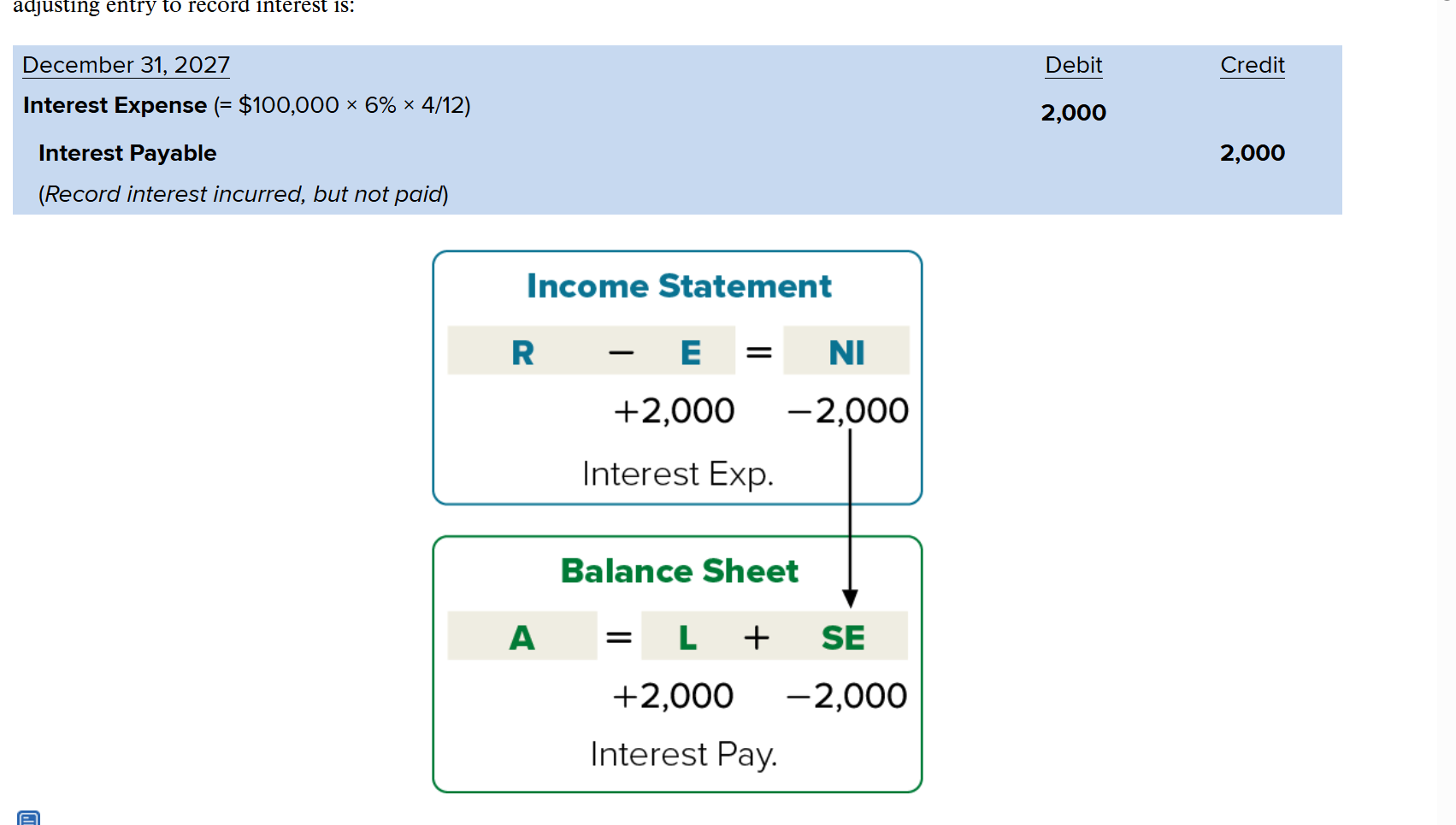
What’s the adjusting entry to record interest?
Debit: Interest Expense
Credit: Interest Payable
Caddell Corporation borrows $100,000 from a bank on August 1, Year 1, by signing an 8 percent, six-month note for the amount borrowed plus accrued interest due six months later on February 1, Year 2. Which of the following is recorded on August 1, Year 1?
A. $104,000 debit to Cash
B. $104,000 debit to Notes Payable
C. $100,000 credit to Cash
D. $100,000 credit to Notes Payable
D. $100,000 credit to Notes Payable
Windsor Corporation borrows $100,000 from a bank on November 1, Year 1, by signing a 9 percent, six-month note for the amount borrowed plus accrued interest due six months later on May 1, Year 2. What is the interest expense per month on this note?
INTEREST= Principle (Rate) (Time)
$100,000×9%×1/12=$750
Why is Interest Payable debited instead of Interest Expense on the repayment date?
Interest Payable was already recorded as Interest Expense in the prior year via an adjusting entry. Debiting it on the repayment date simply eliminates that liability — recognizing it again as Interest Expense would double-count it.
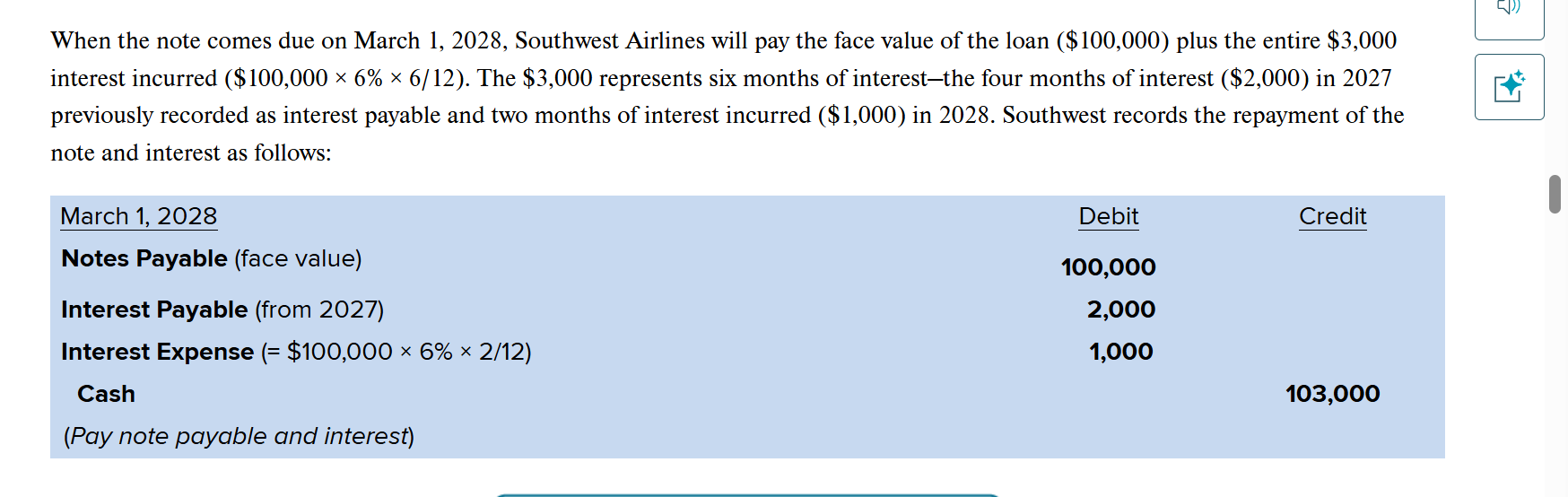
Why does Cash credited equal $103,000 and not just $100,000?
Because the borrower repays both the principal ($100,000) and the full six months of accrued interest ($3,000) simultaneously on the due date.
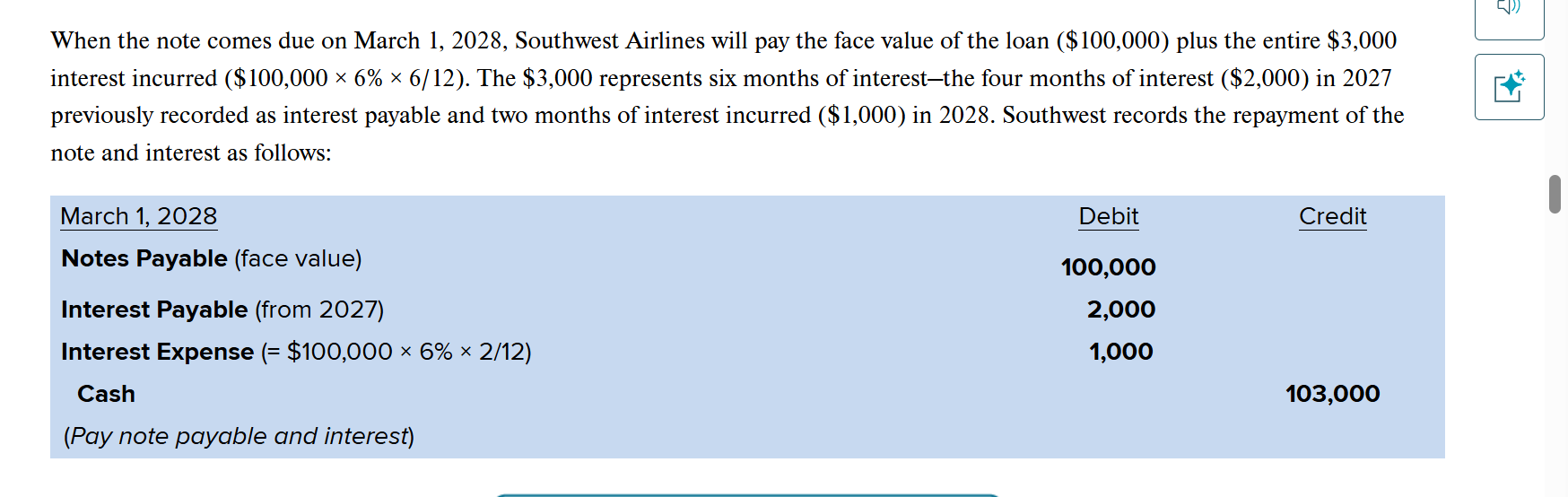
How do you split interest between two accounting periods?
Identify how many months fall in each year. Here, 4 months in 2027 ($100,000 × 6% × 4/12 = $2,000) and 2 months in 2028 ($100,000 × 6% × 2/12 = $1,000).
What is the journal entry to record repayment of a note when interest was partially accrued in a prior year?
Account | Debit | Credit |
|---|---|---|
Notes Payable | 100,000 | |
Interest Payable | 2,000 | |
Interest Expense | 1,000 | |
Cash | 103,000 |
What would the entry look like if no adjusting entry had been made at year-end?
Account | Debit | Credit |
|---|---|---|
Notes Payable | 100,000 | |
Interest Expense | 3,000 | |
Cash | 103,000 |
contingent liability
It is an existing uncertain situation that might result in a future loss.
Examples of Contingent Liability
Lawsuits
Product Warranties
Enviormental Problems
Premium Offers
The accounting treatment for a lawsuit depends on:
the ability to estimate the amount of payment
the likelihood of payment
How is contingent liability recorded on the adjusting entry?
Debit: Loss
Credit: Contingent Liability
When is the contingent liability recorded?
When the likleihood of payment is probable and the amount of payment is reasonably estimable
If the likelihood of payment, and the amount estimated is within the range of $5-$8 million, how should the contingent liability be recorded?
Record the minimum amount within the range. That being $5 million as a liability.
How do you find the warranty liability?
Estimated Warranty Liability = Sales × Expected Warranty Cost %
How do you record contingent liabilities for warranties in the journal entry?
Debit: Warranty Expense
Credit: Warranty Liability
What accounts would you use in the journal entry when recording actual warranty expenditures?
Debit: Warranty Liability
Credit: Cash
How to find the amount of actual warranty liability claims that have been paid?
Total Estimated Warranty Liability - Actual Warranty Expenditures
Contingent Gains
An exisiting uncertain situation that might result in a gain
When is a Contingent Gain recorded?
It’s recorded when the gain is known with certainty
Liquidity
How fast an asset can convert to cash in a relatively short time to pay currently maturing debts
What are the 3 measures of Liquidity
Acid-Test Ratio
Working Capital
Current Ratio
Working Assets
It’s the difference between Current Assets and Current Liabilities. Or how much money you’ll have left after paying off your liabilities?
Why is working capital not the best measure of liquidity?
It does not factor in the relative size of the company
Current Ratio Formula
Current Assets / Current Liabilities
What do current assets include?
Cash + Current Investments + Accounts Recievable + Inventories + Prepaid Expenses
What does it imply if the current ration is > 1?
Current assets exceed current liabilities — generally healthy
What does it imply if the current ration is equal to 1?
Just enough assets to cover liabilities — tight
What does it imply if the current ration is < 1?
Liabilities exceed current assets — potential liquidity problem
In general, the higher the current ratio, the greater the company’s liquidity. True or False?
True
What does it imply if the current ratio is 2?
For every $1 of liabilities, there’s $2 worth of current Assets
Acid Test Ratio / Quick Ratio
Similar to current ratio, It is based on a more conservative measure of current assets available to pay current liabilities.
Acid Test Ratio Formula
Quick Assets (Cash + Current Investments + Accounts Receivables) / Current Liabilities
Is Acid Test Ratio < Current Ratio?
Yes
What factors make the acid test ratio a more accurate measure for liquidity than the current ratio?
It does not factor in current assets such as inventory and prepaid expenses
What does the numerator in the acid base ratio tell us? Quick Assets (Cash + Current Investments + Accounts Receivables) / Current Liabilities
They are accounts that could be quickly be converted to cssh
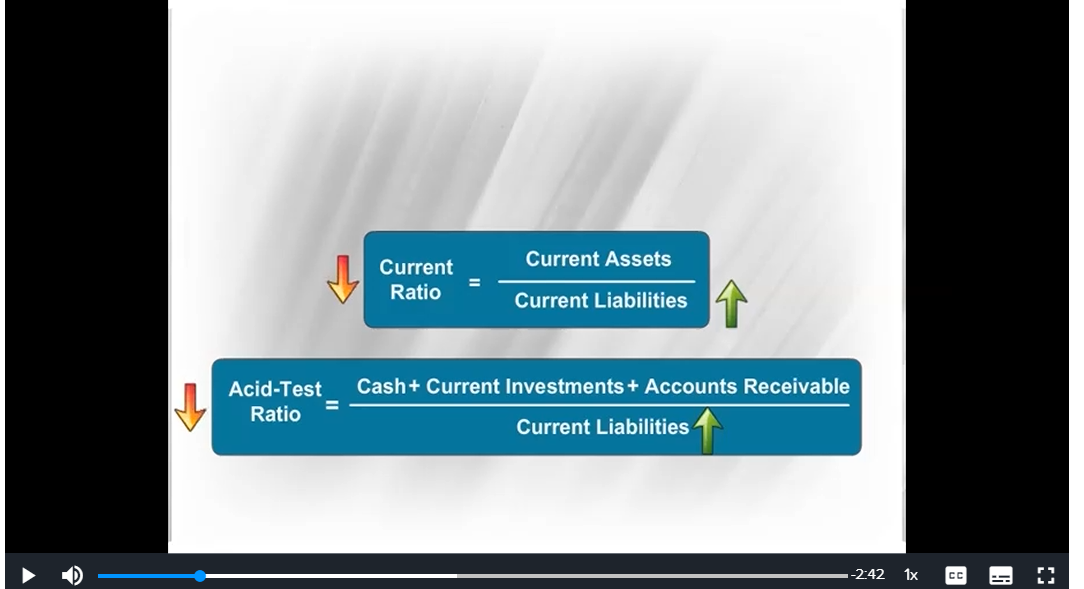
What happens when you increase current liabilities in both the current ratio and acid test ratio?
current ratio and acid test ratio will decrease