Week 3: Epidemiology & Understanding Rates
 Call Kai
 Learn
Learn Practice Test
 Spaced Repetition
 Match
Match Flashcards
 Knowt Play
1/49

There's no tags or description
Looks like no tags are added yet.
Name | Mastery | Learn | Test | Matching | Spaced | Call with Kai |
|---|
No analytics yet
Send a link to your students to track their progress
50 Terms
BEHAVIORAL LEARNING THEORY
-use of reinforcement methods to change learning habits
-give them a cookie bc they did it
cognitive theory
-use of sensory input and repetition to change pattern of thought and change behavior
-A person learning a new route to work creates a mental map using landmarks and directions. Over time and always walking to work, they remember and adjust the route based on experience. This shows learning through thinking, memory, and understanding
critical theory
-conversation ongoing to give ideas and change thoughts and thinking
-A student questions why some people get more opportunities than others and starts a conversation challenging unfair social systems to change thoughts and thinking
developmental
use of techniques specific to learners developmental stage to determine readiness to learn and impart knowledge (age based)
humanistic theory
-assist them to grow by emphasizing emotions and relationships and believe that free choice prompts them to take action in their own best interest
-let people learn from their own mistakes
social learning theory
links info to beliefs and values to change or shift expectations
-a student thought they cant be a nurse but saw their friend succeed and become a nurse When individuals observe others' experiences, the new information influences their beliefs and values, leading to a shift in expectations about what is possible for them.
visual learnner
-vision, seeing, videos, presentations, note taking, power point
-think in pictures
auditory learner
learn through verbal discussion, lectures and reading aloud
-through listening
-reading aloud
-interpret meaning while listening
tactile kinetic
Learn through doing and methods such as trial and error, hands-on approaches, and return demonstration. These learners gain "meaning through exploration."
health literacy
-consider needs and levels when developing interventions
-who do you teach? what do they know?
-what do you need to teach them
-dont wanna teach what they know and dont wanna be on too high of a level
-look at persons ability to understand health info
domains of learning
cognitive, affetive, psychcomotor
cognitive domain
-involves knwoledge and development of intellectual skills
-talking and lecturing (just the discussion part not the skill)
affective domain
Involves a change in attitude and development of values; for example, a client expresses acceptance of having a colostomy and maintains self-esteem.
-more about feeling and attitude
Psychomotor domain
involves the performance of a skill; for example, the community nurse teaches a client how to self-administer insulin.
-return demo
steps to teaching
-identify population
-identify needs
-assess what they already know
-assess readiness to lean
-pick a theory (behavioral for kids)
-indentify learning style
-indentify barrier
-deisgn educational program
-create smart goals
give educational material at
6-8 grade reading level so everybody can understand
objectives for goals
-short and long term
-short term-by end of shift
-long-by discharge
Defining Epidemiology
-Study of the distribution and determinants of states of health and illness in human populations
-used as a research methodology for studying states of health and illness
-also used as a body of knowledge that results from the study of a specific state of health or illness
Why it is important
•Individual and community assessments, using epidemiologic principles, form the database that provides the evidence and rationale for interventions.
Development of Epidemiology as a Science
Florence Nightingale devoted her life to the prevention of needless illness and death. (Nurse and Epidemiologist)
•Epidemiologic triad
3 things
host: succeptable person or organism (immunocompromised)(age)(genetics)
agent: what the person is in contact with (drug,poison, toxin, noise,virus,bacteria, high ir low temps)
environment: physical or social
wheel of causation
host at center and has social, physical or biological risk, patient has genetic core
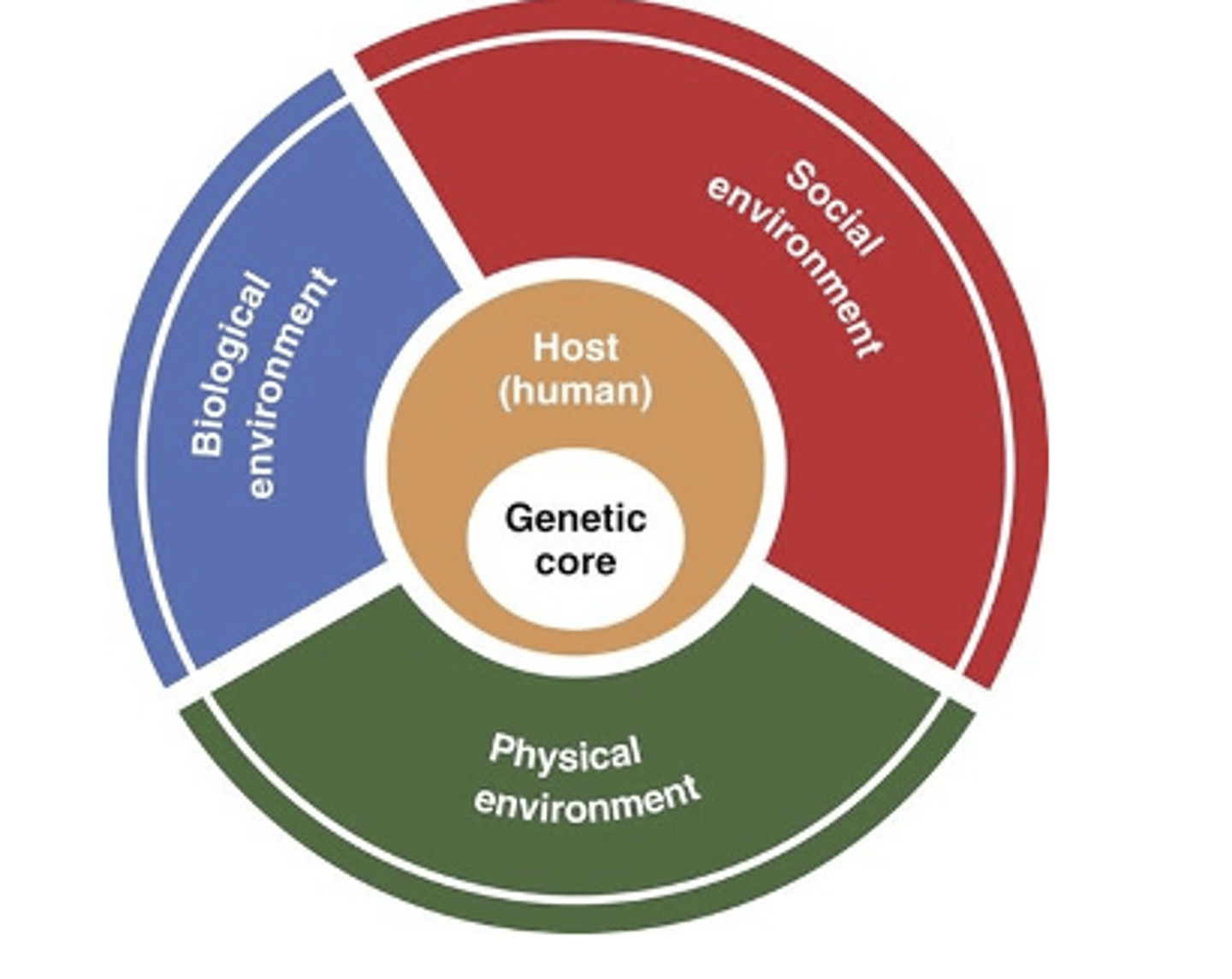
natural hx of disease
prepathogensisis, pathogenesis, or resolution (each with prevention level)
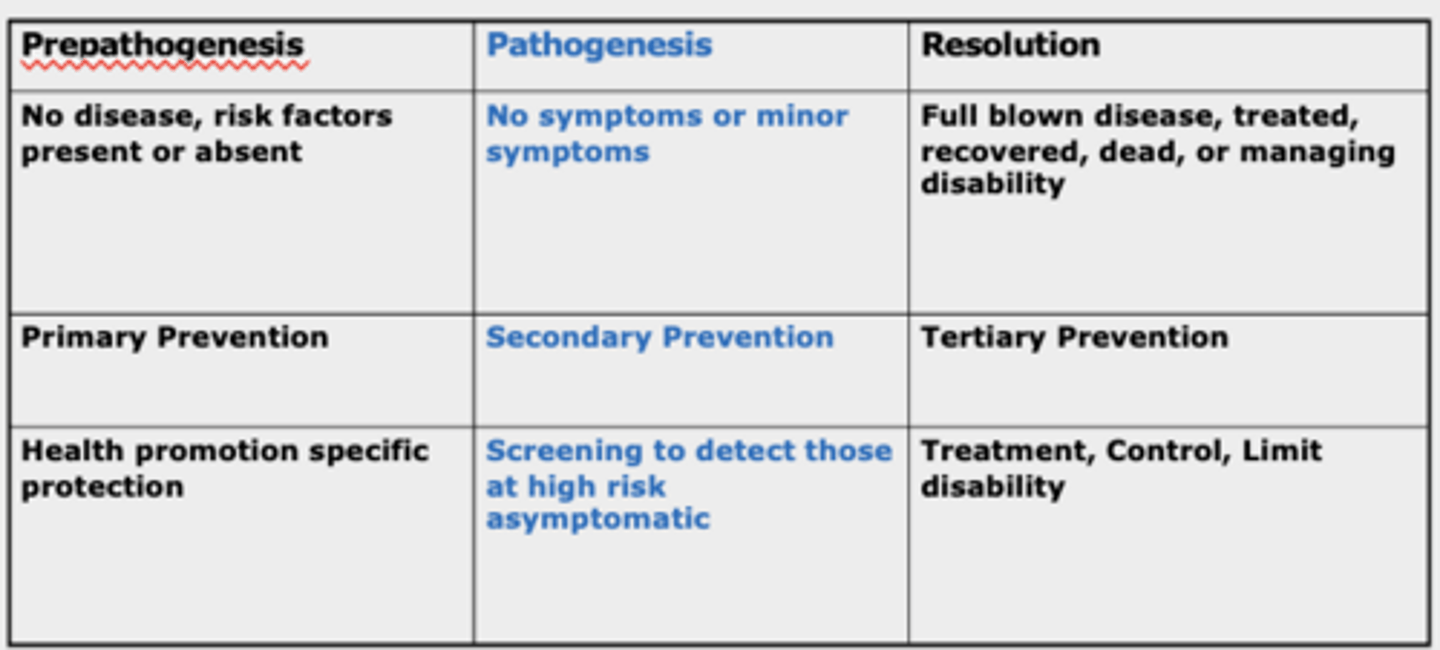
Applying Epidemiologic Principles in Practice
•Assessment of health needs and assets
-Individual assessment
-Community assessment
•Using assessment data for planning and implementing interventions
•Promoting healthy lifestyles
•Preventing and controlling outbreaks
•Contributing to a safe and healthy environment
•Evaluating the effectiveness of health services
•Mortality rate
death rate
•Morbidity rate
disease/illness rate (how many ppl are affected)
Prevalence rate
All cases of that specific disease
INCIDENCE RATE
NEW CASES (must be defined)
(part of total prevelence)
1. A state public health region reports the following:
40 new cases of Kawasaki in children 5-years-old and younger to date this year; 27,000 of the
population are 5 years old and younger.
The public health nurse (PHN) recognizes that the incidence per 10,000 of meningitis in this
region thus far for the current year is:
a. 14.81 per 10,000
b. 15 per 100,000
c. 1.48 per 10,000
d. 14.81 per 100,000
40 (incidence)/27,000= 0.0014814
0.0014814 x10,000= 14.81 per 10,000
endemic
expected level of disease in an area (predicted malaria in africa)
epidemic
over the expected prevalence (over the usual amount in africa)
pandemic
worldwide problem (malaria spreads over the world)
Vertical transmission
occurs through the sperm, placenta, vaginal contact during birth, or consuming human milk.
Horizontal transmission
occurs through contact with a person or objects the person has touched, the air, contaminated body fluids, food, and water (common vehicle), or living creatures like mosquitoes and snails (vectors).
The Zika virus is an example of an infectious pathogen than can be transmitted
vertically from mother to fetus or horizontally by contact with blood or secretions during sexual activity and by vector transmission through mosquito bite.
vector transmission
transmission of an infectious agent by an insect, arthropod, or animal
airborne
My chicken hez tb
measles, VZ, Herpes, tb
-small particles less than 3 mm and stay in air
-neg pressure room
Herd immunity:
Protection due to the immunity of most community members making exposure unlikely (vax most ppl)
Natural immunity:
-Natural defense mechanisms of the body to resist specific antigens or toxins
-active or passive
aquired immunity
-Resistance acquired by the host through actual exposure to the infectious agent
-active or passive
Active:
Production of antibodies by the body in response to infection or vaccination with a specific antigen (natural:gets sick) (aquired:vaccine)
-your body needs to make the antibodies
passive
Transfer of antibodies to the host either trans placentally from mother to newborn (natural passive) or through transfusions of immunoglobulins, plasma proteins, antitoxins (aquired passive)
-you are give antibodies
HIV/immunocompromised ppl doing tb skin test
if they have induration of 5 mm or more they are positive
for reg tb test person with no risk
15 mm or more is positive
for tb test reg person with risk
10 mm or more is positive
airborne:
particles transmitted by air to susceptible host via droplets or particles.
• Measles [airborne isolation precautions]
• Chickenpox [airborne isolation precautions]
• Tuberculosis (pulmonary or laryngeal) [airborne isolation precautions]
DROPLET
• COVID-19 [airborne isolation precautions]
• Pertussis [droplet isolation precautions]
• Influenza [droplet isolation precautions]
• Severe acute respiratory syndrome (SARS) [droplet isolation precautions]
• Common cold
Food borne
• Food infection (bacterial, viral, parasitic infection of food)
◦ Norovirus
◦ Salmonellosis
◦ Hepatitis A
◦ Trichinosis
◦ Escherichia coli (E. coli)
• Food intoxication (toxins produced through bacterial growth, chemical contamination, or disease-producing substances)
◦ Staphylococcus aureus
◦ Clostridium botulinum
water borne diseases
Illnesses caused by contaminated water sources.
-cholera
-hep a
directly observed therapy
ppl with tb
dot: wanna make sure they stick to their meds 6-12 mo observations