PCB4723C Exam 4
 Call Kai
 Learn
Learn Practice Test
 Spaced Repetition
 Match
Match Flashcards
 Knowt Play
1/291

There's no tags or description
Looks like no tags are added yet.
Name | Mastery | Learn | Test | Matching | Spaced | Call with Kai | Chat |
|---|
No analytics yet
Send a link to your students to track their progress
292 Terms
three muscle types
skeletal, cardiac, and smooth
striated muscle
skeletal and cardiac
voluntary muscle
skeletal
involuntary muscle
smooth and cardiac
unstriated muscle
smooth muscle
contraction of muscles
locomotory movement, manipulation, propulsion, emptying, heat, sound
skeletal muscle cells are
MUSCLE FIBERS!!! (LARGE!) formed by myoblasts, parallel bundles
myofibrils
NOT MUSCLE CELLS, but contractile elements!!
muscle fibers with a low percentage of myofibrils cannot generate _________
much tension, but can contract at high frequency for long times
myofibrils have both _____ and ____ filaments
thick and thin!
thick filaments
made of myosin, tails are intertwined with globular heads (each head has actin binding site and ATPase)
Thin filaments
Made of actin, tropomyosin forms strands that cover actin binding sites when relaxed. Troponin stabilizes tropomyosin in its blocking position
troponin three subunits
binds to tropomyosin, actin, and Ca2+
Striations in skeletal muscle!!!
A band, H zone, M line, I band, Z line, (+Sarcomere)
A band
consists of a stacked set of thick filaments and portions of thin filaments that overlap them
H zone
(lighter area in middle of A band) has only thick filaments with no overlapping thin filaments
I band
(in center of A band) holds thick filaments together
Z line
(in center of I band) is a flat cytoskeletal disc where thin filaments connect
sarcomere
is the area between two Z lines • Functional unit of skeletal muscle • 2.5 µm in width
during contraction thin filaments do what, which results in what?
thin filaments slide toward the center of the A band, resulting in shortening of the sarcomere
A BAND ALWAYS ____________ SIZE
stays the same
What happens when Ca2+ bonds to troponin?
It changes shape, resulting in binding sites on actin being uncovered.
What do myosin heads do during cross-bridge cycling?
They bind to actin.
What is the power stroke in cross-bridge cycling?
The cross-bridge bends 45 degrees inward, pulling the thin filament with it.
What happens to myosin after the power stroke?
Myosin detaches and attaches to a new site on actin.
How is shortening accomplished in muscle contraction?
By repeated cross-bridge cycles.
Ca2+ links
excitation and contraction
skeletal muscles are stimulated to contract by
ACh (acetylcholine) at neuromuscular junctions being released
after ACh is released at neuromuscular junctions what does it result in
action potential, conducted along the muscle membrane
after ACh is released at neuromuscular junctions and action potential is conducted, what happens
Surface membrane dips deeply into the muscle fiber to form a transverse tubule (T tubule) • Action potential enters the interior of the muscle fiber along the T tubules • Induces permeability changes in the adjacent sarcoplasmic reticulum
Ca2+ is stored where
in the lateral sacs of sacroplasmic reticulum in skeletal muscles
Elevated cytosolic Ca2+ results in
increased binding of Ca2+ to troponin (contraction)
during relaxation where and how is Ca2+ transported
back into sarcoplasmic reticulum by Ca2+-ATPase pumps (reduces levels)
tendons (in vertebrates)
attach muscle to bones
muscles attach to _________ (in arthropods)
ridges that project from the inner face of exoskeleton (apodemes)
Muscles are arranged in ______ pairs
antagostic pairs (flexors and extensors)
flexors
bend limb
extensors
straighten limb
if a muscle fiber is stimulated so rapidly that it has no chance of relaxing between stimuli, what happens and what is this called?
smooth sustained contraction occurs (Tetanus)
what does tetanus look like on a graph?
a bunch of staggered upwards movements until fatigue begins which straightens it out, action potentials looks like up down up down up down
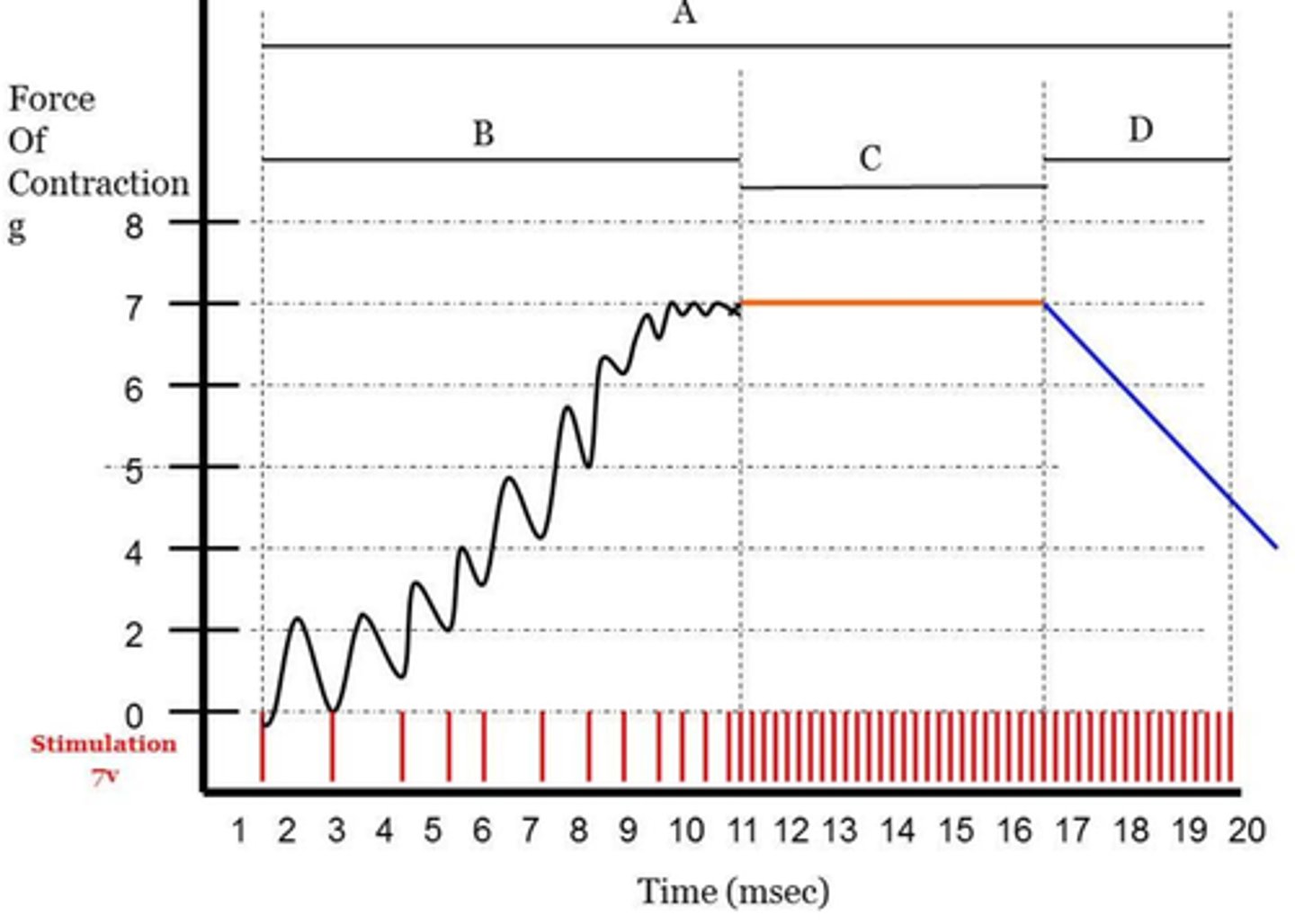
every muscle has optimal _____ at which _____ force can be achieved upon tetanic contraction
optimal length at which maximal force can be achieved
for a muscle to shorten during contraction tension must what
tension > load (forces that oppose movement)
isotonic contraction (flex?)
muscle shortens, tension remains constant, work is done (work=forcexdistance)
isometric contraction (nothing?)
-muscle is prevented from shortening
-tension develops at constant muscle length
-no work is done
Eccentric contraction (extend?)
muscle lengthens during contraction because it is being stretched by external force
if a person is not able to move their leg which of the 3 types of contraction might they be experiencing?
likely isometric contraction as no work is done and the muscle is prevented from shortening
the greater the load _______ velocity
lower
velocity is _______ when load exceeds tension (isometric contraction)
ZERO
hydrostatic skeleton
• A pressurized moving fluid can create largescale movement • Contraction of circular muscles surrounding a closed chamber of body fluid stiffens the body region around it • Longitudinal muscles shorten the chamber upon contraction and lengthen it when relaxed
What is a lever? (skeletal muscle)
A lever is a rigid structure capable of moving around a pivot point (fulcrum)
Bones are levers and joints are fulcrums
what is the power arm?
the part of a lever between the fulcrum and the point where an upward force is applied
what is the load arm?
the part between the fulcrum and the downward force exerted by the load
the lever system of the elbow joint
AMPLIFIES movements of the biceps into larger, more rapid movements of the hand
resilin (elastic protein)
store mucle-generated energy
function of creatine phosphate (vertebrates)
can donate phosphate to form ATP from ADP
phosphagens
creatine phosphate and arginine phosphate (nonvertebrates) ADP to ATP
oxidative phosphorylation
• Takes place in muscle mitochondria • Requires oxygen • Fueled by fatty acids or glucose • Rich yield (~30 ATP per glucose) • Multistep pathway requires more time • Used during light to moderate (aerobic) activity • Myoglobin stores oxygen in muscle fibers
fast-glycolytic fibers can function in anerobic conditions and has ____ resistance to fatigue
LOW RESISTANCE!
glycolysis yield
2 ATP per glucose
fatigue
decreased contractile responses of exercising muscle to stimulation
central fatigue involves
decrease in CNS stimulation of motor neurons
oxygen is needed for recovery of energy systems through oxidative phosphorylation
• Replenishment of creatine phosphate • Conversion of lactate into pyruvic acid and pyruvic acid into glucose • Replenishment of glycogen stores
skeletal muscle fiber types
slow oxidative, fast oxidative, fast glycolytic fibers
slow oxidative fibers (type I)
• 60 - 100 msec to peak tension • Lower myosin-ATPase activity • High resistance to fatigue
fast oxidative fibers (type IIa)
20 - 40 msec to peak tension • Higher myosin-ATPase activity • Intermediate resistance to fatigue
Fast-glycolytic fibers (Type IIb, IId, or IIx)
Similar to fast-oxidative fibers in speed and myosinATPase activity • Low resistance to fatigue • Mostly anaerobic (glycolysis
skeletal muscle has a high degree of
plasticity (can change shape without breaking)
endurance activities improve
oxidative capacity
high intensity activity stimulates
hypertrophy of fast-glycolytic fibers (increases diameter)
what hormone would be blocked to avoid muscle weakening
MYOSTATIN
Testosterone and growth hormone/IGF-I promote synthesis of
myosin and actin filaments
myostatin
negative regulator of muscle growth
disuse atrophy
unused muscle loses mass and strength
damaged muscle =
limited repair is possible due to ability to form new myoblasts
what is needed for flight
high force and high frequency
increased body temp allows for what in terms of ATP and Ca2+ pumps
rapid ATP synthesis and increased Ca2+ pump activity
mitochondria of birds and insects are ____ efficient
more! they allow for higher O2 consumption (flying animals/insects!!)
Flight - synchronous muscle contractions do what
power flight muscle of hummingbirds and large insects (HIGH POWER, LOW EFFICIENCY!)
Flight - asynchronous muscle contractions
longer duration, greater efficiency
afferent and efferent spinal neurons - spinal reflexes are important for
posture and basic protective movements
primary motorcortex
discrete mvoements of hands and fingers and voluntary motor control of the body
brain stem
regulation of overall body posture - involuntary movements of trunk and limbs
cerebellum
coordination and balance (involuntary)
muscle proprioceptors monitor what?
changes in muscle length and tension
muscle length is monitored by
muscle spindles
muscle spindles
monitor muscle length, bundles of specialized intrafusal fibers lying within spindle-shaped connective tissue capsules
changes in muscle tension are detected by
golgi tendon organs
golgi tendon organs
Endings of afferent fibers entwined within bundles of connective tissue fibers in the tendon • Frequency of firing is directly related to tension developed in the muscle • Afferent information reaches the level of conscious awareness of muscle tension
CHANGES IN MUSCLE TENSION
alpha motor neurons in spinal cord
afferent neurons synapse on these in spinal cord (CONTRACTION = result)
gamma motor neurons
initiate contraction of muscular end regions of intrafusal fibers to ADJUST TENSION in muscle spindles
stretch reflex purpose
resist tendency for passive stretch from gravity (UPRIGHT)
smooth muscle
walls of hollow organs and tuber, fibers are smaller and spindle-shaped (single nucleus), sheets,
thick, thin, intermediate filaments
arrangement of filaments
no striations
mechanism of smooth muscle contraction:
During excitation, cytosolic Ca2+ is increased • Ca2+ binds with calmodulin • Ca2+-calmodulin complex binds to and activates myosin light chain kinase (MLC kinase) • MLC kinase phosphorylates myosin • Allows myosin heads to interact with actin and cross-bridge cycling begins
What is unique to smooth muscle?
myosin light chain kinase (MLC kinase)
phasic smooth muscle
contracts in bursts triggered by action potentials that cause raise is cytosolic Ca2+
tonic smooth muscle
partially contracted at all times; varies based on cytosolic Ca2+ levels
multiple individual units must be __________ stimulated by nerves to contract
• Multiple (individual) units must be separately stimulated by nerves to contract
• Contractile activity is neurogenic and phasic
• Can be initiated by the autonomic nervous system
Single-unit muscle fibers are
• Single-unit muscle fibers are self-excitable and contract as a single unit (many together)
• Gap junctions electrically link neighboring cells (functional syncytium)
• Contractile activity is myogenic and may be phasic (pacemaker potentials) or tonic (slow-wave potentials)
• Modified by the autonomic nervous system
smooth muscle contracts slower and uses less energy than ______ muscle
skeletal