Ch.2 ~ Perspectives in Psychology
 Call Kai
 Learn
Learn Practice Test
 Spaced Repetition
 Match
Match Flashcards
 Knowt Play
1/56

There's no tags or description
Looks like no tags are added yet.
Name | Mastery | Learn | Test | Matching | Spaced | Call with Kai |
|---|
No analytics yet
Send a link to your students to track their progress
57 Terms
What were the two main criticisms of structuralism?
the problem of consciousness and levels and accuracy of self-report
gives no role to unconscious processes
Who created the psychoanalytic theory?
Sigmund Freud
in Austria
theory of personality
What was the goal of psychoanalysis?
gain access to the unconscious mind
aiming to treat disorders of the unconscious mind
What are the three layers of the mind discovered by Sigmund?
Id: all the person’s unrefined desires
Ego: keep all impulses of the Id in the unconscious, satisfy wants of Id by rationally determining it
Superego: morality, what’s right and wrong dictated by society
What is the Pleasure Principle?
governs the actions of the Id
the Id seeks pleasure regardless of anything else
What is the Reality Principle?
governs the actions of Ego
concerns itself only with rational appraisal not morality
What were the different methods Freud used to access the unconscious mind
Hypnosis
Free Association
“Freudian slips” (marry women not taking husband name, maybe implying she’s not in a happy marriage)
Projective Tests
*indirect methods
What is the manifest vs latent content?
*dreams represented the Id running free
Manifest: outward description of the dream
Latent: underlying true meaning of the dream that can only be interpreted by a skilled psychoanalyst
What is anxiety reduction?
ego employs defense mechanisms to try to keep out unwanted thoughts and desires
What is the type of energy of the struggle between the Id and Ego?
Psychic
What is repression?
*underlies all other defence mechanisms
the cornerstone
the unconscious forgetting of unacceptable drive, emotions and memories
What is denial?
person tries to deny a rude comment they hear of, claiming to never heard it
denying a symptom of a potential serious illness
**avoids awareness of something that will make them uncomfortable
What is displacement?
arises when a person doesn’t directly deal with a stressful situation
don’t or can’t defend themselves when bullied; feeling powerless
take out frustration in other ways but don’t address the problem
What is reaction formation?
when a person acts or behaves in a way that is completely opposite from how they feel
boy likes girls but teases, bullies and embarrasses her instead: can’t face true feelings
What is rationalization
when a person does something wrong (stealing), might avoid sense of guilt by rationalizing their behaviour
“I had to cheat because the questions were unfair”
What is projection?
someone thinking or behaving a certain way but accuses another of the same thing while the other is innocent
person in a relationship acting very jealous, accusing of cheating; but the person themselves is behaving that way
What is Sublimation
when a person takes unwanted thoughts and impulses into a sociable acceptable behaviour
liking to hit and cause pain to others, so they play a sport where they can do it legally
boxing or rugby
can allow a person to get ahead over time
Why can all the defence mechanisms be given in examples of children?
because they are all childish ways of dealing with your problems
Who was Alfred Alder?
known for individual psychology: we strive for superiority
first follower or Freud to break off
inferiority complex: never feeling good enough; succeeding: gaining that superiority
What are the two problematic parenting styles that Adler thought could form an inferiority complex personality?
Neglect: too much freedom to do what they want, don’t have boundaries, can’t trust others
Pampering: never given enough freedom, parents control every experience, child can’t make decisions on their own and don’t learn from experience, lack independence and very hesitant
What else could affect personality?
the birth order
First born: more problems, feel inferior, trust issues (attention taken away by second born)
Middle: compete with other siblings, not all attention on them
Last: overly pampered by everyone in the family, spoiled and overly dependent
Who was Carl Jung?
major follower of Freud
Analytic psychology
Interested in other cultures and societies
Believed we’re all apart of the collective unconscious: difficult to bring into consciousness
universal and inherited
What is proof Jung used for collective unconscious?
Archetypes
the nurturing mother
shadow: dark side of humanity, struggle of good and evil
male(anima) and female(animus) side of personality
What is the persona by Jung?
mask, and public image a person presents to the outer world
believes goal of life is to realize the self
What are the contrasts between Jung’s Introverts and Extroverts?
Intro: pre-occupied with internal world of own thoughts and feelings, socially reserved
Extro: embrace social situations, comfortable expressing themselves to others
What is Synchronicity according to Jung?
when two events happen at the same time they must have meaning
someone thinking about a friend that they haven’t seen awhile and the phone rings with news about the friend, or the friend calling themselves
Who was Karen Horney?
*followed Freud indirectly
interested in how people could develop problems from interpersonal relationships
What are the three problematic style Horney believed in?
Moving towards people: extremely dependent on others, have insecurity, seek to relief through relationships
needy, clingy, attention wanted, don’t give but only take
Moving against people
very hostile and controlling, take advantages of weakness, see people as objects
Moving Away from people: strong desire for privacy, independent, avoidant, find hard to get close
What were some problems with Freud and Neo-Freudian Theories?
Lack of empirical standards
Anecdotal/concrete evidence
Heavy Reliance on case studies (individual person)
Falsifiability: ability to show that a theory is false
What was the behaviorist theory a reaction to?
Introspection: too reliant on people
Functionalism: no reliable methods and standards
Freudian and Neo-Freudian theories
What was the goal of the behaviorist?
*outward, expressible behavior
measurable and observable
predictable
changeable
*not relying on people saying but what they do
Who was Ivan Pavlov?
studied digestion in animals: noticed dogs anticipated foods but excitement and salivating
discovered the behavior and reward
control and predict behavior through environmental cues
Who was John Watson?
goal was a total reorientation of psychology as a science of observable behavior only
very critical to a person’s thoughts being bias: subjective vs objective: painting vs photograph
How was Conditioned emotional responses shown?
by the Little Albert Experiment
proving that behavior could be learned through conditioning
What did B.F Skinner do?
more productive and disciplined researcher than Watson
shaped by environmental consequences of reward and punishment
Operant conditioning*
learned by teachers and parents
What was humanism?
slaves to our unconscious urges and desires
slaves to our environment
people reach their potential through greater self-awareness and understanding
What did Abraham Maslow believe?
*humanism: more positive aspect
a rich life is one where a person reaches their full potential
“self-actualization” by satisfying basic needs to deeply personal needs
What did Maslow’s hierarchy of needs look like?
growth need: never satisfied (finding friendship, self-esteem)
deficiency needs: can be met and satisfied (hungry? eat)
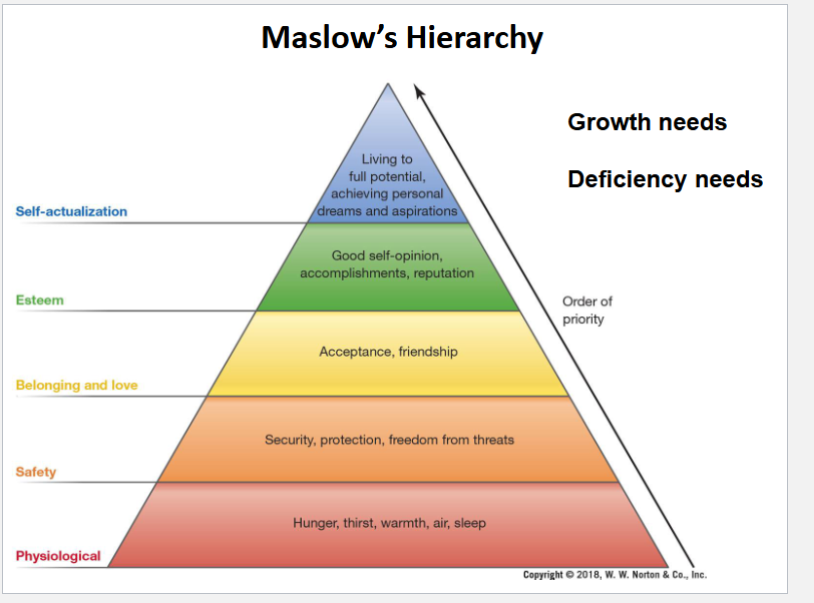
Who else supported Humanism and what did they believe?
Carl Rogers
personal responsibility
phenomenological: wanted to hear others’ view
realized that clients should arrive at their own decisions in therapy, etc.
What were the three cliental outcomes of Carl Rogers study?
Person-centered therapy
Unconditional positive regard: non-judgmental setting
Reflection: repeats clients thoughts back to themselves
What are the two types of the Self-Concept?
Congruence: how they view themselves is similar to how they are viewed in the outside world
Incongruence: self-concept becomes distorted and don’t see themselves as how the world sees them
What is subception?
hearing a comment opposite from what they thought they were: receiving info against their own perceived self-concept
What is distortion?
the defense mechanism one uses to maintain/protect the sense of their own self-concept
What is disorganization?
extreme incongruence
experience extreme anxiety
get defensive and guarded when their own self-concept was challenged
What are the four main elements of humanism?
Personal responsibility
responsibility = control of life direction
“here and now”
live life in the moment, don’t dwell in past
Personal experience
deciding actions one can take with their life
Personal growth
always evolving and trying to become the best versions of themselves
Who is a fully functioning individual?
open to new experiments, striving to live life to the fullest
comfortable with who they are
trust their own decisions
not restricted by opinions of others
What two types of therapy was a result of humanism?
modern counselling
group
What was Cognitive Revolution?
George Miller
concerned with mental functions, based on how we think, remember and make decisions
How many modern psychology disciplines are we focusing on and what are they?
*5
Social
Clinical
Developmental
Neuroscience
Cognitive
What is social psychology?
social cognition
examples are: workplace, social media, helping behavior, stereotypes and prejudice
What is clinical psychology?
addressing psychological struggles of children and adults
focuses on counselling therapy to diagnose and solve the problems
examples are: autism, attention-deficit disorder, depression
What is Developmental psychology?
how thinking changes how people age
examples: language development, reading, problem solving
What is neuropsychology?
brain processes when there are damages in the brain
examples are: Alzheimer’s, Parkinsons, epilepsy
What is cognitive psychology?
mental processes that the mind creates
examples are: perception, memory, thinking and reasoning
What is the modern view of the mind?
product of brain functioning: they’re connected
What is an example of nature and nurture working at the same time?
human speech
babies have the potential but need to learn by hearing it or else it won’t develop properly: need a proper environment
What techniques of psychology do we still use today?
self-report
unconscious processes
observable behavior