Lipids
 Call Kai
 Learn
Learn Practice Test
 Spaced Repetition
 Match
Match Flashcards
 Knowt Play
1/9

There's no tags or description
Looks like no tags are added yet.
Name | Mastery | Learn | Test | Matching | Spaced | Call with Kai |
|---|
No analytics yet
Send a link to your students to track their progress
10 Terms
What are lipids?
fats, oils, waxes, insoluble in water, most fats and oils are triglycerides
What are lipids made up of?
carbon, hydrogen, oxygen (lower proportion of oxygen than carbohydrates)
What are triglycerides?
Three fatty acids combined with glycerol, formed by esterification (condensation reactions, forms ester bond)
Properties of triglycerides
Large ratio of energy-storing carbon-hydrogen bonds compared to no. Carbon atoms so a lot of energy is stored in the molecule
High ratio of hydrogen to oxygen atoms act as a metabolic water source- releases oxygen when oxidised
Large and hydrophobic so are insoluble in water so wont affect water potential
Low mass to energy ratio so a lot can be stored in a small volume
What are phospholipids?
One fatty acid molecules is replaced by a phosphate molecule. Whilst fatty acid molecules repel water (hydrophobic), phosphate molecules attract water (hydrophilic)
What two parts is a phospholipid made up of?
Hydrophilic head which interacts with water (is attracted to it) but not with fat, and a hydrophobic tail which orients itself away from water but mixes readily with fat
Properties of phospholipids
2 charged regions so are polar
positioned in water so that heads are exposed to water and tails aren't forming a phospholipids bilayer membrane structure which makes up the plasma membrane around cells.
phospholipid structure allows them to form glycolipids by combining carbohydrates within the cell-surface membrane which are important in cell recognition
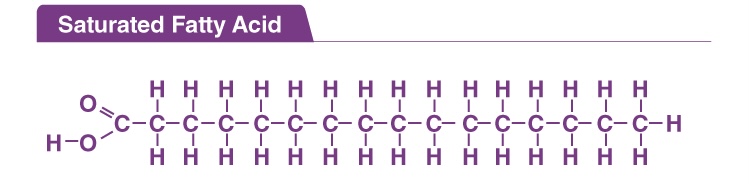
What are saturated fatty acids?
The hydrocarbon chain has only single bonds between carbons
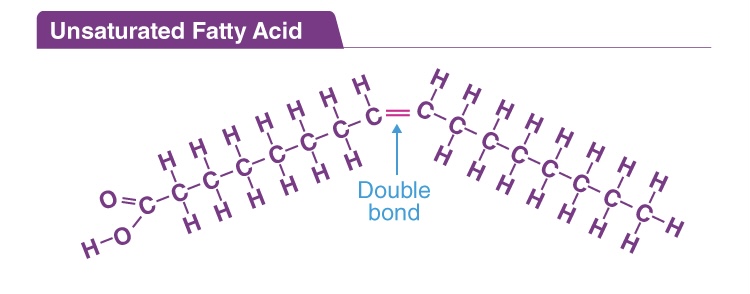
What are unsaturated fatty acids?
have one or more double bonds between carbon atoms
Cause bends/kinks in fatty acid tail so phospholipids further apart
Increase fluidity
Function of lipids
Protection of vital organs,
insulate the body
insoluble so prevent evaporation in plans and animals- waxy cuticle
form the meyelin sheath around some neurones
water source
source of energy as when oxidised provide more than twice the same energy as the same mass of carbohydrates