T2 - Coastal Landscapes and Change
 Call Kai
 Learn
Learn Practice Test
 Spaced Repetition
 Match
Match Flashcards
 Knowt Play
1/50

There's no tags or description
Looks like no tags are added yet.
Name | Mastery | Learn | Test | Matching | Spaced | Call with Kai |
|---|
No analytics yet
Send a link to your students to track their progress
51 Terms
Why is a coast an open system?
It receives inputs from outside and transfers outputs away from the coast into other systems like transferring water into the atmosphere
What is a sediment cell?
A self contained section of coastline where there are inputs, transfers and outputs
Give me examples of inputs, transfers and outputs in a sediment cell:
Inputs - Cliffs, offshore bars
Transfers - Longshore drift
Outputs - Spits, beaches
What is a negative feedback loop?
A stabilizing mechanic that lessens any change
Example
A storm erodes a lot of a beach
This causes lots of sediment to be deposited as an offshore bar when the waves lose their energy
This bar dissipates their wave energy which protects the beach from further erosion
Over time the bar gets eroded as a buffer while sediment can be added from longshore drift or wind
Then once the bar is gone dynamic equilibrium returns
What is a positive feedback loop?
A mechanic that exaggerates the change making it more unstable
Example
People walking over a sand dune destroying vegetation & causing erosion
The roots no longer hold sand together
The sand dune will be completely eroded eventually leaving more of the beach open to erosion & further from dynamic equilibrium
What is the littoral zone?
The area of the coast where land is subject to wave action
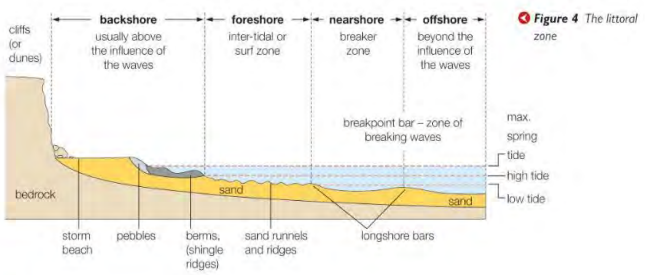
What are the 4 subzones in the littoral zone?
Backshore - The beach & parts that can be seen at low tide
Foreshore - Where wave processes occur
Nearshore - Where the water starts to get shallower from the sea
Offshore - The open sea
What are the 6 erosional processes?
Corrosion - Sand & pebbles are hurled against the cliff
Abrasion - Sediment is ‘rubbed’ along the coastline to slowly erode it
Attrition - Waves causing rocks and pebbles to hit each other & become rounder
Hydraulic action - A wave hitting a cliff face causing air to be forced into cracks which widens them
Solution - Mildly acidic seawater causing alkaline rock like limestone to be eroded
Wave quarrying - Breaking waves hit the cliff face & exert pressure to pull away rocks
What are the 5 factors that lead to erosion rates increasing?
High waves with a long fetch (distance wind has travelled over the wave)
Waves approach the cliff perpendicular
At high tide when they go further up the cliff
Heavy rainfall as water trickles down through permeable rocks to weaken it
If it is in winter as destructive waves are the largest & most powerful during winter
What are the 3 factors that can make rocks more vulnerable to erosion:
Rock type (sedimentary is more vulnerable compared to igneous & metamorphic)
Amount of cracks & fractures in the rock (leads to hydraulic action)
Lithology of the rock (the minerals that make up a rock)
How are stumps formed?
Caves are formed from widening faults in the base of a headland
The cave widens eroding into the side of a headland to make an arch
The arch will widen until it can’t support itself & leaves a stack on one side detached from the mainland
Erosion attacks the base of the stack till it collapses into a stump
What is a wave-cut notch/platform?
Erosion attack the base of a cliff to create a notch of eroded material between high & low tide
As this notch becomes deeper from weathering weakening the cliff at the top
The cliff becomes unstable and falls under its own weight
What is a blowhole?
A pothole on the top of a cliff from chemical weathering
And a cave at the bottom eroding deeper into the cliff face so the pothole deepens
When they meet a vertical channel is created for waves to travel into and up the cliff face
Explain the process of longshore drift:
Waves hit the beach at an angle determined by the direction of prevailing wind
The waves push sediment in this direction up the beach in the swash
Due to gravity the wave carries sediment back down the beach in backwash
This moves sediment along the beach over time
What are the 4 processes of transportation other than longshore drift?
Traction - Large sediment rolls along the sea bed & is pushed by currents
Saltation - Smaller sediment bounces along the sea bed being pushed by currents
Suspension - Small sediment is carried within the water
Solution - Dissolved sediment is carried within the water
What is swash-aligned and drift-aligned?
Swash-aligned is when waves approach parallel to the coast so there isn’t much longshore drift
Drift-aligned is when waves approach at a significant angle so there is longshore drift
Why does deposition occur?
When waves lose energy and can’t carry the sediment anymore
Gravity from the energy becoming low so heavy stuff is deposited first
Flocculation where clay clumps together making it denser so it drops
What are 5 depositional landforms?
Spits, a long narrow strip of land formed by deposition
Bars, a spit that crosses a bay and links up 2 sections of coast making a lagoon
Tombolo, a bar that connects mainland to an offshore island, formed from wave refraction of the coastal island to reduce velocity increasing deposition
Cuspate foreland, longshore drift along each side of a headland creating beaches which meet in the middle causing a triangle shape along the beach
Offshore bars, a region where sand is deposited off shore as the wave breaks early
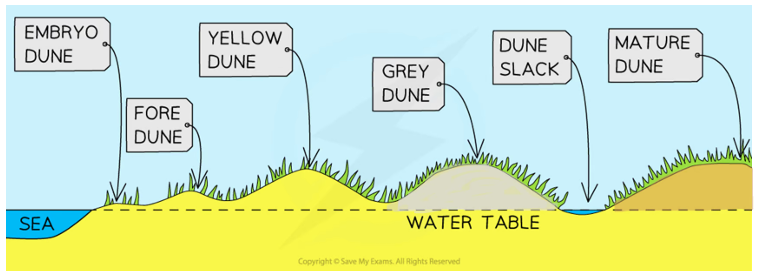
Explain Sand Dune & Plant succession:
Wind blows sand inland, plants stabilise them
Embryo dunes - Sand is trapped by debris & pioneer species begin to colonise, very fragile
Fore dunes - Embryo dunes give some protection, marram grass grows & has deep roots up to 3m, plants add organic matter to the dune making it more hospitable for plants
Yellow dunes - Marram grass dominates but more delicate flowers & insects are found, 20% of the dune is exposed
Grey dunes - Less than 10% of exposed sand, has more biodiversity, acidity and water is increased, shrubs appear
Mature dunes - The oldest and most stable dune found hundreds of metres from the shoreline
Explain Salt Marsh succession:
Low-energy environments where deposition occurs
They are behind spits & in estuaries where sediment settles & salt-tolerant plants colonise
Pioneer zone/mudflats - Low-lying muddy areas that are regularly flooded by the tide with little vegetation, salt-tolerant pioneer plants colonise
Lower salt marsh - Pioneer plants can survive with frequent flooding
Middle marsh - As the surface rises above the tide sea lavender colonises as the mud is deeper & there is more biodiversity
Upper marsh - Higher parts flood occasionally with grasses & shrubs colonising so more stable soils & less salty
What is mechanical weathering and 3 types of it:
Definition - The breakdown of rocks due to physical forces & no chemicals
Freeze-thaw - Water enters cracks in rocks, freezes & expands by 10% which puts pressure on the rock
Salt Crystallisation - As seawater evaporates, salt is left behind which grows into crystals over time which can corrode rocks from chemicals
Wetting and Drying - Clay expands when wet and contracts when drying which can cause coasts to dry up
What is chemical weathering and 3 types of it:
Definition - The breakdown of rocks through chemical reactions
Carbonation - Rainwater absorbing CO2 from the air to create a weak acid that reacts with calcium to be dissolved, acid rain reacts with limestone this way
Oxidation - When minerals become exposed to the air from cracks the mineral will become oxidised and increase volume causing it to crumble (how iron rusts)
Solution - When rock minerals like rock salt are dissolved
What is biological weathering and 5 types of it:
Definition - The breakdown of rocks due to the actions of plants, bacteria and animals
Plant Roots - Roots growing into cracks exerting pressure & splitting them
Birds - Puffins dig burrows into cliffs to weaken them
Rock Boring - Clams secrete chemicals that dissolve rocks
Seaweed acids - Some seaweeds contain acid which if hit against a rock will dissolve (kelp)
Decaying vegetation - Water that flows through decaying vegetation and over coastal areas will be acidic
What does the type of mass movement depend on?
The angle of the cliff
The rocks lithology and geology
The amount of vegetation on the cliff face
The saturation of the ground
What are the 2 types of mass movement?
Slides (sediment in the same place and the whole thing moves downhill)
Flows (all the material mixes)
Give me 3 types of mass movement (flows):
Soil creep - Movement of soil down hill
Solifluction - Top layers thaw during summer but lower layers stay frozen & the surface layer flows over the frozen layers
Mudflows - An increase in water content in soil can lead to mud flowing over rock
Give me 3 types of mass movement (slides):
Rock falls - Rock falls
Rock slides - Water between joints and bedding planes reduces friction and causes sliding
Slumping - When soil is saturated with water soft materials fall forming rotational scars
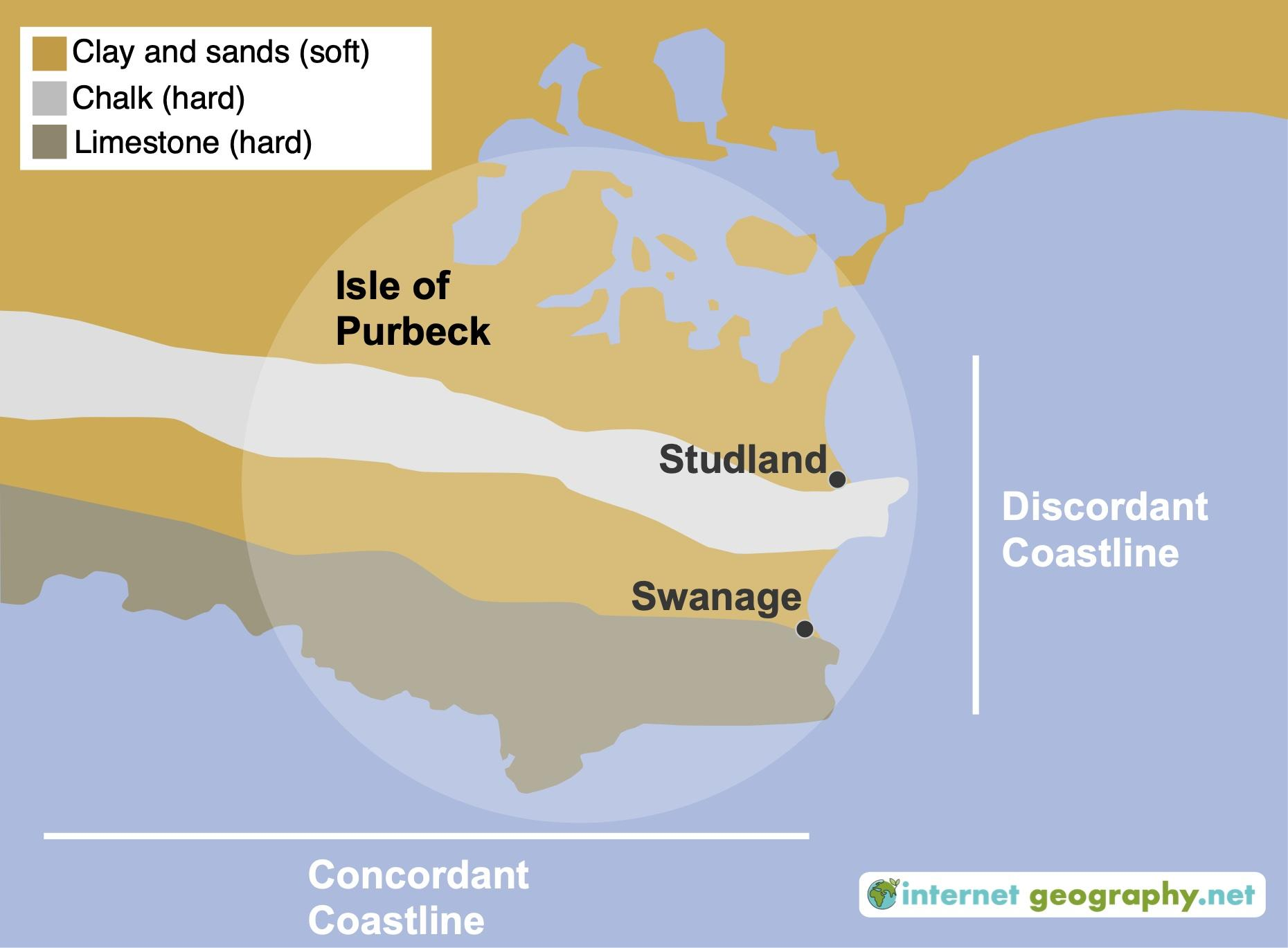
What is a concordant coastline? and an example of one
Where the rock strata (layers) run parallel to the coast
Normally bands of more resistant and then less resistant rock so different landforms form
Example - Dalmatian coast where rise in sea level floods areas between resistant rock
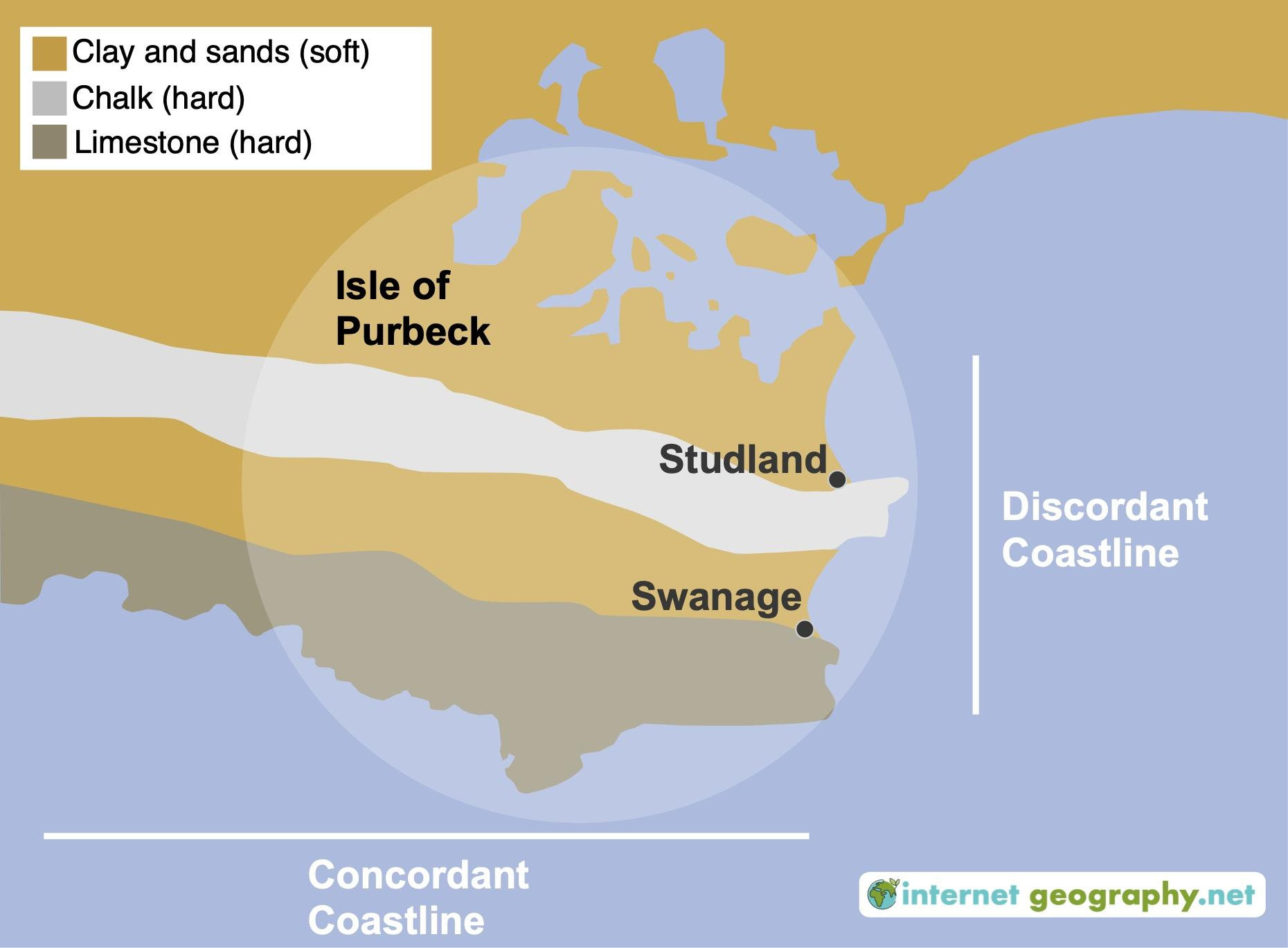
What is a discordant coastline? and an example of one
Where rock strata (layers) run perpendicular to the sea creating headlands and bays where less resistant rock erodes faster than more resistant rock
Example - The Jurassic coast (Dorset)
What is wave refraction?
Where waves turn and lose energy around a headland on an uneven coastline
What is plant succession?
The long-term change in a plant community in an area
E.g a salt marsh forming
Why is marram grass a good pioneer plant?
It is tough & flexible
It has adapted to reduce water loss through transpiration
Roots grow up to 3m deep and can tolerate up to 60°C
How can strength of a wave vary?
In summer there are constructive waves compared to destructive winter waves
Climate change means the UK can become stormier leading to an increase in destructive waves
Human activity can affect the sediment supply across an area
What is isostatic change?
Sea level change caused by post-glacial adjustments
Since the Ice Age Southern England has been sinking around 1mm a year
What is eustatic change?
The thermal expansion of water
Water expands when it gets warmer so the volume increases & sea level increases
What is coastalisation?
The movement of people towards the coast
Why may coastalisation increase?
Tourism
High-yield agricultural land
Housing pressure inland
Why does a storm surge occur?
When there is a short-term change in sea level due to low pressure during a tropical cyclone
What are the 3 factors affecting vulnerability to storm surges?
Subsidence (sinking) of the land
Removing natural vegetation like mangrove forests (Bay of Bengal)
Global warming as increasing surface temperatures increases the frequency & intensity of storms
What are environmental refugees?
People who are displaced due to coastal flooding
What are the 4 different approaches to coastal management?
Hold the line - Defenses are built to keep the shore where it is
Managed retreat - Defenses are removed or changed to move land inward
Advance the line - Defenses move the shore seawards
Do nothing - No defenses are put in place so the coast can erode
What factors affect the coastal management technique?
Economic value of the land & stuff being protected
Technical feasibility of putting in hard engineering
Ecological & cultural value of land like pre historic sites
What is the ICZM?
A holistic approach to a coastline as the entire sediment cell can be effected
Recognizes peoples livelihoods & make sure coastal management is sustainable
Must involve all stakeholders and working with natural processes
What is an SMP?
SMP - Shoreline management plan
Identifies all the activities that occur at the coastline
What is hard engineering?
Man made structures to prevent erosion
Effective at preventing erosion but at a high cost and with significant environmental impact
Likely to exacerbate erosion elsewhere
What are 2 examples of hard engineering?
Rip Rap (Rock Armor)
Large rocks that reduce wave energy while allowing water to flow through
Cost effective
Rocks are sourced from elsewhere so don’t fit in
Pose a hazard to people
Revetments
Wooden or concrete ramps that absorb wave energy
Cost effective
Ugly
Constant maintenance needed
What is soft engineering?
Defenses that work with the physical environment by using natural methods
What are 4 examples of soft engineering?
Beach nourishment
Sediment is taken from offshore sources to buildup the beach
Protects from cliff erosion
Increases tourist potential
Needs constant maintenance
Impacts on local coastal habitats
Cliff regrading & drainage
Reduces the angle of the cliff to stabilize it from rotational slumping
Cost effective
Cliff can collapse suddenly as it is drier
Can look unnatural
Dune stabilization
Marram grass is planted to kickstart dune stabilization
Cost effective & creates an environmnt
Planting is time consuming
Marsh creation
Managed retreat & allowing low-lying areas to flood
Creates a wildlife environment
No cost
Farmers lose ladn
How can coastal management be more sustainable?
Managing the natural resources already there
Creating alternative livelihoods for people who lose land
Educating communities on how to adapt
Monitoring the coastal changes & then mitigating
Managing flood risk/relocation
How can coastal management affect the sediment supply?
Building a sea wall will reflect wave energy downdrift & increase erosion somewhere else
Less erosion will occur in areas with a sea wall so there is less sediment in the area
Less sediment on the beach will expose the cliff to erosion
Groynes stop longshore drift so sediment isn’t moved away from one part of the coastline
What is terminal groyne syndrome?
Groynes trap sediment from longshore drift
Sediment builds up on one side of a beach
This starves the other side of the groyne
Without sand to protect it, wave energy hits the beach & erodes it