Topic 1 - Tectonic processes and hazards
 Call Kai
 Learn
Learn Practice Test
 Spaced Repetition
 Match
Match Flashcards
 Knowt Play
1/40

There's no tags or description
Looks like no tags are added yet.
Name | Mastery | Learn | Test | Matching | Spaced | Call with Kai |
|---|
No analytics yet
Send a link to your students to track their progress
41 Terms
Define a hazard
An event that has the potential to be a threat to human life, property and the environment
What is the OFZ?
What is the CFZ?
- The Oceanic Fracture Zone is a belt of activity through the oceans & along mid-ocean ridges, through Africa
- The Continental Fracture Zone is a belt of activtiy along the mountain ranges from Spain through the Alps, to the Middle East and to the Himalayas
How do convection currents work?
1. Heat from the inner core convects through the mantle to the asthenosphere
2. Hot magma rises due to it becoming less dense with heat
3. Magma is then cooler at the top as it is further away from the core and then becomes more dense, sinking back to the bottom
4. Cooler magma is then reheated and begins to rise again creating a convection current
What are the 4 layers of Earth?
- Crust (Lithosphere) - Uppermost layer, thinnest, least dense & lightest (oceanic crust = 7km thick & continental crust = 70km thick)
- Mantle (Asthenosphere) - A semi-molten layer where convection currents can occur, largely made of silicate rocks & is rich in iron. (Depth of 700-2890km below the crust)
- Outer core - Dense, semi-molten rocks containing iron & nickel alloys (Depth of 2890-5150km below the crust)
- Inner core - Dense & solid due to the extreme pressures from the cores high temperature (Depth of 5150km+ below the crust)
Why is the core so hot?
- Residual heat from formation, kinetic energy from the collision was converted to heat
- Radioactive decay of uranium-238
What happens at a destructive plate boundary with a continental and oceanic plate?
- The denser oceanic plate subducts below the continental, leaving a deep ocean trench
- The oceanic crust is melted as it subducts into the asthenosphere, extra magma is then created causing pressure to build up
- This magma forces through weak areas in the continental plate where explosive & high pressure composite volcanos erupt
- Fold mountains occur when sediment is pushed up during subduction
What happens at a destructive plate boundary with 2 oceanic plates?
- The heavier, older plate subducts leaving an ocean trench and fold mountains
- This built up pressure from the subducting plate entering the asthenosphere and heating up into magma causes underwater volcanoes to burst through
- Lava cools & creates new land called island arcs
What happens at a destructive plate boundary with 2 continental plates?
- Both plates aren't as dense so lots of pressure builds instead when they collide
- This causes a pile up of continental crust on top of the lithosphere due to the pressure between the plates, forming fold mountains e.g the himalayas
What happens at a constructive plate boundary with 2 oceanic plates?
Magma will rise between the gap left by the 2 plates sperating to form new land
Underwater volcanoes form as the magma rises
New land forms on the ocean floor by lava filling the gaps (sea floor spreading)
What is the evidence of seafloor spreading?
Every time new rock forms, the magnetic grains in the rock switch their alingment with north & south
There are therefore symmetrical bands of rock with alternating bands of magnetic polarity
What happens at a constructive plate boundary with 2 continental plates?
Any land in hte middle is forced apart, leaving a rift valley
Volcanoes form where magma rises
Eventually the gap (rift valley) will fill with water & seperate from the other island
What is ridge push?
Gravity acting on the slope created when plates move apart, pushing the plaates further away & widening the gap
What is slab pull?
When a plate subducts, the part that is sinking pulls the rest of the plate with it to cause more subduction
What happens at a conservative plate boundary?
2 parallel plates move at different speeds & in different directions
When they rub against eachother, pressure builds up
For oceanic crust this displaces a lot of water
For continental crust, fault lkines occur with the ground being cracked
What is the focus & epicentre of an earthquake?
Focus - The point underground where the earthquake originates from
Epicentre - The area directly above the focus on the ground
What are characteristics of primary waves?
Travel through any state of matter
Longitudinal
Vibrates in the direction of travel
4-8km/s
What are characteristics of secondary waves?
Transverse
Travel only through solids
2.5-4km/s
What are characteristics of love waves?
Near to the surface
Cause the ground to shift side to side
Travel 2-4.5km/s
What are characteristics of rayleigh waves?
Near to the surface
Cause the ground to shift up & down
Longitudinal
1-5km/s
What seismic waves are the most destructive?
S-waves & L-waves as they have large amplitudes but are at different speeds to have a delayed impact
What is soil liquefaction?
Water moisture within the soil separates from the soil & rises to the surface
This causes soil to behave like a liquid
What are landslides?
Unconsolidated material or loose rocks collapsing
How is a tsunami formed?
When an oceanic crust is jolted, all the water above gets displaced upwards
This water then gets pulled back down due to gravity, causing it to act like a wave
The wave travels fast but with low amplitude
As the sea level decreases there is friction between the sea bed & waves
This causes the waves to slow down & gain height
What makes a country vulnerable to a tsunami?
High population density
Little coastal defences
Long duration
Large wave amplitude & long fetch
Slow gradient
Small beach
Primary hazards from a volcano:
Lava flows
Pyroclastic flows (mixture of rock,lava,ash & gases moving across the surface)
Tephra (volcanic rock) and ash flows blasted into the air to land on buildings
Volcanic gases (sulphur dioxide & carbon monoxide)
Secondary haards from a volcano:
Lahars
Rock,mud & water traveling down the sides of volcanoes
Occur when the heat of the eruptio causes snow & ice to melt or when there is heavy rainfall
Jokulhaup
Snow & ice in glaciers melt after an eruption causing sudden floods
Acid rain
Sulpfur dioxide in the atmosphere
What is a disaster?
A serious disruption of the functioning of a community involving human, material, economic & environmental losses that exceeds the ability of the affacted community to cope using its own resources
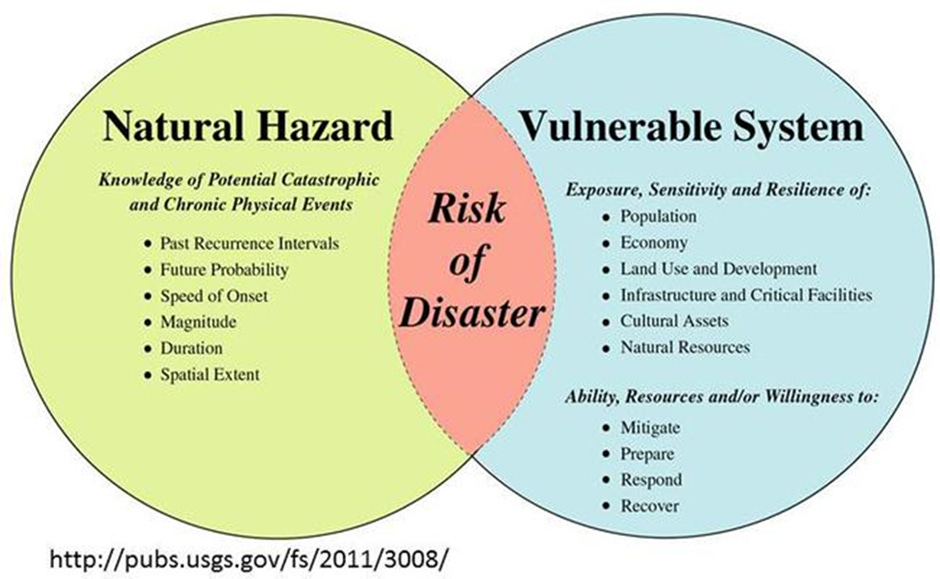
What is the hazard risk equation?

What is Degg’s model? & What does it show?
A hazard becomes a disaster if it is met by a vulnerable population
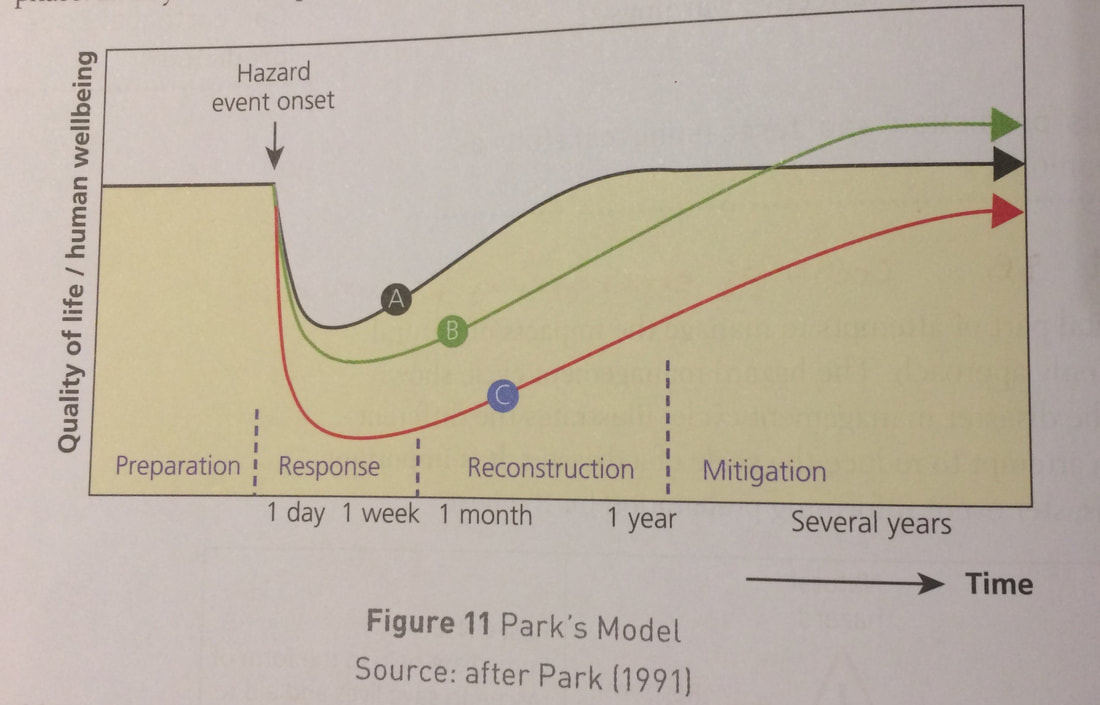
What is the Park Model? & What does it show?
Shows the importance of recovery & compares different events
Curve A = Small impact on QoL & a short response time as QoL improves quickly after a few months
Curve B = Medium impact on QoL as reconstruction takes longer but mitigation improves QoL so the community has improved
Curve C = Major impact on QoL as a slow reconstruction phase means even year slater QoL has not returned to pre-disaster levels
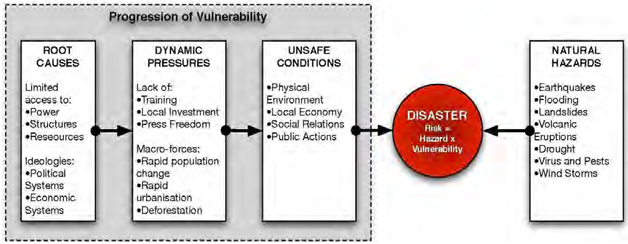
What is the PAR model? & What does it show?
Analyses factors that make a population vulnerable to a hazard going from countrywide, to county, to individual
Root causes - Caused by underlying economic, demographic, political processes
Dynamic processes - Local economic/political factors
Unsafe conditions - Physical conditions that affect an individual
What is a hazard profile?
A description of a hazard that outlines its physical characteristics & important figures about the hazard
What is VEI?
The volcanic explosivity index measures the relative explosiveness of a volcanic eruption based on the height of ejected material & duration of the eruption. It ranges from 0 to 8 logarithmically
What is the Modified Mercalli Scale?
Measures the destructiveness of an earthquake subjectively, the scale varies from I to XII and only measures physical impacts like furniture moving or houses collapsing
What is the moment magnitude scale?
Measures the amount of energy released in an earthquake from 0-9
What is the richter scale?
Measures the amplitude of the waves produced during an earthquake & is logarithmic from 1-10
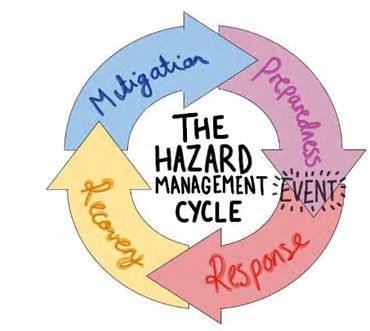
What is the hazard management cycle?
Preparedness - Being ready for an event to occur (public awareness & training)
Response - Immediate action taken after an event (evacuation & medical assistance)
Recovery - Long-term responses (reconstruction)
Mitigation - Strategies to lessen effects of another hazard (warning signals & observatories)
How can volcanoes be predicted?
Small earthquakes around the time
Changes to the top surface of a volcano swelling up
Changes to the gradient of the volcano as it swells up
How does modify the event work for an earthquake, tsunami & volcano
Earthquake
More public buildings to shelter people
Infrastructure is reinforced
Private homes are improved
Tsunami
Tsunami walls but only up to a certain amplitude
Replanting coasts with mangroves & a large beach
Volcano
Diverting lava flows
Reinforcing house roofs
What are the 3 different approaches to managing a tectonic hazard & reducing its impact?
Modify the event
Modify the vulnerability
Modify the loss
How does corruption affect the vulnerability of an area?
Money may not be directed towards hazard preparedness
Inequality can lead to more deaths
Lack of transparency can affect foreign aid