Production and conversation
 Call Kai
 Learn
Learn Practice Test
 Spaced Repetition
 Match
Match Flashcards
 Knowt Play
1/18

There's no tags or description
Looks like no tags are added yet.
Name | Mastery | Learn | Test | Matching | Spaced | Call with Kai |
|---|
No analytics yet
Send a link to your students to track their progress
19 Terms
What are literal meanings in conversation?
Relatively stable meanings of words and sentences.
What are socially implied meanings in conversation?
Depends on speaker, speaker’s understanding and views of the listener, the context/situation, goals, etc
What is syntax?
The parts of speech of words and the rules for combining them in order.
E.g. pronoun, verb, adverb
Why is conversation harder than just alternating between decoding and producing speech?
Utterances carry both literal and socially implied meanings.
How might ‘it snowed overnight’ carry both literal and socially implied meaning?
Literal → Snow fell during the night
Socially implied → if texted to a colleague, travel may be difficult.
How might expectation foster conversation?
Proposed expectations that people may hold and that may help explain how people navigate the demands of conversation
Speakers try to get listener to understand something → Listener is trying to interpret what speaker says guided by expectation that speaker is making effort to communicate intentionally.
What is expectation: Quality?
Speakers usually try to say things they believe are true, e.g. paths outside are icy
Violations prompt search for non-literal meaning → literal meaning obviously false, so infer a non-literal meaning.
What is expectation: Quantity?
Give enough information and do not offer unnecessary extra information.
E.g. have the main paths been cleared yet? → Yes
Extra information is often treated as meaningful rather than accidental.
What is expectation: Relevance?
Say things that are relevant to current communicative situation/goal.
E.g. If someone says, “Sorry I was late, it snowed overnight,” listeners usually connect the two ideas.
The utterance is understood as explaining the lateness, not as a random weather comment.
What is expectation: Manner?
Speakers try to be clear and avoid unnecessary obscurity
E.g. the paths are icy → main point is that paths are icy.
Very obscure wording can make listeners wonder why the speaker chose it → can prompt a search for a non-literal meaning, such as joking or sarcasm.
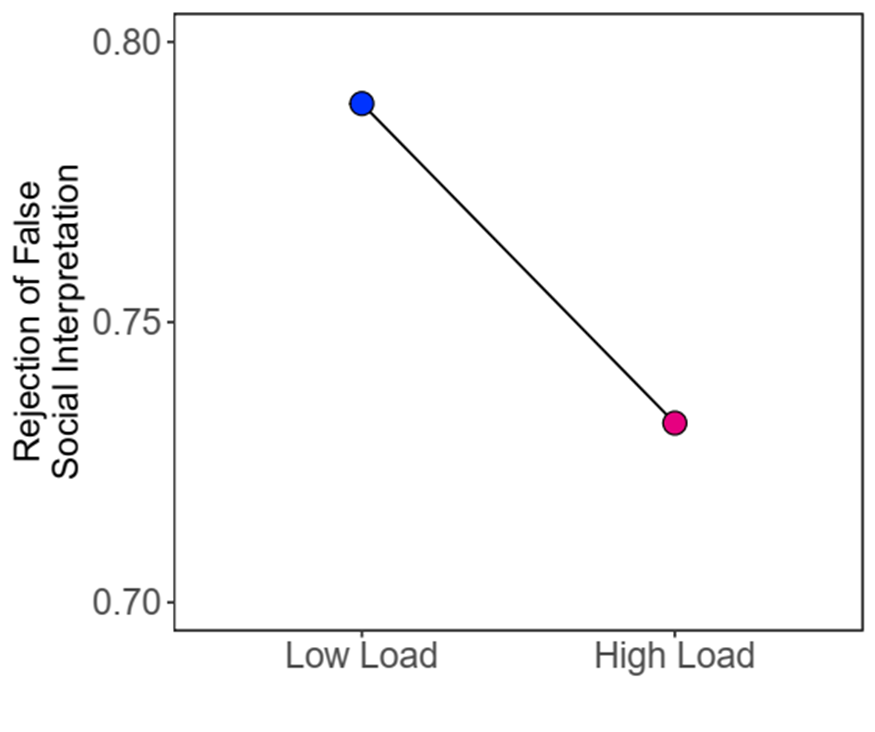
What did De Neys & Scheaken (2007) find in a study using sentences with true literal meanings and false socially implied meanings while manipulating WM cognitive load?
e.g. some oaks are trees
Literal → at least some, possibly all oaks are trees (true)
Socially → some but not all oaks are trees (not true) → should reject as false if automatically processed.
People made and rejected social interpretation around 75% of the time.
But people made the social interpretation less often under cognitive load.
Suggests social interpretation is not automatic, appears to take extra effort when cognitive resources being used.
What did Keysar et al (2000) find in an eye tracking study of whether listeners take the speaker’s perspective into account?
Studied involved a shelving unit display but some shelves were blocked from speaker’s view and listener could see all shelves but also which ones were blocked for speaker. Then confederate speaker had to ask listener to move objects on shelf in different perspective taking contexts → E.g. move truck down one shelf (only one truck) vs move candle up one shelf (small and big candle visible to listener but only small visible to speaker).
Listeners usually did choose item that matched the speaker’s perspective but this was not automatic → first drawn to item that matched their own perspective.
Suggests not automatic, takes time and effort.
What is the speaker’s burden?
In conversation, speakers may not go straight from meaning to speech → may also take listener into account when formulating a message and choosing words.
Takes effort
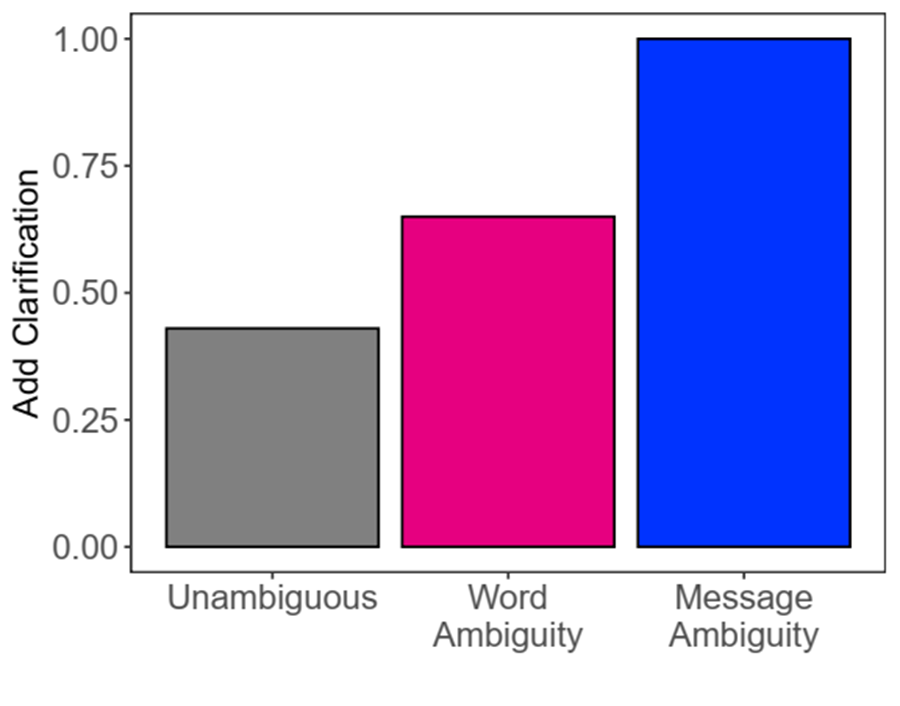
What did Ferreira et al find in a study of whether speakers take the listener’s perspective into account?
Study involved speaker and listener looking at picture displays where speaker’s job was to tell listener to mark items in particular order:
Unambiguous condition → e.g. bat, goat, swan
Message ambiguous condition → e.g. two similar bats (small vs big) and swan
Word ambiguous → e.g. baseball bat, animal bat and swan.
Message ambiguity condition → almost always clarified
Word ambiguity → clarified some of the time but not all of the time → suggests avoiding word-level ambiguity is harder than avoiding message level ambiguity
Unambiguous → sometimes added extra clarification
How are listeners active not passive?
Following along: nods, ‘mhm’
Confusion: facial expression, interject with questions.
Evidence speakers use cues from listener → speakers pronounce potentially confusable words more distinctly after receving feedback that listener has misunderstood them.
What is common ground in effective communication?
Shared understanding of what we’re talking about, what we both know, what we’ve discussed so far, etc.
Which level of speech and word processing can common ground be though of as overlap?
Level of meaning → cannot be transmitted directly so has to be built up during interaction
What did Brennan and Clark find in a study investigating common ground using card matching game?
One ppt was director, other was matcher. Director had to choose words to refer to pictures clearly enough for matcher to arrange them. Some pictures could be described with same terms, e.g. white dog vs black dog so directors sometimes had to add clarity to avoid ambiguity. What was shown when ambiguity disappeared?
Directors tended to keep using same clarified term even after ambiguity was gone
Suggests term had become part of shared common ground for that pair
But when matcher changed, speakers tended to abandon previously established term → suggests tied to one conversational partner
What did Branigan, Pickering and Cleland (2000) find in a study of syntax structure and interactive alignment?
Study involved confederate describing pictures using particular syntactic structure and seeing if ppt would copy on next turn → e.g. girl gives boy a book vs girl gives a book to boy.
Ppts tended to reuse syntactic structure they had just heard
Happened even when describing a different picture with different words
Evidence for syntactic alignment