bipn 100 final
 Call Kai
 Learn
Learn Practice Test
 Spaced Repetition
 Match
Match Flashcards
 Knowt Play
1/92

Earn XP
Description and Tags
starting card 66 is past mt material*
Name | Mastery | Learn | Test | Matching | Spaced | Call with Kai |
|---|
No analytics yet
Send a link to your students to track their progress
93 Terms
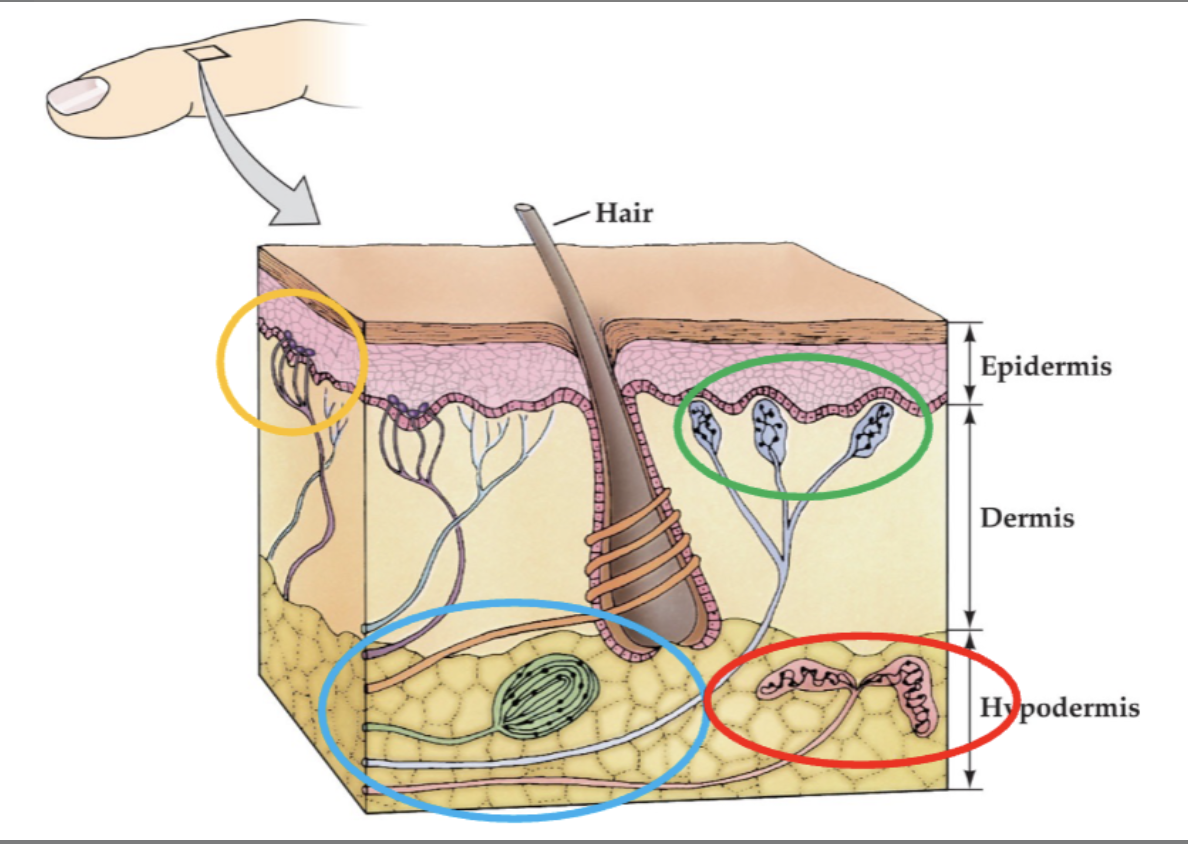
Skin - Variety of Receptors for Touch
Merkel disks - fine texture, ____
_____ corpuscle - fine mechanical sensitivity
Deep subcutaneous tissues:
Pacinian corpuscle - ____; sensitive to ____
Ruffini’s ending - detect ____ of skin when we move fingers or limbs
pressure; Meissners; vibrations; textures; stretching
Type of stimulus WITHIN a modality is coded by:
____ _____ - different pathways process different types of stimuli
labelled line
Location mapping
relative mapping of receptors in ____ SOMETIMES maintained in CNS
periphery
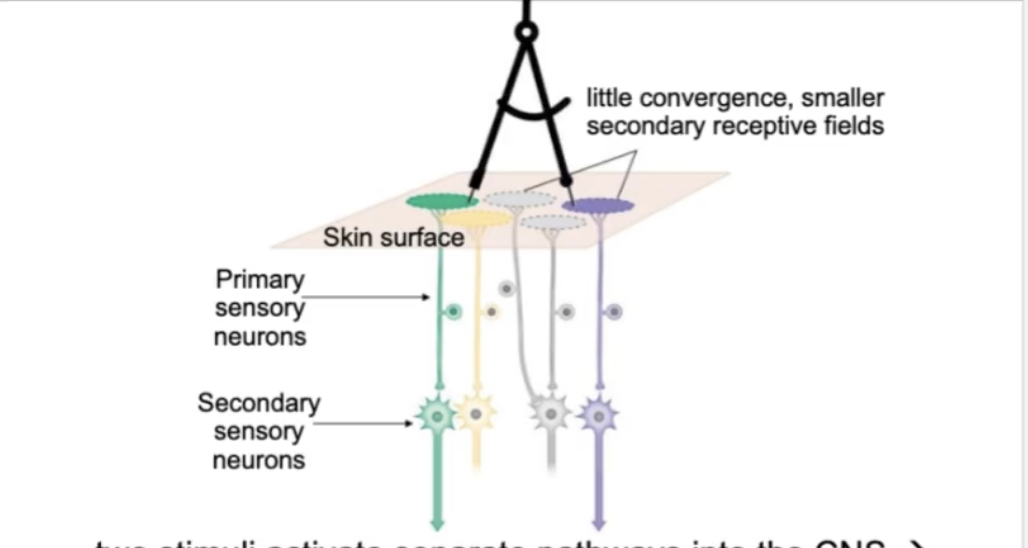
Receptive Fields
SMALL receptive fields are found in ___ senstive areas (ie fingertip)
two stimuli activate separate pathways into the ___ → two points are perceived as _____
more; CNS; distinct
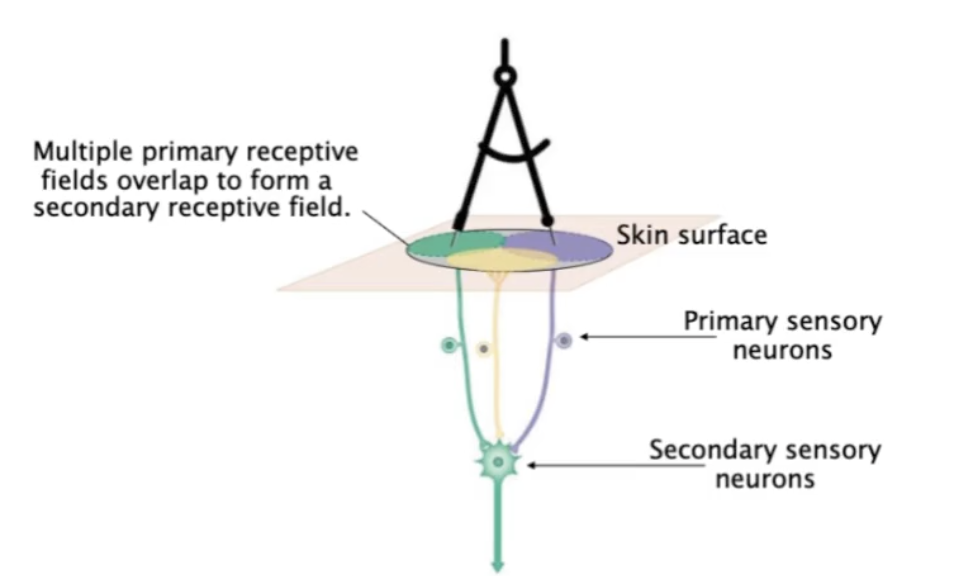
Receptive Fields
Convergence creates ____ receptive fields
two stimuli fall within a ____ receptive field → two points are received as ____
large; secondary; single
Type of receptor
_____ respond for the DURATION OF A STIMULUS
as long as a signal is there, ap will be triggered → continue to communicate with your brain → constantly aware of what that stimulus is
____ ADAPT to a constant stimulus
ap stop once the stimulus is ID, typically not harmful stimulus; ex. glasses on face all day
tonic; phasic
Thermal Receptors
cool receptors: __
Warm receptors: __
heat NOCICEPTORS: __
Cold nociceptors: __
____ are for detecting PAIN
Aδ; C; Aδ; C; nociceptors
Thermal Receptors
have free nerve endings for cool and warm receptors
____ ___ - temperature sensitive ion channels
have ____ cold receptive fields than warm receptive fields
Thermo TRP; MORE
Thermal Receptors
Aβ
____ aka fast
____ aka touch
temperature (___)
Aδ
_____ aka fast
____ aka for pain
temperature (___)
___ pain
C fibers
_____ aka slow
____ aka for pain
temperature
___ pain, burning pain or itch
myelinated; mechanical; non-pain; myelinated; nociceptor; painful; sharp; unmyelinated; nociceptor; dull
Spinal Cord
Levels
cervical: ____ - ____; affects ____
thoracic: ___ - ____; affects _____, ____, ____
lumbar: ____ - ____; affects _____
sacral ____ - ____
C1; C7; arms; T1; T12; abdomen; trunk; legs; L1; L5 legs; S1; S5
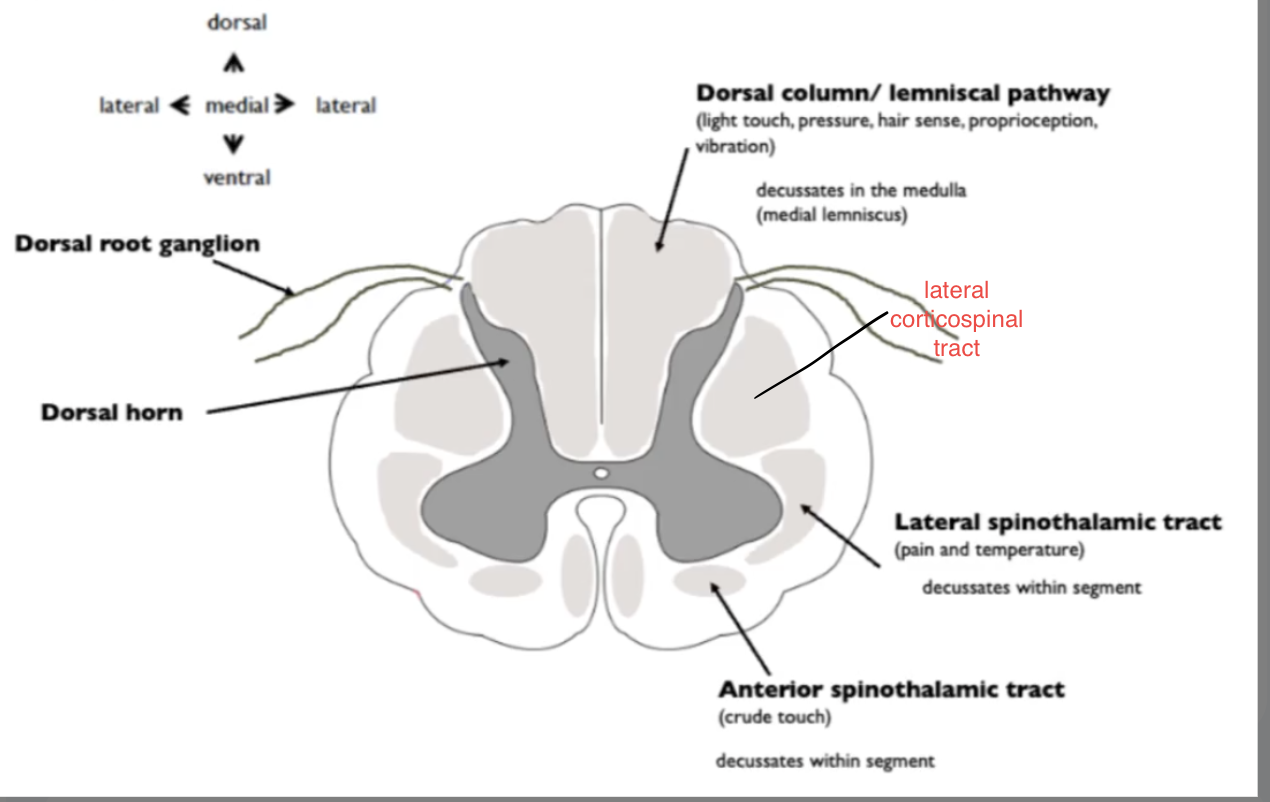
Spinal Cord
____ ____
light touch, pressure, vibrations, proprioception aka being aware of body’s location
_____ spinothalamic tract - pain and temperature
____ spinothalamic tract- crude touch
dorsal - _____
ventral - ____
RMBR: dorsal fin of orca is the TOP fin, ventral is BOTTO
dorsal column; lateral; anterior; sensory; motor
TOUCH pathway
__ primary afferent neuron
the primary afferent neuron comes into the ____ root ganglion
decussates in the brainstem - _____
the secondary order neuron ascends _______ (on the same side)
dorsal column
Aβ; dorsal; medulla; ipsilaterally
PAIN pathway
__or _ ____receptors (depdends on the stimulus)
the primary afferent neuron comes into the ___ root ganglion
decussates in the same segment of the ____ ___
and the secondary neuron ascends _____ aka on the opposite side
Aδ; C fibers; dorsal; spinal cord; contralateral
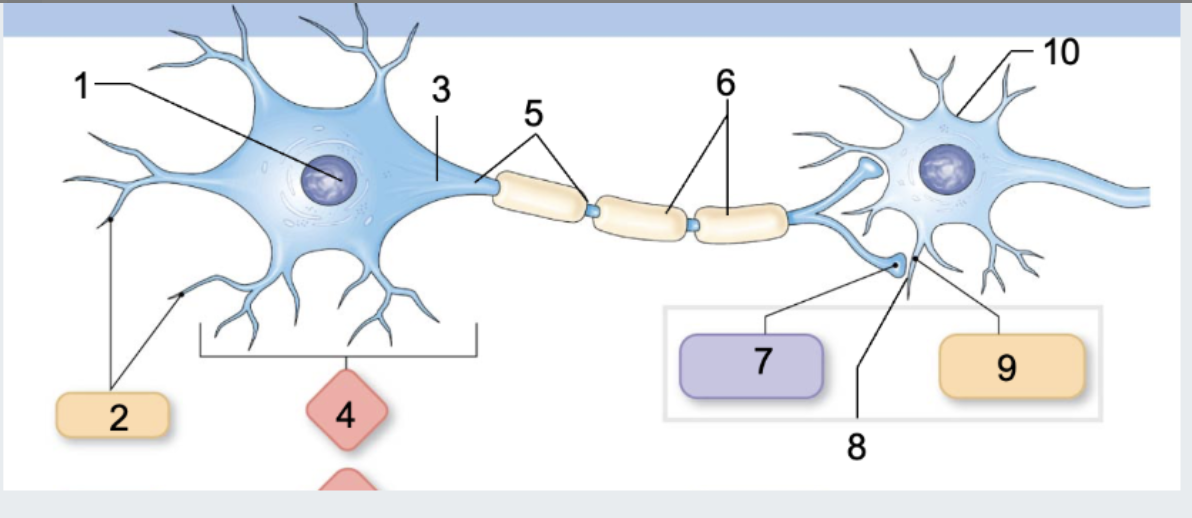
Label 1-5
1.
1. nucleus
dendrites
axon hillock
cell body
axon
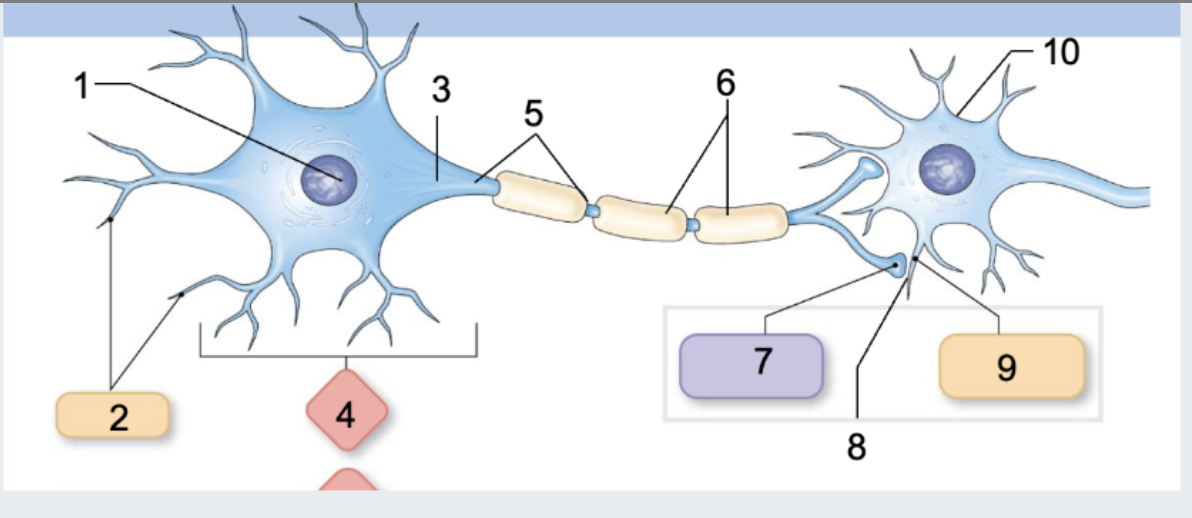
Label 6-10
myelin
presynaptic axon terminal
synaptic cleft
postsynaptic dendrite
postsynaptic neuron
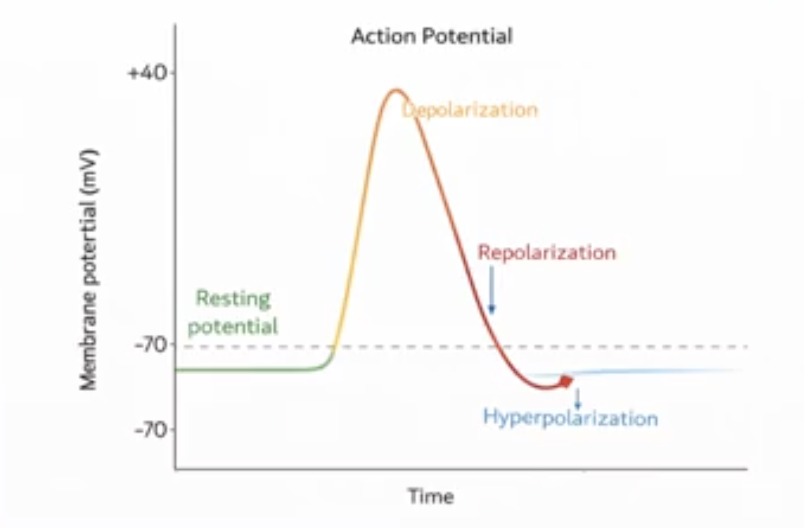
Depolarization
membrane less ____ → positive ions move ___ → membrane potential goes from negative to positive
Repolarization
membrane returns to ____ value after signal is complete
Hyperpolarization
membrane more ____ → positive ions move __ → membrane potential goes from positive to negative
polar; IN: resting; polarized; OUT
Action Potential
large, fast, long distance spread of ____ ____ ____ that travels along the axon
same ____ and ____ everytime
travels in one direction
axon hillock to terminal
rapid reversal of the membrane potential that briefly makes the INSIDE of the neuron _____
all or nothing effect, you either fire a AP or no
stronger stimuli lead to multiple __
membrane potential change; magnitude; pattern; positive; aps
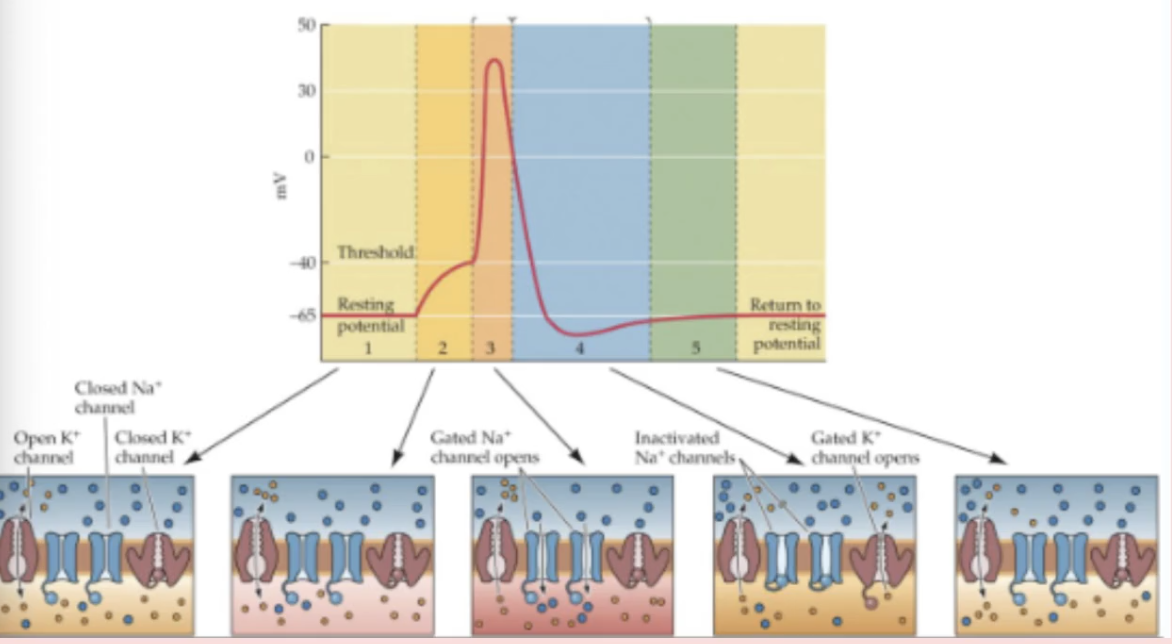
Action Potential 5 Steps
_____ aka rising phase
membrane becomes LESS polarized as positive ions move IN (inside the cell becomes more positive);
membrane potential goes from negative → positive
_____ aka falling phase
membrane returns to resting value after signal is complete
_____ aka undershoot
membrane becomes more polarized as ____ ions move OUT (IC- more negative). Membrane potential goes from positive → negative
depolarization; repolarization; hyperpolarization; positive
Neurotransmitter Release
Signaling Steps
chemical NT travels across the synaptic gap to the dendrites/cell body of the next cell
electrical signal aka ___ ____ in the dendrite
if threshold is met at the ___ ___, an AP is triggered
AP travels down the axon to the axon terminal
this triggers the release of NT
the elctrical signal reaches the presynaptic axon terminal
VG ___ channels open up
____ flows INTO the terminal
binds to synaptic vesicles
triggers them to dock to the membrane
release NT into the ____ ___
NT bind to receptors on postsynaptic cell cause a graded potential based on what receptor they bind to
graded potential; axon hillock; Ca2+; Ca2+; synaptic cleft
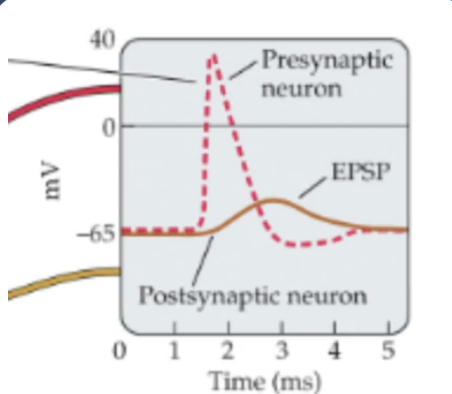
EPSP
if ___ ions flow through, the cell becomes slightly DEPOLARIZED and has small ____ postsynaptic potentials
____ proabability of AP firing
___ influx locally depolarizes dendrite
positive; excitatory; increases; Na+
IPSP
if ___ ions flow through, the cell becomes slightly HYPERPOLARIZED and has small ___ postsynaptic potentials
_____ probability of AP firing
___ influx locally hyperpolarizes dendrite
negative; inhibitory; decreases; Cl-
EPSP and IPSPs are ____ and not “all or none” like ap
graded potentials that lead to an action potential are called _____ potentials (can be larger or smaller depending on how much NT is released)
the amount of NT released depends on amount of ___synaptic ___
stronger stimuli, ___ APs, ___ neurotransmission
weak stimulus releases little NT
strong stimuli causes more ap and releases more nt
graded; synaptic; pre; Ca2+; more; more
Synaptic Potentials to AP
epsp and ipsp constantly happening on ___ and ____
an individual epsp generally NOT enough to trigger an ap
net sum of many EPSP ____ IPSPs must reach threshold
dendrites; soma; minus
TERMINATING Synaptic Transmission
____ - transport into axon terminals for reuse or into glial cells
_____ ____ - enzymes inactivate NT
____ - diffuse out of the synaptic cleft
reuptake enzymatic degradation; diffusion
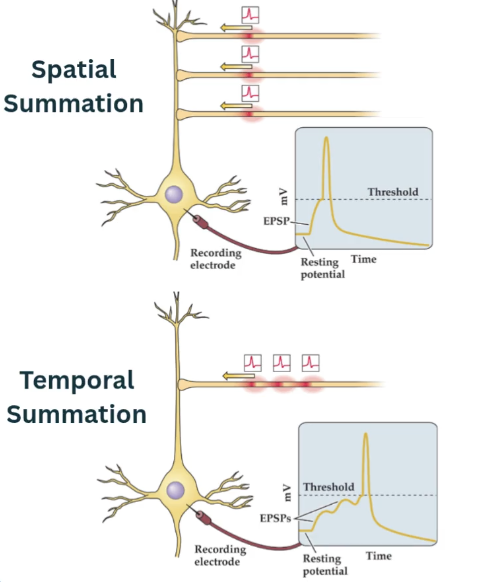
_____ summation - epsps or ipsps arriving NEARER each other (spatially) will summate better
potentials su if close enough in space
_____ summation - epsps or ipsps arriving closer together in TIME (temporally) will summate better
potentials sum if close enough in time
spatial; temporal
_____
fast on/off
all or non on/off
ligand-gated ion channels made up of protein subunits that together form an ion-conducting pore in the center of the receptor
ionotropic
_____
slower off/off
can amplify or dampen signals
indirectly linked with ion channels through signal transduction mechanisms, like G proteins
metabotropic
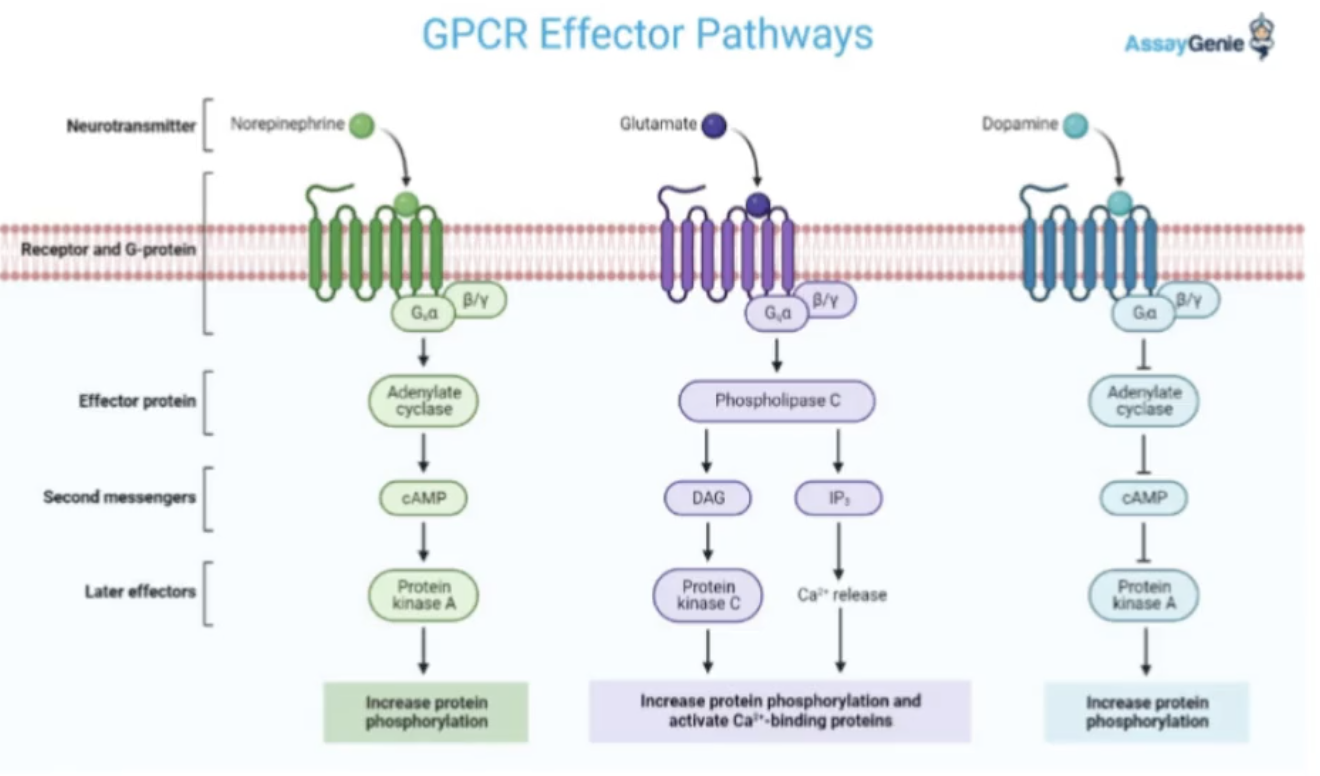
GPCR Effector Pathways
NT will bind to a ______ receptor → activate the receptor (aka __ ___) → target the ____ protein → target a ____ messenger → target later effector proteins → cellular response
transmembrane; g protein; effector; second
GPCR pathways
___: DECREASES cAMP
___: INCREASES cAMP
G⍺q: increase ___, ____ produciton
βy: ____ ion channels
G⍺i; G⍺s; IP3; DAG; regulates
G⍺i: ____ AC, ____ cAMP
G⍺s: ____ AC, ____ cAMP
inhibits; decreases; activates; increases
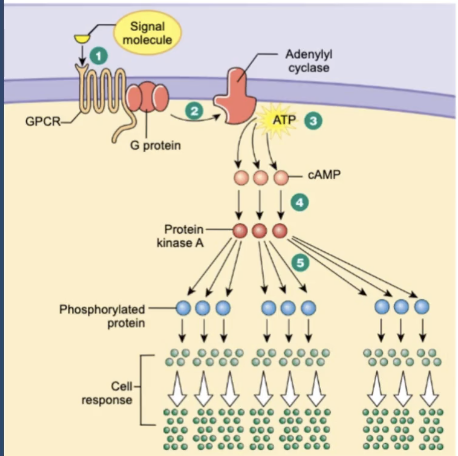
GPCR pathway: G⍺i and G⍺s
signal molecule binds to G-Protein GPCR, which ____ the G protein
G Proteins turns on ____ ___, an amplifier enzyme
AC converts ATP to ____
cAMP activates protein kinase A
Protein kinase A ____ other proteins, leading ultimately to a cellular response
activates; adenylyl cyclase; cyclic amp; phosphorylates
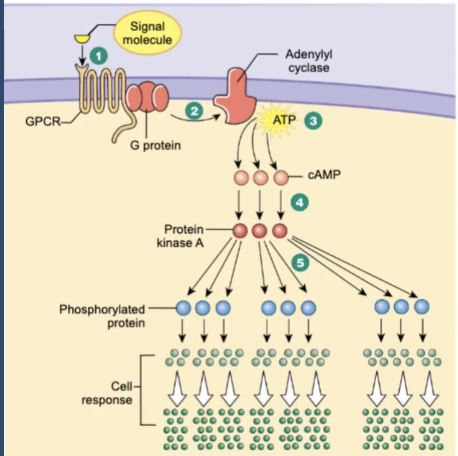
G Proteins: specifically G⍺i, G⍺s
are coupled to a receptor inside the cell; can be coupled to either Gi, Gs, or Gq proteins
hormone, drug, NT, or any other ligand bind to a sepcific receptor- going to cause the receptor to CHANGE _____ and that activates the G protein
G protein has 3 subunits: ___, ____, ____
once activated alpha ____ from the other beta and gamma
subunit releases GDP and a ___ binds to the alpha subunit
Alpha + GTP will move together and move to __
AC takes ATP and converts it to cAMP aka ____ messenger
cAMP activates PKA - kinases will phosphrylate protein and change their conformation therefore their ____
cell reponse
conformation; alpha; beta; gamma; separates; GTP; AC; secondary; function
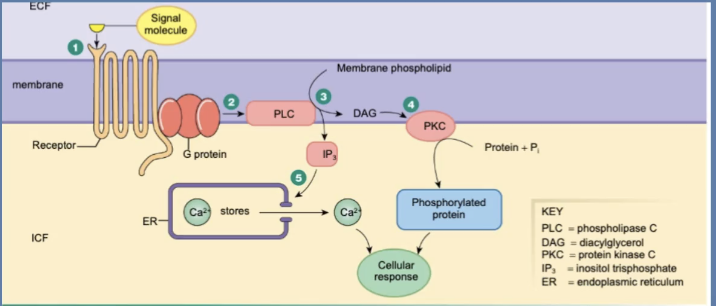
GPCR Pathway for G⍺q:
G⍺q: activates ___, increases ___, ___ production
PLC; IP3, DAG
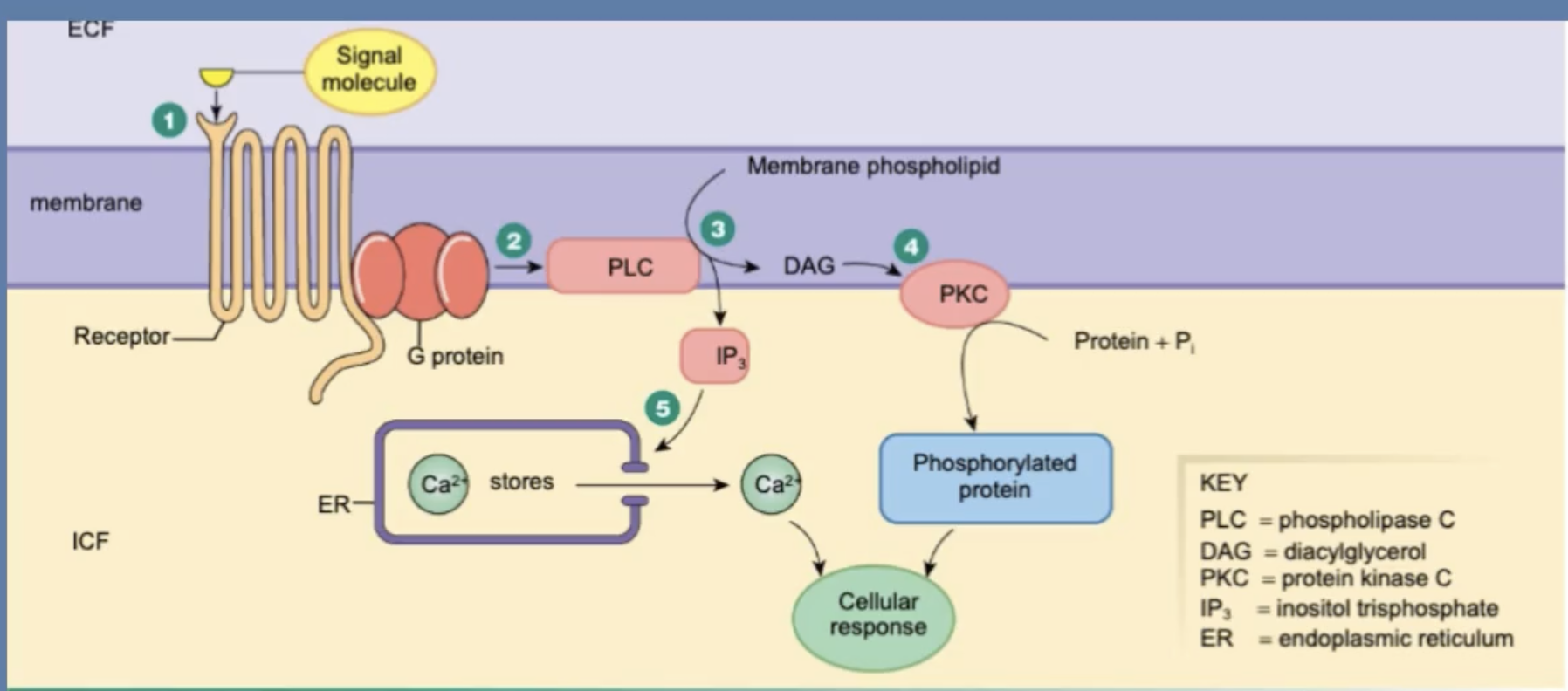
GPCR Pathway for G⍺q:
Signal molecule activates receptor and associated G protein
G protein activates phospholipase C, a ____ enzyme
PLC converts membrane phospholipids into ___, which remains in the membrane, and ___ which diffuses into the cytoplasm
DAG activates protein kinase ___ which phosphorlates proteins
IP3 causes release of CA2+ from organelles, creating a Ca2+ signal
amplifier; DAG; IP3; C
Categories of NS
CNS - ____
____ and ___ ___
PNS - ____
____ - these are nervous system processes your brain runs automatically and without you thinking about them
___ - these are functions you manage by thinking about them
central; brain; spinal cord; peripheral; autonomic; somatic

____ NS (part of PNS)
____ muscles and VOLUNTARY movements
___ neuron that goes from the brain directly to the target skeletal muscles
Somatic; skeletal; one
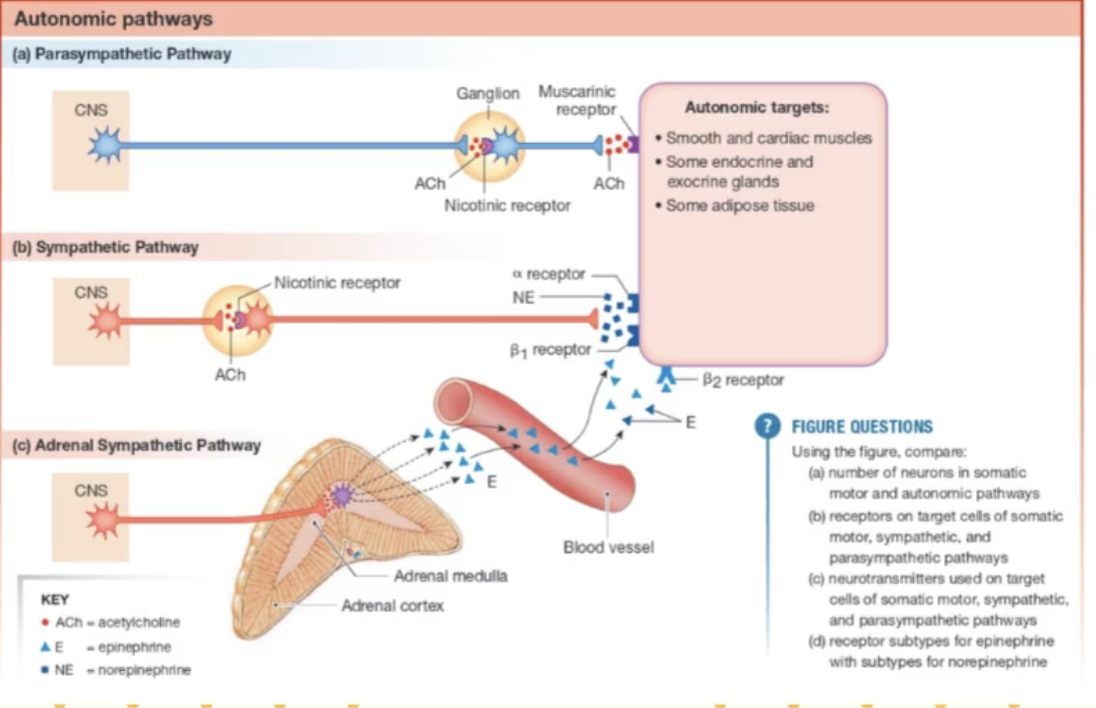
____ NS (part of PNS)
___, ____ and -___ muscle, glands
INVOLUNTARY movements
need ___ neurons that goe sfrom the brain to ganglion (____ neuron) then ganglion to target organ (____ neuron)
autonomic; organs; smooth; cardiac; two; preganglionic; postganglionic
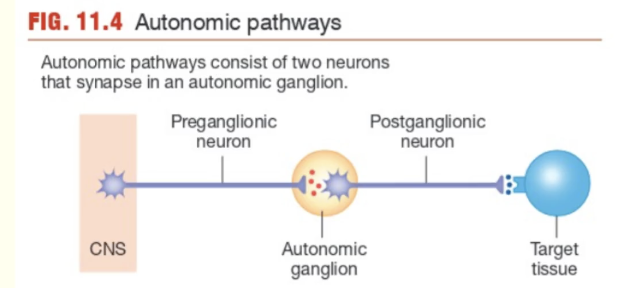
Autonomic Pathways:
in total involving ___ neurons that synapse in an autonomic ganglion
CNS → _____ neuron → autonomic ganglion → ____ neuron → target tissue
2; preganglionic; postganglionic
____ Nerves
rest and digest
CONSTRICT airway and pupils
stimulate saliva activity of stomach
slow heartbeat
____ Nerves
fight of flight
RELAX airway
dilate pupils (letting more light in and processing fight or flight better)
inhibit activity of stomach
increase heartbeat
both target the same organs
parasympathetic; sympathetic
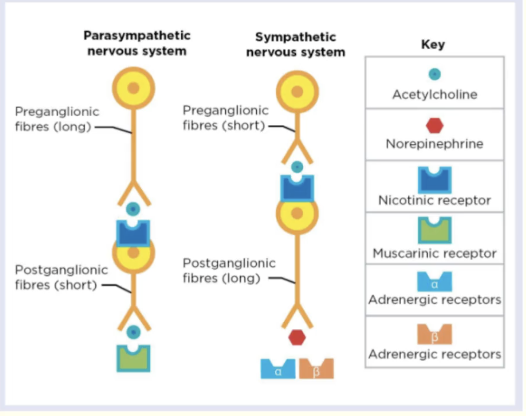
Parasympathetic NS
cell bodies are in ___ ___ and ___
preganglionic release NT → _____ → binds to nicotinic acetylcholine receptors on post ganglionic → post ganglionic release NT aka _____ → bind to _____ ____ receptors on target tissue
RMBR: parasympathetic has ____ preganglionic fibers
spinal cord; brainstem; acetylcholine; acetylcholine; muscarinic acetylcholine; LONG
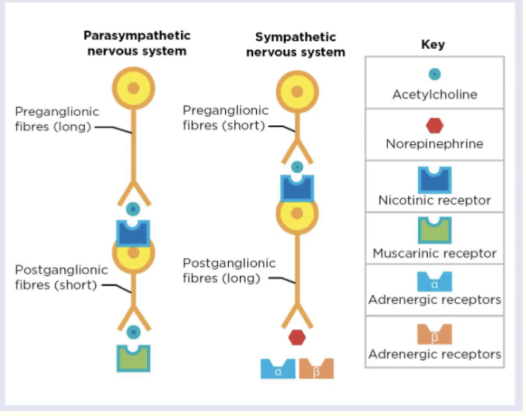
Sympathetic NS
cell bodies are in ____ ____ or ____
preganglionic release NT aka ____ → binds to nicotinic ____ receptors on post ganglionic → post ganglionic releas NT aka ____ → binds to ____ receptors on target tissue
RMBR: adrenergic receptor have either ____ or ____
sympathetic has _____ preganglioinic fibers
spinal cord; brainstem; acetylcholine; acetylcholine; norepinephrine; adrenergic; alpha; beta; short
Endocrine system
helps maintain ____
process is little bit slower BUT they are ___ acting responses
homeostasis; long
Endocrinology
Hormones
chemicals released by an endocrinoe gland into the ____ that regulates ____ target organs/tissues/cells
targets produce physiological response
Endocrine glands
release hormones into ____ to act on ___ target tissue physiology and function
Homeostasis
maintenance of a constant internal state or environment
bloodstream; specific; bloodstream; distant
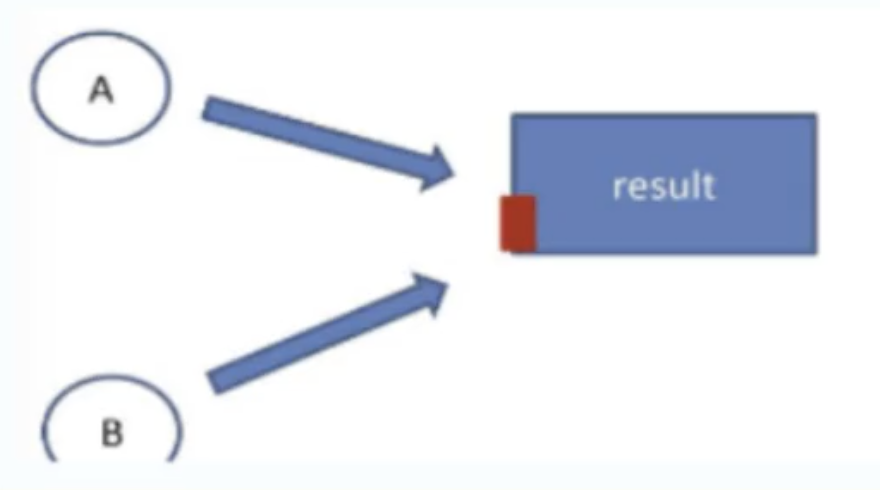
Hormone Interactions:
_____ - hormone’s can aid in increase intracellular effector proteins to increase the cellular function of the mechanism
permissive
Hormone Interactions:
____ - two or more hormones produce the same effects in a target cell and their results are amplified
synergistic
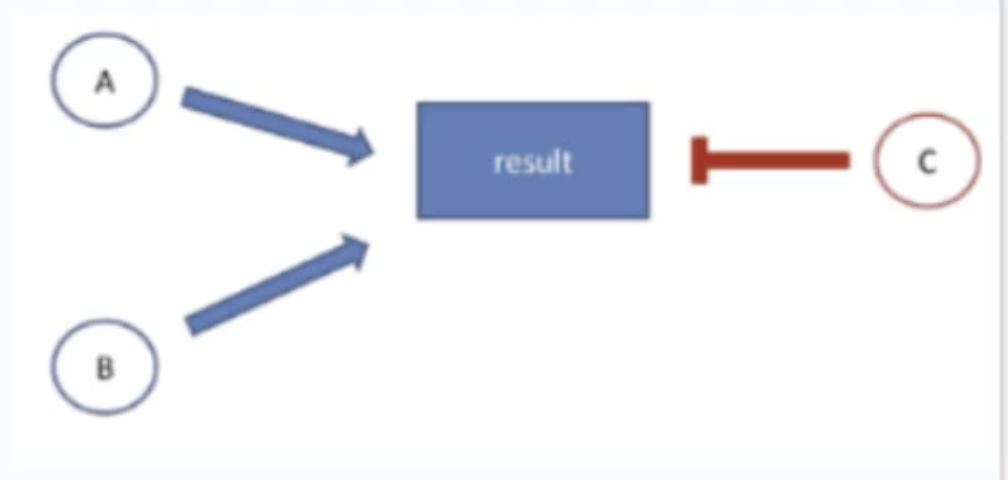
Hormone Interactions:
_____ - two molecules work together to oppose its function and keep homeostasis
antagonistic
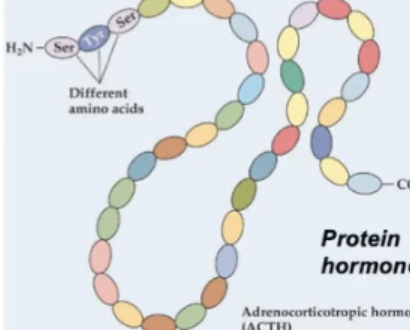
Structural Class of Hormones
peptide hormones
made in advance, stored in ____
string of amino acids; e.g. ____
released into the plasma to ____
bind to receptors on transmembrane
specificity is determined by presence and availability of the receptor
relatively ____
vesicles; ACTH; dissolve; rapid
Structural Class of Hormones
steroid hormones
derived from cholesterol
membrane ____
eg. estradiol, _____
made on ___, cant be stored by _____
diffuse out the cell and bind to ___ in the plasma
bind to receptors the cell
alters protein production for SLOW but ___-last effects
permeable; cortisol; demand; lipophillic; proteins; long
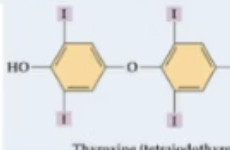
structural class of hormones
amine hormone
modified single amino acids; e.g. ___, melatonin, thyroxine
hybrid
most bind to receptors on target cell membrane
can act as both long acting and short acting
LONG acting act like ____; eg thyroid horones
SHORT acting act like ___; eg catecholamines
epinephrine; steroids; peptides
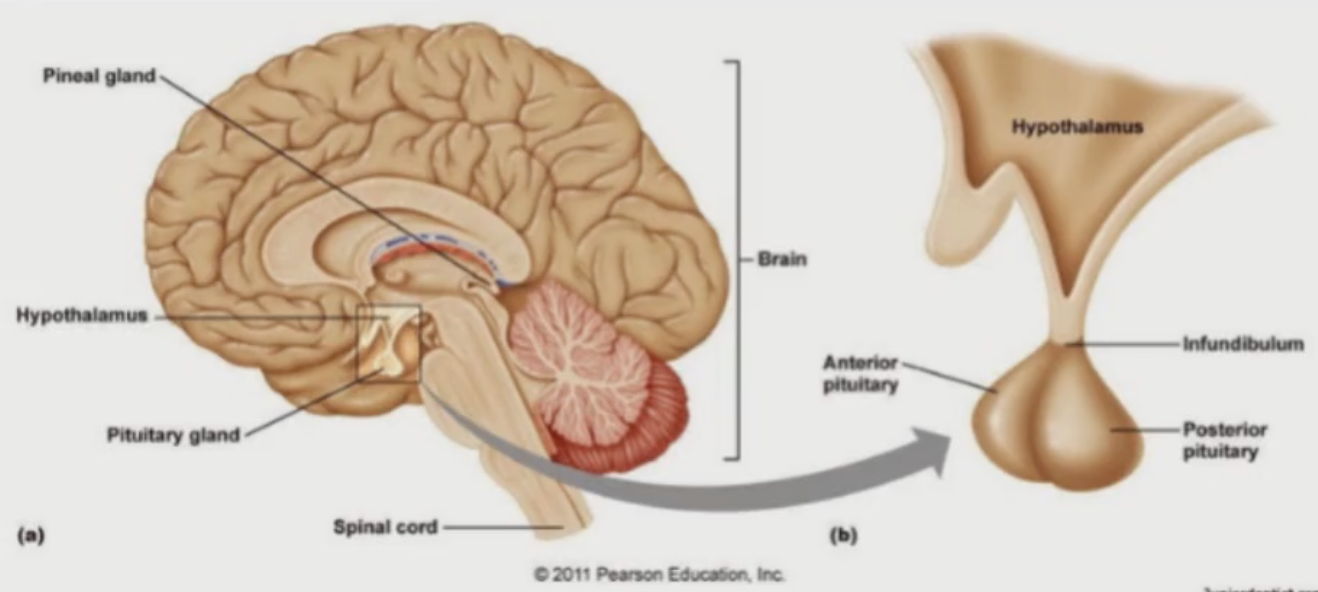
Main source of hormones in the brain come from:
____
pea-sized gland at base of skull in midline
2 anatomically and functionally discrete divisions: ____ and ____
_____
sits above pituitary and under thalamus
connects to anterior pituitary via stalk
pituitary; anterior; posterior; hypothalamus
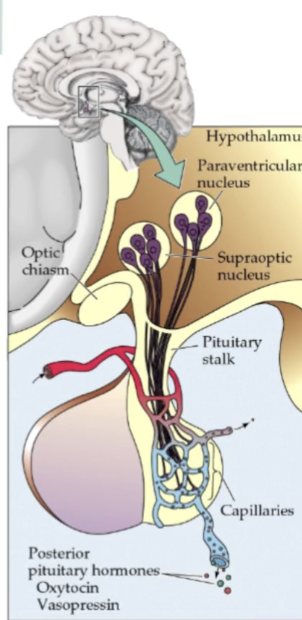
POSTERIOR Pituitary System
posterior pituitary develops as an extension of ____
releaes hormones, but hormones (are/not?) made in posterior pituitary
neuroendocrine cells in two hypothalamic regions (PVN, SON) project axons down infundibulum (or pituitary stalk)
axon terminals in posterior pituitary release 2 hormones in capillary bed
1. _____
2. _____
hypothalamus; NOT; oxytocin; vasopressin
Posterior pituitary system
_______
peptide hormone
STIMULATES UTERINE CONTRACTIONS
triggers milk letdown reflex
mediates sexual arousal and affection responses
Oxytocin
posterior pituitary system
_____
antidiuretic and peptide hormone
increases BP
conserves water
strucutrally similar to other one
monogamy hormone in praire voles
Vasopressin
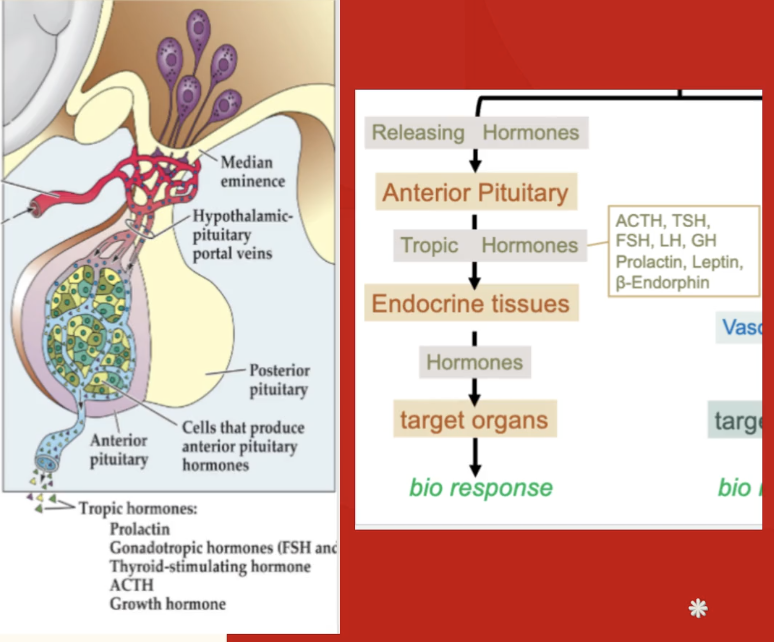
ANTERIOR Pituitary System:
hypothalamic neuroendocrine cells produce ____ hormones
releasing hormoens secreted into “hypothalamus-pituitary portal system” or capillaries
hormones travel to anterior pituitary and locally affect hormone-producing cells in the anterior pituitary
anterior pituitary cells then release many ___ hormones into the bloodstream (these stimulate endocrine glands; eg ovaries and thyroids)
example of tropic hormone: ___
releasing; tropic; ACTH
Hormones are synthesized in the ____ and stored in the ____ pituitary
hypothalamus; posterior
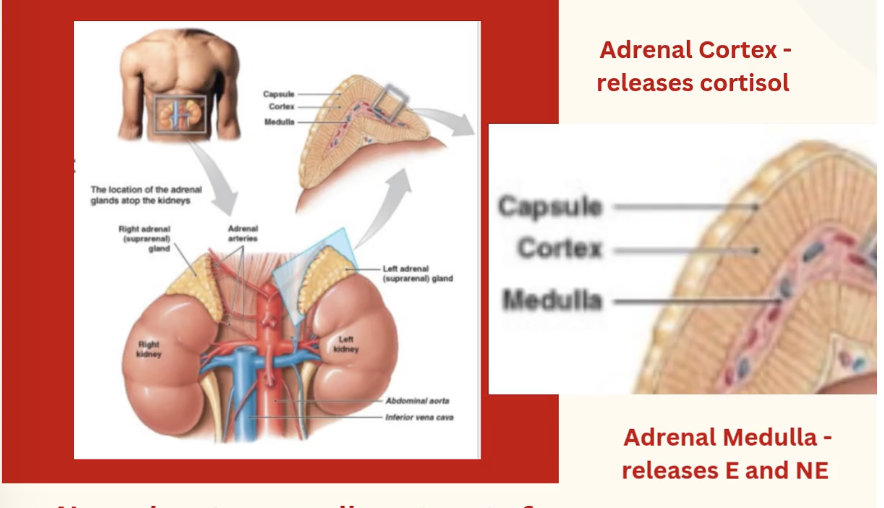
ADRENAL GLAND- NOT a part of the brain, sits on top of the _____
Two parts:
Adrenal ___ - outer part of the adrenal gland
releases ______:
3 classes:
1. glucocorticoids: eg ____
2. mineralocorticoids: eg aldosterone
3. sex steroids: e.g. androstenedione
Adrenal ___ - inner part
releases ____ and ____ in response to ___ NS activation
kidney; cortex; adrenocorticoids; cortisol; medulla; epinephrine; norepinephrine; Sympathetic
Cortisol
_____ (what type of andrenocorticoid?)
stress hormone induced by psychological stress, hypoglycemia, infection
increases ___ production
suppresses immune system
glucocorticoid; glucose
Anterior Pituitary Hormone Pathway: CORTISOL
Hypothalamus releases ___ → travels down to ____ pituitary to produce ___ → which travels down to the adrenal cortex to produce _____
this can all negatively feedback and could ____ the hypothalamus and anterior pituitary once enough cortisol is produced
CRH; anterior; ACTH; cortisol; inhibit
Too LOW of cortisol
___ ACTH
____ disease
autoimmunity
hypotension
take synthetic steroids
low; addison’s
Too HIGH cortisol
___ ACTH
____ syndrome
chronic stress
hypertension
impairs memory formation
drugs, surgery
high; Cushing’s
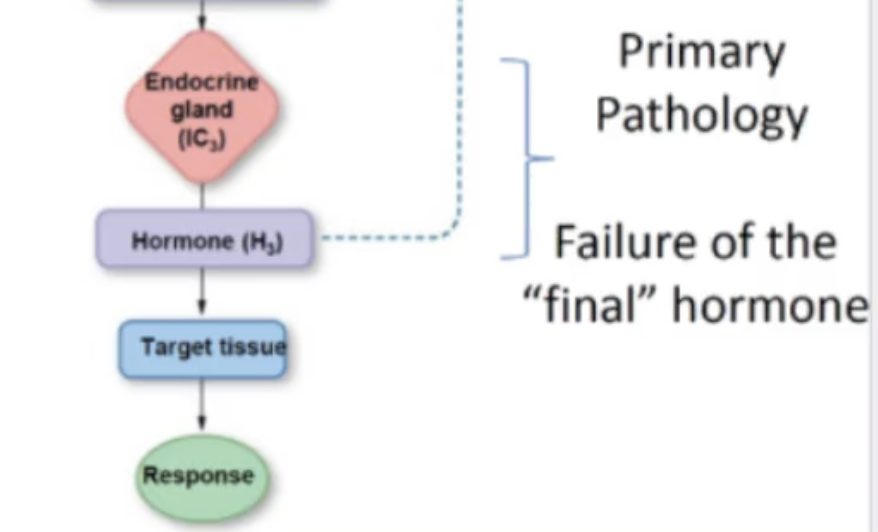
PRIMARY PATHOLOGY
affects the ___ gland or the ___ hormone (specifically ____ cortex)
affects ____ production
have a problem with the final hormone - can either have over or under production
for OVER production:
LOW ___ and ___ levels and HIGH ____ levels
this can feedback negatively onto the anterior pituitary and should decrease amounts of cortisol
solution is for surgery to remove tumor
for ____ production:
____ ACTH and CRH levels and ___ cortisol levels
____ feedback negatively if cortisol levels low
endocrine; final; adrenal; cortisol; ACTH; CRH; cortisol; under; high; low; CANNOT
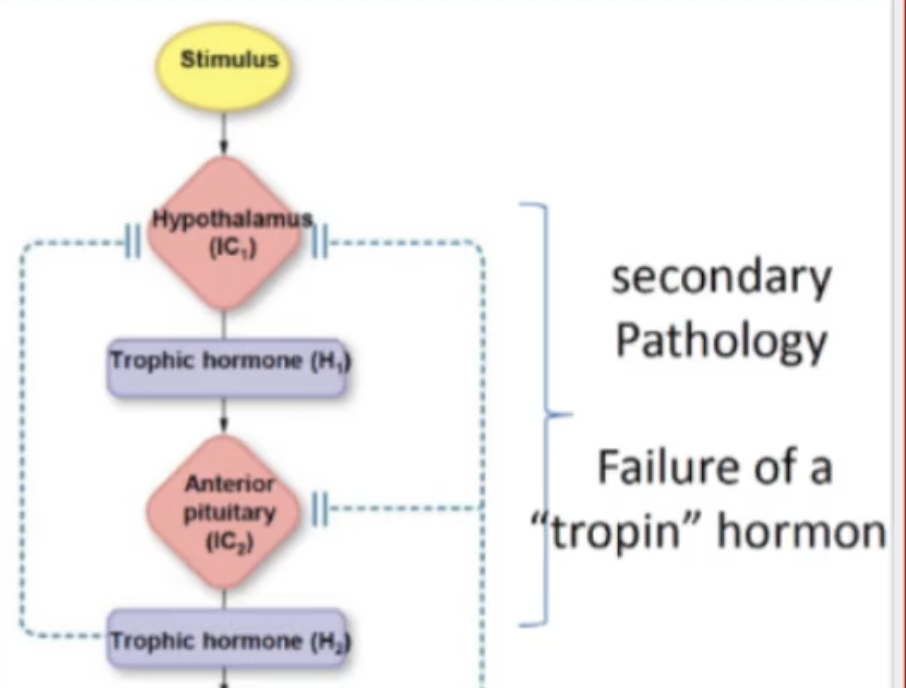
SECONDARY PATHOLOGY
have a problem wit the ____ or ____ pituitary
affects ____ production
OVERproduction:
___ CRH and ACTH levels, ___ cortisol levels
since this increases cortisol, it will negatively feedback on the hypothalamus and AP → hypothalamus will respond, but AP will keep producing ___ since there is a tumor
UNDERproduction:
HIGH ___, LOW ____ and _____ levels
if levels of ACTH are low, adrenal cortex will not be stimulated and can’t produce cortisol, will tell hypothalamus to make CRH to increate those levels→ NO negative feedback
hypothalamus; anterior; ACTH; low; high; CRH; ACTH; cortisol
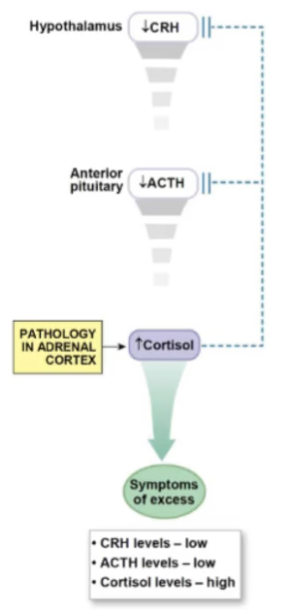
Cushings Syndrome
Primary pathology
pathology in the ____ ___ - they make too MUCH ____
suppresses ACTH and CRH
Secondary pathology
tumor in the ___ ____ - make too MUCH ___
increases ____ production and lowers ___
symptoms
emotional distrubance, osteoporosis; obesity; skin ulcers
adrenal cortex; cortisol; anterior pituitary; ACTH; cortisol; CRH
Addisons Disease
Primary Pathology
pathology in the ___ ___ - too LITTLE ____
low cortisol does not suppress ACTH and CRH, therefore ___ ACTH and CRH
failure in feedback loop
adrenal cortex; cortisol; high
Between the two: does Addisons/Cushings have ONLY primary pathology
Addisons
Upper Motor Neurons (UMN)
these are the motor neurons whose cell bodies lie in the ____ ___ or _____ and they activate the lower motor neuron
connects brain to spinal cord
Lower Motor Neurons (LMN)
these are the motor neurons of the ___ ___ (AHC) and brain stem motor nuclei of the cranial nerves that innervates skeletal muscle directly
connects spinal cord to muscle
motor cortex; brainstem; spinal cord
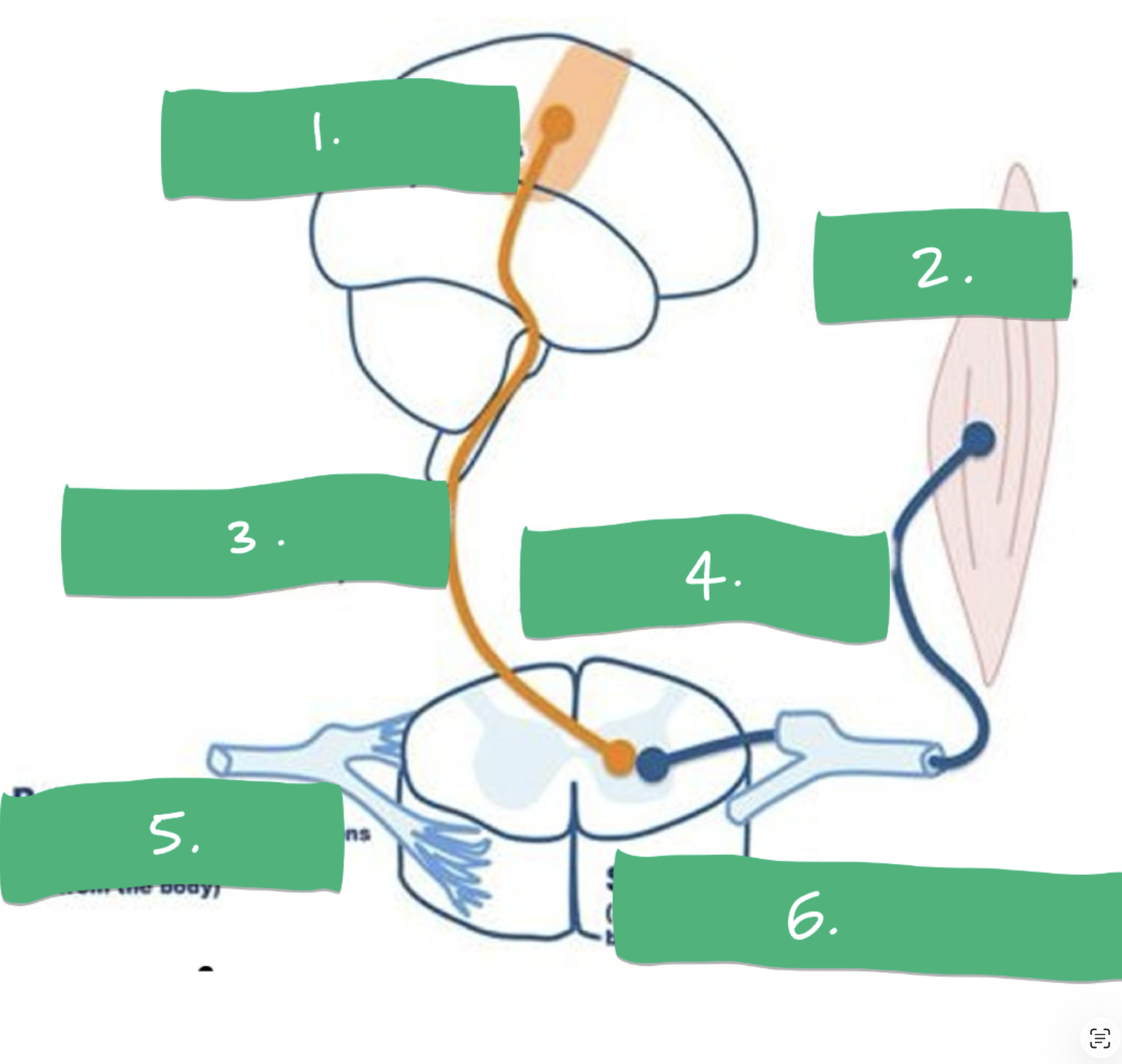
Label 1-6
motor cortex
muscle
upper motor neuron
lower motor neuron
peripheral nervves
spinal cord
LMN cell bodies are organized in the ___ horn of the spinal cord:
lower motor neuron are arranged _____:
____ ventral horn → proximal muscles
muscles closer to the middle, like trunk, shoulder
____ ventral horn → distal muscles
muscles further away from body like hands
flexors and extensors are also grouped into separate layers/regions
RMBR Like: M = Medial = Middle (of the body & L = Lateral = Limb-end muscles
ventral; topographically; medial; lateral
Driving Force eqtn
Vm - Eion
vm = membrane potential
Eion= equilibrium potential
If Vm is LESS than Eion, current is _____ for POSITIVE ions
If Vm is MORE than Eion, current is ____ for POSITIVE ions
THINK: if membrane is negative, the ion wants the membrane to be more positive so to make it less negative, positive charge must enter
INWARD; OUTWARD
Glial Cells: SEAMOS
_____
_____
_____
_____
_____
_____
Schwann; ependymal; astrocytes; microglia; oligodendrocytes; satellite cells
___ channels are OPEN during depolarization
___ channels are OPEN during resting and repolarization
Na+; K+
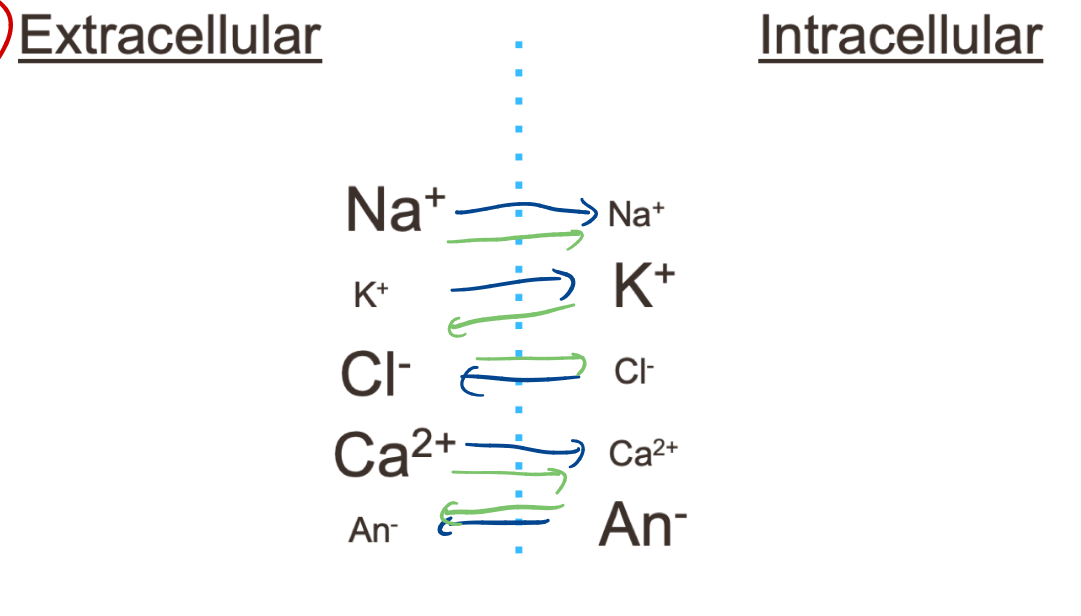
Explain the logic behind diagram
Electrostatic force - blue
Concentration gradient - green
The concentration gradient pushes an ion from where it is more concentrated to where it is less concentrated (i.e. Na+ higher outside so pushed inside)
The ion goes to the side “Opposite charged” side (i.e. cations go inside the cell (intracellular aka negative)))
Inhibiting Na/K/ATPase prevents ___ from exiting cell. This _____ intracellular Na+ and ____ intracellular K+
Bc intracellular N+ is now higher, the Na+ gradient becomes ____
the Na+/Ca2+ exchanger aka NCX needs that Na+ gradient to bring Na+ in and push Ca2+ out. if the Na+ gradient is weaker, NCX works less aka ___
this results in less ____ that leaves the cell and there an increase inside
____ heart contraction
Na+; increases; decreaes ; weaker; slows; Ca2+; stronger
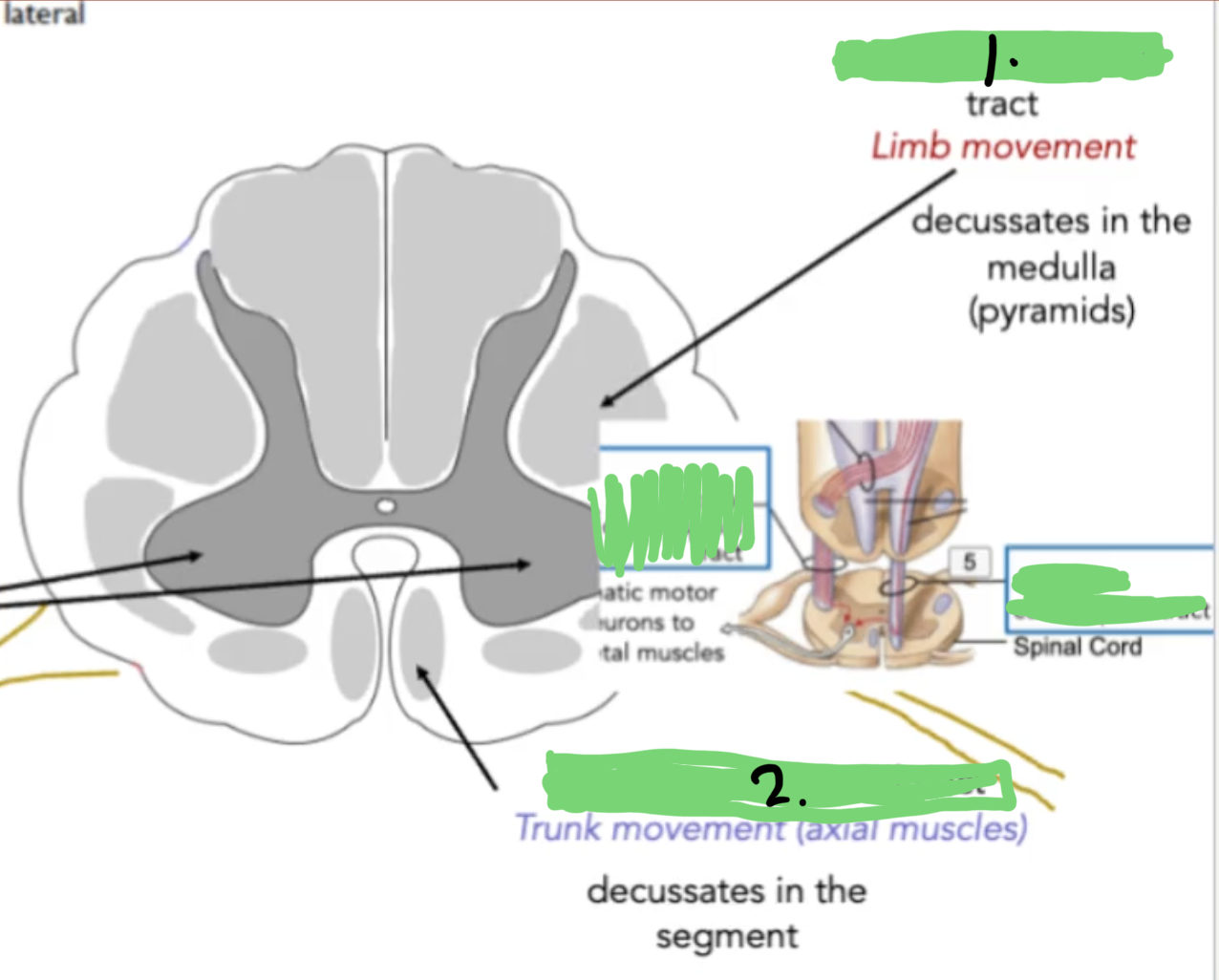
Label 1 and 2
lateral corticospinal tract; anterior corticospinal tract
Lateral corticospianl tract
f(x)- ____ movement
decussates in the ____(pyramids, aka brainstem)
limb; medulla
Anterior corticospinal tract
f(x) - ____ movement (axial muscles)
decussates _____ the segment
trunk; within
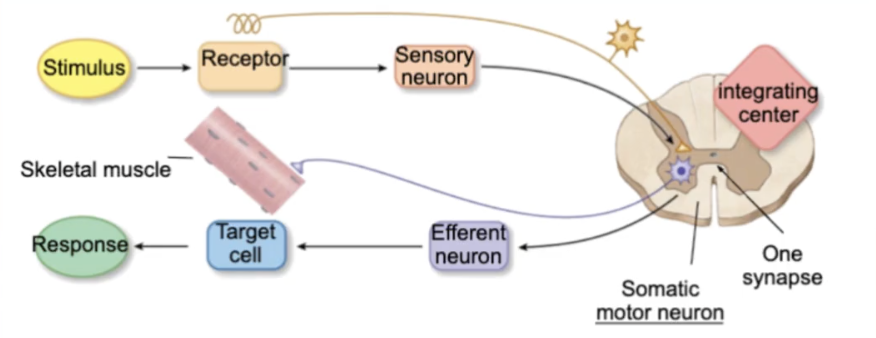
Skeletal Muscle:
______ reflex aka stretch
bc it’s a reflex it stays within the ______ - does not have to go up to the brain in order to execute a movement; the spinal cord works as an integrating center
RMBR somatic motor neuron is _____ therefore will release acetylcholine onto nicotinic receptors
monosynaptic; spinal cord; excitatory
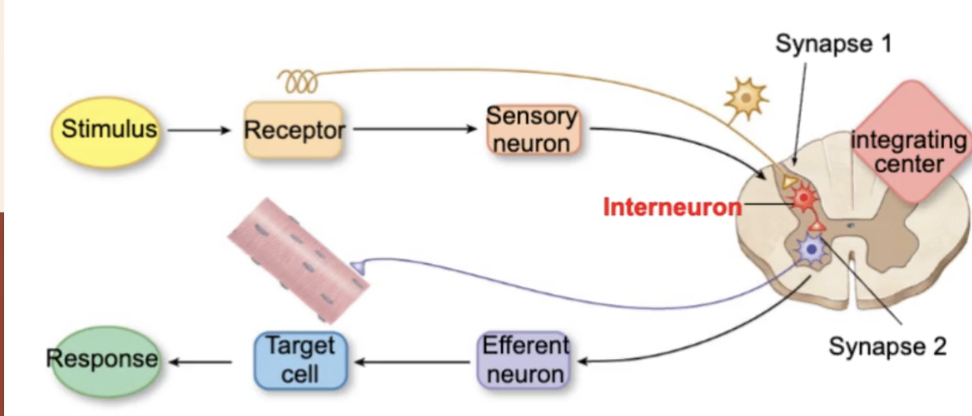
Skeletal Muscle:
_____ Reflex aka stretch
will make the motor neuron fire ___ aps - if you stop firing ap decrease contractions therefore ___
the interneuron creates ____ within the motor neuron to stop firing ap
polysynaptic; fewer; IPSPs
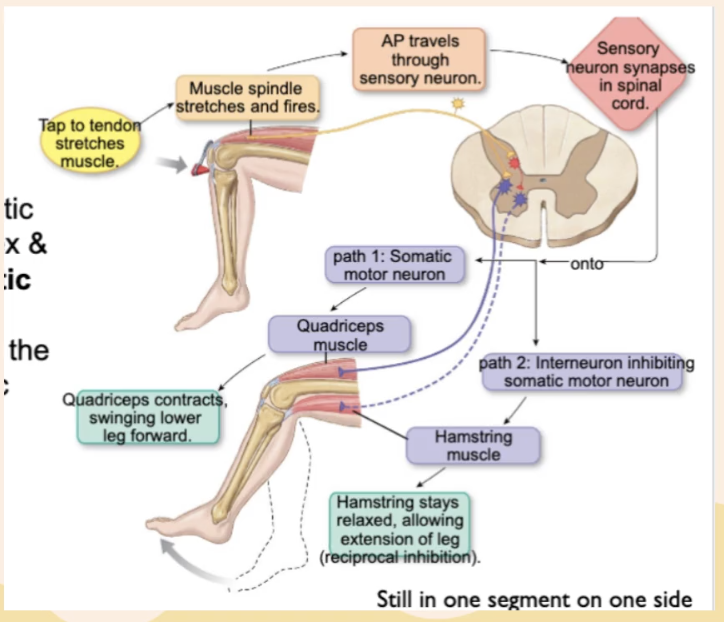
Patellar Tendon Reflex aka Knee Jerk
monosynaptic stretch reflex and polysynaptic reciprocal inhibition of the ___ muscle
will need to activate BOTH in order to contract the quadricep muscle and relax the hamstring muscle in order to see the reflex occur
when we have a ____ this is typically to inhibit an AP in the post synaptic neuron and therefore RELAX a muscle
antagonistic; interneuron
Three Types of Muscles
___ muscle - large, multinucleated cells, appear striated voluntary
___ muscle - striated but smaller, branched, uninucleate. cells join by intercalated disks. involuntary
___ muscle - small, lack striations, uninucleate, involuntary
skeletal; cardiac; smooth
Muscles Work in _____ pairs
muscle contraction can pull on a bone but CANNOT push a bone away
antagonistic muscle groups move bones in opposite directions
axons leave the spinal cord via the ____ root; this is an _____ signal ONLY (aka releases acetylcholine)
antagonistic; ventral; excitatory
___ ___ - one motor neuron and all the muscle fibers it innervates; a muscle may have many motor units of different types; all the motor units that innervate a muscle are the motor ___
motor unit; pool
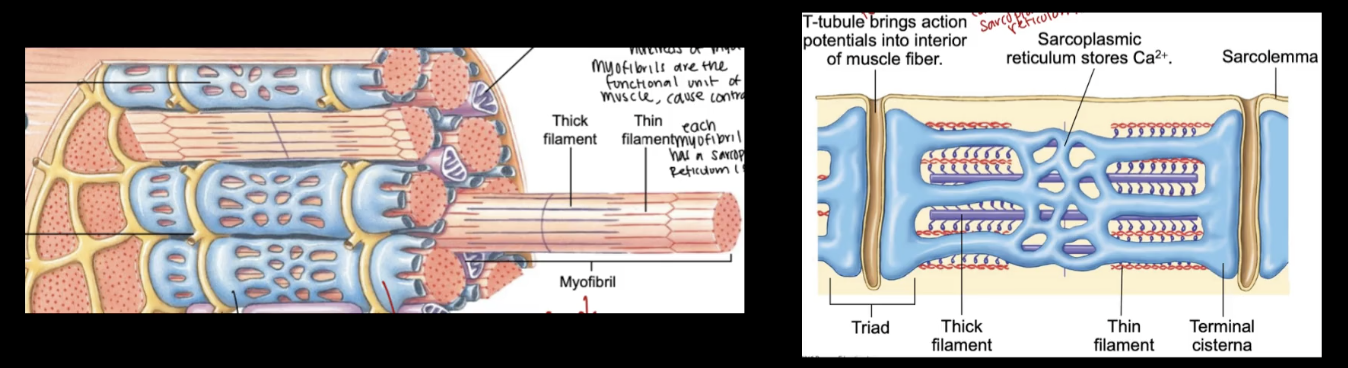
Muscles are Bundles of Cells that Work Together
______ Reticulum - essentially like the endoplasmic reticulum (BUT specific for the muscles) store Ca2+
___ - allow the AP to travel deeper into the muscle cell
Contractile proteins
THICK filmanet - ____
THIN filament - ___
Regulatory Proteins
____
____
Sarcroplasmic; T-tubules; myosin; actin; tropomyosin; troponin
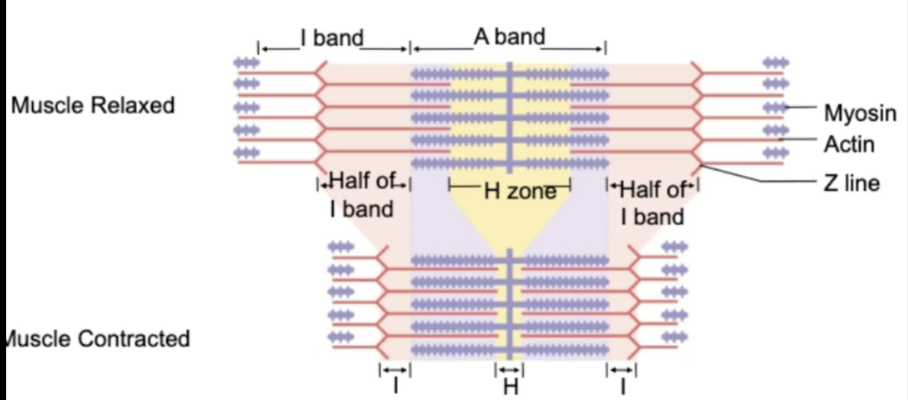
The Sarcomere ____ during Contraction
filaments DON’T shorten - they ____ - and this is how the muscle contracts. their size does NOT change at all
muscle contraction - sliding filament theory → ______ actin and myosin filaments of fixed length slide past one another in a process that requires energy
the _____ shortens and that causes the muscle to contract
shortens; contract; overlapping; sarcomere
_____ ____ aka NMJ
the whole ____
the motor end is comprised of a series of juncitonal folds (with ___ ____ receptors aka nACh)
NMJ contains a ___ density of nACh receptors
Neuromuscular Junction; synapse; nicotinic acetylcholine; high
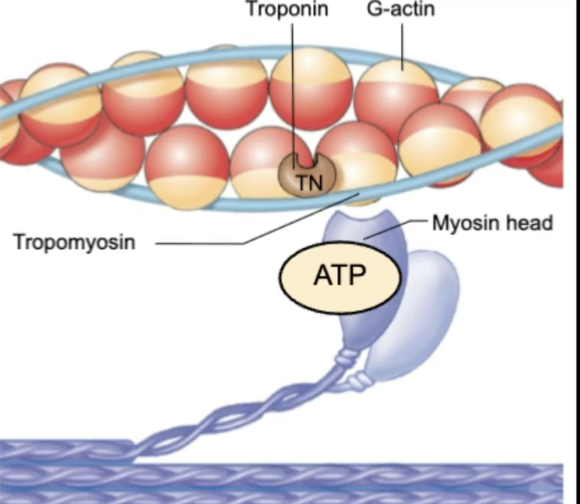
The Relaxed State
myosin head is cocked
tropomyosin partially ___ binding site on actin
myosin is weakly bound to actin
tropomyocin is ____ myosin from strongly interacting with the actin
troponin is NOT bound by _____
blocks; preventing; calcium
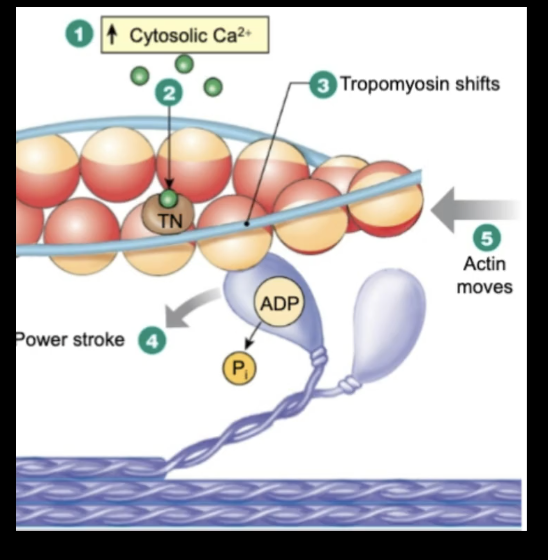
Initiation of Contraction
Ca2+ levels ____ in cytosol
Ca2+ binds to troponin aka TN
Troponin-Ca2+ complex pulls tropomyosin ___ from actin’s myosin binding site
Myosin binds strongly to actin and completes power ____
actin filament moves towrads center of ___
*** this is Calcium is important
increase; away; stroke; sacromere
The contraction cycle
in order to have a contraction - the myosin head needs to ___ strongly to actin to perform the ____
during resting state - NO ___ is present so the actin binding site is blocked by tropomyosin
tropomyosin has ____ bound to it - ““ is what has a binding site for ____
to initiate a contraction - Ca2+ levels must increase so they can bind to troponin - once bound this will pull on the tropomyosin and move it away from its original site - no longer blocks the binding site on actin where the myosin head need to bind to ___ the muscle = contraction
For contraction itself-
the active site on ___ is exposed to Ca2+ binds to troponin
the myosin head forms a cross bridge with actin
during the power stroke, the myosin head bends and ___ and ___ are relased
A new molecule of ATP attaches to the myosin head, causing the cross bridge to detach
ATP _____ to ADP and phosphate, which returns the myosin to the “____” position
bind; powerstroke; Ca2+; troponin; Ca2+; shorten; actin; ADP; phosphate; hydrolyzes; cocked
____ ___ - when you die → no longer make ATP → myosin head doesn’t unbind → muscle stays contracted
rigor mortis
![<p>Initiation of Muscle AP</p><ol><li><p>motor neuron releases ___ at the neuromusular junction (the presynaptic cell releases NT into the synaptic cleft)</p></li><li><p>NT is going to cross the synaptic cleft and bind to receptors on the post synaptic celll - in this case we refer to it as a the motor end plate</p></li><li><p>ACh is always ____ so when they bind - Na+ will flow in - ____ - initiate muscle AP</p></li><li><p>The AP ( or depolarization) will travel down the tubule and open DHP channel which is a VG calcium channel - lets Ca2+ in</p></li><li><p>DHP channel is physically linked to the RyR channel (mechanically gated Ca2+ channel on the SR)</p></li><li><p>When DHP open, the RyR opens and Ca2+ flows ____ the SR and bind to ____</p></li></ol><p>Relaxation Phase : Clearing Ca2+</p><ol start="7"><li><p>the Sarcoplasmic Ca2+ pump uses ATP to pump Ca2+ back into the SR</p></li><li><p>____ in free cytosolic [CA2+] causes Ca2+ to unbind from troponin</p></li><li><p>tropomyosin recovers binding site. when myosin head releases, elastic elements pull filaments back to their replaced position</p></li></ol><p></p>](https://assets.knowt.com/user-attachments/9be47270-bdc7-4877-bd77-0aa1b0ce8ebd.png)
Initiation of Muscle AP
motor neuron releases ___ at the neuromusular junction (the presynaptic cell releases NT into the synaptic cleft)
NT is going to cross the synaptic cleft and bind to receptors on the post synaptic celll - in this case we refer to it as a the motor end plate
ACh is always ____ so when they bind - Na+ will flow in - ____ - initiate muscle AP
The AP ( or depolarization) will travel down the tubule and open DHP channel which is a VG calcium channel - lets Ca2+ in
DHP channel is physically linked to the RyR channel (mechanically gated Ca2+ channel on the SR)
When DHP open, the RyR opens and Ca2+ flows ____ the SR and bind to ____
Relaxation Phase : Clearing Ca2+
the Sarcoplasmic Ca2+ pump uses ATP to pump Ca2+ back into the SR
____ in free cytosolic [CA2+] causes Ca2+ to unbind from troponin
tropomyosin recovers binding site. when myosin head releases, elastic elements pull filaments back to their replaced position
ACh; excitatory; depolarize; out; troponin; decrease
Smooth Muscle
small, lack striations, uninucleate, _____ (depends on communication from sympathetic and parasympathetic branches to help control smooth muscle)
involuntary
Smooth muslce communication with neighboring cells
Single-unit smooth muscle cells: connected by ___ ____, when one cell depolarizes, all connected cells contract as a single unit (ie uterus, GI, bladder)
Multi-unit smooth muscle cells: NOT electrically linked, each cell must be stimulated ____ (ie large airways, most arteries, iris, ciliary body)
gap junctions; independently