Marine Fish Early Life History & Larval Development
 Call Kai
 Learn
Learn Practice Test
 Spaced Repetition
 Match
Match Flashcards
 Knowt Play
1/56

There's no tags or description
Looks like no tags are added yet.
Name | Mastery | Learn | Test | Matching | Spaced | Call with Kai | Chat |
|---|
No analytics yet
Send a link to your students to track their progress
57 Terms
What is the significance of studying early life history in marine fishes?
It is important for population replenishment and recruitment of young into the population.
What are some challenges in studying larval fishes?
They are small, diffuse in large oceans, and exhibit large morphological diversity.
What does year class variation in larval fishes affect?
It affects fisheries dynamics.
Why are spawning and nursery locations important in marine fish studies?
They help understand habitat effects on fish populations.
What is the role of growth and condition studies in larval fish research?
They assess environmental effects, including pollutants.
What does dispersal in larval fishes refer to?
It refers to the connection between spawning locations and nursery/adult habitats.
What are the two modes of larval development in marine fishes?
Direct development (no larval phase) and indirect development (larval phase present).
Which types of fishes exhibit direct development?
Surf perch, all elasmobranchs, most livebearing bony fishes, and most fishes with large eggs.
What characterizes indirect development in marine fishes?
It involves planktonic early development and a larval phase.
What is a bipartite life cycle in marine fishes?
It occurs when larvae occupy different habitats from adults.
What are the three stages of larval development?
Pre-flexion, flexion, and post-flexion.
What happens during the pre-flexion stage of larval development?
Absorption of yolk sac to the start of notochord flexion.
What occurs during the flexion stage of larval development?
The start to completion of notochord flexion.
What is the significance of the larval period in fish development?
It involves the development of axial skeleton, fins, organs, and sensory abilities, with extremely high mortality.
What characterizes the juvenile period in marine fishes?
It is a miniature version of the adult with fully formed skeleton, organs, and fins, but immature.
What is the pelagic larval duration (PLD) for bluehead wrasse?
40-50 days.
What is eye migration in flatfishes?
It occurs during metamorphosis, where the eye migrates from one side of the body to the other.
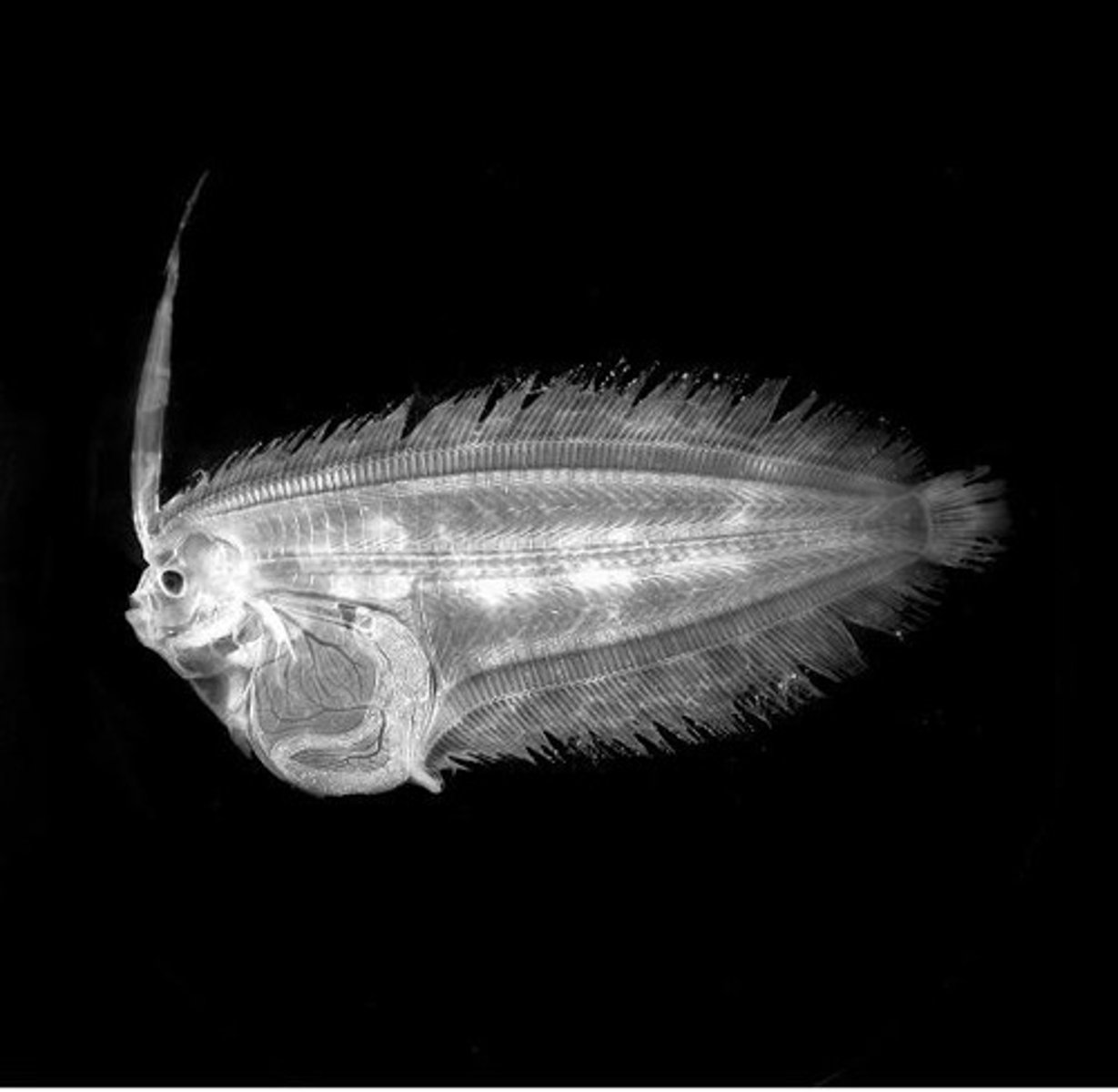
What is the typical size range for eye migration in flatfishes?
From 4 to 120 mm, depending on the species.
What are some examples of diverse morphological forms in larval fishes?
Myctophid with stalked eyes, serranid with pelvic and dorsal spines, and holocentrid with head and snout spines.
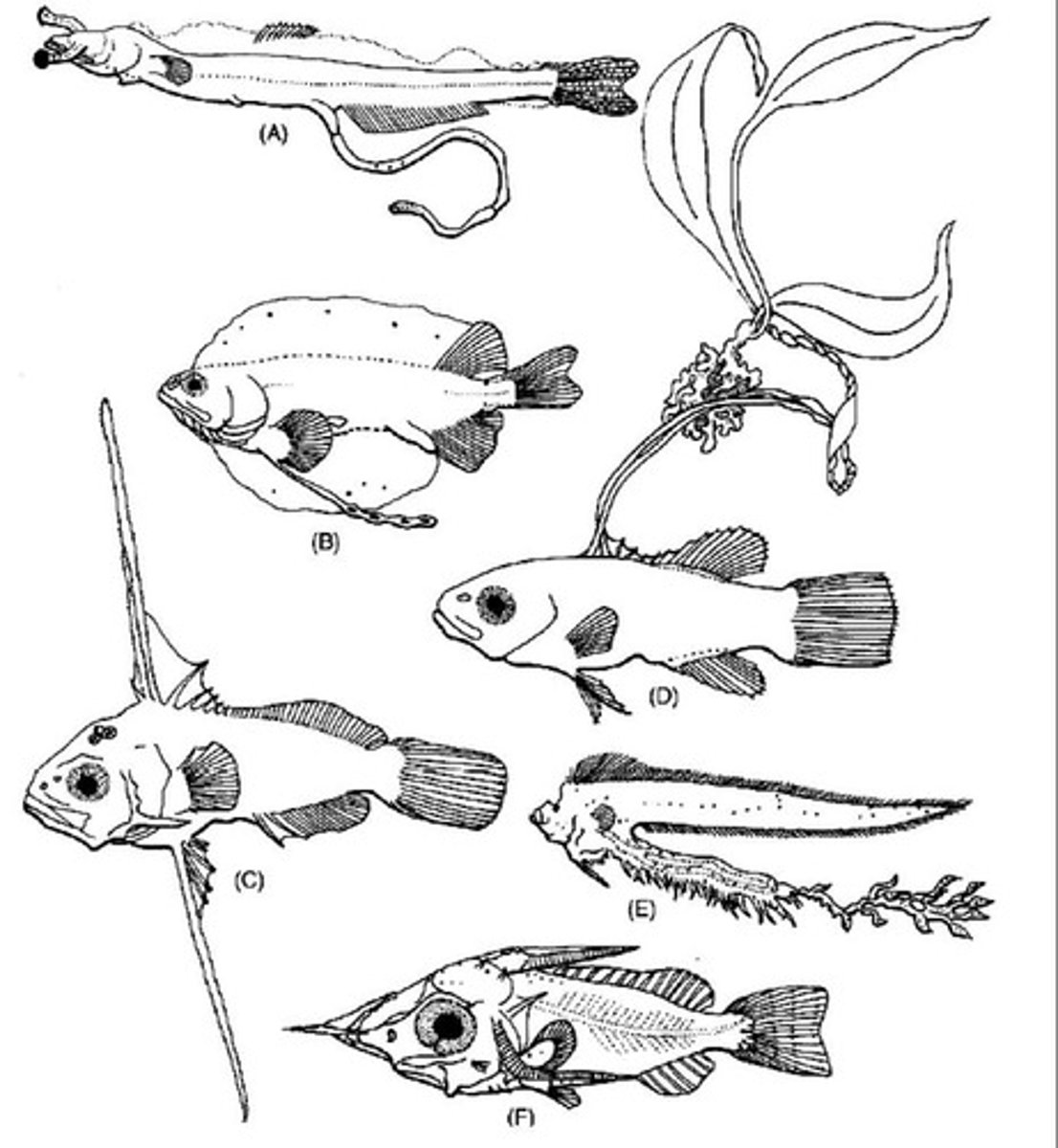
What is the role of metamorphosis in larval fishes?
It marks the transition from larval to juvenile stages, often involving habitat and food type changes.
What are the three main sources of larval mortality?
Starvation, predation, and physical processes (e.g., advection, temperature/salinity extremes, O2 min).
What does the Critical Period Hypothesis state?
Larvae are most vulnerable to starvation immediately following yolk absorption and must obtain food during the critical period of first feeding to survive.
What is the Match-Mismatch Hypothesis?
It suggests that larval success is related to the temporal alignment of fish reproduction and prey availability, leading to success when larvae co-occur with food (match) and failure when they do not (mismatch).
What is the Growth-Mortality Hypothesis?
It posits that favorable feeding leads to higher growth, shorter larval duration, and less cumulative larval mortality.
What is the significance of larval dispersal?
It facilitates population connectivity and the exchange of individuals among local populations, which is important for population management.
What distinguishes open populations from closed populations?
Open populations have significant exchange among local populations, while closed populations have little or no exchange.
What is recruitment in the context of fish populations?
Recruitment refers to the entry of young into the adult population, transitioning from the pelagic realm to benthic juvenile/adult habitat.
How is settlement typically measured in demersal species?
Settlement is measured using light traps or by divers visually surveying natural benthos or artificial sampling units.
What is the relationship between larval survival and environmental conditions?
Subtle differences in survival during the early stages can lead to significant differences in recruitment to the adult population.
What does the equation dN/dt = -ZN represent?
It represents population decay, where Z is the instantaneous mortality rate.
What is the implication of increased growth rates in early larval stages?
Increased growth rates can lead to higher survival rates in early larval stages due to factors like temperature or food availability and lower predation risk.
What is the typical timing of larval settlement?
Settlement typically occurs at night and is often synchronized with lunar cycles.
What role does temperature play in larval survival?
Temperature can influence growth rates, which in turn affects survival rates in early larval stages.
What are the implications of high mortality rates in early larval stages?
High mortality rates can significantly impact the recruitment and future population strength of fish.
What is the effect of predation on larval fish?
Predation can lead to decreased survival rates, especially if larvae are smaller and less developed.
What is the significance of the larval survivorship gauntlet?
It refers to the various challenges and threats larvae face during their early life stages, impacting their survival and recruitment.
What does the term 'year-class strength' refer to?
It refers to the number of individuals that survive from a particular cohort or year, which can be influenced by early survival rates.
How do physical processes affect larval fish survival?
Physical processes like advection and temperature extremes can lead to increased mortality rates in larval fish.
What is the role of food availability in larval fish success?
Food availability during the critical feeding period is crucial for larval survival and growth.
What can small differences in survival rates lead to?
Small differences in survival rates of the youngest stages can result in large differences in recruitment to the adult population.
What method is used to sample different life stages of pelagic species?
Towed nets of different openings and mesh sizes.
What is meant by 'Young-of-the-year' in temperate species?
Young first detected in their juvenile habitat.
What are otoliths?
Ear stones located in the inner ear that function in sensing gravity and acceleration.
What information can otoliths provide?
Age and growth information for individuals.
What is essential for early juvenile survival?
Recruits must settle in suitable habitat, find food, avoid predation, and compete successfully.
What are 'carry-over' traits?
Traits resulting from larval life that influence early juvenile survival, such as size and growth-related traits.
What hypothesis suggests that larger size is beneficial for survival?
Bigger-is-better hypothesis.
What does otolith microstructure data reveal?
Information on early life history traits and ecological processes associated with settlement and early survival.
What factors are important during the settlement of pelagic species?
Larval growth, emergence, pelagic larval duration, size-at-age at settlement, and condition at settlement.
What does selective mortality across life stages refer to?
Tracking the survival rates of different cohorts of juveniles and larvae.
How does size at hatch influence survival?
Size at hatch influences survival through the larval stage and into the juvenile stage.
What are beneficial traits for new recruits?
Large size at settlement, small size for faster escape, high condition, risk-taking behavior, and greater initial sheltering behavior.
What is ontogenetic migration?
The transition of recruits into different habitats as they grow, with changes in food, competitors, and predators.
Why are nursery habitats essential?
They are essential for the completion of the life cycle and influence early survival of juveniles.
What is 'essential fish habitat'?
Habitat necessary for managed fish to complete their life cycle, contributing to sustainable fisheries.
What organization works to define essential fish habitat for federally managed species?
NOAA (National Oceanic and Atmospheric Administration).
What threats must be minimized to nursery habitats?
Threats from fishing practices, coastal development, and other human activities.