Physical Geography: The Carbon and water Cycles - The Carbon cycles
 Call Kai
 Learn
Learn Practice Test
 Spaced Repetition
 Match
Match Flashcards
 Knowt Play
1/47

There's no tags or description
Looks like no tags are added yet.
Name | Mastery | Learn | Test | Matching | Spaced | Call with Kai |
|---|
No analytics yet
Send a link to your students to track their progress
48 Terms
Carbon stores magnitude
- Lithosphere - 99.985%
- Hydrosphere - 0.0076%
- Pedospehere - 0.0031%
- Cryosphere - 0.0018%
- Atmosphere - 0.0015%
- Biosphere - 0.0011%
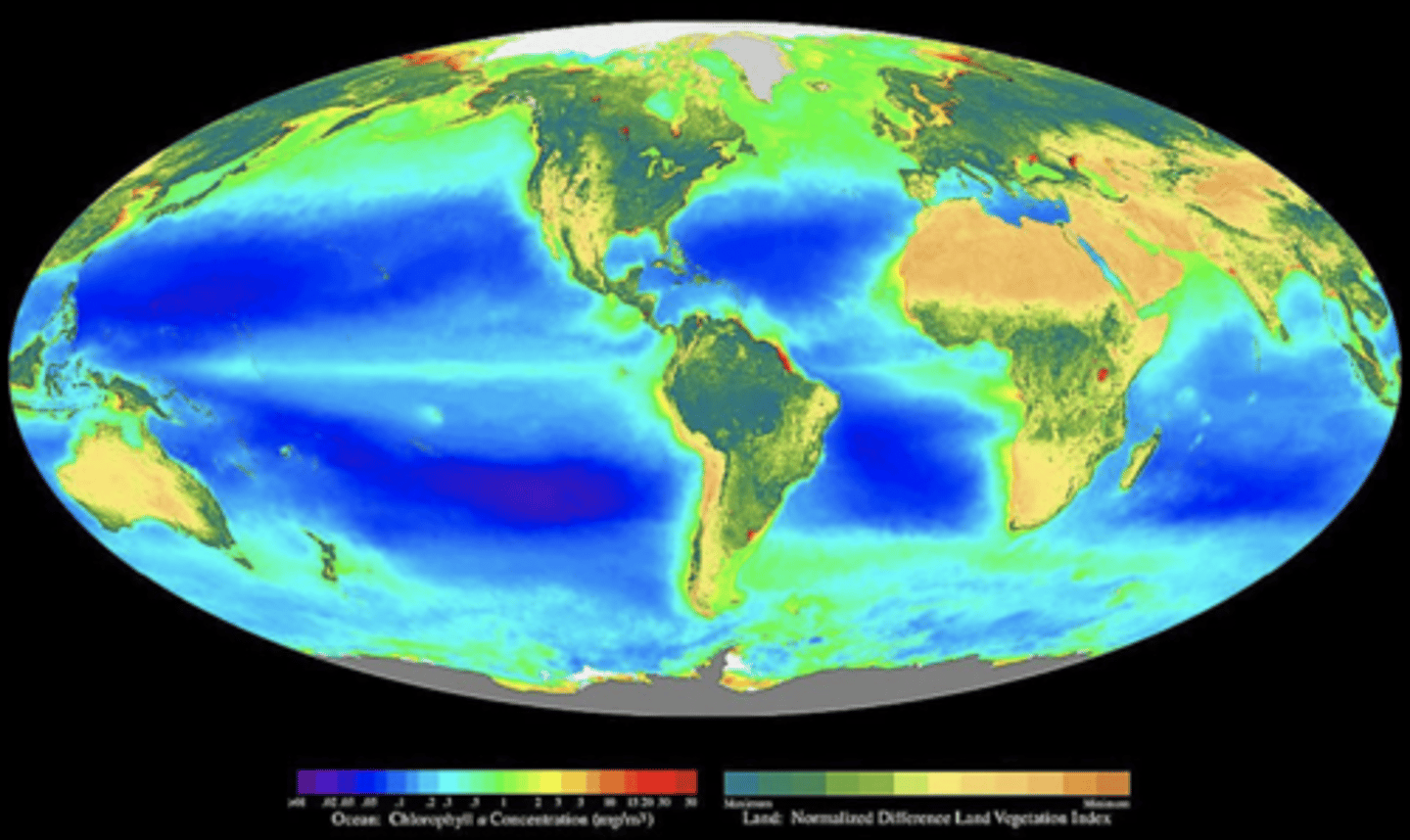
Global distribution of vegetation stores of carbon
- High in rainforest areas (Indonesia, Philippines, South America, Central Africa)
- Very Low in desert areas (North Africa, Middle East)
- Generally Highest around the equator (perfect climate)
- Human impact
Origins of Carbon
- Stored in Mantle at constructive and destructive plate boundaries as well as hot spot volcanoes - particularly when plates are subducted (Metamorphism of carbonate rocks)
- Some Co2 remains in atmosphere, some is dissolved into ocean
Carbon Sink
store that absorbs more than it releases
Carbon source
Store that releases more than it absorbs
Carbon transfers
Processes that transfer carbon between stores. Transfers such as inputs and outputs affect the size of carbon stores.
Measuring Carbon
- Measured in Gigatonnes (GTC)
- 1 GTC = 10^9 tonnes (1 Billion Tonnes)
- Transfers are measured in GTC/Years
Photosynthesis as a transfer
- Light energy used to turn CO2 into a carbohydrate usually glucose
- O2 Released
- Some glucose is used in photosynthesis , the rest is stored as starch
Respiration as a transfer
- Some carbohydrate used in respiration, others stored in biomass
- Opposite of photosynthesis
- Less abundant than photosynthesis, so does not balance out
Decomposition as a transfer
- Physical, chemical and biological mechanisms that transforms organic matter into increasingly unstable forms
- includes physical breaking down of organic material by wet-dry, shrink-swell, hot-cold and freeze-thaw cycles
- physical mechanisms include animals, wind, other plants and leaching and transport in water
-chemical mechanisms include oxidation and condensation
- biological transformation include feeding and digestion
- carried out by decomposers which break down matter
- ensures that compounds are recycles for life
Combustion as a transfer
- Occurs when any organic material is reacted (Burned) in the prescence of Oxygen
- Gives products of CO2 Water and energy
- Organic matter can be any vegetation or fossil fuel
- If other molecules are present they may combine with oxygen to form pollutant molecules such as nitrous oxides or sulfur oxides
Biomass combustion
- Burning of living and dead vegetation
- Fire consumes 10-20% of carbon and emits into atmosphere
Weathering as a transfer
- Breakdown and decay of rock
- Carbon dioxide and rainwater can form a weak carbonic acid
- weathering can cause rocks to dissolve with carbon being held in suspension
- Carbon is transported via the water cycle to the ocean
- Carbon is then used to build the shells of marine animals.
Geologic sequestration
- captured from factorys (CCS)
- Injected into salt formations or depleting oil/gas reserves at depths below 2600ft
oceanic sequestration
injecting carbon dioxide deep in the oceans
Hydrocarbon extraction, burning and cement manufacture in changes in carbon cycle
- Pressure from sediment leads to anoxic decomposition, combined with heat from hydrocarbons
- when fossil fuels burned CO2 released
- Cement industry responsible for 5% of anthropogenic CO2 emissions
- 900KG of CO2 for every 1000KG of cement produced
Farming practices in changes in carbon cycle
- When soil is ploughed, aerobic conditions lead to further decomposition
- emissions from tractors
- enteric fermentation - methane released from livestock
- Rice paddies cause 10% agricultural CH4 outputs
Deforestation in changes in carbon cycle
- decrease in forest
- increase in agricultural land
- burning causes fast release of CO2
Urban growth in changes in carbon cycle
- Lack of vegetation
- CO2 from transport and building
- 2012 - cities were responsible for 47% of CO2 emissions
Natural climate change and its impacts on the carbon cycle
- During the quaternary period (2.6 mya) global climates changed between warm (Interglacial) and cold (Glacial) period
- Trends for temperature and CO2 Mirror each other
- Higher CO2 leads to global warming
-Lower CO2 reduces the efficiency of greenhouse effect
Impact of cold conditions on carbon stores and transfers
- enhanced chemical weathering due to more CO2 held in colder air
- Forest cover would be different in different areas, affecting significance and distribution of photosynthesis and restoration
- Decomposers would be less effective, reducing carbon transfers to the soil
- Less water flowing into oceans (Snow and ice) meaning less sediment transferred along river snad less build up on the ocean floor
- Soil may be frozen over vast areas of land reducing the ability to absorb carbon
Impact of warm conditions on carbon stores and transfers
- Noticeable most in higher latitutes
- Melting permafrost releases carbon, which warms temperatures, which melts permafrost, creating a positive feedback loop
Impacts of wildfires on Carbon cycles
- Releases large quantities of carbon emissions
- Creates noticeable spikes in carbon dioxide levels
- Wildfires turn forests from carbon sinks to a source as combustion returns large quantities of carbon emissions back into atmosphere
Impacts of volcanic activity on carbon cycles
- Produce large quantity of carbon that was trapped for millions of years
- Volcanoes emit 130-280 million tonnes of CO2/Year
- Also erupt lava containing silicates that cause weathering converting CO2 in air to carbonates in solution
- Slowly absorbed from atmosphere
Carbon budget
The amount of carbon that is stored and transferred within the carbon cycle
Changing carbon cycles impact on atmosphere and climate
- Enhances greenhouse effect
- Deforestation/afforestation hugely impacts carbon cycle
- Vegetation - removes CO2 and gives O2 and Water, which increases levels of humidity and cloud cover, which facilitate plant growth
- Plankton - Promotes formation of clouds and their creation due to the chemical DMS
Ocean acidification
- Dissolving CO2 in ocean creates carbonic acid
- getting rid of coral reefs and therefore habitats and food for marine life and threatens biodiversity
- Oyster larvae was dieing on coast in USA, leading to millions of dollar in losses
Ocean warming
- Massively decreases plankton
- Which limits oceans ability to take carbon from the atmosphere making the ocean a less effective carbon sink
Melting sea ice
- 40% retreat in 35 years
- Loss of habitat for algae, which effects the food chain all the way up to polar bears
- Loss of habitat for polar bears and walruses - loss of food source.
Ocean salinity
- Low in NA
- Caused by high precipitation and high temperature
- precipitation leads to higher runoff into the sea
- Higher temperatures lead to melting greenland ice sheet that also increases fresh water into the sea.
Sea level rise
- Melting of terrestrial ice
- High temperatures have higher summer melting and decreased snowfall therefore a net gain in oceanic water
- Thermal expansion - water heats up and expands making water take up more space therefore rising sea levels
Feedback
Return or knock on effect leading to a change in effectiveness in 1 or more processes in a cycle
Positive feedback
Actions that further destabilise the system
Negative feedback
Actions that counteract change, restabilising the system
Albedo feedback
Rise in temp reduces snow cover of surface, reducing the albedo effect. This then heats the earth which rises the temperature
Modifying climate change: CCS
- Capture CO2 emissions from coal dire power stations and industry
- Gas is transported to a site to be stored
-Could cut global CO2 emissions by 19%
1. Once captured - CO2 is compressed and transported by a pipeline to an injection well
2. Injected as a liquid into reservoirs or aquifers
- Boundary Dam in canada - 1 million tonnes a year stored - cuts t emissions by 90%
- Cons
^ Relies on reservoirs being empty
^ Very expensive
^ Unsure of Long term impacts of storing large amounts underground
Modifying climate change - Afforestation
- Trees act as carbon sink and release moisture into atmosphere, controlling global climates
- Plantation forests comprise 7% of global forests and are more effective compared to natural forests
- Pro - Considered by the IPCC as a legitimate strategy
- Con
^ Long term political commitment (So a new gov doesn't cut down)
^ Take up a large amount of space
Modifying climate change - Land Use (Carbon farming and reducing rate of deforestation)
- Carbon farming - where a crop is replaced by another that is more productive and absorbs more CO2 from the atmosphere
- Forestry stewardship council (FSC) - advise timber products grown sustainably through certifying the products
- Carbon payments - Countries/Businesses pay monthly towards forests being protected, developing renewable energy or planting trees
- Selective management system - Malaysia where certain trees are sustainably selected to be felled and then replaced
Modifying climate change - Grasslands
- Offers a GHG mitigation storage of 810 million tonnes by 2030, mostly stored in soil
Soil carbon storage can be improved by:
- avoidance of over stocking grazing animals
- adding manures and fertilisers that have direct impact on soil organic carbon levels through the added organic material
- Revegetation - improved pastures and legumes
Modifying climate change - Croplands
Increases soil organic content by;
- Reduced or no tillage to avoid accelerated decomposition
- Use animal manure rather than fertiliser so biomass can be returned
Modifying climate change - Forrested land and tree crops
- Preserve current forests
- Reforesting - increase density in degrading forests ncreasing biomass density therefore carbon density and storage
Improved aviation practices - Movement management
- Avoid circling while in air
- Towing aircraft while on the ground
- Making routes more fuel efficient rather than fastest or shortest
Improved aviation practices - Flight management
- 100% occupied seats by encouraging last minute sales
- Boeing 787 uses 3L less of fuel per 100 passengers
- Cruising at lower speeds
- Matching aircraft type for route (Smaller for domestic)
Improved aviation practices - Design technology
- Improved aerodynamics (Reduced resistance)
- Maximising number of seats per aircraft
- Carbon capture within the engines
- Reduced weight of aircraft and engines
- Increased use of biofuels
Political initiatives against climate change - IPCC (1988)
- Intergovernmental panel of climate change
- Scientists and experts set up to monitor analyse climates
Political initiatives against climate change - Kyoto Protocol (1997)
- Targets for developed countries to reduced global GHGs emissions
- Established concept of trading carbon emissions between member countries
- Not all developed countries signed the deal
- Some countries have since withdrawn
- Not legally enforceable
Political initiatives against climate change - The Paris Agreement (2015)
- COP21 195 countries adopted the first legally binding global climate deal enforced by 2020
- Limited global temperature rises to 1.5 degrees
- Countries can and have dropped out (USA)
- Developed nations will continue to support initiatives in developing countries aimed at reducing emissions
Tackling climate change - Regional commitments
-