Unit 1 Psychology Exam Flashcards
 Call Kai
 Learn
Learn Practice Test
 Spaced Repetition
 Match
Match Flashcards
 Knowt Play
1/108

There's no tags or description
Looks like no tags are added yet.
Name | Mastery | Learn | Test | Matching | Spaced | Call with Kai |
|---|
No analytics yet
Send a link to your students to track their progress
109 Terms
What were the findings for the insecure/avoidant attachment style?
25% of infants will seek little contact with their caregiver while playing and are not distressed when their caregiver leaves. They are distant and avoidant when their caregiver comes back and are comfortable around a stranger.
What is Nature? Give examples.
What you are genetically given at birth by your parents. They remain constant throughout your life.
Examples: eye colour, bone structure, blood type
How can you tell which part of the mental health continuum a person is on?
This can be identified by observing their level of emotional wellbeing, ability to cope with stress, day-to- day functioning, relationships and whether symptoms are mild, temporary or persistent.
What were the findings for the insecure/ resistant attachment style?
10% of children will seem quite anxious or clingy while playing, will become angry when their caregiver leaves and aren’t comforted when they return, and don’t use their caregivers as an exploration space.
What was the conclusion of Hubel & Weisel’s experiment? (use key terminology)
The visual system of mammals, including humans, has a critical period of development.
How may having an insecure-avoidant attachment style as an infant affect an individual?
Avoidant attachments linked to emotional distancing, discomfort in closeness and a strong reliance on independence in later relationships.
what were the findings for the secure attachment style?
65% of children will play and explore comfortably when their mother is present, becomes uncomfortable when their caregiver leaves, and gets very upset when the stranger tries to calm them down. They will calm down quickly when the caregiver returns.
What is the fourth stage of Piaget’s cognitive development? What are the Key concepts?
Formal Operational → 12+ years
Abstract thinking → the ability to think about ideas that are not physically present.
Logical thinking → the ability to think systematically, follow rules and problem solve.
Idealistic thinking → the tendency to think about what should be, often questioning rules.
What are the 3 components of the mental health continuum.
Mentally Healthy
able to bounce back from adversity
Mental health problem
Usually short term
Mental disorder
Cannot function in everyday life
What are critical periods? Give an example.
A fixed period of development in which an organism has heightened sensitivity to external sensitivity that are compulsory for development of a particular skill.
eg: development of visual cortex (Hubel and Weisel).
What are some differences between Sensitive and Critical Periods. (Give 2 Examples)
- Missing a critical period can mean you miss learning a certain skill, while you can still learn the skill after the sensitive period.
- Critical periods are specific timeframes, while sensitive periods start and end slowly
- Critical periods require specific experiences, while sensitive periods are a bit broader.
What is the aim of Harry Harlow’s attachment in monkeys experiment?
The aim was to test whether infant attachment is primarily based on feeding, or emotional comfort.
What was the conclusion of Harry Harlow’s experiment of attachment with monkeys?
He found that attachment is driven by comfort and emotional security rather than feeding.
What is the first stage of Piaget’s cognitive development? What are the key concepts?
Sensorimotor → birth - 2 years
Object permeance → understanding an object continues to exist even when it cannot be seen
Goal Directed behavior → a planned series of actions with a purpose.
What is an example of an insecure - avoidant attachment?
- Isn’t distressed when their caregiver leaves.
- Ignores or avoids caregiver when they come back
- Seeks little contact with the caregiver when playing
- Comfortable with strangers
What is an example of secure attachment?
- Comfortable around their caregiver
- Distressed around strangers
- Uses caregiver as a base of exploration
- Comforted when care giver returns.
What are the first 4 stages of Erik Erikson’s stages of psychological development? What are the key crisis?
Stage 1 Hope: → 0 - 18mths
Trust vs Mistrust
Stage 2 Will → 18mth - 3 yrs
Autonomy vs Shame & Doubt
Stage 3 Purpose → 3-5yrs
Initiative vs Guilt
Stage 4 Competence → 5-12 yrs
Industry vs Inferiority.
What are the last 4 stages of Erik Erikson’s stages of psychological development? What are the key crisis?
Stage 5 Fidelity → 12-18yrs
Identity vs Role confusion
Stage 6 Love → 18-25yrs
Intimacy vs Isolation
Stage 7 Caring → 25-65 yrs
Generativity vs Stagnation
Stage 8 Wisdom → 65yrs+
Integrity vs Despair.
What was the aim of Hubel and Weisel’s experiment?
The aim was to study the effects of visual depravation on the visual system in mammals. They aimed to understand how the visual cortex is affected by critical and sensitive periods of development.
What is Atypical Behavior? Give an example.
A person acting in ways that is unusual for them
eg: A person not speaking to their co-workers for a week, even though they see them every day.
What is typical behavior?
What is usual or appropriate; at most times a person acts as they usually would do.
eg: a person not speaking to their co-workers because they are a Buddhist monk who has taken a vow of silence.
How may having a secure attachment as an infant affect an individual?
- Secure attachment is linked to between emotional regulation, higher self-esteem and more positive social relationships later in life.
How may having an insecure -resistant attachment as an infant affect an individual?
- Resistant attachment is linked to heightened emotional sensitivity, fear of abandonment and a strong need for reassurance in later relationships.
What is an example of an insecure - resistant attachment?
- Don’t use their caregiver to explore, and prefer to cling
- get angry or distressed when their caregiver leaves
- Isn’t comforted when their caregiver returns.
What are sensitive periods? Give an example.
Specific times during development when a biological event is more ‘sensitive’ or responsive to certain types of environmental; stimuli. We can still learn after the sensitive period has ended but the learning process is less efficient.
eg: learning to walk, crawl, riding a bike.
What is Nuture? Give examples.
Nurture is the process of caring for, encouraging, and helping someone or something grow and develop.
eg: Nutritional intake, vocabulary, family, where you live.
What is the second stage of Piaget’s cognitive development? What are the key concepts?
Pre-operational stage → 2-7yrs
Symbolic thinking → a type of thinking that uses symbols such as words or images to solve problems
Animism → the belief that inanimate objects have feelings
Egocentrism → a limited ability to share or appreciate someone else’s view
Transformation → the understanding that something can change from one state to another.
What is the third stage of Piaget’s development? What are the key concepts?
Concrete operational stage → 7-12yrs
Reversibility → the understanding that actions can be undone or reversed
Conservation → understanding certain qualities of an object remain the same even in a different appearance.
Classification → the ability to sort objects into groups based on them features.
What is Chronic Traumatic Encephalopathy? Include symptoms.
Chronic Traumatic Encephalopathy (CTE) is the result of too many subconcussive hits to the head. Symptoms can begin as early as the age of 30, most in sufferers 40's and 50's, but it can only be diagnosed using a post-mortem. Symptoms include problems in thinking and memory, changes in personality, slowness in cognitive functioning. In some cases, it can also lead to an early dementia.
What is a Concussion?
A concussion occurs when there is a sudden jolt to the head which causes the brain to bump the inside of the skull. It affects neurons in the brain by stretching and sometimes tearing neurons or causing death of other neurons by releasing toxins. Some symptoms of being concussed include blackouts, headache, blurred vision, problems with balance, changed mood and behavior, memory problems, and problems with thinking clearly, sleeping, anxiety and depression, fencing response where the arm goes up. There is generally no long-term issues for single concussions as most concussions heal and symptoms disappear within a few days.
What happens to patients with Broca's or Wernicke's Aphasia?
Patients with Broca's Aphasia understand speech and know what they want to say but have difficulty saying the words. A typical patient with Broca's aphasia speaks slowly and laboriously and uses simple sentences.
Patients with Wernicke's aphasia aren't able to understand speech or produce coherent language.
What happens when there is damage to the parietal lobe damage?
Parietal lobe damage creates spatial neglect, and patients are unable to notice anything on one side of their body. This is most common in the right parietal lobe, leaving patients to neglect the left side of their world. This occurs commonly in stroke victims, and is mostly visual, but can occur for other senses and the extent & severity of neglect depends on the severity & specific location of their brain injury.
What happens when there is frontal lobe damage? Reference Biological, Psychological and Social changes
- Biological changes - often problems with motor activities
eg. black expressions, minimal head & eye movement
- Psychological changes - emotion, personality and cognitive (thinking) which in turn affects behavior
eg. lack of emotional responsiveness, euphoria, impulsiveness, aggression ect, problems with planning and goal directed behavior
- Social changes - socially inappropriate behavior which in turn affects relationships.
eg. more people with this type end up in jail.
What is brain injury?
Brain injury refers to any brain damage that impairs/interferes with the normal functioning of the brain, temporary or permanently. Acquired brain injury occurs after birth by accident, deliberate injury, stroke, alcohol, drugs, inflammation or disease.
What are 3 similarities between Re-routing and sprouting?
1. Both occur more easily in infancy and childhood when the brain is more developmentally plastic. as we age the brain gradually loses the ability to compensate for damage but not necessarily altogether.
2. Both can occur at all levels of the central nervous system, from the cerebral cortex down to the spinal cord.
3. Both change the brain by allowing for entirely new neural connections to occur.
What is sprouting in relation to adaptive plasticity.
Growth of additional branches on axons or dendrites to enable new connections. Sprouting can also involve re-routing when sprouting occurs from a damaged area and the new growth activates previously deactivated neurons.
What is re-routing in relation to adaptive plasticity?
An undamaged neuron that has lost a connection with an active neuron may seek a new active neuron and connect with it instead.
What is Adaptive Plasticity?
Adaptive plasticity the brain's compensation for lost functions due to brain damage as well as in response to interaction with the environment by reorganizing its structure.
What is Synaptic pruning?
Synaptic pruning is a type of developmental plasticity and is the 'pruning' of weak or unused synaptic connections in the brain. Synaptic pruning is a long term process, where the brain fine tunes its connections. What is pruned or kept is based on experience, allowing neurons to work more efficiently. Adults have 40% fewer synapses than a 3-year-old, and it occurs in childhood, but peaks in adolescence then stabilizes around 30.
What is Synaptogenesis
Synaptogenesis is a type of developmental plasticity and is the rapid expansion in the formation of new synapses as this part of these neurons also develop new dendrites and more dendrite branches. This allows more connections to be formed between neurons (and more new pathways). Most of the brain growth happens quickly in sensory and motor areas of the cerebral cortex. Before birth and in infancy has the most intense development, but it can occur throughout the lifespan and more neural connections are made than can ever be used.
What is Myelination?
Myelination is a type of developmental plasticity and is the process of creating myelin to protect and insulate neurons - this has the effect of making neural transmission more efficient and effective. It increases brain size (volume) starting in the hindbrain then moving to midbrain and lastly forebrain. Myelination starts before birth, and infancy has the most intense development, but continues to occur in childhood. There is a second peak in adolescence in the prefrontal cortex, and it does occur in adulthood, though less.
What is developmental plasticity?
Developmental plasticity is the brain’s natural ability to change and grow from birth. It begins when the young brain starts processing sensory information, like what we see and hear. Our neural connections are shaped and strengthened by our experiences and interactions with the environment, especially during childhood. Although this ability continues throughout life, it becomes less strong as we get older.
What is the difference in neural plasticity in developing brains compared to developed brains?
Sensory and motor cortices have a higher level of plasticity in developing brains. During infancy and childhood, developing brains are more plastic than that of an adult. e.g. infants can learn a language quicker and recover from brain injury quicker.
How does neural plasticity occur?
Plasticity occurs when new neural pathways can form and link up with existing pathways, existing pathways may interconnect with other pathways and they re-organize and reassign neural connections and pathways based on which parts of the brain are overused, under used and/or injured.
When does neural plasticity occur?
Neural plasticity occurs during the stages of brain development when we are young, during learning throughout our entire lives and sometimes in response to brain injury.
What is Neural Plastciticy?
Neural plasticity is the ability of the brain's neural structure and function to be changed by experience throughout the lifespan. These changes occur at the connections of the neurons, usually at the synapse.
Spinal Reflex
Spinal reflexes are an unconscious, involuntary movement that is initiated by interneurons in the spinal cord.
What do Gaba and Glutamate do?
Some neurotransmitters have an excitatory effect (Glutamate). they make the post-synaptic neuron more likely to fire.
other neurotransmitters have an inhibitory effect (GABA). They make the post-synaptic neuron less likely to fire.
Lock and Key Process
The neurotransmitter (KEY) has a complementary shape to the receptor (LOCK). They bind together, unlocking the post synaptic neuron.
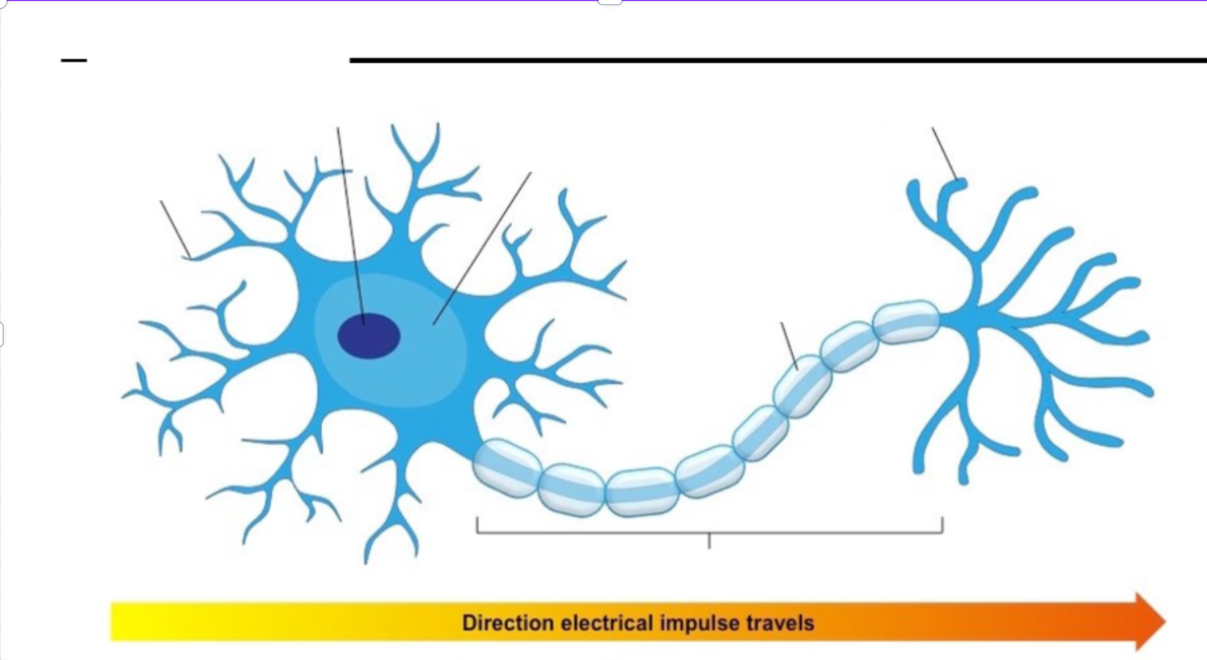
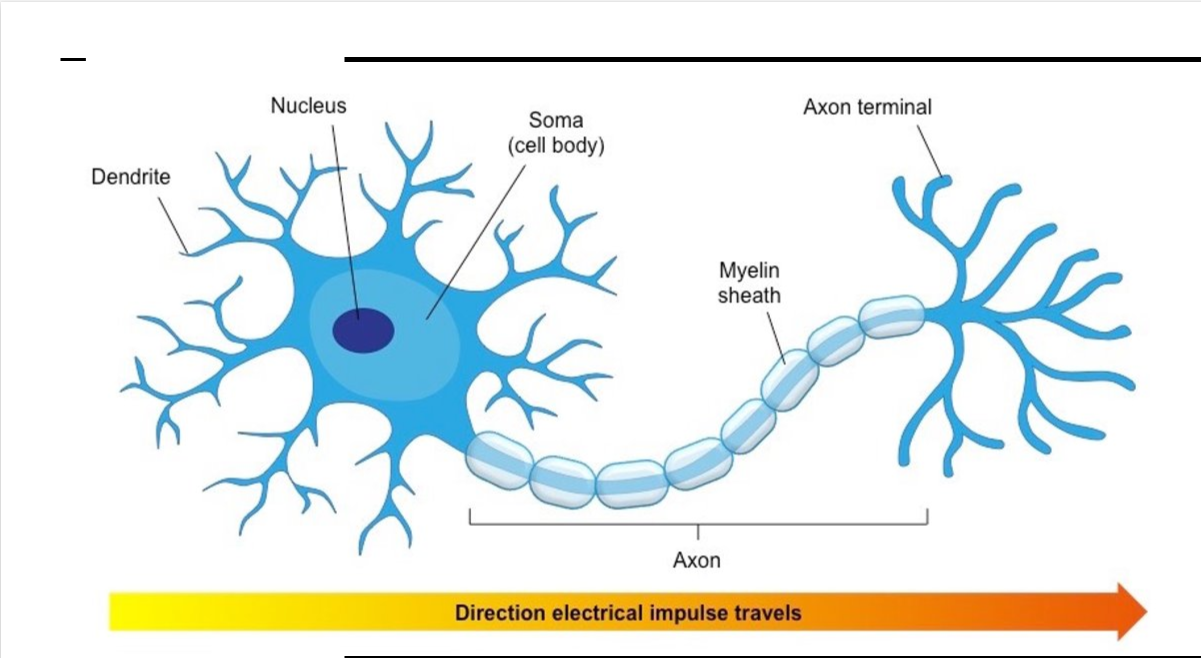
Label this neuron
What are terminal buttons.
Terminal buttons hold neurotransmitters which are released to carry messages to the dendrites of other neurons.
What are Axon terminals.
Axon terminals are branches on the end of the axon containing small sacs of neurochemicals.
What are the Nodes of Ranvier?
The Nodes of Ranvier are small gaps where the myelin sheath is missing
What is the Myelin Sheath?
The myelin sheath is a white fatty covering that helps insulate the axon to help deliver messages quicker.
What is an Axon?
An Axon is a single tubelike fluid filled with extension that transmits information from the soma to the axon terminals.
What is the Nucleus?
The Nucleus stores DNA and provides biochemical information to keep the neuron functioning.
What is the soma or cell body?
The cell body (soma) integrates the neural information it receives from the dendrites. Also houses the cell nucleus.
What are dendrites?
Dendrites are short branching nerve fibers which detect and receive neural info from other neurons & transmits info to soma.
What are Motor Neurons?
Motor neurons send messages from the central nervous system (CNS) to the rest of the body. These messages tell muscles to move, glands to release chemicals, and organs like the heart to keep working properly.
What are Interneurons?
Interneurons act as a link between sensory and motor neurons, allowing them to communicate with one another.
What is a sensory neuron
Sensory neurons collect information from both outside and inside your body. They pick up things from your senses (like sight, sound, and touch) and also from inside your body (like your muscles and joints), then carry that information to the central nervous system (CNS).
What is the right hemisphere of the brain in charge of?
- Spatial & visual thinking
- Emotional recognition and thought
- Creativity
- Imagination
- Left field vision
- Left side motor skills
- Non-verbal
What is the left hemisphere of the brain in charge of?
- Analytical processing
- Language (verbal)
- Ordered sequencing
- Rational thought
- Logic and planning
- Right field vision
- Right side motor skills
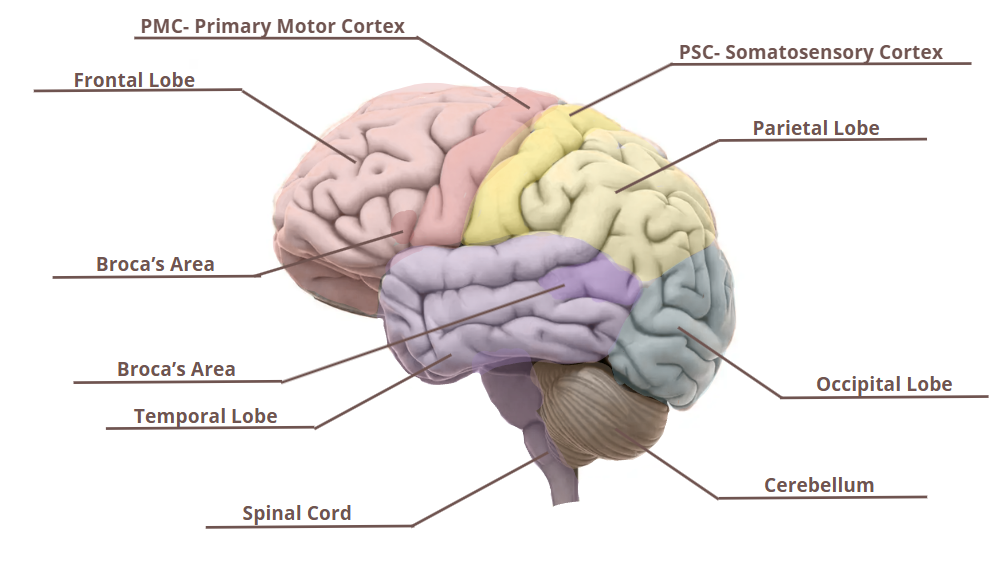
Name the Lobes and important areas of the brain.
Wernicke's Area
Wernicke's area is located in the temporal lobe in the left hemisphere. It is involved with comprehension of speech.
The Temporal Lobe
The Temporal lobe is located in the lower central area of the brain, above and around each ear. The temporal lobe receives and processes sounds from both ears, as well as memory of facts and personal memories. The left lobe also contains the Wernicke's Area.
The Occipital Lobe
The Occipital lobe is located at the rear end of each hemisphere (back of the head). The occipital lobe receives and processes visual information. eg. the Occipital lobe interacts with the temporal lobe to recognize faces.
The Primary Somatosensory Cortex (PSC)
The PSC is located in the Parietal Lobe and receives and processes sensory information from skin, such as touch, pressure, temperature and pain. The Right PSC receives info from the left side of the body and vice versa. Amount of the cortex devoted to a body part is related to sensitivity & amount of use. Eg. Lips, fingers and tongue have more cortical space than less sensitive areas like the forearm.
The Parietal Lobe
The Parietal Lobe is located behind the frontal lobe and occupies the upper back half of the brain. It receives and processes sensory information from the body and is involved with spatial reasoning. The Parietal lobe also contains the Primary Somatosensory Cortex (PSC).
The Primary Motor Cortex (PMC)
The PMC is located in the frontal lobe, and control voluntary movement of skeletal muscles. The left PMC controls the rights side of the body and vice versa. Specific points along the PMC are involved with movement with particular muscles in the body. The size of PMC area is related to precision of movement of the body part (eg. fingers take up more space than thighs).
Broca's Area
Broca's area is located in the frontal lobe and plays a crucial role in the production and articulate of speech. The Broca's area coordinates messages to your lips, jaws, tongue and vocal cords to enable you to produce words clearly and fluently. The Broca's area is only located in the left hemisphere.
Frontal Lobe
The frontal lobe is involved with complex mental functions like planning and reasoning. The frontal lobe is also involved with attention, personality and control of emotions. The frontal lobe also contains the Primary motor cortex (PMC) and Broca's area.
Cerebellum
The cerebellum is located in the hindbrain and is cauliflower like and sized like a tennis ball. The cerebellum helps coordinate voluntary movement, regulates balance, posture, muscle tone, coordination. Damage to the cerebellum leads to problems with muscle coordination and damage.
Pons
The pons is located in the hindbrain and is a 2.5cm nerve bundle above the medulla. The ponds are in charge of sleep, dreaming, arousal from sleep, and also helps control breathing. the pons relays messages between areas in the brain.
Medulla
The Medulla is located in the hindbrain, and it controls automatic functions like breathing, heart rate, digestion and blood pressure. This is why a blow to the back of the head can be fatal.
Substantia Nigra
The substantia nigra is located in the midbrain and contains one of the largest collections of dopamine producing neurons in the brain. Dopamine is a neurotransmitter involved in movement and coordination.
Reticular Formation
The Reticular Formation is located in the midbrain and extends from the of the spinal cord through the hindbrain & up to the midbrain. The Reticular formation helps us selectively focus our attention and alertness, as well as regulates arousal and muscle tone (tension).
Cerebrum
The Cerebrum is located in the forebrain and is known as the outer layer of the brain. The Cerebrum is responsible for everything we subconsciously think, feel and do. The Cerebrum is divided into 2 hemispheres, and each hemisphere can be further divided into 4 lobes.
Hypothalamus
The Hypothalamus is found in the forebrain. It is peanut sized and sits on top of the thalamus. The Hypothalamus helps to maintain homeostasis by controlling Body temperature, sleep and wake cycle and hunger & thirst. It connects the nervous and endocrine system.
Thalamus
The Thalamus is found in the forebrain and sits on top of the brain stem. It is in charge of relaying information from almost all the receptor sites (except the nose) and passes it to the cerebral cortex. Damage may result in loss of senses.
What are the 8 types of investigation methologies.
Case Study
Classificication & Identification
Controlled Experiment
Correlation Study
Fieldwork
Literature Review
Modeling & Simulation
Product, process or system design
What are independant variables?
Variables that are changed or manipulated by the researcher to find its effect on the on the dependant variable.
What are dependant variables?
The variable that the researcher measures.
What are Controlled Variables?
Variables that the researcher hold constant (or controls) throughout the experiment.
What are extranious variables.
Any variable that isn’t the independant variable but may affect results.
What are confounding variables?
Variables that have affected the results but isn’t the independant variable.
What is the hypothesis?
A testable prediction that includes refrence to:
The independant variable
The dependant variable
A clear direction for the relationship between variables
a mention of all groupsbeing tested by way of comparison
What is a Random Sample?
Selecting participants from the population in a way that means each member of the population has an equal chance of being selected to participate in the study
What is a Stratified Sample?
First dividing the population into subgroups, and then randomly selecting participants from each subgroup in the proportion that they appear in the population
What is Convinent Sampling?
Selecting participants that are readily available and convenient.
What is a Within Subjects Design for Controlled Experiments? Include advantages / Disadvantages.
Each participant is exposed to both the experimental and control conditions.
Advantages - Eliminates participant differences
Limitations - Order effects can act as extraneous variable
What is a Between Subjects Design for Controlled Experiments? Include advantages / Disadvantages.
Participants are allocated to different groups, each group is exposed to a different condition
Advantages - No order effects
Limitations - Participant differences
What is a Mixed Design for Controlled Experiments? Include advantages / Disadvantages.
Has the features of both a between-subjects design and within-subjects design
Advantages - combines the advantages of both within subjects and between subjects design.
Limitations - Can be more difficult to carry out and can produce results that are difficult to analyse
What are the 5 Ethical Concepts
Beneficence
Integrity
Justice
Non-maleficence
Respect
What are the ethical guidlines?
●Confidentiality
●Debriefing
●Informed consent procedures
●Use of deception in research
●Voluntary participation
●Withdrawal rights
What is Primary and Secondary Data?
●Primary Data: Data we collect ourselves from a study that we have designed.
●Secondary Data: Data that have been collected by someone else that we use when conducting a literature review of the existing knowledge on a research topic.
What is Qualitive vs Quantitive Data
●Qualitative Data: Non-numerical data, they are verbal descriptions of states or qualities that are often organised into themes.
●Quantitative Data: Numerical data, they are recorded in the form of numbers.
What is the true value?
the value or range of values that would be found if a quantity could be measured perfectly
Precision
How close a set of measurement values are to one another
Accuracy
How close the measurement is to the true value of the quantity being measured