Class 23: CH 12 last 4 sections
 Call Kai
 Learn
Learn Practice Test
 Spaced Repetition
 Match
Match Flashcards
 Knowt Play
1/46

There's no tags or description
Looks like no tags are added yet.
Name | Mastery | Learn | Test | Matching | Spaced | Call with Kai |
|---|
No analytics yet
Send a link to your students to track their progress
47 Terms
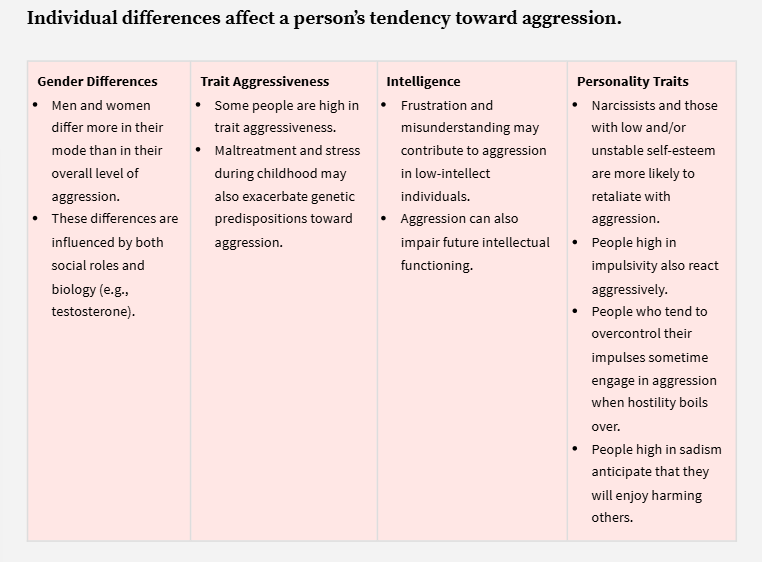
How do men and women differ in aggression?
Men: more likely to engage in physical aggression (e.g., violence, assault, homicide)
Women: more likely to engage in relational/verbal aggression (e.g., gossip, exclusion, threats to friendships)
Overall aggression levels are similar, but differ in type of expression
Conclusion:
Gender differences in aggression are mainly about how aggression is expressed, not how much.
consequences of verbal aggression
victims at high risk for depression.
distress and humiliation
What factors explain gender differences in aggression?
Biological factors: men have higher testosterone, which is linked to aggression (especially under provocation)
Physical differences: men are generally larger and stronger, making physical aggression more likely
Cognitive factors: men are more likely to interpret others’ actions as hostile or provoking
trait aggressiveness
A stable personality characteristic that predisposes individuals to engage in aggressive behavior across various situations. This trait can influence one's likelihood of using either physical or verbal aggression.
more likely than others to agress over time and across situations, susceptible to hostile thoughts, express anger, engage in physical and verbal aggression
How does parenting influence aggression across generations?
Coercive parenting, inconsistent discipline, and physical abuse increase aggression
Exposure to family conflict also promotes antisocial behavior
These patterns can create a cycle of aggression
Aggressive behavior can be passed down across 3 generations
hostile attribution bias
the degree to which a person who is provoked infers that another’s actions were committed with hostile intent. even when other’s intentions are innocent
more of this leads to more aggressive reactions
How does early childhood abuse influence later aggression?
How does early childhood abuse influence later aggression?
What evidence shows that aggression has a genetic component?
Twin studies compare identical vs. fraternal twins
Identical (monozygotic) twins are more similar in aggression than fraternal (dizygotic) twins
Aggression levels remain correlated over time, especially in identical twins
Suggests aggression is partly influenced by genetics
How are genes and serotonin linked to aggression?
No single “aggression gene,” but links exist with serotonin regulation
Serotonin helps regulate stress and impulse control
Low serotonin levels are associated with higher aggression
The enzyme MAO-A (monoamine oxidase A) helps process serotonin
A rare low level of MAO-A variant is linked to violent and antisocial behavior bc difficulty metabolizing serotonin (for someone who’s experienced maltreatment)
warrior gene
poor intellectual functioning can:
result in ppl not being able to process subtleties of a social situation
not know how to interpret other’s actions
lead to frustration bc of reading/ math deficits
difficult to understand inappropriateness of aggression
How do self-esteem, narcissism, and unstable self-esteem, and impulsivity relate to aggression?
Low self-esteem: more emotional reactions to failure, criticism, and rejection
Narcissism:
Grandiose but fragile self-view
Often linked to low implicit self-esteem
Highly sensitive to threats or slights
Unstable self-esteem: self-worth fluctuates based on social feedback
Both narcissism and unstable self-esteem → greater aggression when provoked
impulsivity: react without thinking for consequences
How does the prefrontal cortex relate to aggression?
The prefrontal cortex controls self-regulation and impulse control
reduced = greater impulsive reaction
Violent individuals (e.g., murderers) show lower activity (glucose metabolism) in this region
People with weaker frontal lobe functioning are more aggressive when provoked
Those with stronger functioning show less aggressive responses
sadism
A tendency to derive pleasure from inflicting pain or suffering on others, often associated with aggressive behavior and a lack of empathy.
section review: 12.5 individual differences in aggression
aggression causal approaches
analyze why individuals act destructively, focusing on biological, psychological, and social factors.
Key theories include evolutionary adaptation, social learning, cognitive scripts, and the frustration-aggression hypothesis.
normative approaches to aggression
self-regulating standards that evaluate whether an aggressive response is appropriate in a given situation. They often act as mediators between situational triggers (e.g., provocation) and the behavioral response.
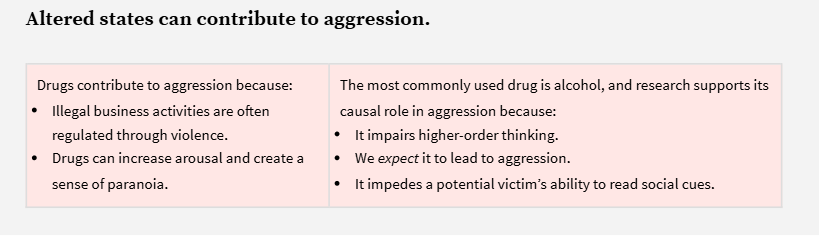
How does alcohol increase aggression?
Impairs self-control and higher-order thinking
Reduces inhibitions → more impulsive reactions to provocation
Limits ability to consider consequences
Higher doses → more aggression
weakens self regulation
less distressed by their mistakes by mistakes
What is alcohol myopia and how does it relate to aggression?
Alcohol reduces ability to process social cues (e.g., emotions)
cant read emotions on face of another person
Focuses attention on immediate cues, not consequences
Leads to misreading situations and escalating conflict
Makes people more likely to be both aggressors and victims
section review: alcohol & aggression 12.6
domestic violence
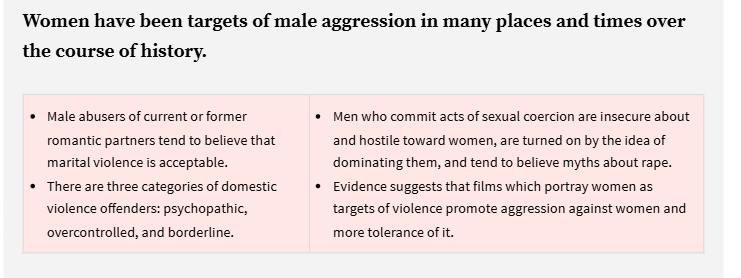
Occurs between romantic partners who interact frequently
High commitment makes people more likely to tolerate abuse
Experiencing aggression → increased acceptance of future aggression
Leads to a cycle of escalating violence
what predicts spousal abuse?
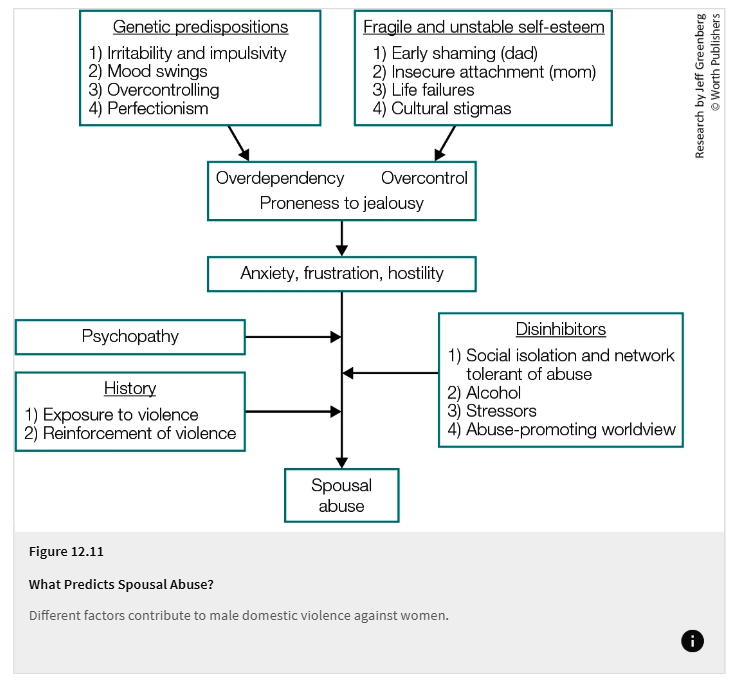
3 types of domestic violence offenders
psychopathic abuser
overcontrolled abuser
borderline abuser
psychopathic abuser
physical aggression inside and outside the relationship
bullies w low impulse control
history of violence
overcontrolled abuser
not violent generally but builds up resentment
uses relationship w partner as target for displaced aggression
borderline abuser
narcissistic and likely to have borderline personality
uncertain, insecure sense of self
proclivity for defensiveness
abandonment issues
anger
impulsivity
disordered childhood attachment with parents, involving neglect or abused
relationship is source of psychological security so they get jealous and control partner
cyclical pattern of abuse and then apology
What are key patterns of rape and sexual coercion?
Most perpetrators are known to the victim
Date rape (within dating/relationships) is more common than stranger rape
Among college women:
~50% report some form of sexual coercion
6–15% report rape
What did Malamuth (1981) find about men’s willingness to rape?
Men rated likelihood of raping if they could “get away with it”
65% said zero likelihood
35% reported some likelihood (> 0)
Especially concerning given social pressure to deny such behavior
How do sexually aggressive men view sex and power?
Associate sex with power and control
When primed with power (e.g., “authority,” “control”), rate women as more attractive
Low perceived power → may use sexual aggression to compensate
What is hostile masculinity syndrome?
Combination of:
Hostile sexism
Belief in rape myths
Insecurity about masculinity/power
Sexual arousal from dominance
Linked to sexual coercion and partner abuse
Stronger in convicted rapists, especially with general aggressiveness
What do experiments show about media exposure and sexual aggression?
Watching films with sexual coercion/rape → ↑ rape myth acceptance and acceptance of violence
Violent pornography → ↑ aggression toward women (especially after provocation)
Nonviolent sexual content:
No immediate aggression effect
But long-term exposure → ↑ acceptance of violence and ↑ risk of sexual aggression
section review: violence against women 12.7
what is catharsis
A psychological theory that suggests releasing strong or repressed emotions can lead to a reduction in aggression and violence. It proposes that expressing feelings, such as anger, can provide relief and diminish the likelihood of aggressive behavior.
Does catharsis reduce aggression?
Catharsis (venting aggression) is a myth
Includes both:
Direct (e.g., hitting something)
Vicarious (e.g., watching violent media)
Actually increases aggression by:
Making violence seem acceptable
Reinforcing aggressive scripts
Increasing arousal, which can be misinterpreted as anger
Evidence: people are more aggressive after violent events (e.g., sports, films)
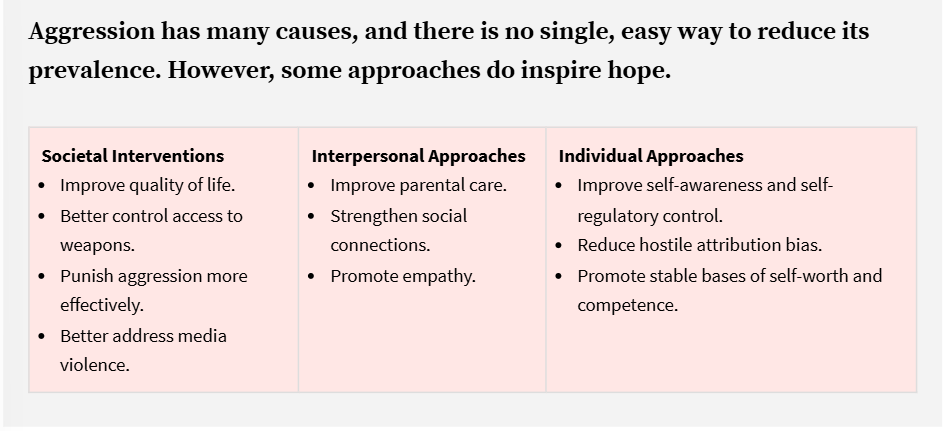
societal intervention
reduce frustration by improving quality of life
better control access to weapons
more effectively punish aggression
reduce or reframe media depictions of aggression
How can aggression be reduced by addressing frustration?
Reduce sources of frustration (e.g., poverty, poor living conditions)
Improve social conditions, especially in high-risk communities
Address systemic issues (e.g., unfair or excessive policing)
Teach children problem-solving, communication, and negotiation skills
How do firearms influence aggression and how can harm be reduced?
Presence of guns → primes aggressive thoughts (weapons effect)
Handling guns can ↑ testosterone → ↑ aggression
Firearms make aggression more lethal, especially assault weapons
Solutions:
Limit access to high-risk weapons
Red flag laws → restrict access for high-risk individuals
if they have signs of crisis or violent intent, block from purchasing firearms
Does punishment reduce aggression?
Can reduce aggression if people expect serious consequences
But can also backfire by:
Modeling aggression
Increasing frustration
Example: physically punished children → more aggressive later
What makes punishment effective in reducing aggression?
Must be:
Severe (but not modeling aggression)
Prompt (immediate)
Perceived as justified
Consistent
multisystematic therapy
addresses multiple factors influencing a child's behavior, combining interventions for families, schools, and communities to reduce aggression and improve overall well-being.
rehabilitation
a process aimed at restoring an individual's well-being and reducing future aggression through various therapeutic interventions.
no deterrence (instill fear or doubt of consequence) or retribution (receiving deserved punishment/vengeance)
How can media be used to reduce aggression?
Limit exposure to violent media, especially for children
Show negative consequences of aggression → reduces aggressive behavior
Avoid portraying aggression as rewarding or beneficial
Promote prosocial media (e.g., prosocial video games) → ↓ aggression, ↑ helping behavior
interpersonal interventions
improve parental care
better communication
strengthen social connections
more cooperation
improve social skills
enhance empathy
take another POV
individual interventions
improve emotional self-awareness
increase self regulatory strength
minimize obstacles
training
teach how to minimize hostile attributions
improve people’s sense of self-worth and control
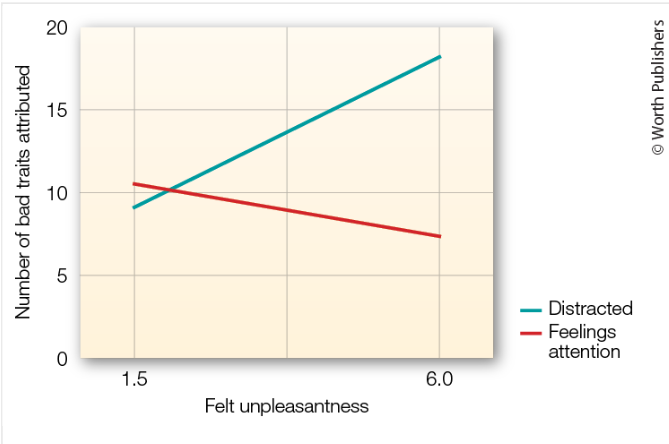
What did Berkowitz & Troccoli (1990) find about self-awareness and aggression?
Procedure:
Participants experienced discomfort (or not)
Then either:
Distracted with irrelevant task: or
Made self-aware (focused on their feelings)
Then rated another person
Results:
Distracted + discomfort → more negative (aggressive) ratings
Self-aware + discomfort → less aggression, even more positive/controlled responses
How can training reduce aggressive behavior in children? (Hudley & Graham, 1993)
12-week program targeting hostile attribution bias
Used games, role-play, and discussion to teach intent interpretation
Helped children distinguish accidental vs. intentional harm
Results:
↓ tendency to assume others have hostile intent
↓ verbal aggression
↓ teacher-rated aggressive behavior (vs. control group)
How do self-esteem and competence relate to reducing aggression?
High, stable self-esteem → lower hostility and anger when threatened
Secure attachments (e.g., supportive relationships) → less aggression and antisocial behavior
Providing self-worth and belonging can reduce violence (e.g., mentoring youth)
Aggression can be a substitute for lost feelings of competence/control
Giving people alternative ways to achieve competence reduces aggressive behavior
section review: reducing aggression 12.8