CNS + Bio basis for learning
 Call Kai
 Learn
Learn Practice Test
 Spaced Repetition
 Match
Match Flashcards
 Knowt Play
1/46

Earn XP
Description and Tags
lec 3
Name | Mastery | Learn | Test | Matching | Spaced | Call with Kai |
|---|
No analytics yet
Send a link to your students to track their progress
47 Terms
what is bio psyche?
application of bio principles to study of mental processes and behaviour
what does William James (1890) argue about bio psyche?
the scientific psychology should be grounded in bio understanding
name the research methods for bio psyche
lesion studies, animal studies, enhancing neural function, measuring neural activty, genetic manipulations
who made the theory of reflex action 1662
Descartes
explain descartes theory of reflex action
hydraulic model of causation and brain function i.e. fluid comprises animal spirits, Fire (A) is the stimulus causing a chain of processes between the foot (B) continuing up the nerve tube to a cavity in the brain (F), the opening of tthis cavity allows fluid to enter the nerve tube resulting in the reflex action 1.e. pulling foot away
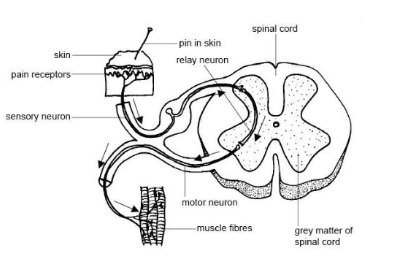
explain spinal reflex
stimulus ‘triggers’ electrical activity in neuron, multiple parallel pathways act simultaneously, these sequence of actions = relay/circuit, results inn sensation of pain
label spinal reflex
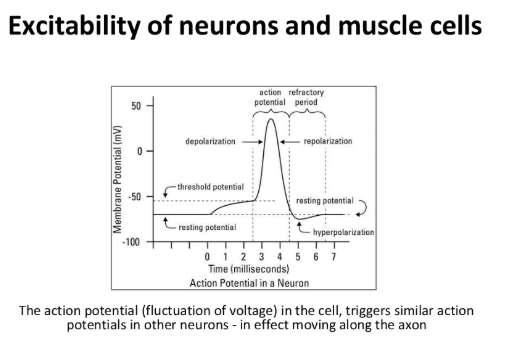
what is an action potential
info is transmitted along neurons as sharp impulses of electricity, this triggers activity/activation (produces action potential)
what model from which school of psychology demontrates action potential and looks at neurons
the connectivist model of cognitive and bio psyche
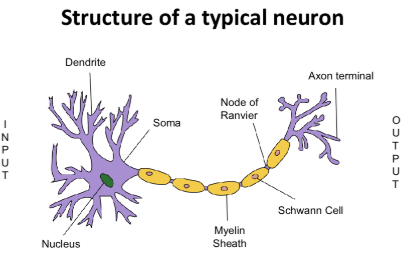
label the structure of a typical neuron
label the excitability of neurons and muscle cells
summarise neuron activity in the brain (how is neuron activity defined)
neuronal activity in the brain is often described in abstract terms e.g. info (in bio terms its callled action potential)
explain the use of this info/ neuron activity in brain
info is the correlation of socially meaningful content and neuronal signals, info can also be a spinal reflex registered in the brain
how does communication function between neurons
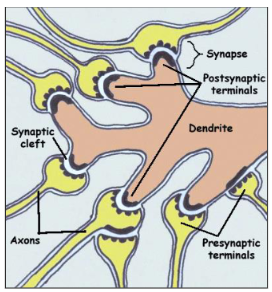
the synapse is the region where one neuron communicatees with another, synapse consists of part of the cell and the small gap between. action potentials dont cross generally from one neuron to another, communication between neurons works by neurotransmitters (chemical)
label image of synapse region
explain the function of neurotransmitters
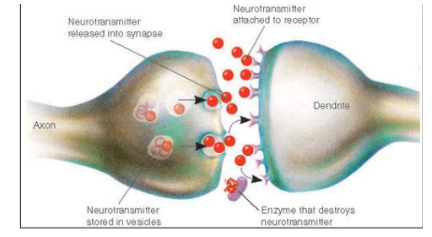
in response to the arrival of action potentials, the neurotransmitter is released at the terminal of the presynaptic neuron influencing the activity of the postsynaptic neuron. molecules termed ‘receptors’ are influenced by neurotransmitters creating new action potential
lebel image of synaptic transmission
explain neurotransmitters and behaviour (4)
mediates connections between neurons and control behaviour and mental processes
e.g.- emotional states are influenced by the release of neurotransmitter (e.g serotonin and GABA)
drugs can artificually manipulate the activity of neurons to target certain synapses e.g. pyschopharmacology
mood altering drugs indicate the interdependence between mental states and phsycial events in the brain e,g. anti-depressants
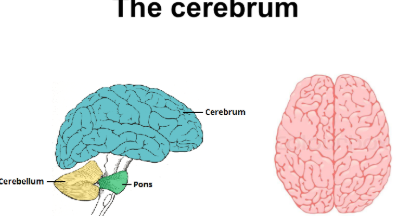
label the cerebrum
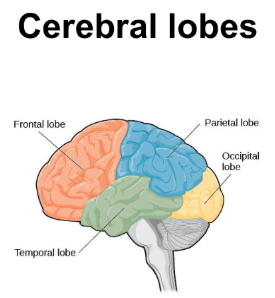
label the cerebral lobes
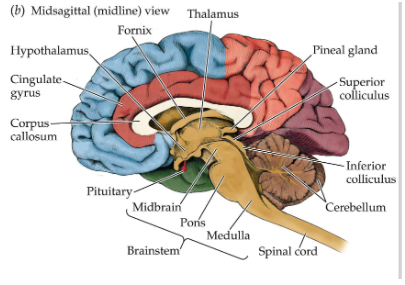
label brain
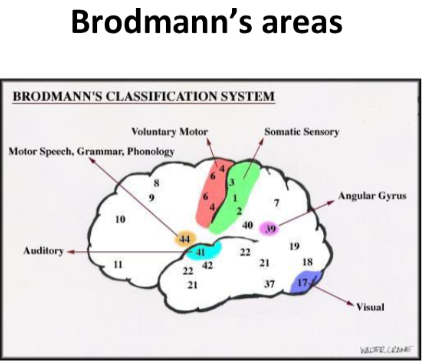
label Brodmann’s areas
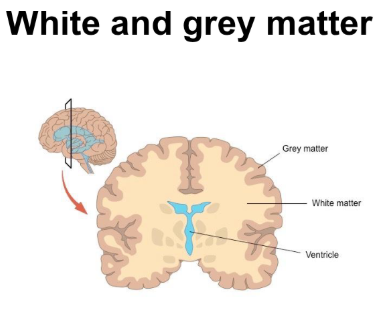
label white, grey matter and the ventricle
explain information processing (4)
the brain is a super system of systems composed of an elaborate interconnection of small but macroscopic cortical regions and sub cortical nuclei
these are made up of microscopic local circuits (neurons) which are connected by synpases
the brain makes decisions based on internal and external events
different parts of the brain process different types of info
summarise the connectionist neural net
parallel distributed processing (PDP)
has important theoretical practical consequences
items of info are not stored at specific sites; they are distributed throughout the whole net
whats included in the bio basis of learning
non-associative habituation/sensitization, associatiive learning (conditioning)
explain learning by Toates (2011)
acquisition of knowledge ot skill triggered in a particular situation
bahaviour that results in potential to change behaviour
results in physical changes in the brain
what are the 2 types of learning according to Toates 2011
non-associative learning: habituation and sensitisation
associative learning: conditioning
explain non-associative learning: habituation
most basic learning form
decoupling of association
progressive decline of response to stimulus
facilitates attention to new stimuli
consequence of change at the neural level
explain sensitization
progressive response following repeated exposure to stimulus
efficient firing on neuron (LTP)
both adaptive and maladaptive
e.g. pain response=adaptive
e.g. drug sentivity = maladaptive
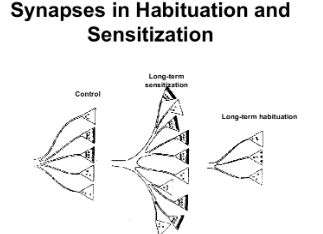
label image of synapses in habituation and sensitisation
what is classical conditioning as associative learning
-pairing of 2 stimuli results in behaviour change
what does LTP stand for
long term potentiation
explain LTP
Bliss and Lomo 1973 dicovered a persistent strangthening of synapses in the hippo of anesthetized rabbits
electrical stimulation in the hippo produced an increased response (potentiation) in the connecting synapse - a phenomenon they called LTP
how can LTP be associative
activity in the presynaptic neurons also infleunced the ‘sensitivity’ of nearby synapses
if weak and steong synapses are active simuktaneously then the weak synpase will be potentiated
what is opererant c
learning behaviour can be shaped by external cues and responses
what can a random response to a particular sitch be a connsequence of?
reinforcement
punishment
positive reinforcement
negative reinforcement
positive punishment
negative punishment
whats does hebbs law state in hebbian learning
‘neurons that fire together wire together’
what is Hebb’s law explaining
-when axon of cell A is near enough to excite cell B and repeatedly takes part in firing it, some growth process ot metabolic change takes place in one ot both cels such that A’s efficiency, as one of the cells firing B is increased.
what does Hebbs (1949) suggest is the organisation of behaviour
learning involved the strengthening of connections between neurons
events are represented as activity flow through neuronal loop
repeated activation of two neurons leads to formation and stregthening of a functional link
whats does repeated stimulation of synapse result in
it results in pre-synpatic and post-synaptic change
label repeated synapse stimulation
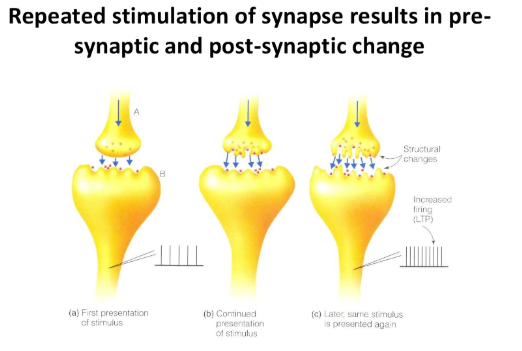
whats are hebbian implications for learning
it highlights role of synatic plasticity in learning as strictural changes in neuronal connectivity
what is the hebb synapse
synapse which has increased strength due to learning
transformation of a neutral stimulus to a conditioned stimulus
describes the process of long-term changes (LTP)
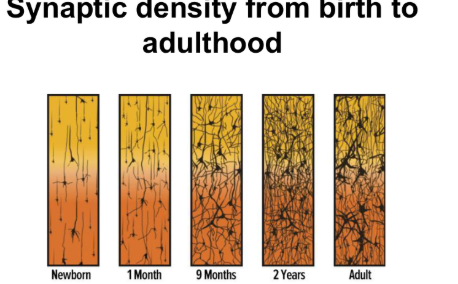
what is involved in synaptic pruning
branching and weeding (neuronal pruning'/neuro-structural reassembly)
explain synaptis pruning
refers to changes in the neural sturcture by reducing the overall number of neurons/connections, leaving more efficient synaptic configurations
used to describe amturation of behaviour and cog intelligence in kids as ‘weeding out’ lesser used synapses
label image of synaptic density from newborn to adults hood