Chapter 22 - Cloning and Biotechnology
 Call Kai
 Learn
Learn Practice Test
 Spaced Repetition
 Match
Match Flashcards
 Knowt Play
1/16

There's no tags or description
Looks like no tags are added yet.
Name | Mastery | Learn | Test | Matching | Spaced | Call with Kai |
|---|
No analytics yet
Send a link to your students to track their progress
17 Terms
Natural cloning in plants
bulbs
leaf bases swell with stored food from photosynthesis
buds form internally
develop in the next growing season
runners
lateral stem grows away from parent plant
roots develop where it touches the ground
rhizomes
specialised horizontal stem underground
buds develop and form new vertical shoots
stem tubers
tip of an underground stem becomes swollen with stored food
buds develop to produce new shoots
used in horticulture to produce new plants
splitting of bulbs
cuttings (sections of stems) are planted with rooting hormones
Micropropagation
making large numbers of genetically identical offspring from a single parent using tissue culture techniques
used when a desirable plant
does not readily produce seeds
doesn’t respond well to natural cloning
is very rare
has been genetically modified or selectively bred
is required to be pathogen free
take a sample of tissue (meristem) and dissect in sterile conditions
sterilise in bleach etc
material from the plant is known as explant
explant placed in sterile culture medium containing plant hormones which stimulate mitosis
callus is divided up and individual cells are transferred to a new culture medium to stimulate development of plantlets
plantlets are potted
Advantages and disadvantages of micropropagation
Advantages:
allows for the rapid production of large numbers of plants with known genetic makeup
producing disease free plants
possible to produce viable numbers of plants after genetic modification
can produce large numbers of seedless plants (sterile)
provides a way of growing plants which are naturally infertile
can reliably increase the numbers of rare plants
Disadvantages:
produces a monoculture
relatively expensive
requires skilled workers
explants and plantlets are vulnerable to infection by moulds
if the source material is infected with a virus, all the clones will be too
Natural animal cloning
common in invertebrates
some can regenerate entire animals from fragments of the original e.g. starfish
some produce clones as part of normal reproductive process
females can produce offspring without mating in some insects
Cloning in vertebrates
monozygotic twins (identical)
embryo splits to form 2 separate embryos
artificial twinning
split in early embryo is produced manually
can be used to produce a number of identical offspring
e.g. in cattle
cow treated with hormones to super-ovulate
ova fertilised
cells are split to produce several smaller embryos
grown in the lab for a few days before being implanted in a surrogate
somatic cell nuclear transfer
nucleus is removed from a somatic cell
nucleus removed from a mature ovum harvested from a different female of the same species (enucleated egg cell)
nucleus from somatic cell is placed into enucleated egg cell and given an electric shock to fuse them and so it begins to divide
developed embryo is transferred into a third animal
new animal is a clone of the animal that the somatic cell came from
Pros and cons of animal cloning
Pros:
enables high yielding animals to produce more offspring
enables the success of the male passing on desirable genes
enables genetically modified embryos to be replicated
enables rare, endangered or extinct animals to be reproduced
Cons:
inefficient process
many cloned animals fail to develop
many cloned animals have shortened lifespans
has been relatively unsuccessful so far
ethical concerns
strict legislation to prevent cloning of humans
Bioremediation
use of biological systems to remove soil and water pollution
What are the advantages of using of microorganisms?
no welfare issues
enormous range of microorganisms capable of carrying out many different chemical syntheses
genetic engineering allows artificial manipulation of microorganisms
microorganisms have a short lifecycle
the nutrient requirements are cheap
required conditions are cheap - low temperature, oxygen and food etc
How are microorganisms used for medication?
producing penicillin
antibiotic produced by a mould
making insulin
used for type 1 (occasionally type 2) diabetes
bioremediation
microorganisms used to break down pollutants and contaminants in soil or water
How are microorganisms grown?
inoculating broth
inoculating agar
Growth of bacterial colonies
lag phase
bacteria are adapting to new environment
growing and synthesising the enzymes they need
log / exponential phase
rate of reproduction is close to its theoretical maximum
stationary phase
total growth rate = 0
reproduction rate = death rate
death / decline phase
reproduction has almost ceased
increasing death rate
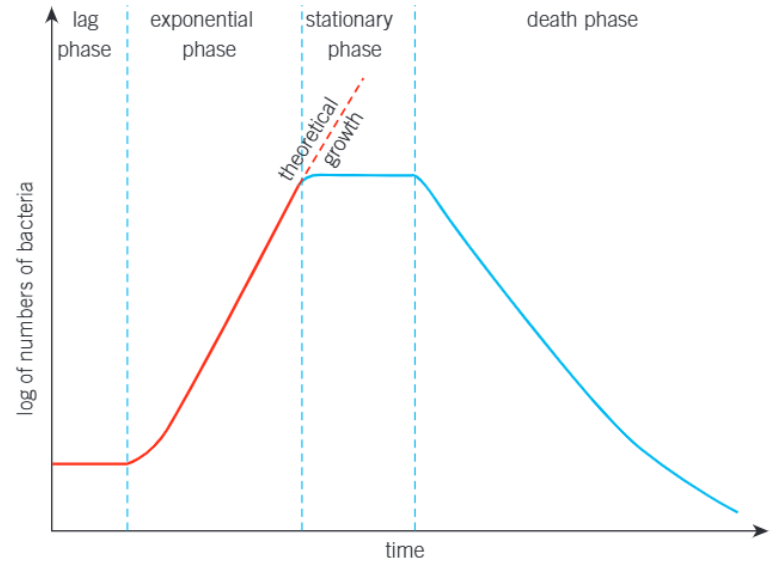
What are the limiting factors that prevent bacterial growth?
nutrients available
oxygen levels
temperature
build up of waste
change in pH
What are the advantages of using isolated enzymes instead of whole organisms?
less wasteful as they don’t require substrate to grow / reproduce
more efficient as they work at much higher concentrations
more specific - no unwanted enzymes
ideal conditions can be used
less downstream processing as other byproducts are not produced
What are the advantages of using extracellular enzymes instead of intracellular?
extracellular are excreted by microorganisms making them easy to isolate
only produce relatively few types of extracellular enzymes - easy to identify
more robust than intracellular
What are the pros and cons of using immobilised enzymes?
Advantages:
can be reused
easily separated from reactants and products (reduce downstream processing)
greater temperature tolerance
smaller long term costs as they can be reused
easy to manipulate
Disadvantages:
reduced efficiency
higher initial costs of materials
higher initial costs - bioreactor
more technical issues
How are enzymes immobilised?
surface immobilisation
bound to the surface of insoluble supporting materials either by adsorption or covalent or ionic bonds
adsorption
simple & cheap
enzymes can be lost relatively easily
covalent / ionic bond
strongly bound
active site may be modified
entrapped in a matrix
widely applicable to different processes
expensive & difficult to entrap
encapsulated in a microcapsule
simple to do
relatively expensive
behind a semi permeable membrane
What are the types of bioprocesses for culturing microorganisms?
batch fermentation
microorganisms are inoculated into a fixed volume of medium
as they grow, nutrients are used up
biomass and waste products build up
during stationary phase - form desired end products
stopped before death phase
continuous culture
microorganisms inoculated into sterile nutrient medium
nutrients added continually
culture broth is continually removed