Exam 4 for Microbio
 Call Kai
 Learn
Learn Practice Test
 Spaced Repetition
 Match
Match Flashcards
 Knowt Play
1/69

Earn XP
Description and Tags
Yeay
Name | Mastery | Learn | Test | Matching | Spaced | Call with Kai |
|---|
No analytics yet
Send a link to your students to track their progress
70 Terms
What is a virus
an obligate intracellular parasite
What does obligate intracellular parasite mean?
1. Requires a host cell for replication
2. Reproduces at the expense of the host cell
What is the difference between a capsid and a envelope?
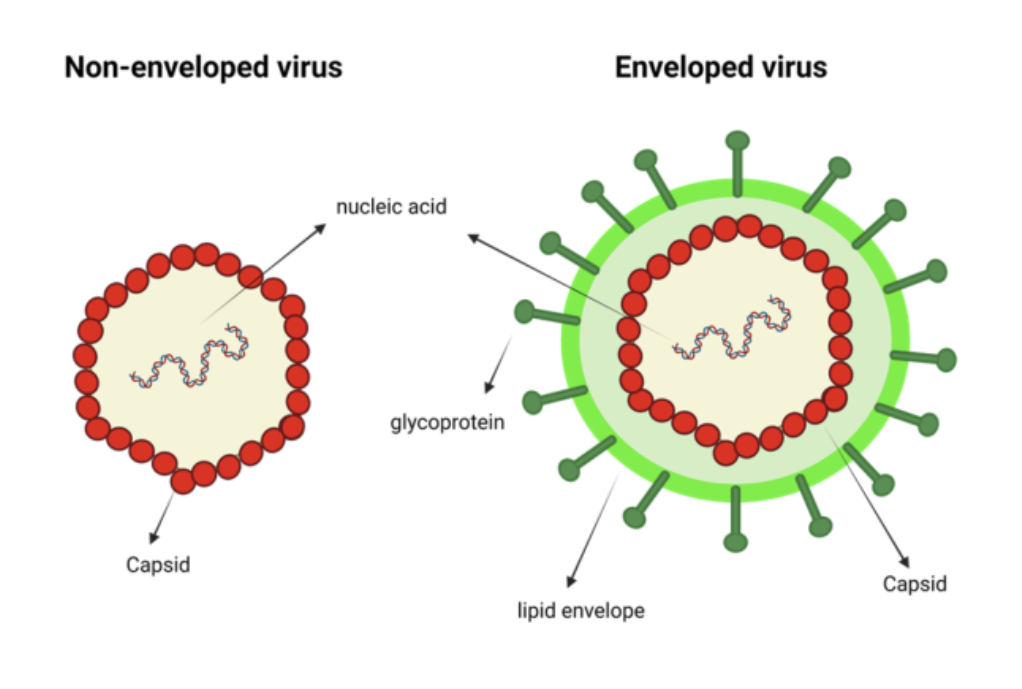
How are viruses commonly classified?
By their genome type (DNA or RNA, strand type, and sense)
What are the two main types of viral genetic material?
DNA & RNA
What does single-stranded (SS) mean?
What is positive-sense RNA (+RNA)?
RNA that can act directly as mRNA and be translated into protein
What is negative-sense RNA (−RNA)?
RNA that is complementary to mRNA and must be converted before translation
What enzyme do negative-sense RNA viruses need?
RNA-dependent RNA polymerase
What does RNA-dependent RNA polymerase do?
Converts negative-sense RNA into usable mRNA
What is ambisense RNA and how does it function?
RNA containing both positive and negative-sense regions, some parts are translated directly, others must first be converted
What are some of the shapes of viruses?
a. Rods
b. Polyhedrons
c. Spheres
d. Bacteriophages
Viruses are often specialized to infect certain hosts. Even within the same virus type, different strains may infect different species or behave differently, this is called?
Host-specific “strains”
What does Host range refer to?
This refers to which organisms a virus can infect.
Narrow host range → infects only one species
Broad host range → infects multiple species
What is Tissue tropism
This is about which specific cells or tissues within the host the virus targets.
Dormancy / Latency
Some viruses can “hide” in the body for years without causing symptoms.
What is special about viral replication?
Viruses can only reproduce inside cells
What is the lytic cycle?
A viral replication cycle that results in destruction of the host cell
What are the steps to the lytic cycle?
• Attachment (Adsorption)
• Penetration
• Replication (Synthesis)
• Assembly
• Release
What is the lysogenic cycle?
A viral replication cycle where the virus integrates into the host genome and does not kill the cell
What are the steps to the lysogenic cycle?
• Attachment
• Penetration
• Integration
• Replication
(Propagation)
Can viruses evolve?
Yes, viruses evolve through mutations and natural selection
Do viruses have metabolism?
No
Q: What is an epidemic?
A disease outbreak in a specific region or population
What is a pandemic?
A worldwide disease outbreak
Q: What is a major environmental role of viruses?
Causing disease and large-scale outbreaks
What does HIV stand for?
Human Immunodeficiency Virus
What disease does HIV cause?
AIDS (Acquired Immunodeficiency Syndrome)Flashcard 1
Q: What does HIV stand for?
A: Human Immunodeficiency Virus
Flashcard 2
Q: What disease does HIV cause?
A: AIDS (Acquired Immunodeficiency Syndrome)
Flashcard 3
Q: When was AIDS first reported in the US?
A: 1981
Flashcard 4
Q: What cells does HIV primarily target?
A: CD4+ helper T cells
Flashcard 5
Q: Why are CD4+ cells important?
A: They coordinate the immune response
Flashcard 6
Q: What happens when CD4+ cells are destroyed?
A: The immune system becomes weakened
Flashcard 7
Q: What are opportunistic infections?
A: Infections that take advantage of a weakened immune system
Flashcard 8
Q: Why do people with AIDS often die?
A: From opportunistic infections, not the virus itself
Flashcard 9
Q: What gene mutation can provide resistance to HIV?
A: CCR5 gene mutation
Flashcard 10
Q: What does the CCR5 gene encode?
A: A receptor HIV uses to enter cells
Flashcard 11
Q: How do most HIV tests work?
A: They detect anti-HIV antibodies
Flashcard 12
Q: Do HIV tests usually detect the virus directly?
A: No
When was AIDS first reported in the US?
1981
What cells does HIV primarily target?
CD4+ helper T cells
Why are CD4+ cells important?
They coordinate the immune response
What happens when CD4+ cells are destroyed?
The immune system becomes weakened
What are opportunistic infections?
Infections that take advantage of a weakened immune system
What gene mutation can provide resistance to HIV?
The CCR5 gene mutation is a receptor HIV uses to enter cells it is linked to susceptibility to Smallpox
How do most HIV tests work?
They detect anti-HIV antibodies
How do viruses contribute to genetic exchange?
By inserting or transferring genetic material between cells or organisms
What does “novel evolutionary innovations” have to do with viruses
They can help with the creation of CRISPR
What does Bacteriophages mean?
Bacteriophages = bacteria “eaters”
What are the two reproductive cycles of bacteriophages and what is induction (switching)?
The process of exiting the Lytic phase (virulent) and entering the Lysogenic phase (temperate) or vice versa.
What are the 3 main hypotheses on origins of viruses?
Plasmid hypothesis → escaped genes
Symbiont hypothesis → reduced cells
RNA world hypothesis → ancient pre-cellular life
How many main hypotheses explain the origin of viruses?
3
What are prions?
Prions are infectious agents that contains no DNA or RNA.
What does “prion” stand for?
Proteinaceous infectious particle.
How do prions replicate/spread?
By causing normal proteins to misfold.
What types of transmissible spongiform
encephalopathies (TSEs) can prions cause?
– Mad cow disease
– Scrapie in sheep
– Creutzfeldt-Jacob disease in humans
What are viriods?
They are tiny, naked, circular RNA molecules
What is reverse transcriptase?
An enzyme that converts RNA into DNA.
What are restriction enzymes? Why are they important?
Enzymes that cut DNA at specific sequences. Used in genetic engineering and DNA analysis.
What is an oncolytic virus? is it a viral theray?
A virus engineered to infect and kill cancer cells.
What are two potential medical uses of viruses?
Treating infections and fighting cancer.
What are archea?
Archaea are a group of microorganisms that look similar to bacteria but are biochemically very different—especially when it comes to their cell walls.
Can you gram-stain Archaea?
Gram-positive → thick, uniform cell wall layer
Gram-negative → thinner wall with a surface layer (S-layer) made of proteins or glycoproteins
What is different about Archaeal cell walls?
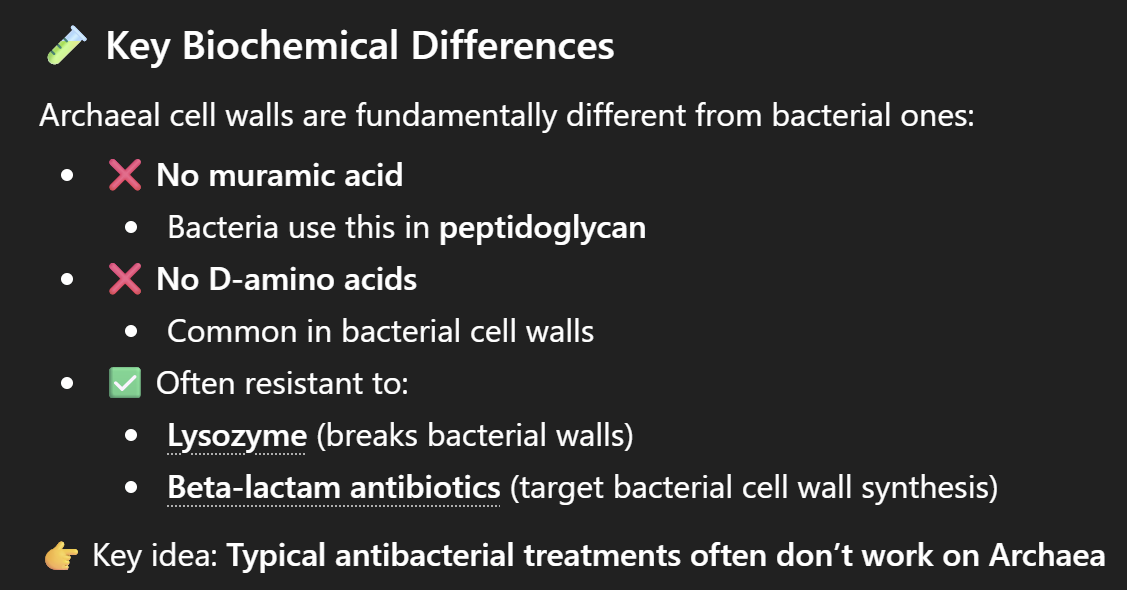
If Archaea don’t have murein, what do they have instead?
Similar to bacterial peptidoglycan, but:
Structurally different
Lacks muramic acid
Uses different chemical linkages
What type of molecules make up bacterial/eukaryotic membranes?What type of linkage is found in bacterial/eukaryotic membranes?
Fatty acids and Ester bond linkages
What type of molecules make up archaeal membranes?
What type of linkage is found in archaeal membranes?
Branched-chain hydrocarbons and Ether linkages.
Which is more stable: ester or ether linkages?
Ether linkages.
What are diglycerol tetraethers?
Lipids that span the entire membrane in some Archaea.
What type of membrane can tetraethers form?
A monolayer.
Which organisms often have monolayer membranes?
Extreme thermophilic Archaea.
How many chromosomes do most Archaea have? And are archaeal chromosomes larger or smaller than bacterial ones?
One, usually smaller
What is the structure of archaeal DNA? Do Archaea have histones?
Circular, double-stranded DNA. Some do have histones
Archaeal DNA replication proteins are similar to which domain?
Eukaryotes.
Compare Archaea to bacteria plasmids
Plasmids
Archaea generally have few plasmids compared to bacteria
Is Archaeal Gene expression more bacterial-like?
Yes,
Often polygenic
One mRNA can code for multiple proteins (like bacteria)
No RNA splicing
Unlike eukaryotes, introns are not removed
Are Archaeal Promoter regions similar to bacterial promoters?
Yes, Promoter regions (where transcription starts) are similar to bacterial promoters.
Is the Archaeal Ribosome bacteria-like or Eukaryotic-like
Size: 70S ribosomes (same size as bacteria)
Shape: Unique, different from both bacteria and eukaryotes
Is Archaeal tRNA more bacterial or Eukaryotic?
Contain unique modified bases not seen in bacteria or eukaryotes
The initiator tRNA carries methionine
This is more like eukaryotes (bacteria use a modified methionine)
Archaea are a molecular mix, including ___ from bacteria and ___ from Eukaryotes:
Bacterial-like:
Circular DNA
Polygenic mRNA
70S ribosomes
Eukaryotic-like:
Histones (in some)
DNA replication machinery
Methionine initiator tRNA
Elongation factor similarity
Are Archaea considered evolutionarily closer to eukaryotes or bacteria?
Archaea are often considered evolutionarily closer to eukaryotes than bacteria are.