Perio 2 FINAL
 Call Kai
 Learn
Learn Practice Test
 Spaced Repetition
 Match
Match Flashcards
 Knowt Play
1/153

There's no tags or description
Looks like no tags are added yet.
Name | Mastery | Learn | Test | Matching | Spaced | Call with Kai |
|---|
No analytics yet
Send a link to your students to track their progress
154 Terms
soft
bristle stiffness that cleans further interproximal and further subgingival
modified bass
burshing technique, 45 degree angle to long axis, gentle circular motions, sweep bristle toward occlusal edge, MOST EFFECTIVE METHOD
subjective
Interviewing the patient – patient’s point of view
objective
Examining the patient, Vital signs, all exam findings, ie head and neck,
intra-oral, dentition, oral hygiene, pathology, caries, periodontal etc.
assessment
the problem list, diagnoses from the Subjective and Objective data.
plan/procedure
Today’s treatment and plan for further tests, surgery, education, management.
mirror, explorer, probe
basic exam instruments
retraction, indirect vision, indirect illumintation, transillumination
dental mirror uses
explorer
used to detect tooth characterristics, calculus, caries, grooves, fractures, furcations ect.
Pigtail/ cowhorn explorer
used for calculus detection in normal sulci or shallow pockets
11/12-type explorer
calculus detection i n shallow to deep pockets and furcations
multiple overlapping strokes
assessmentt stroke with EXPLORER
Nabers
curved for furcation measurement
UNC15
All mm 1 to 15
Michigan
Marks at 3, 6, 8mm
sulcus depth, recession, BOP, lesion measure, calculus detection, sounding for bone
funcitions of periodontal probe
walking stroke
assessment stroke with PERIO PROBE
probing depth, recession
attachmentt equals ____ plus _____
recession
distance from GM to CEJ
class I
furrcation concavity can be felt with probe tip but not entered
class II
Probe is able to enter furcation but not pass through
class III
probe passes completly through furcation
class IV
probe passes through furcation and is visible
class I
slightly more mobility than normal
class II
moderately more mobility than normal
class III
severe faciolingual/mesiodisttal mobility combined witth veretical movement
debridement
Instrumentation of crown and root surfaces to remove deposits
scaling
calculus removal strokee using scalers or curettes
root planing
smoothing the root to remove infected and necrotic tooth substance
exploratory stroke
Using a scaling instrument to explore for calculus.
Light grasp
lateral
stroke activation occurs with ____ movement of the wrist and forearm.
pull
working stroke for scaling is a ____ stroke
root planing
Strokes are more numerous and lighter than the scaling stroke
as close as possible
intraoral fulcrum should be ____ to the working area
sickle scalers
Designed for supragingival surfaces due to pointed tip
sickle
Primarily used for removal of medium to large supragingival calculus and calculus just below contact
parallel
in POSTERIOR working end should be ____ to the long axis
across
in ANTERIOR working end should be ____ the long axis
8
sittting position forr ANTERIOR surfaces TOWARD
12
sitting position forr ANTERIOR surfaces AWAY
sickles
excellent for calculus removal on proximal of anteriror and enamel apical to contact posterior, not reccommened for root surfaces
universal curette
supra or sub gingival small-med calculus throughout the mouth
columbia 13/14
universal curette for ANTERIOR teeth and premolars
4R/4L
larger universal curette designed for MOALRS
mccall 17/18
universal curette designed for use on 2nd and 3rd
molars. Good for line angles and buccal, lingual surfaces
70-80
angualation of sickle and universal curette towards the tooth for activation
oblique/horizontal
______ stroke is used for buccal/ lingual surfaces
vertical
_______ stroke used for mesial and distal surfaces
gracey curette
Designed for use on certain teeth and certain surfaces, one cutting edge per working end
1/2 and 3/4
GRACEY for Anterior teeth: all tooth surfaces
7/8
GRACEY for posterior teeth: buccal and lingual surfaces
11/12
GRACEY for posterior teeth MESIAL surfaces
13/14
GRACEY for posterior teeth DISTAL surfaces
70
gracey curette is angled ___ degrees
lower
GRACEY _____ edge is the working cutting edge
closed
scaler should be inserted into sulcus with blade ____
2
how many gracey are needed to instrumentt POSTERIOR teeth?
mini
smaller blade (shorter working end) for narrow pockets and longer lower shank for
deeper pockets
anatomic crown
area above the cementoenamel junction (CEJ)
anatomic root
component of the tooth apical to the cementoenamel junction that is covered with cementum
clinical crown
portion of tooth visibly present in oral cavity
clinical root
portion of tooth structure not visible in the mouth
max first premolars and mandibular molars
teeth that have 2 ROOTS
max molars
teeth with 3 ROOTS
root trunk
undivided region of root complex
root cone
divided portion of root complex
furcation
area beteween individual root cones
furcation fornix
roof of furcation
degree of separation
angle of separtation between two roots
divergence
distance between two roots
co-efficient of separation
length of root cones in relation to the length of root complex
passive eruption
Increasing length of the clinical crown seen with aging and in the absence of clinical evidence of inflammation
1
stage of passive eruption: The most apical limit of the epithelial
attachment is at the cementoenamel junction
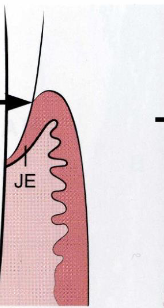
2
stage of passsive eruption: the most apical limit of the attachment is on the cementum, with the base of the gingival sulcus still on the enamel surface
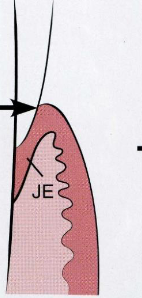
3
stage of passive eruption: The most apical limit of the epithelial attachment is on the cementum, with the base of the sulcus at the cementoenamel junction
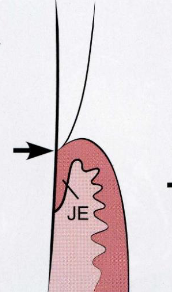
4
stage of passive eruption: Both the base of the sulcus and the epithelial attachment are on the surface of the cementum
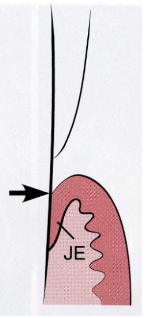
palatal
interproximal furcation in the MAXILLARY molars are toward the ___ aspect
palatal
mesial and distal furcation measurement of MAXILLARY molars should be approached from the ____
MB roots
where are MAXILLARY FISRT molar ROOT CONCAVITIES found usually
palatal root, between M and D roots, mesial and distal surfaces
root trunk concavities on MAXILLARY FIRST molars can be found on
furcation to cervical line, mesial root, distal root
where are MANDIBULAR first molars root concavitties
mesial and distal
fucation of maxillary FIRST PREMOLAR can be accessesed from ___
mesial
develomental groove is found on the _____ of crown and root trunk of maxillary first premolars
proximal
single rooted teeth many have ___ root concavities
palatal
lateral incisors may have a ____ groove on the cingulum
mini gracey, hirschfeld files, diamond files
What kits can be checked out for specific instrumentation needs?
shorter and thinner working end, 3mm longer lower shank
What is different between a mini-gracey and a regular gracey
larger
Is it better to have a smaller or larger degree of separation or roots?
long
is it better to have a long or short root trunk?
tip vibrations
how do ultrasonic scalers fracture calculus from tooth and clean pocket
elliptical or linear movements
what determines the number of working ends on a ultrasonic scaler
longer more powerful strokes
higher power on ultrasonic scaler means
cool and flush debris
function of water in ultrasonic scaler
Acoustic streaming
unidirectional fluid flow caused by ultrasound waves
Acoustic turbulence
movement of ultrasonic tip causes coolant to accelerate, producing a swirling effect
Cavitation
formation of bubbles in the water causes by the turbulence – bubbles implode and cause further shock waves
microflora
combination of ultarsonics acoustic streaming, acoustic turbulence, and cavilation has shown to disrupt ____
efficiency, plaque removal, furcation access, less tissue deistension, deep pocket penetration, less strain
ADVANTAGES of POWERED INSTRUMENTS
aerosols, reduced tacile sensitivity, noise
DISADVANTAGES of POWERED instruments
HVE and pre-procedural rinsing
how to reduce AEROSOLS with powered instrumenting