Eve Q4 Last Lectures
 Call Kai
 Learn
Learn Practice Test
 Spaced Repetition
 Match
Match Flashcards
 Knowt Play
1/85

There's no tags or description
Looks like no tags are added yet.
Name | Mastery | Learn | Test | Matching | Spaced | Call with Kai |
|---|
No analytics yet
Send a link to your students to track their progress
86 Terms
Molluscs
Super successful soft bodied
animals – most with a shell
More marine species in
phylum Mollusca (>100,000
species) than any other
phylum in the sea
Highly diverse morphology,
can be found in most
habitats in the sea
All molluscs have soft bodies, and most have a hard calcareous
(i.e. calcium carbonate) shell. Three Key Body Parts
Shell is secreted by a thin layer of tissue called the mantle
Muscular foot for locomotion
Radula for feeding is usually a ribbon of “teeth”
(Presence of veliger larva)
Major groups of molluscs
• Gastropods
• snails, sea slugs
• Bivalves
• clams, mussels, oysters
• Cephalopods
• octopuses and squids
• Chitons
Molluscs: Gastropods
Most snails have
spiraled shells, and their
bodies also coiled
Gastropods have a radula, a
ribbon of teeth that create
a rasping tongue
The shape of the radula
teeth is determined by diet
Teeth can be mineralized
with iron to scrape algae
from rocks
Molluscs: gastropod diets
Most gastropods are
herbivores and detritivores,
but several groups of snails
have evolved to be
predators and parasites
A few are
suspension
feeders
Nudibranchs
Molluscs
Cone Snails
Predators with a harpoon-like radula and venom
Feed on polychaetes, molluscs, some on fish.
~800 species
Molluscs
gastropods
Elysia chlorotica (a
sea slug) steals
chloroplast from
green seaweed and
incorporates them
into their bodies
Sea slugs can do some
amazing things, like steal
cnidarian stingers and
seaweed chloroplasts
Hermissenda
crassicornis (a
nudibranch) steals
nematocysts from
hydroids and stores
them in their body
projections
Molluscs: Bivalves
Bivalves have two shells that close
around the soft-bodied animal
They lack a radula
• Strong adductor muscle closes
the shell (e.g. scallop meat)
Most bivalves are
suspension feeders
They use long folded
gills to obtain
oxygens and also to
filter food particles
from the water
Often draw water
into long siphons
Most bivalves use their foot to bury themselves in sediment
Many live attached to hard substrates (e.g. oysters, mussels)
Some can swim (e.g. scallop, Lima clam)
Many bivalves live attached to hard substrates (e.g. oysters, mussels)
Some can swim (e.g. scallops, file clam
Molluscs
bivalves
Many bivalves live attached to hard substrates (e.g. oysters, mussels)
Some can swim (e.g. scallops, file clam
Molluscs: Cephalopods
Squids have 8 arms and 2
tentacles
All are strong swimmers and
live in the open ocean
They have a reduced shell called
a quill
They have an image forming
eye (independently evolved
from our eye) Squid
Squid, Octopus, Chambered Nautilus
Molluscs: cephalopods
Humbolt Squid
Bryozoans
“moss animals”
Small animals with a retractable crown of
tentacles using for feeding (lophophore) – all
are suspension feeders
Nearly all are colonial – individual zooids are
not independent
Important prey items for a variety of other
inverts and fishes
Many species on the California coast
Echinodermata (“echinoderms”)
All Echinoderms have:
• Adults have radial symmetry! – usually five-point
symmetry, but larvae are bilaterally symmetrical
• Characterized by a water vascular system (water-filled
canals)
• Tube feet extend from the water vascular system,
used for locomotion on sensing the environment
There are no freshwater echinoderms!
There are no terrestrial echinoderms!
Strictly sea creatures.
Echinoderm skeletons are formed
By ossicles that link together.
The are connected by Mutable
Collagen Tissue that can change its
mechanical properties quickly and
either allow the skeleton to deform
or stiffen.
Seastars use this to surround a prey,
stiffen the skeleton and pull open the
shell of the prey.
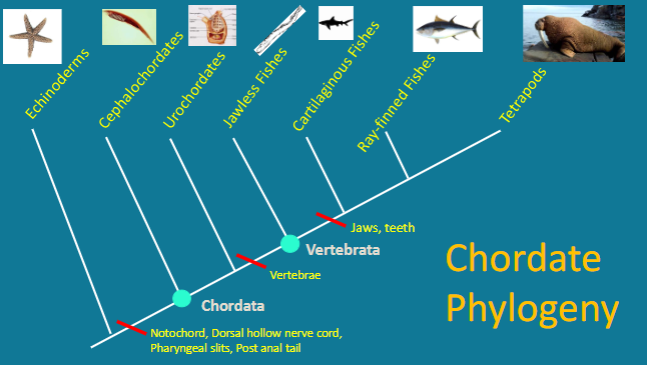
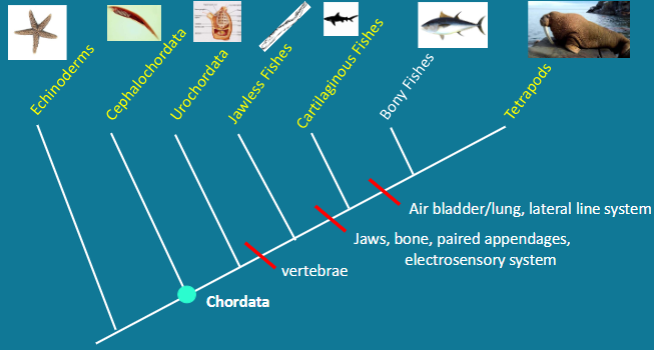
chordate
Phylogeny
Basic Chordate Body Plan
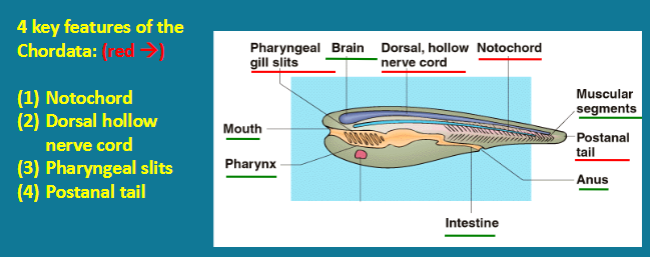
Chordata (Phylum)
Major Group
• Lancelets (Cephalochordata)
• Tunicates, Sea Squirts (Urochordata)
• Jawless Fishes
• Vertebrates
• includes fishes, amphibians, birds & reptiles,
turtles, and mammals
Lancelets: Cephalochordata
Has all of the features of
chordates:
Notochord, dorsal hollow
nerve cord, pharyngeal slits,
Post anal tail
~25 species
Sea Squirts & Tunicates: Urochordata
• Adults do not look like chordates, but larvae have all the chordate characteristics
• Adults can be solitary or colonial (multiple zooids), and are sessile (attached to
substrate)
• All are suspension feeders that actively pump water through a filter basket to capture
small food items (and breathe)
• About 3000 specie
Tunicates
The only chordates that are sessile as adults. Likely this is possible because they are
suspension feeders with efficient filter mechanism that works well in low water flow
Tunicates: solitary & colonial
Some are colonial - asexual reproduction
Jawless fishes: the hagfish
Hagfishes support important fisheries
sometimes for food, but also for skin (“eel skin”)
Lampreys: Jawless fish
• Lampreys can be parasitic
• They have many teeth on a round
mouth
• Their teeth are made of keratin
• They are eaten in many parts of the
world
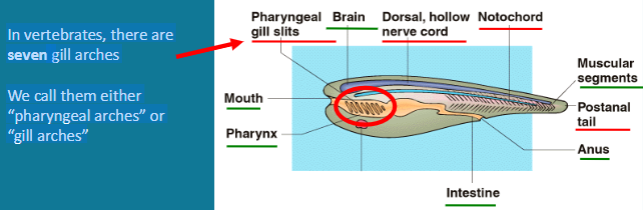
The evolution of jaws
Jaws evolved from gill arches
In vertebrates, there are
seven gill arches
We call them either
“pharyngeal arches” or
“gill arches”
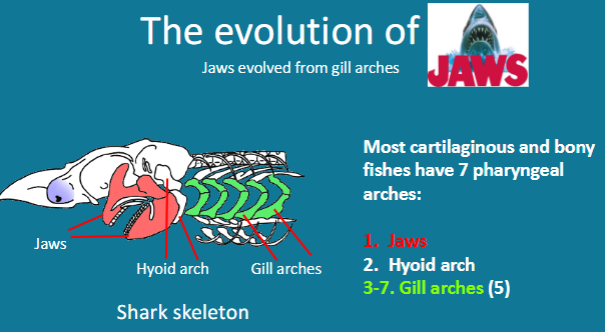
The evolution of jaws
Most cartilaginous and bony
fishes have 7 pharyngeal
arches:
1. Jaws
2. Hyoid arch
3-7. Gill arches (5)
Jaws
Hyoid arch Gill arches
Jaws evolved from gill arches
Most cartilaginous and bony
fishes have 7 pharyngeal
arches:
1. Jaws
2. Hyoid arch
3-7. Gill arches (5)
Extreme suction feeding: the slingjaw wrasse
Accomplished by
extreme protrusion of
the jaws (up to 60% of
the fish’s body length!)
Biting with the oral jaws: the parrotfish
Accomplished with
direct application of
the jaws to the
substrate
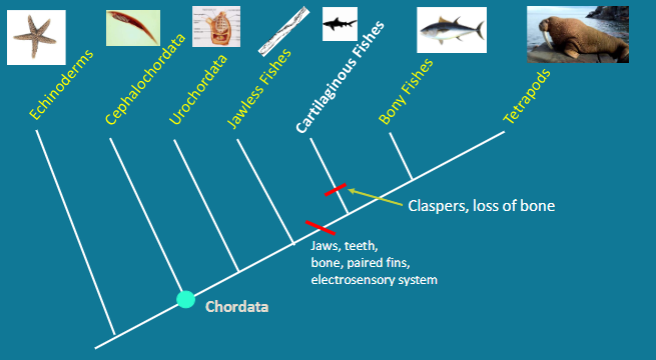
Cartilaginous Fishes:
Sharks, Rays, Chimaeras
Blacktip shark, Chimaera, Stingray
Cartilaginous fishes have claspers for reproduction
Claspers function during internal fertilization
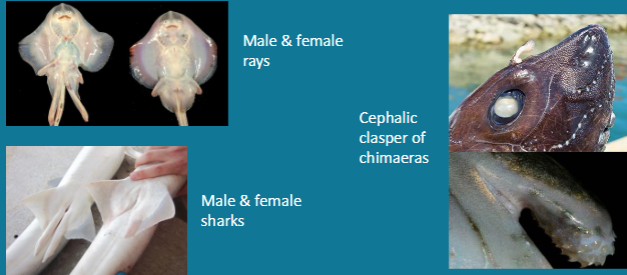
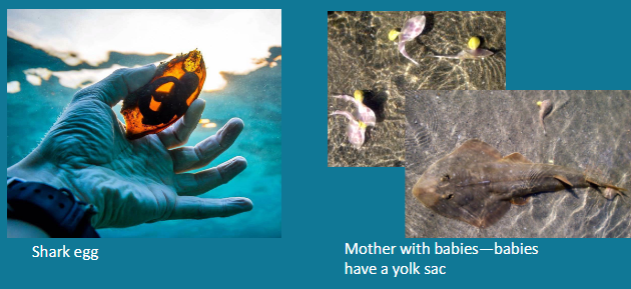
May lay eggs or give birth to live offspring
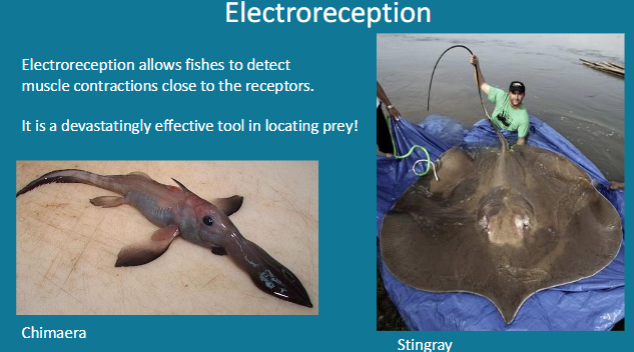
Electroreception
Electroreception allows fishes to detect
muscle contractions close to the receptors.
It is a devastatingly effective tool in locating prey!
Metal Detectors
Transmit electromagnetic field which
cause metal to become energized and
retransmit their own electromagnetic field.
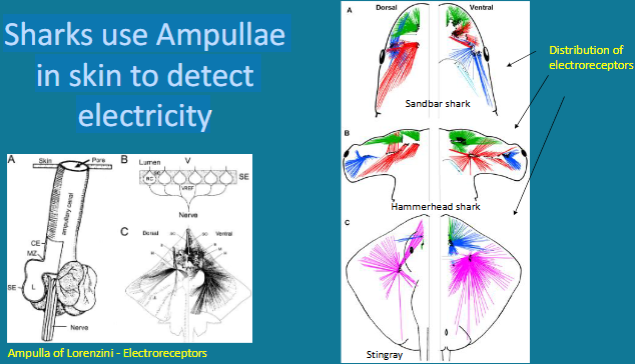
Sharks use Ampullae
in skin to detect
electricity
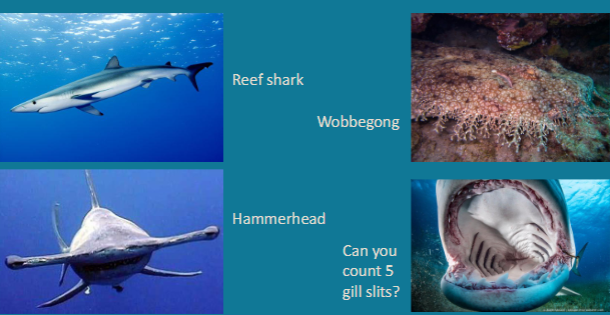
Sharks are surprisingly diverse!
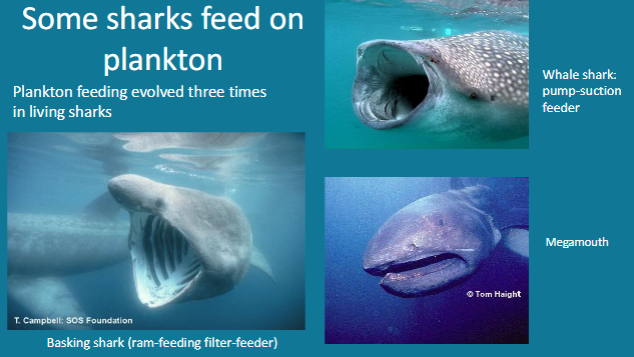
Some sharks feed on
plankton
Plankton feeding evolved three times
in living sharks
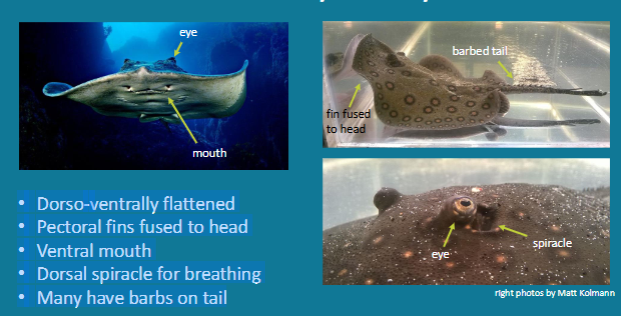
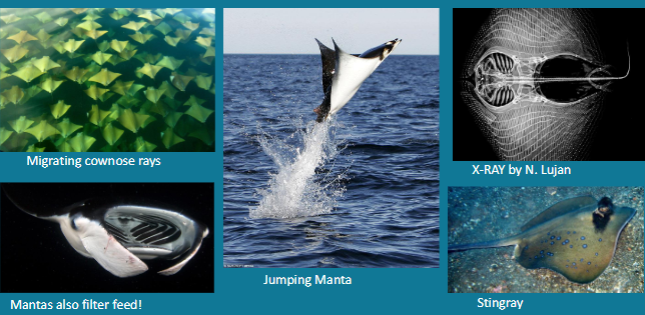
Anatomy of Rays
• Dorso-ventrally flattened
• Pectoral fins fused to head
• Ventral mouth
• Dorsal spiracle for breathing
• Many have barbs on tail
Ray diversity
White Sharks
Reach 19 ft.
Live up to 70 years
Eats marine mammals
Endothermic (warm-blooded)
Independent Evolution of the Sawfish form
in Rays and Sharks
The saw functions in prey capture
Thresher Shark
Thresher sharks have a
very long dorsal lobe of
caudal fin.
What is the function of
this elongate tail?
Air Bladder
Function in most fish is buoyancy control, several fish also use as a lung.
Air bladder has a specialized region where capillaries exchange gasses
between the air bladder and blood.
Some fish have a direct connection
between esophagus and air bladder.
They use the bladder as a lung.
Tarpon, catfish (more common in
freshwater)
Lateral line – a unique fish organ for mechanosensation
detect minute changes in pressure – helps fish detect
prey, predators, or conspecifics (schooling), and orient to current
How does lateral line mechanosensation work?
1) Changes in pressure from pore to pore push
water of canal to different pores
2) Water pushes on jelly
3) Jelly moves hairs
4) Hairs trigger nerves
Species Richness in Chordate Groups is
unevenly distributed
Bony Fishes – 36,000 species (~18,000 are Marine)
Tetrapods – 30,000 species
Cartilaginous Fishes – 1,000 species
Jawless Fishes – 100 species
Urochordata – 3,000 species
Cephalochordata – 25 species
Two major types of swimming
Swimming by undulating the body
Swimming with paired or median fins
- Pectoral fins
- Dorsal fin
- Anal fi
Fish morphology
Fish shape is related to swimming and feeding
functions (“form follows function”)
See if you can guess what lifestyles the fishes on the
left have.
Fish swimming motions use different body parts and
different amounts of the total body
Trunkfishes swim with their fins
a hard, inflexible carapace protects them from
predators, but limits undulation of the body axis
Fish reproduction and life history
Fish reproductive modes:
Oviparous fish – most marine fishes are oviparous, with mothers releasing eggs into
the water (“free spawning”) or depositing them on or in something
Ovoviviparous fishes – mother retains egg inside body, which then hatch and live
young are released – mostly in cartilaginous fishes but also some bony fishes
Viviparous – embryos obtain nutrition from the walls of the mother’s reproductive
tract – for example, surf perches, some rays, and many sharks
Fish fertilization can be internal or external
All cartilaginous fishes have internal
fertilization (as we saw last week!)
• males have two “claspers” and insert
one into female
• much of their reproductive lives are still
a mystery
Internal fertilization is rare among bony
fish, but it does happen in some groups
• Most bony fishes have external
fertilization and are oviparous
Not all oviparity is the same
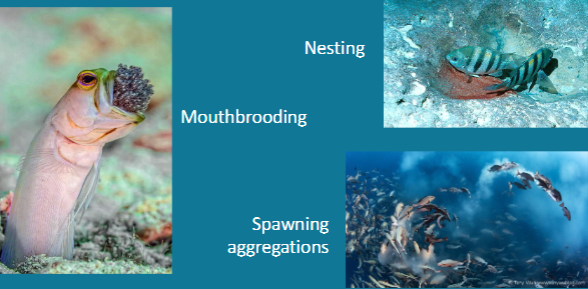
Spawning
Aggregations
Note clouds of
eggs and sperm
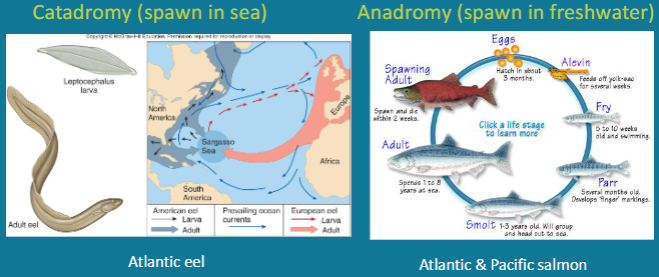
Fish reproduction can involve migrations between
freshwater and saltwater
Catadromy (spawn in sea
Northern Pacific Bluefin Tuna migrate huge distances
under high fishing pressure
Vertical Daily Migration in Bigeye Tuna
What is the “deep scattering layer”?
• layer of deep-living fishes
and other animals
• ”scatters” sonar
• air bladder reflects
sonar!
• many make vertical diel
migrations
• Tuna can swim down to
them and eat them
Tunas are Endothermic
Endothermy:
- Ability to raise body temperature above ambient
and defend body temperature.
• High energetic costs of constant, fast swimming
• Allows fish to move across temperature gradients
Tunas use a counter-current system – similar concept
to getting oxygen into blood stream with gills, but also
used to transfer heat between veins and arteries
Being endothermic helps tunas ignore water
temperature thresholds, and perform constantly at a
high rate
Tuna heat
their
blood by
moving
blood next
to their
warm
muscles
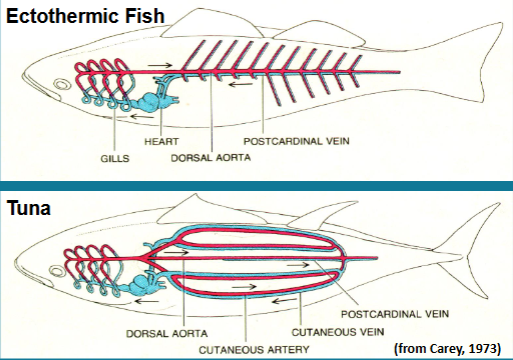
There are other endothermic marine fishes!
• Tunas (15 species)
• Lamnid Sharks
(Great white,
Mako, Salmon
shark)
• Opah (bony fish)
Major Evolutionary Novelties in Fishes
Endothermy – Evolved 3 times
2 jaws !! Found in all Ray-Finned fishes.
Antifreeze proteins in Antarctic fish. Evolved at least 3 times
Bioluminescence. Evolved more than 20 times
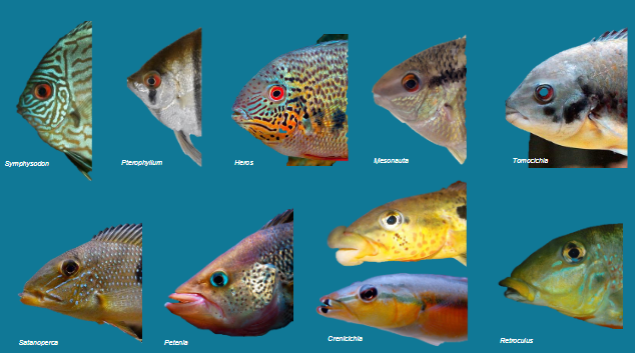
2 Jaw Systems
Oral Jaws & Pharyngeal Jaws
Oral jaws are the same as our jaws
Pharyngeal jaw develops from the last two gill arches
Oral jaws collect prey, pharyngeal jaws process prey
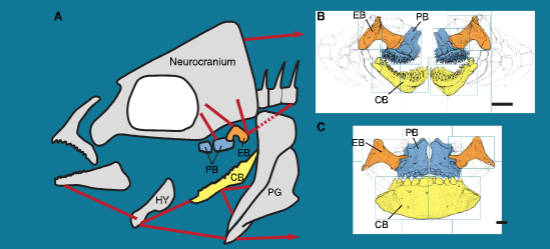
2 Jaw Systems
Oral Jaws & Pharyngeal Jaws
Oral jaws at the front of the head
Pharyngeal jaw at the back of the mouth cavity
Oral jaws collect prey, pharyngeal jaws process prey
Pharyngeal jaws develop from gill arches
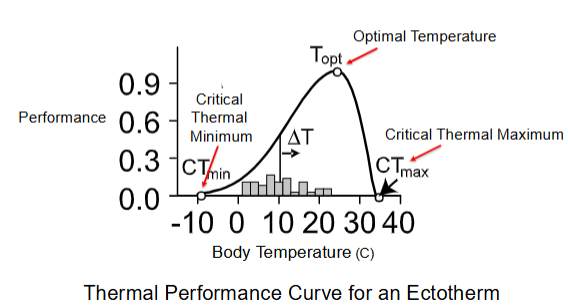
Advantage of Endothermy
Maintain body temperature close to optima
Tunas are Endothermic
(warm-bodied)
Advantage of Tuna Endothermy:
• constant, fast swimming, requires high
energetic expenditure.
• Endothermy allows tuna to move across
temperature gradients and maintain high
physiological performance.
Antifreeze Proteins
Proteins that bind to ice crystals preventing ice forming in blood
Evolved in many metazoan groups, ~5 times in marine fishes
Allows fish to occupy very cold water
Bioluminescence
Biological Production of Light
- Produced by a chemical reaction
- May be produced by the fish or symbiotic bacteria
- Functions in camouflage, defense, predation,
and communication.
Bioluminescence can be intrinsic
or from symbiotic bacteria
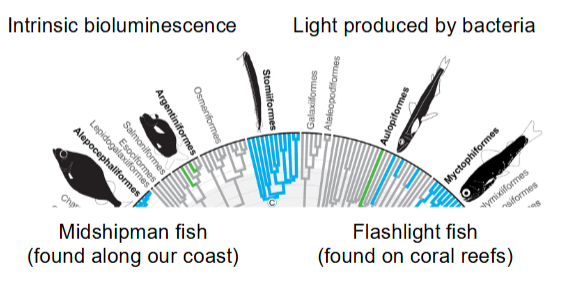
Phylogenetic
Distribution of
Bioluminescence
In
Ray-Finned Fishes
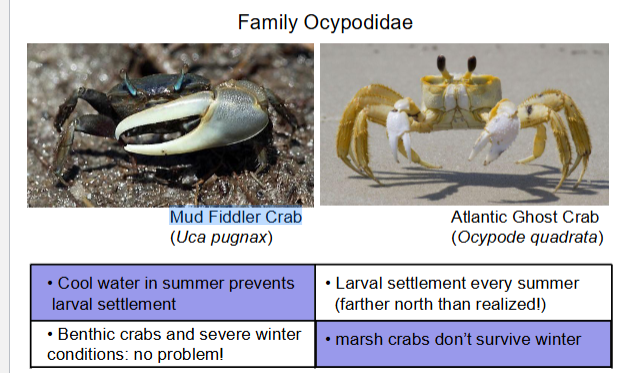
For crab experiment of planktonic an benthic
In this case temperature
constraints on larval growth
limit the species range
Ghost Crabs are Different!
They appear to be limited by
temperature effects on
adults in winter
Even closely related species in the same region may
have range limits set by different factors
Atlantic Ghost Crab
(Ocypode quadrata)
Mud Fiddler Crab
Biological Pump
movement of
carbon and other elements to
the deep sea through sinking
of shallow water organisms
and detritus (marine snow)
Sinking material stays buried
for long periods if
thermohaline circulation slow
Natural vs Anthropogenic
climate change
Observed
temperature changes
far exceed
predictions from
natural causes only
Tropicalization
s planet Earth warms,
the distribution of many
species may shift
Basic hypothesis: move
toward the poles (away
from the equator)
On land, populations can
also move higher in
elevation (mountains).
What about the sea?
What if you live near the
poles
Tropicalization in California
Resurveying old plots from 1933 in 1992 (60 years later)
– Pacific Grove rocky intertidal
Southern species became more common and northern species became less common
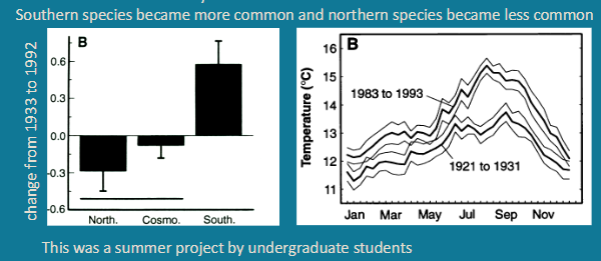
Species invasions – global homogenization
warming waters may give
advantage to non-native species
that can handle the temperatures
of their new homes
Examples: fouling invertebrate
communities and estuarine algae in
CA (and worldwide)
Some species of tunicates and
bryozoans can now be found
worldwide
Melting ice raises sealevel
by 1.8 mm per year.
Expansion of water due to
increasing temperature
raises sea level by 0.6 mm/yr
Ocean Acidification:
Increase in CO2 causes ocean to become more acidic (lower pH)
CO2 dissolves in water in proportion to its concentration in air
low pH can compromise the ability of organisms with shells and skeletons
to biomineralize calcium carbonate, and can disrupt neurological function
(larval fish may be unable to smell)
extra CO2 can boost plant growth, but not always the case
• some marine seaweeds also have calcium carbonate skeletons
(coralline red algae)
• not all marine primary producers are CO2 limited
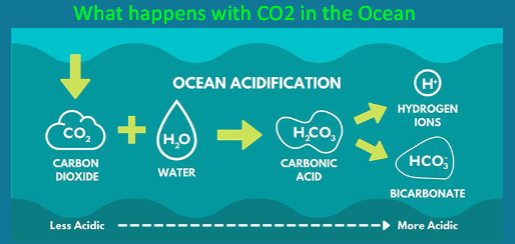
Climate Change: Effects on Ocean Processes
The ocean has moved faster in past 30 years (caused by increased surface winds,
that are caused by increased water temperature)
Dead Zones – Oxygen depleted water due to too much nutrients and abundance of
microbes eating decaying vegetation. These are happening more with higher temps.
Also, caused by polluted run-off (Mississippi River mouth is a major dead zone)
Methyl mercury – concentrates in big ocean fish and is toxic to humans. Since 1970 there is
a 55% increase in Bluefin tuna due to higher water temperature.
Biodiversity loss – Temperatures increasing faster in deep ocean
National Marine Sanctuaries
Gulf of the Farallones
• expanded in 2016
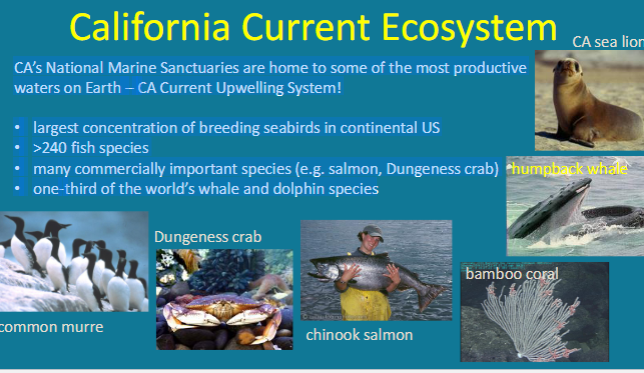
California Current Ecosystem
CA’s National Marine Sanctuaries are home to some of the most productive
waters on Earth – CA Current Upwelling System!
• largest concentration of breeding seabirds in continental US
• >240 fish species
• many commercially important species (e.g. salmon, Dungeness crab)
• one-third of the world’s whale and dolphin species
largest concentration of blue whales on Earth
145 ton animal
takes 1 ton of krill to fill their stomachs
nearly 0.5 million krill
Cordell Bank National Marine Sanctuary
deep rich seamounts – 400ft average depth
used to be heavily fished
trawling banned
closed to fishing since 2005
Cordell Bank National
Marine Sanctuary
As of 2020, these are the current restrictions
on commercial fishing activity in Cordell Banks
*No fishing gear can contact bottom in main bank
* Only demersal seines can contact bottom
Waste Disposal in the Sea
garbage, sewage, radioactive material
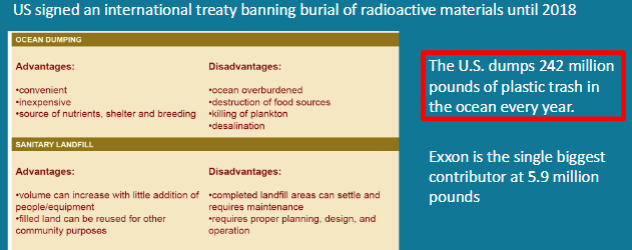
US signed an international treaty banning burial of radioactive materials until 2018
The U.S. dumps 242 million
pounds of plastic trash in
the ocean every year.
Exxon is the single biggest
contributor at 5.9 million
pounds
Great Pacific Garbage Patch
8 million tons
per year is
dumped in the
ocean
mall plastic particles – including microplastic beads that
were used in toothpaste & cosmetics (now banned in the US).
Eaten by a wide range of animals.
Poorly understood impact on marine health – active area of research
Climate Change:
What is Changing
1. Greenhouse gasses in the atmosphere are increasing (e.g. CO2)
2. Increased CO2 causes acidification of the ocean
3. Higher greenhouse gasses causes increased temperature
-this alters species ranges and stresses some directly
-warm water causes coral bleaching on reefs
-causes higher surface wind which moves water faster
-increases methyl mercury concentration in food chain
-loss of ice causes sea level rise
What makes a mammal a mammal?
• Mammary glands that produce milk
for nursing
• Possess fur or hair
• Warm-blooded
• Four limbs (tetrapod)
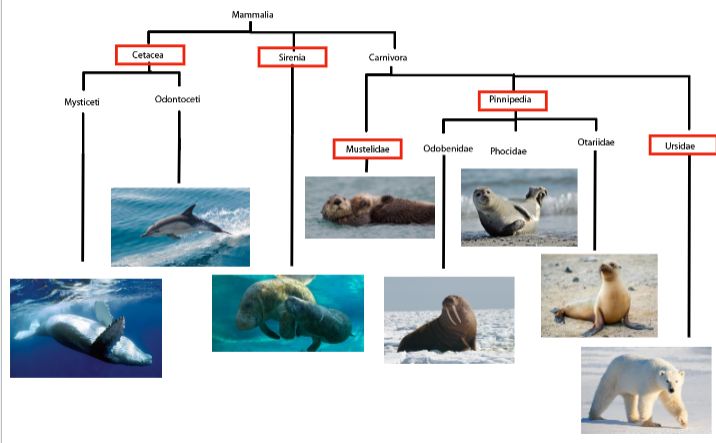
Marine Mammals 5 groups
Manatees\
Pinnipeds
sea otters
cetaceans
polarbear
General morphological patterns in marine
mammals
Drag reduction:
• Streamlining of body shape
• Loss or modification of rear limbs
• Loss or modification of fur
• Elaboration and modification of sensory capabilities
Blubber
a thick layer of
connective tissue and fat that
provides strong insulation.
It is highly vascularized and
organized with connections to
deeper muscle by tendons
2 inches thick in dolphin,
up to 2 ft thick in whales.
Often gives shape to cetacean body.
Found in cetaceans, pinnipeds, manatees, penguins
Rich in Vitamin D, omega-3 fatty acids – important nutrients
Cetaceans: whales and dolphins
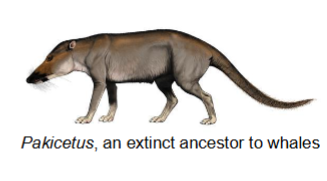
Marine fishes -> land mammals -> marine mammals
An evolutionary reversal:
the first “whale” was a land
mammal
What living mammal are
cetaceans most closely
related to? hippo
Cetaceans: whales and dolphins
Two major groups:
1.Toothed whales (Odontocetes)
2.Baleen whales (Mysticetes)
Cetaceans
*Dolphins are toothed whales
Toothed whales
• About 73 species
• Diverse and can be
abundant in all the
world’s oceans
• Typically do not make
major migrations
• Extreme development of
acoustic capabilities