1.3 Transport in Cells
 Call Kai
 Learn
Learn Practice Test
 Spaced Repetition
 Match
Match Flashcards
 Knowt Play
1/37

There's no tags or description
Looks like no tags are added yet.
Name | Mastery | Learn | Test | Matching | Spaced | Call with Kai |
|---|
No analytics yet
Send a link to your students to track their progress
38 Terms
How may substances move into and out of cells?
Diffusion
What is the definition of diffusion?
The movement of particles from an area of high concentration to an area of low concentration.
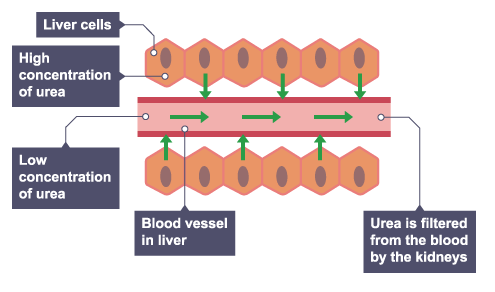
What are some of the substances transported in and out of cells by diffusion?
O₂ and CO₂ — gas exchange
Urea from cells → blood plasma — excretion in kidney
What are the different factors that affect the rate of diffusion? (3)
Concentration gradient
Temperature
Surface area of membrane
What effect does concentration gradient have on the rate of diffusion?
Steep gradient = faster rate of diffusion
particles moving down gradient > particles moving against gradient — random
What effect does temperature have on the rate of diffusion?
Higher temperature = faster rate of diffusion
particles have more kinetic energy → move quicker → more collisions
What effect does the surface area of the membrane have on the rate of diffusion?
Larger SA = faster rate of diffusion
larger SA = more physical space for particles to move through → more molecules can cross membrane at same time
A single-celled organism has a relatively ________ ___________ _______ ___ ________ _________.
This allows sufficient transport of molecules into and out of the cell to meet the needs of the organism.
large surface area to volume ratio
Why can’t multicellular organisms rely on diffusion?
Small SA:V
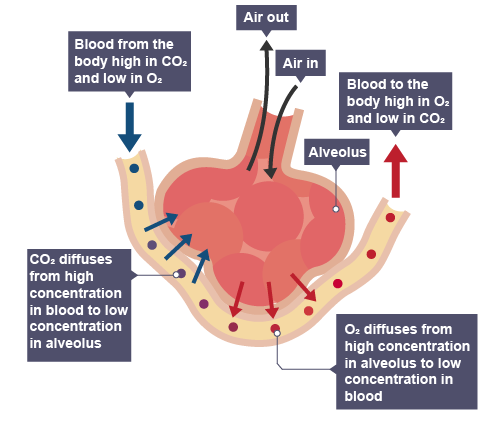
Explain diffusion in the lungs.
O₂ transferred → blood
CO₂ transferred → lungs
in aveoli — covered in capillaries — supplies blood
Explain diffusion in the small intestine.
Cells have villi
digested food absorbed over membrane of villi → bloodstream
Explain diffusion in gills in fish.
Water (w/ O₂) passed through mouth and over gills
Each gill has gill filaments — gill lamellae increase SA
diffusion of:
O₂ → blood
CO₂ → water
Explain diffusion in the roots of plants.
Root hair cells have large SA — projects into soil
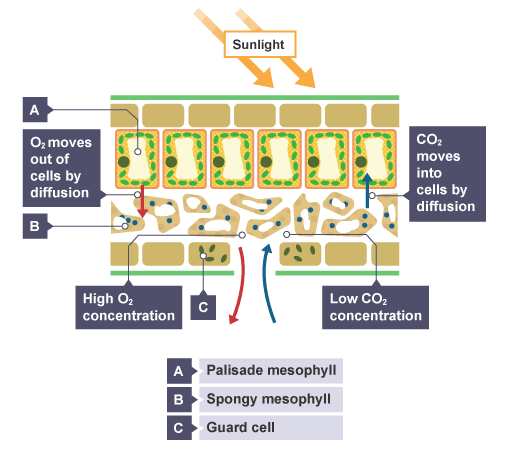
Explain diffusion in the leaves of plants.
CO₂ diffuses through stomata — photosynthesis
O₂ and water vapour move through stomata
Stomata controlled by guard cells
How are the lungs adapted for exchanging materials?
Aveoli = large SA
Aveoli and capillary walls are thin → short diffusion pathway
Capillaries provide efficient blood supply → steep concentration gradient
lungs supply O₂ → makes blood in capillaries oxygenated
exchanges it for CO₂ — can be breathed out
How is the small intestine adapted for exchanging materials?
Villi = large SA
Villi have single layer of surface cell → short diffusion pathway
How are leaves adapted for exchanging materials?
Flat shape = large SA
Air spaces in leaf = large SA → more CO₂ enters cells
How fish adapted for exchanging materials?
Fish gills — lamellae = large SA
Water flows in one direction — blood in the other → steep concentration gradient
How is the effectiveness of an exchange surface increased? (4)
Large SA
Thin membrane → short diffusion pathway
Efficient blood supply — animals
Being ventilated — animals; gas exchange
What is the definition of osmosis?
The movement of water from an area of high water concentration to an area of low water concentration through a partially permeable membrane.
What does dilute and concentrated mean in the context of osmosis?
Dilute = high conc. of water
Concentrated = low conc. of water
What is meant by a hypertonic solution?
Lower conc. of water than inside cell
Water moves out of cell by osmosis
What is meant by a hypotonic solution?
Higher conc. of water than inside cell
Water moves into cell by osmosis
What is meant by a isotonic solution?
Conc. of water in cell = conc. of water outside cell
No net movement of water in or out of cell
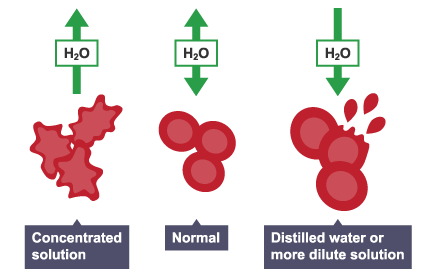
What happens if you place an animal cell in a hypertonic and hypotonic solution?
Hypertonic — water leaves cell → shrivels
Hypotonic — water enters cell → bursts
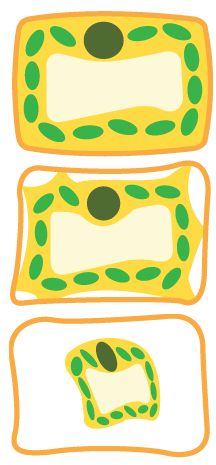
What happens if you place a plant cell in a hypertonic and hypotonic solution?
Hypertonic — water leaves cell → cell membrane moves away from cell wall = plasmolysis
Hypotonic — water enters cell → swells → turgor pressure
What does turgor pressure do in plants?
Keeps leaves and stems of plants rigid
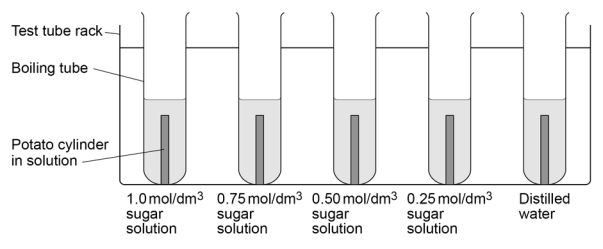
Required Practical 3 — Osmosis:
Describe a method to investigate the effect of a range of concentrations of salt or sugar solutions on the mass of plant tissue.
Cut potato pieces to same size — from same potato; no skin
Measure initial mass of each piece using balance
Place the pieces into 3 difference concentrations of sugar solution
Leave pieces in solutions for same amount of time (least 10 mins) — same temperature
Remove pieces and blot with paper — same technique
Measure final mass using balance — calculate change in mass
Repeat experiment for each concentration at least 2 more times — calculate mean change in mass
A student investigated the effect of different sugar solutions on potato tissue.
This is the method used:
Add 30 cm3 of 0.8 mol dm-3 sugar solution to a boiling tube.
Repeat step 1 with equal volumes of 0.6, 0.4 and 0.2 mol dm-3 sugar solutions.
Use water to give a concentration of 0.0 mol dm-3 .
Cut five cylinders of potato of equal size using a cork borer.
Weigh each potato cylinder and place one in each tube.
Remove the potato cylinders from the solutions after 24 hours.
Dry each potato cylinder with a paper towel.
Reweigh the potato cylinders.
The table below shows the results.
Concentration of sugar solution in mol dm-3 | Starting mass in g | Final mass in g | Change of mass in g | Percentage (%) change |
0.0 | 1.30 | 1.51 | 0.21 | 16.2 |
0.2 | 1.35 | 1.50 | 0.15 | X |
0.4 | 1.30 | 1.35 | 0.05 | 3.8 |
0.6 | 1.34 | 1.28 | -0.06 | -4.5 |
0.8 | 1.22 | 1.11 | -0.11 | -9.0 |
Why did the student calculate the percentage change in mass as well as the change in grams? [1 mark]
To allow results to be compared
A student investigated the effect of different sugar solutions on potato tissue.
This is the method used:
Add 30 cm3 of 0.8 mol dm-3 sugar solution to a boiling tube.
Repeat step 1 with equal volumes of 0.6, 0.4 and 0.2 mol dm-3 sugar solutions.
Use water to give a concentration of 0.0 mol dm-3 .
Cut five cylinders of potato of equal size using a cork borer.
Weigh each potato cylinder and place one in each tube.
Remove the potato cylinders from the solutions after 24 hours.
Dry each potato cylinder with a paper towel.
Reweigh the potato cylinders.
The table below shows the results.
Concentration of sugar solution in mol dm-3 | Starting mass in g | Final mass in g | Change of mass in g | Percentage (%) change |
0.0 | 1.30 | 1.51 | 0.21 | 16.2 |
0.2 | 1.35 | 1.50 | 0.15 | X |
0.4 | 1.30 | 1.35 | 0.05 | 3.8 |
0.6 | 1.34 | 1.28 | -0.06 | -4.5 |
0.8 | 1.22 | 1.11 | -0.11 | -9.0 |
The results in the table above show the percentage change in mass of the potato cylinders.
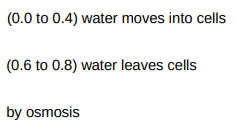
Explain why the percentage change results are positive and negative. [3 marks]
0.0 - 0.4 water moves into cells
0.6 - 0.8 water leaves cells
By osmosis
A student investigated the effect of different sugar solutions on potato tissue.
This is the method used:
Add 30 cm3 of 0.8 mol dm-3 sugar solution to a boiling tube.
Repeat step 1 with equal volumes of 0.6, 0.4 and 0.2 mol dm-3 sugar solutions.
Use water to give a concentration of 0.0 mol dm-3 .
Cut five cylinders of potato of equal size using a cork borer.
Weigh each potato cylinder and place one in each tube.
Remove the potato cylinders from the solutions after 24 hours.
Dry each potato cylinder with a paper towel.
Reweigh the potato cylinders.
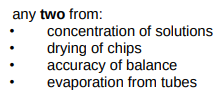
Suggest two possible sources of error in the method given above. [2 marks]
Drying of chips
Concentration of solutions
A student used cubes of potato to investigate the effect of surface area and volume on the rate of osmosis.
This is the method used:
Cut two cubes of potato of size 2 cm × 2 cm × 2 cm
Cut one of these cubes into 8 cubes of potato of size 1 cm × 1 cm × 1 cm (sample A).
Do not cut the other cube (sample B).
Measure the mass of each sample A and the mass of sample B.
Place all the cubes into a beaker of distilled water.
Leave for 30 minutes.
Remove the cubes from the beaker and dry the surfaces with a paper towel.
Measure the mass of each sample of cubes
Why did the student dry the surface of each potato cube in step 5 of the method? [1 mark]
Excess water doesn’t contribute to mass of cubes
What is the definition of active transport?
The movement of substances from a more dilute solution to a more concentrated solution — against a concentration gradient.
Requires energy ← respiration
Describe active transport in root hair cells.
Take up water and mineral ions from soil → healthy growth
Mineral ions in higher conc. inside cells = no diffusion
Mineral ions move from soil → cell — active transport
Describe active transport in the gut.
Glucose and amino acids ← food
move from gut → bloodstream
Lower conc. of sugar molecules in gut than blood — no diffusion
Sugar moves from gut → blood — active transport
Process | Definitions | Substances moved | Energy required |
Diffusion | The movement of particles from an area of ______ concentration to an area of ______ concentration. | CO₂, O₂, H₂O, food substances, waste — e.g. urea | ____ |
Osmosis | The movement of ______ from an area of _______ _________ _____________ to an area of _______ _________ _____________ through a ___________ ____________ _________. | ______ | ____ |
Active transport |
| __________ _____ → plant roots, ________ from the gut → intestinal cells, from where it moves → blood | ____ |
high
low
No
water
high water concentration
low water concentration
partially permeable membrane
H₂O
No
dilute
concentrated
against
concentration gradient
energy
respiration
Mineral ions
glucose
Yes
People with diabetes have difficulty controlling their blood glucose concentration.
The body cells of a person with untreated diabetes lose more water than the body cells of a person who does not have diabetes.
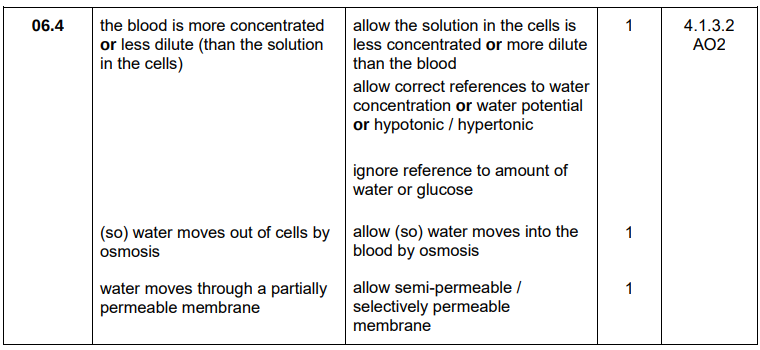
Explain how diabetes can cause the body cells to lose more water. [3 marks]
Blood is more concentrated
Water moves out of cells by osmosis → through a partially permeable membrane
Glucose is absorbed into the blood in the small intestine by both diffusion and active transport.
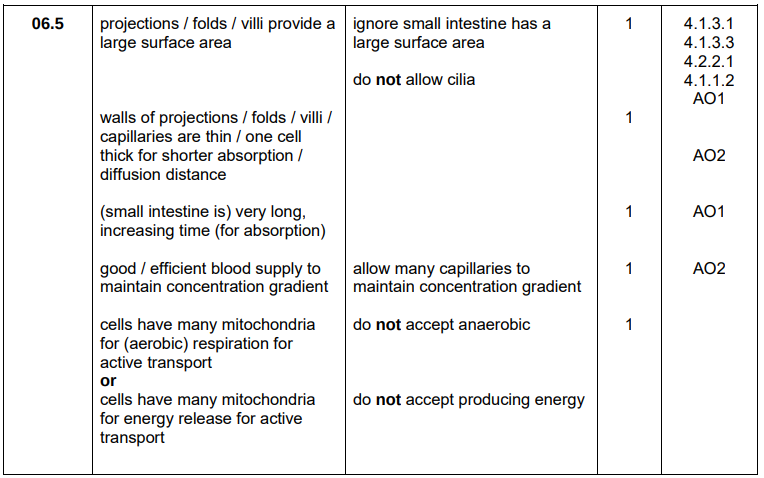
Describe how the small intestine is adapted for efficient absorption. [5 marks]
Villi = large surface area
Walls of capillaries — one cell thick → short diffusion distance
Small intestine is long → increases time for absorption
Efficient blood supply → maintains concentration gradient
Cells have many mitochondria — aerobic respiration → releases energy for active transport