Lecture 3: Pay for Performance
 Call Kai
 Learn
Learn Practice Test
 Spaced Repetition
 Match
Match Flashcards
 Knowt Play
1/12

There's no tags or description
Looks like no tags are added yet.
Name | Mastery | Learn | Test | Matching | Spaced | Call with Kai |
|---|
No analytics yet
Send a link to your students to track their progress
13 Terms
Describe an example of performance pay
Safelite - Lazear, E. P. “Performance Pay and Productivity” American Economic Review 90(3) (December 2000): 1346-1361
What were the facts of the Safelite PPP (performance pay plan)?
Safelite (Columbus, OH) - largest installer of auto glass in US
Employees work independently, no interactions, output easily measured (quality handled seperately)
Employees paid on hourly basis, independent of output
Lazear convinced CEO to introduce piece rate compensation in mid-1990s
New compensation system (PPP) introduced on staggered basis in locations across country → allow many before-after comparisons involving 2000 workers
Under new scheme, workers’ pay calculated in 2 ways
(1) According to hourly rate (same as before)
(2) Piece rate per windshield installed
Workers paid maximum of these 2 amounts
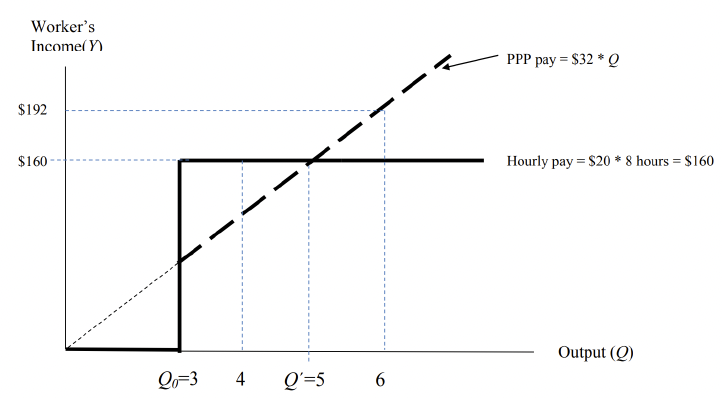
Explain how this graph illustrates the PPP
Under hourly pay scheme - workers received $20/hr for 8-hr day (for total of $160/day) given they produced enough to keep their jobs (Q0)
Under PPP - workers received $32/windshield successfully installed → for each day, workers paid maximum of hourly and PPP compensation
e.g. Q = 4 → choose hourly pay, Q = 6 → choose PPP pay, Q = Q’ = 5 → breakeven output
What were the predicted effects of introducing PPP?
Before PPP available → no financial incentives provided for additional output beyond Q0
Thus, expect both low- and high-ability workers to produce Q0 (at m)
When PPP available → expect high-ability workers to raise output to Q1 (at n) but low-ability workers to stay at m
So both mean and variance of output should rise
How did PPP affect employee performance at Safelite?
Consistent w/ theory, both mean and variance rose → increase in productivity amounts to 20% rise [(3.24 - 2.70)/2.70 = 0.20] and is highly statistically significant
BUT need to account for time trends, seasonal effects and other changes in management policy
![<ul><li><p>Consistent w/ theory, both mean and variance rose → increase in productivity amounts to 20% rise [(3.24 - 2.70)/2.70 = 0.20] and is highly statistically significant</p></li><li><p>BUT need to account for time trends, seasonal effects and other changes in management policy</p></li></ul><p></p>](https://knowt-user-attachments.s3.amazonaws.com/6c1b59fa-989b-4685-8749-55c05613d96a.png)
How did Lazear account for confounding factors affecting employee performance?
Estimated the following regression equation → see pic
Estimated value of beta was 0.368 → indicating that controlling for seasonal factors and annual time trend, output is 0.368 log units higher under PPP
Effect is statistically significant and corresponds to 44% higher level of productivity under PPP → much higher than 20% gap
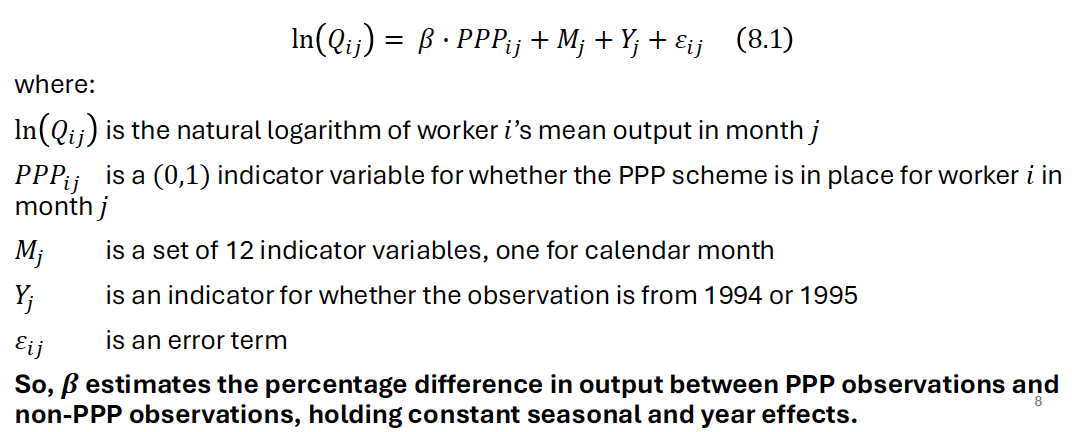
Why do we find a 44% increase in productivity in regression vs only 20% increase when we compare means?
Failing to control for seasonality underestimates true productivity-enhancing effects of PPP
PPP was first introduced in months where output is usually low for seasonal reasons (Autumn)
How much of the 44% increase in productivity is actually due to Safelite’s initial workers improving their job performance?
Turnover at Safelite is high → according to theoretical model, PPP scheme makes workplace more attractive to high-ability workers, but not to low-ability workers
Over time, might expect Safelite’s mix of workers to change as it becomes easier both to hire and retain more able workers relative to others
To determine contribution of changing employee mix to 44% productivity improvement → Lazear estimated 2nd regression model (see pic)
New element is set of worker fixed effects (Wi) → allow productivity equation to have different intercept for each Safelite worker
(8.2) estimates beta by comparing output of same worker before and after change to PPP → estimates of (8.2) are within-worker estimates of effect of PPP
Since we can only estimate these changes for workers who stayed at Safelite before and after PPP plan → eliminates selection effects from estimate of beta

What was the result of Lazear’s 2nd regression model that accounted for contribution of changing employee mix?
Estimated value of beta is 0.197 → typical worker who worked at Safelite both before and after PPP was introduced produced 0.197 more log units of output under PPP
Effect is highly statistically significant and corresponds to 22% higher level of productivity under PPP → half of 44% estimated effect
Only half of 44% productivity increase associated w/ PPP was due to Safelite’s existing workers working harder
Remaining half is pure employee selection effect → incentive pay made Safelite a more attractive workplace for more able workers
Supported by additional evidence that turnover after PPP was lower for high performers than for other workers
Did the PPP raise Safelite’s profits?
PPP caused increase in total payment to workers and material costs → but increase in labour costs from PPP was only 7%
Unless additional material costs ate up remaining 44 - 7 = 37% gain in (productivity - wages) → profits likely rose compared to non-PPP scenario
Thus, HRM innovations can generate massive productivity improvements AND changes in HRM policy affect both motivation and selection
What is the ‘Hawthorne Effect’?
Western Electric’s Hawthorne Works (Cicero, Illinois) - industrial sociologists conducted experiments on effects of working conditions and employee performance between 1924 and 1932
Experiment on 6 female factory workers who assembled telephone relays in dedicated room over period of 5 yrs (1927-32)
During this period, researchers changed variety of working conditions (e.g. no. and length of break times, food during breaks, shorter workday, lighting in room) and measured effects on workers’ productivity based on no. of finished relays
Changing almost any of these variables, regardless of direction of change → appeared to increase workers’ productivity in short-term
While empirical validity of result is now questioned → ‘Hawthorne effect’ used to describe situations where experimental subjects (especially workers) change their behaviour not due to experimental treatment received, but simply because they know they are being studied
Was workers’ response to Safelite’s PPP just a ‘Hawthorne Effect’?
Lazear ruled this out by measuring productivity not only immediately after the introduction of PPP but many months later → effects appear to be lasting
What’s happening at Safelite now?
According to Clayton Frech (Safelite’s Regional VP for greater LA), PPP still around in 2014 → but no longer relevant to most workers
Safelite acquired by Belron (world’s largest dedicated vehicle glass repair and replacement company) → Belron shifted Safelite’s emphasis from productivity to quality, safety and customer satisfaction
Belron introduced standardised tools, raising safety and quality → but slowed things down (harder to qualify for PP)
Instead of adjusting PPP to keep it relevant to more workers → introduced new incentive plan (net promoter score) that explicitly rewards quality and customer satisfaction
Thus, Belron recognised output of Safelite worker is multidimensional inc. no. of units, quality, safety, customer satisfaction, maintaining company’s reputation