Cell Structures and Stem Cells
 Call Kai
 Learn
Learn Practice Test
 Spaced Repetition
 Match
Match Flashcards
 Knowt Play
1/16

There's no tags or description
Looks like no tags are added yet.
Name | Mastery | Learn | Test | Matching | Spaced | Call with Kai |
|---|
No analytics yet
Send a link to your students to track their progress
17 Terms
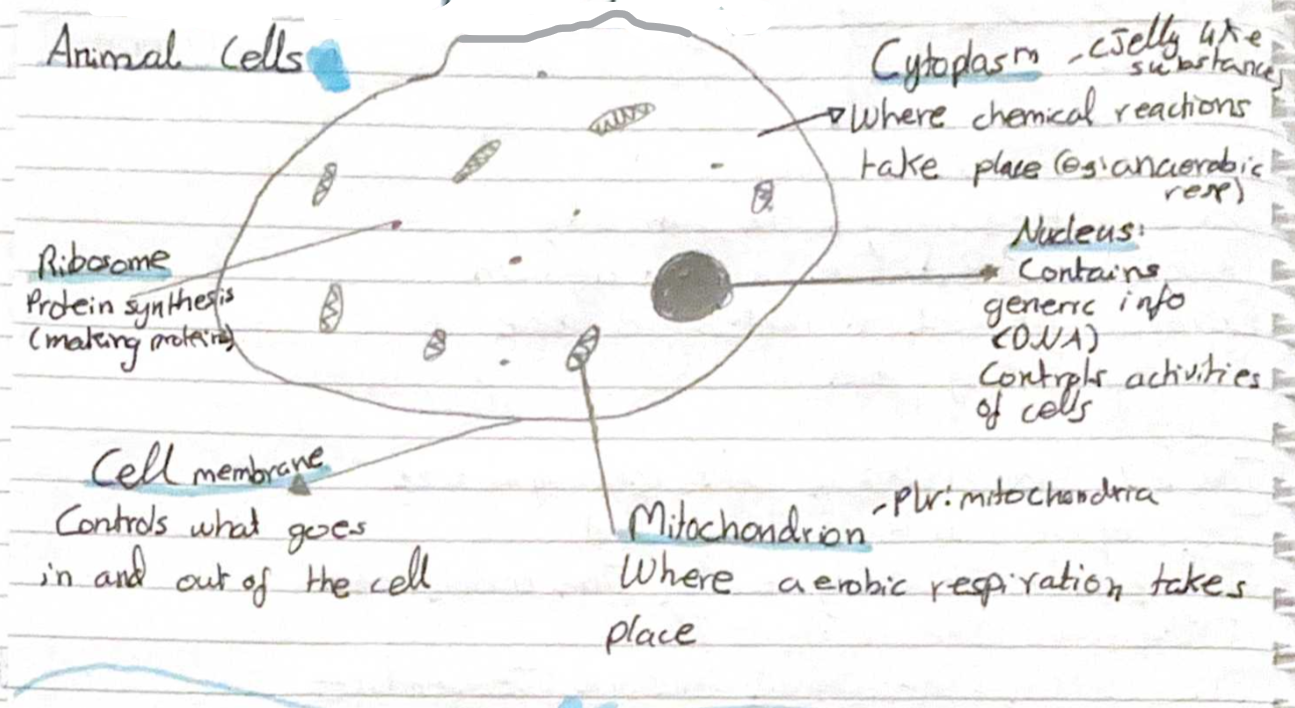
Animal Cell
Anaerobic respiration occurs in the cytoplasm. Anerobic Respiration takes place when there isnt enough oxygen, and it takes place in the cytoplasm. Glucose—> Lactic acid (energy). The energy that is produced is less energy compared to the energy produced in Aerobic Respiration but it can be produced with only glucose.
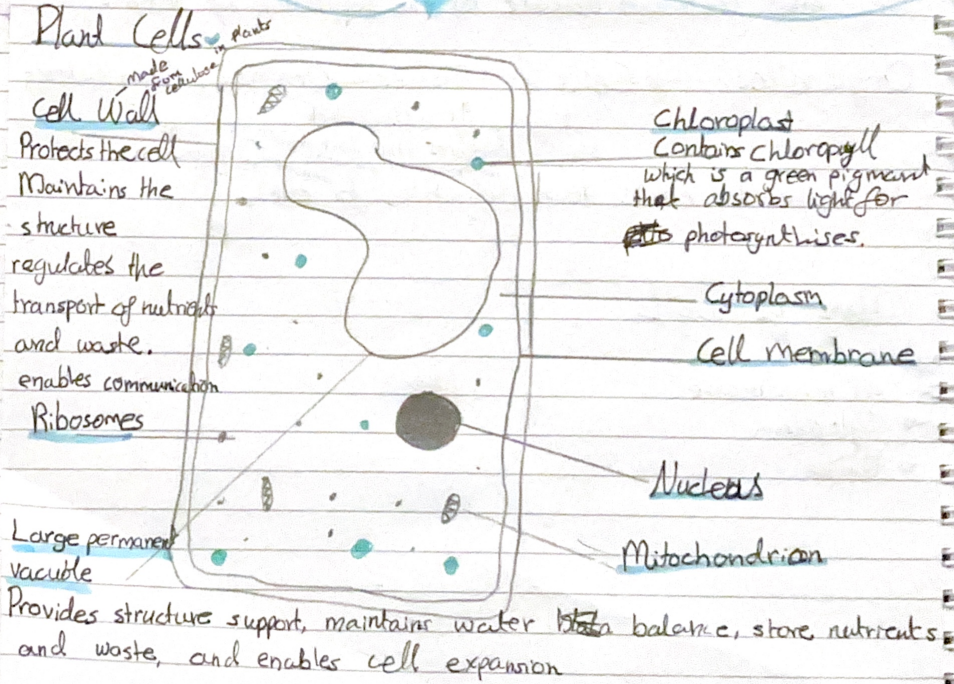
Plant Cell
The large permenant vacuole contains sap.
The Cell Membrane us also partially permiable, which means it allows some things through but wont allow other things through
Which three organelles does Plant cells have but Animal cells do not
Organelles are the subunits that make up a cell. A plant cell has some additional organelles which are not in an animal cell, these include the:
Cell Wall
Chloroplast
Large permenant vcacuole.
Eukaryotic
Animals and plants, Fungi and Protoctists are examples of eukaryotic organisms and they have their genetic information enclosed in nucleus. Eukaryotic cells have membrane-bound organelles.
Stem Cells and how they are useful
Stem Cells are cells which keep their ability to differentiate. Most types of animal cells differentiate at an early stage. Plant cells retain the ability to differentiate throughout their life spans. In mature animals, cell division (or stem cellls) is mainly restrained to repair and replacemement.
Stem cells can be useful because they can be used to make any cell and to make an organ for someone who needs it (samiha credit)
Cell differentiation, Stem cells in plants, and the importance of cell differentiation
Describes the process where a cell changes from one cell type to another in order to become specialised. In plants they are called meristem and are usually found in the roots and shoots.
Cell differentiation is important in a growing embryo because it changes a simple, unspecialised zygote into many different specialised cells. These specialised cells form tissues, organs, and body systems, allowing the organism to grow and function properly.
Uses of Stem cells
1: Nerve cells can repair broken spinal cords or damaged brain tissue.
2: New bone marrow cells to cure blood abnormalities.
3: New retinal cells to cure blindness.
4: Heart cells to replace heart tissue damaged due to coronary heart disease
5: Cartilage tissue to repair worn joints.
6: Pancreas cells that make insulin to cure diabetes.
Types of Stem Cells: Embryonic Stem Cells (ES)
They are able to differentiate into any cell.
After the embryo comes the foetus.- (A small point miss said)
Embryonic stem cells need to be harvested at the early stages of the embryo’s development, because otherwise the cells would have already have started differentiating.
Two sources of ES cells
. (in-vitro fertilisation) IVF is fertilisation that occurs outside the body in labs. It is when human embryos are produced during fertility treatment.
Spare human embryos produced during fertility treatment/IVF is a source of ES cells.
. Differentiation can be initiated by the addition of chemicals
called growth factors
. ES cells can also be produced by cloning (does it need more info?)
Advantages of ES cells
Using embryos left over from IVF treatment means using stem cells that would otherwise be wasted but can now improve human lives.
Are able to differentiate into any cell to become a specialised cell.
If cloned embryonic stem cells are made, they will be genetically identical to the patient and therefore will not be rejected by the immune system.
Disadvantages of ES cells
Using leftover embryos from IVF treatment can lead to rejection as they are not genetically identical to the patient. So it can be rejected by the patient's immune system
Ethical concerns about killing a potential human.
Human embryos are delicate and hard to grow in laboratory conditions, which reduces the efficiency of cloning.
There may be a lack of women donating their eggs. So less embryos and human eggs are obtained.
It is difficult to make ES cells differentiate into the correct cell types. If they do not differentiate properly, they may form tumours and cancers in the body. Tumours are mssses formed from uncontrolled cell divisions.
Adult/Tissue stem cells
They are located in the bodies of children or adults. When they aee extracted, they are grown in laboraty cultures. Locations of Adult Stem cells include; Brain, eyes, heart, muscles, bone marrow, skin, liver and blood.
They cannot differentiate into all cell types, just a few, and are mainly used for repair and replacement.
Advantages of Adult/tissue stem cells
No embryos are killed so they have fewer ethical issues than ES cells.
Shortage of embryos or need for donors is not a concern.
They are partly differentiated and so easier to control. They also have less chance of producing tumours.
Using patients own cells prevents rejection as the cells will be genetically identical.
Disadvantages of Adult/tissue stem cells
Stem cells taken from older people may not last very long as cells age.
Adult stem cells are difficult to extract.
Adult stem cells are limited in terms of cells they differentiate into.
Nerve cells are very difficult to poroduce from adult stem cells making it difficult to create therapies for spinal cord and brain repair.
IPS cells
(Induced Pluripotent Stem cells)
IPS cells are adult cells that are reprogrammed to a pluripotent form.
Pluripotent cells are useful because they can differentiate to become almost any type of specialised cell in the body.
Scientists can grow nuerons with neurological defects to see what they can do to help others and find a cure.
How a cell becomes pluripotent
4 genes need to become re-activated to become pluripotent. They take the harmful substance/s from the virus, then put the 4 genes in the virus.
The cell is exposed to the virus, then the genes make specific proteins which then enter the nucleus and act on the DNA which makes the cell pluripotent.
How can Stem cells be used in medicine
Stem cells can be encouraged to develop into certain tissue types, for example replace damaged nerve cells to treat paralysis.