IN ☢️ Particles and Radiation
 Call Kai
 Learn
Learn Practice Test
 Spaced Repetition
 Match
Match Flashcards
 Knowt Play
1/97

There's no tags or description
Looks like no tags are added yet.
Name | Mastery | Learn | Test | Matching | Spaced | Call with Kai |
|---|
No analytics yet
Send a link to your students to track their progress
98 Terms
What is at the centre of the atom
Small nucleus contain protons and neutrons
Overall positive charge
What is the charge of a proton?
1.6×10⁻¹⁹C
What is the charge of a neutron?
0
What is the charge of an electron?
−1.6×10⁻¹⁹C
What is the mass of a proton?
1.673×10⁻²⁷ Kg
What is the mass of a neutron?
1.675×10⁻²⁷ Kg
What is the mass of an electron?
9.11×10⁻³¹ Kg
What is a nucleon number?
Number of protons and neutrons: atomic mass
What is an isotopes?
Same number of protons but different number of neutrons
How can isotopes be used?
Carbon dating
Medicine
What is carbon dating?
Carbon Dating:
All living things contain the same ratio Carbon 14 and Carbon 12
Carbon 14 is radioactive (created by cosmic rays the strike the atmosphere
After death Carbon 14 begins to decay
Physicists can use the percentage of Carbon 14 left and compare with isotopic data to calculate age
What is specific charge?
Specific charge is ratio of charge to mass
specific.charge=masscharge
How does number of neutrons affect the stability of an atom?
The more number of neutrons compared to protons the more unstable the nucleus. So the nuclei is more likely to be radioactive. (therefore decay to become more stable)
Why do radioactive nuclei decay?
They decay to become more stable
What forces act on a nucleus?
Electromagnetic force
Gravity (very small compared to other forces)
Strong nuclear force
How do the 3 forces that act on nucleus influence it?
If strong nuclear force (SNF) didn’t exist:
The nucleus is act on by gravity which pulls the atoms together.
However there is also the electromagnetic force which causes repulsion between the protons in nucleus
It is much stronger than gravity so the nucleus would just fly apart
However due to SNF the nucleus stays together:
The strong nuclear force holds the nucleus together
What is strong nuclear force?
Attractive force which holds nucleus together
Much stronger than electrostatic force
What is the range of strong nuclear force?
0.5fm to 3-4fm
What is a femtometer? (fm)
1×10⁻¹⁵ m
What happens to strong nuclear force when larger than 3-4 fm?
It becomes 0/negligable
What happens to strong nuclear force when less than 0.5 fm?
It becomes repulsive at very small distances
Why does the SN force become repulsive after 0.5 fm?
Otherwise nucleus’ would be crushed to a point
Does the SN force act the same between all nucleons?
Yes irrelevant if proton-proton, proton-neutron, neutron-neutron
What is relationship between Electrostatic force and SN force?
Refer to image
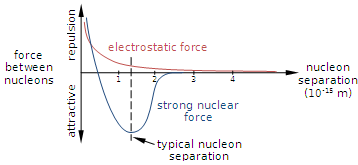
What is the range of electromagnetic force?
Infinity (but becomes weaker as distance increases)
When does alpha decay occur?
It happens in very big atoms (with more than 82 protons)
Why does alpha decay occur?
Because the nuclei of these atom are two big for the strong nuclear force to keep them stable so they decay and emit alpha particles
What is an alpha decay particle ?
α24
What is an alpha particles decay equation?
XZA=YZ−2A−4+α24
What is range of alpha particles?
Very short only a few cm in air
How to check for radiation?
Geiger miller counter
Spark counter
They measure ionising radiation
How to check if radiation source is alpha?
Using an ionising radiation detector (e.g, Geiger counter)
If it is held to an alpha source and moved away slowly the count rate will drop within a few cm
What is beta minus decay occur?
The emission of an electron(beta particle) from the nucleus along with an antineutrino
When does beta minus decay occur?
Occurs in particles that are ‘neutron rich’ so have to many neutrons compared to electrons
What happens during beta minus decay?
A beta particle is emitted from the nucleus.
When this happens a neutron is turned into a proton I the nucleus
The antineutrino particle released carries the same energy and momentum
What is beta minus decay equation?
XZA=WZ+1A+β−10+νe
How did scientists hypothesis neutrino?
Scientific originally believed only electrons were emitted during beta minus decay, but they then realised energy before decay was different to the energy after.
Which didn’t fit with conservation of energy.
So a particle (now called neutrino) was hypothesised which would have the missing energy, be neutral (so charge was conserved) and negligible/0 mass (as was not detected then)
What is beta particle?
β−10
What is a neutrino?
νe
What is an antinuetrino?
νe
What is different/similar between antiparticles and particles?
They have the same mass
But opposite charge
What is mass and charge of neutrino?
Negligible mass and 0 charge
How to covert from Joules to Electron Volts?
1eV = 1.6×10⁻¹⁹ J
What is EM radiation made of?
Made of particles of light called photons
What is annihilation?
When a particle meets its antiparticle
All of the mass gets converted to energy
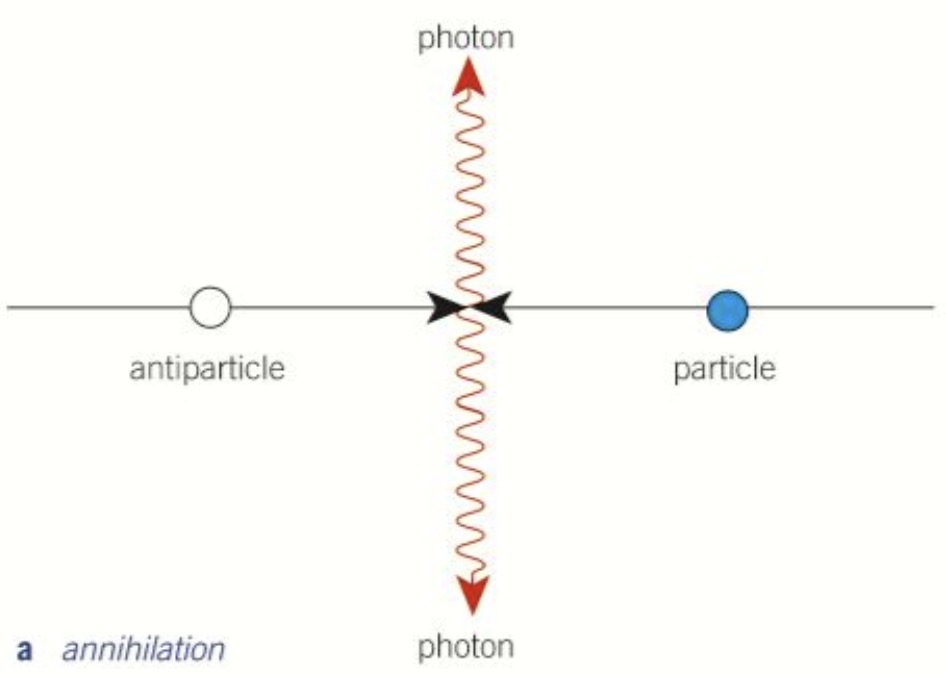
What happens to the mass of particles on annihilation?
All of it gets converted to energy in form of gamma rays (2 photons)
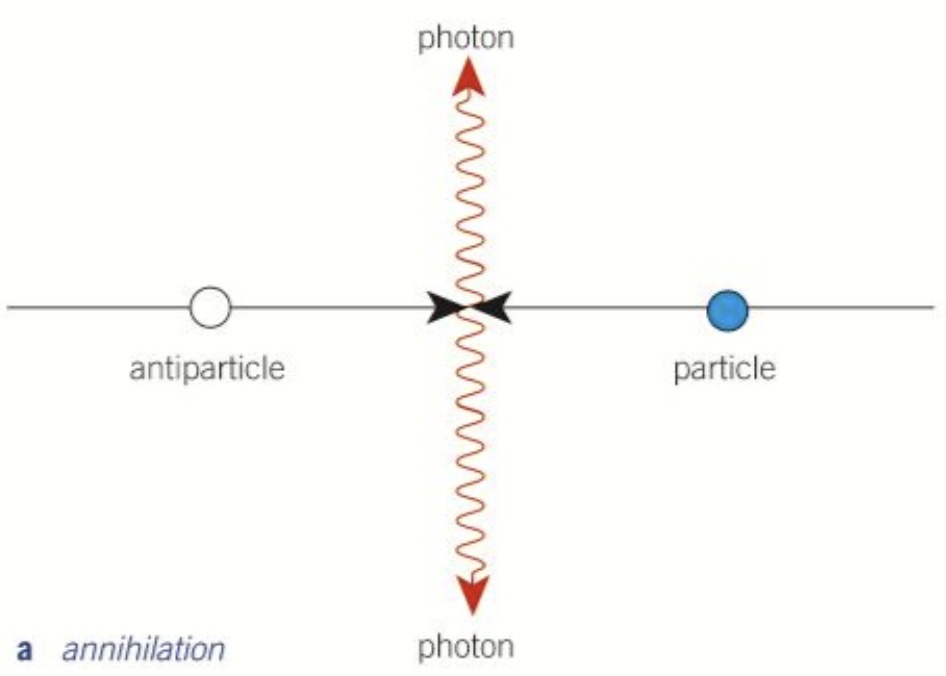
Why does annihilation not happen in ordinary particles?
Because antiparticles only exist for a fraction of a second
What is the equation for energy of a photon?
E=λhcIn joules
How to work out the minimum energy of a photon?
The rest energy of particle (MeV)= minimum energy of the photon produced
What is produced in annihilation?
All mass of particle is turned into energy in form of 2 gamma ray photons (
How do PET scanners work?
A positron-emitting isotope is place in then blood stream
The gamma rays are then detected by the electron-positron annihilation that occurs
The gamma rays are detected by a scintillator (they are easily differentiated from other gamma rays as they travel I opposite directions)
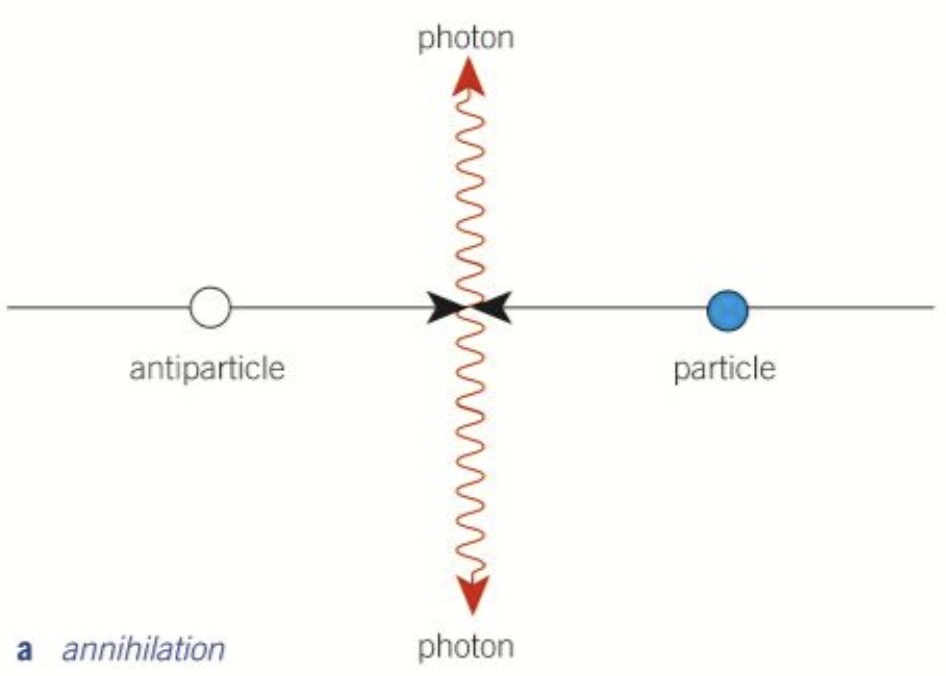
Why are gamma ray photons from annihilation easily dectected?
When annihilation occurs the gamma ray photons produced travel in opposite direction so they can easily be differentiated other gamma rays
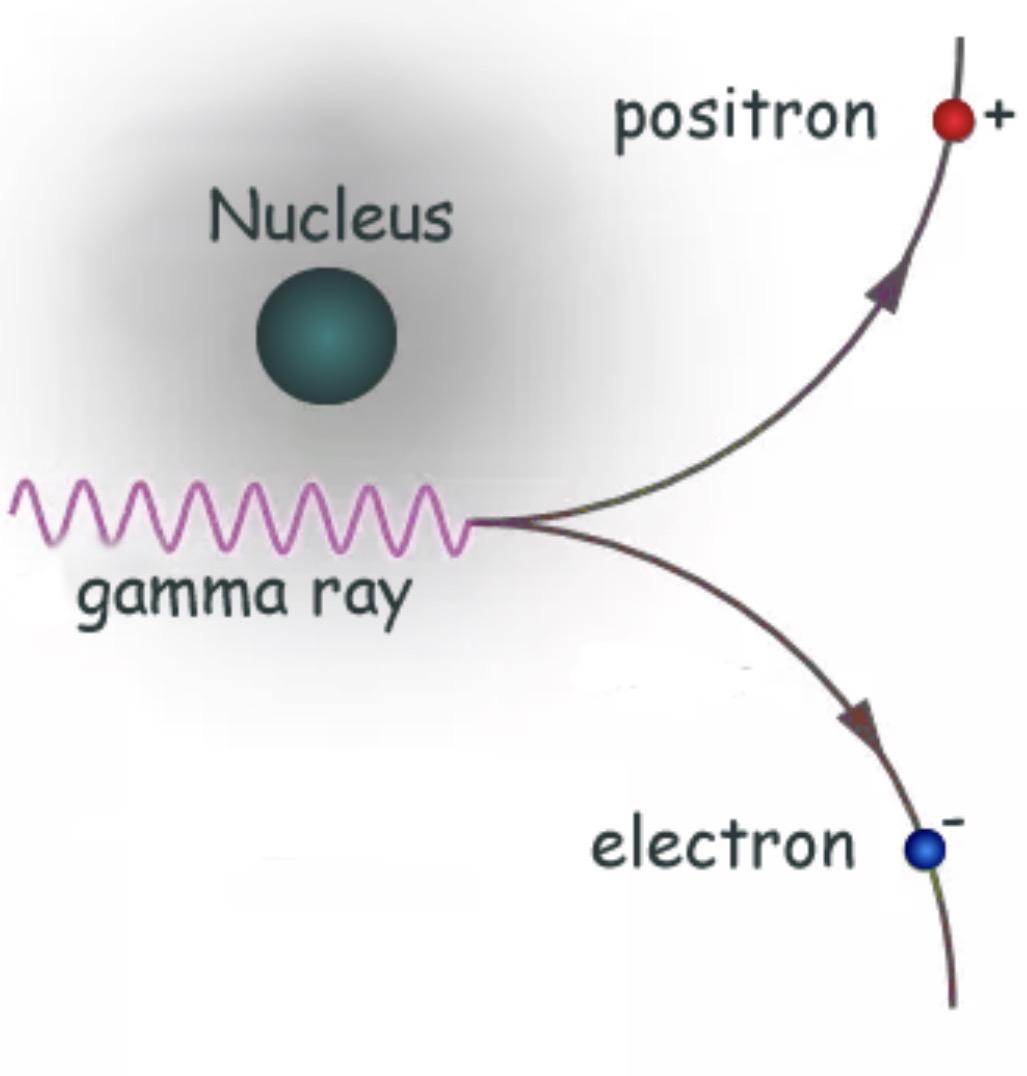
What is pair production?
A photon turns into particle-antiparticle pair [energy is converted into mass]
The minimum energy of a photon is at least twice the rest energy of 1 particle produced
![<p>A photon turns into particle-antiparticle pair [energy is converted into mass]</p><p>The minimum energy of a photon is at least twice the rest energy of 1 particle produced</p>](https://assets.knowt.com/user-attachments/eb54a51c-dfce-4529-9cda-84f34f41fd3b.jpg)
How does minimum energy of photon relate to the energy of a particle-antiparticle pair in pair production?
The minimum energy of a photon= total rest energy of particles produced (MeV)
Emin=2E0
How does minimum energy of photon relate to the energy of a particle in annihilation ?
The minimum energy of 1 photon produced = Rest energy of 1 particle (MeV)
Emin=E0
When can an electron-positron pair be produced in pair production?
Only from a gamma ray photon when they are near a nucleus
What are photons?
Packets of EM radiation
When particles are produced in pair production in a detector what do they do?
They are in an applied magnetic field and have opposite charges so they curve away from each other in opposite directions
What is frequency?
The number of complete waves passing a point per second
What is wavelength?
The distance between two adjacent crests of a wave
What is the order of the EM spectrum?
⬆Increasing wavelength
Radio Waves
Microwaves
Infrared
Visible Light
Ultra Violet
X-Rays
Gamma Rays
⬇Increase frequency
What happens to energy of a photon E=hf as frequency increases?
As frequency increases so does energy
E=hf
What are the 4 fundamental force?
Electromagnetic force
Weak nuclear force- Responsible for nuclear decay
Strong nuclear force- holds the nucleus together
Gravity- significantly weaker than other forces
What is Weak nuclear force?
It is a fundamental force responsible for nuclear decay
What is Strong nuclear force?
A fundamental force which holds nucleus together working against electromagnetic force (which repels protons)
What is an exchange particles also known as?
Gauge particles
What is the exchange particle and which particles will the electromagnetic force affect?
Virtual photon and all charged particles
What is the exchange particle and which particles will the weak nuclear force affect?
w+,w− Bosons and all particles
What is the exchange particle and which particles will the strong nuclear force affect?
Pions π+,π−,π0 and hadrons
What is the exchange particle and which particles will the gravity affect?
The graviton(????) and all particles
What are virtual particles?
Real particles that exist for a very short time and transfer energy and momentum
What is y-axis in Feynman diagrams?
Time
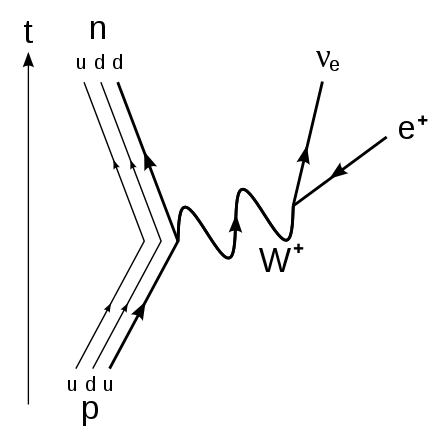
What is equation and Feynman diagram for Beta plus decay?
p→n+e++νe
W+ boson exchanged
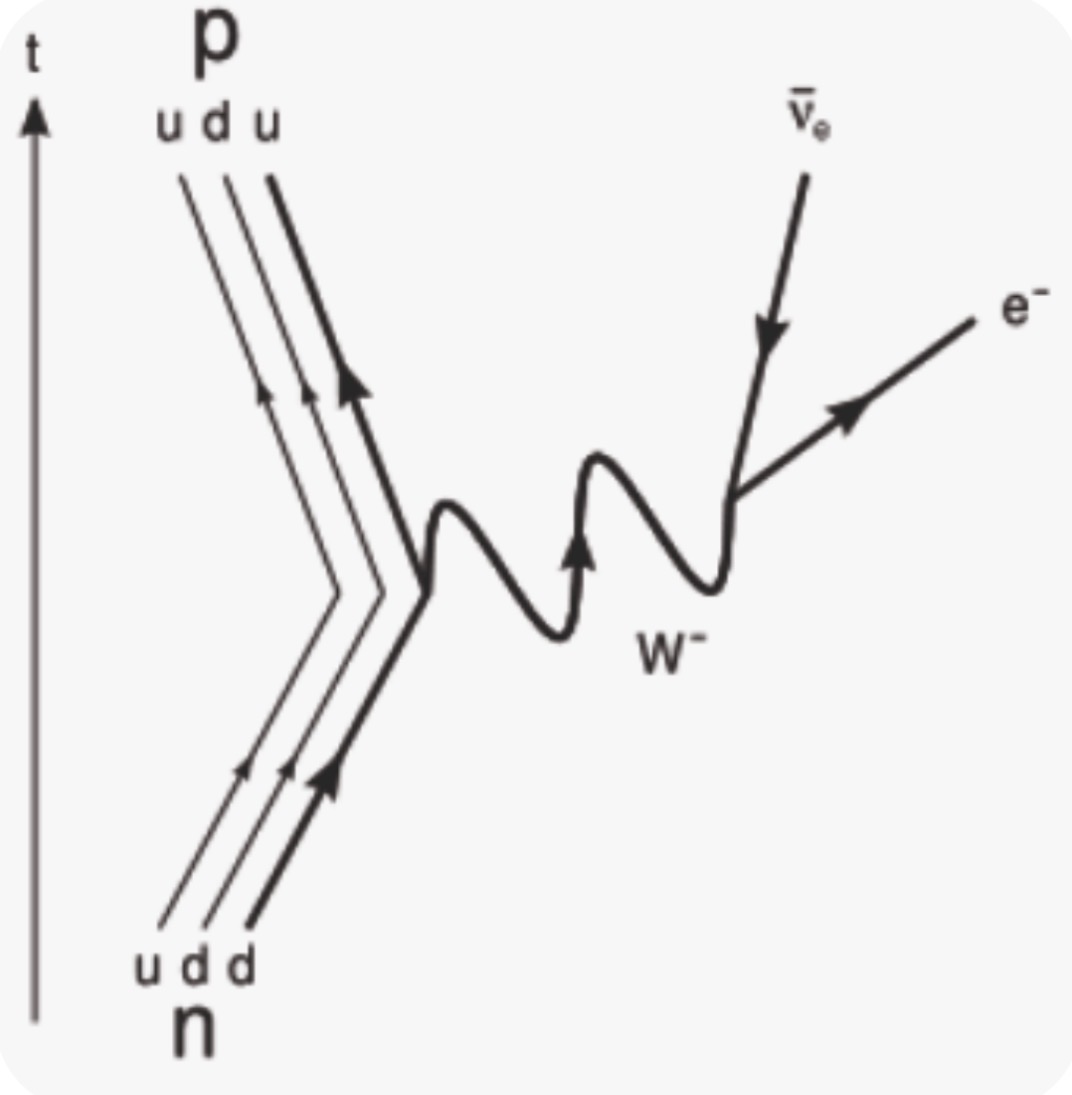
What is equation and Feynman diagram for Beta minus decay?
n→p+e−+νe
W- boson exchanged
What happens in beta plus decay?
A proton turns into a neutron, positron and neutrino
W+ boson exchanged
What happens in beta minus decay?
A neutron turns into a proton, electron and antineutrino
W- boson exchanged
What is equation and Feynman diagram for Electron capture decay?
p+e−→n+νe
W+ boson exchanged
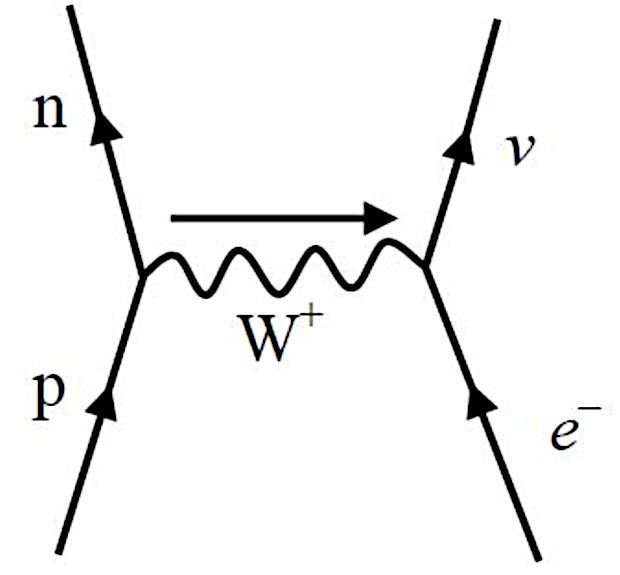
What happens in electron capture?
A proton rich nuclei captures an electron from inside atom and it is turned into a neutron and neutrino
W+ boson exchanged
How is the range of force determined form exchange particles?
The heavier the particle the shorter the range of force
As W boson is heavy the weak interaction has a very short range
However as photon has negligible mass the range of electromagnetic force is infinite
How to draw Feynman diagram?
Baryons on one side leptons on other side
The charges must be balanced
The y axis is time
A W+ going left is same as W- going right
What is electron proton collision?
It is very similar to electron capture except that electron collide at high speed with proton so W- (travel left from electron to conserve charge)

What electromagnetic repulsion?
When two particles of equal charge get closer to each other they repel and a virtual photon is exchanged
What are particles are affected by strong nuclear interaction?
Hadrons
What are the two types of hadrons?
Baryon: have 3 quarks
Proton, Neuton
Meson: two quark (typical particle & antiparticle pair)
Pion, Kaons
What is baryon number of Hadrons?
Baryons: B=1
Mesons: B=0
What do Baryons always eventually decay into?
They are unstable so decay into proton (only stable baryon)
What are leptons?
Particles which don’t interact with the strong nuclear force
Electrons, muons, electron neutrino, muon neutrino
e−,m−,νe,νm
What values are conserved?
Charge
Lepton Number
Baryon Number
Strangeness
What will muon eventually decay into?
It will eventually decay into an electron
Are quarks fundamental particle?
Yes hadrons are made of them
What is quark structure of proton?
uud
What is quark structure of a neutron?
ddu
What particles have strangeness?
A strange quark, they have strangeness of -1
What happens to quarks when neutron decays into protons?
As neutron (ddu) turns into a proton (uud) and electron and neutrino
A down quark must turn into an up quark via the weak nuclear interaction
What are hadrons?