Physics - paper 2
 Call Kai
 Learn
Learn Practice Test
 Spaced Repetition
 Match
Match Flashcards
 Knowt Play
1/615

There's no tags or description
Looks like no tags are added yet.
Name | Mastery | Learn | Test | Matching | Spaced | Call with Kai |
|---|
No analytics yet
Send a link to your students to track their progress
616 Terms
What are scalar quantities?
quantities with only magnitude, no direction
Examples of scalar quantities
Speed
Distance
Mass
Temperature
Time
What are vector quantities?
quantities which have a direction and magnitude
Examples of vector quantities
force, velocity, displacement, acceleration, momentum.
What is a force?
a push or pull on an object
Are forces scalars or vectors?
vectors
What is a contact force?
When two objects have to be touching for a force to act
Examples of contact forces
- friction
- air resistance (drag)
- tension
- normal contact force
What is friction?
a contact force that opposes the motion of objects, acting in the opposite direction to movement or intended movement
How does friction work?
from surface imperfections colliding, converting kinetic energy into heat. it pushes in the opposite direction
What is air resistance?
the force that opposes the motion of objects through air
How does air resistance work?
it is a type of friction caused by air molecules colliding with a moving object, acting in the opposite direction of motion to slow it down
What is tension?
The force within a stretched object such as a cable or rope.
What is normal contact force?
The upward reaction force exerted by a surface on an object resting on it, acting perpendicular to the contact boundary.
What are non-contact forces?
forces that can affect an object without touching it
Examples of non-contact forces
- weight
- gravitational forces
- electrostatic forces
- magnetic forces
What do forces do?
Forces can cause objects to:
- Accelerate
- Decelerate
- Change shape
- Change direction
What is weight?
A measure of the force of gravity on an object
What is gravity?
a force of attraction between objects due to their masses
What is a resultant force?
The overall force acting on an object
When multiple forces act on an object, the resultant force is the single force that has the same effect as all the individual forces combined.
How can you find the resultant force?
- Adding forces that act in the same direction.
- Subtracting forces that act in opposite directions.
- Pythagoras for forces that act at right angles
What is Newton's first law?
An object will remain at rest or at aconstant velocity unless acted upon by a resultant force
In other words
When forces are balanced, an object at rest stays still, or a moving object keeps moving at the same speed and direction
What is work done?
Energy is transferred when a force moves an object.
What happens when there is a resultant force on an object?
The object's motion will change
What do free-body force diagrams show?
all the forces acting on a body
What is Newton's second law?
The acceleration of an object is directly proportional to the resultant force acting on it. and it is inversely proportional to the mass
In other words
if you apply a bigger force, the object accelerates more; if the object is heavier, it accelerates less
Newton's second law formula?
Force = mass x acceleration
What is Newton's third law?
For every action there is an equal and opposite reaction
Example of Newton's Third Law
If you push on a wall, it will push back on you with an equal and opposite force
What does Newton's third law mean?
if you exert a force on an object, it exerts an equal and opposite force back
forces are always:
- equal in size
- act on separate objects
- simultaniuos
- the same type (two frictional forces)
What is inertia?
The tendency of an object to resist a change in motion
That means
- An object at rest stays at rest unless something forces it to move
- an object moving at a constant speed keeps moving at a constant speed in the same direction unless somthing changes it
How does inertia link to mass?
The more mass an object has, the more inertia it has. This means heavier objects are harder to start or stop moving
How can you find the resultant scalar forces?
by adding them together, as they have no direction
How can you find the resultant vector forces?
If they are at right angles to each other, you can use Pythagoras' theorem
Formula for inertial mass
inertial mass = force/acceleration
What is inertial mass?
A measure of how difficult it is to change the velocity of an object
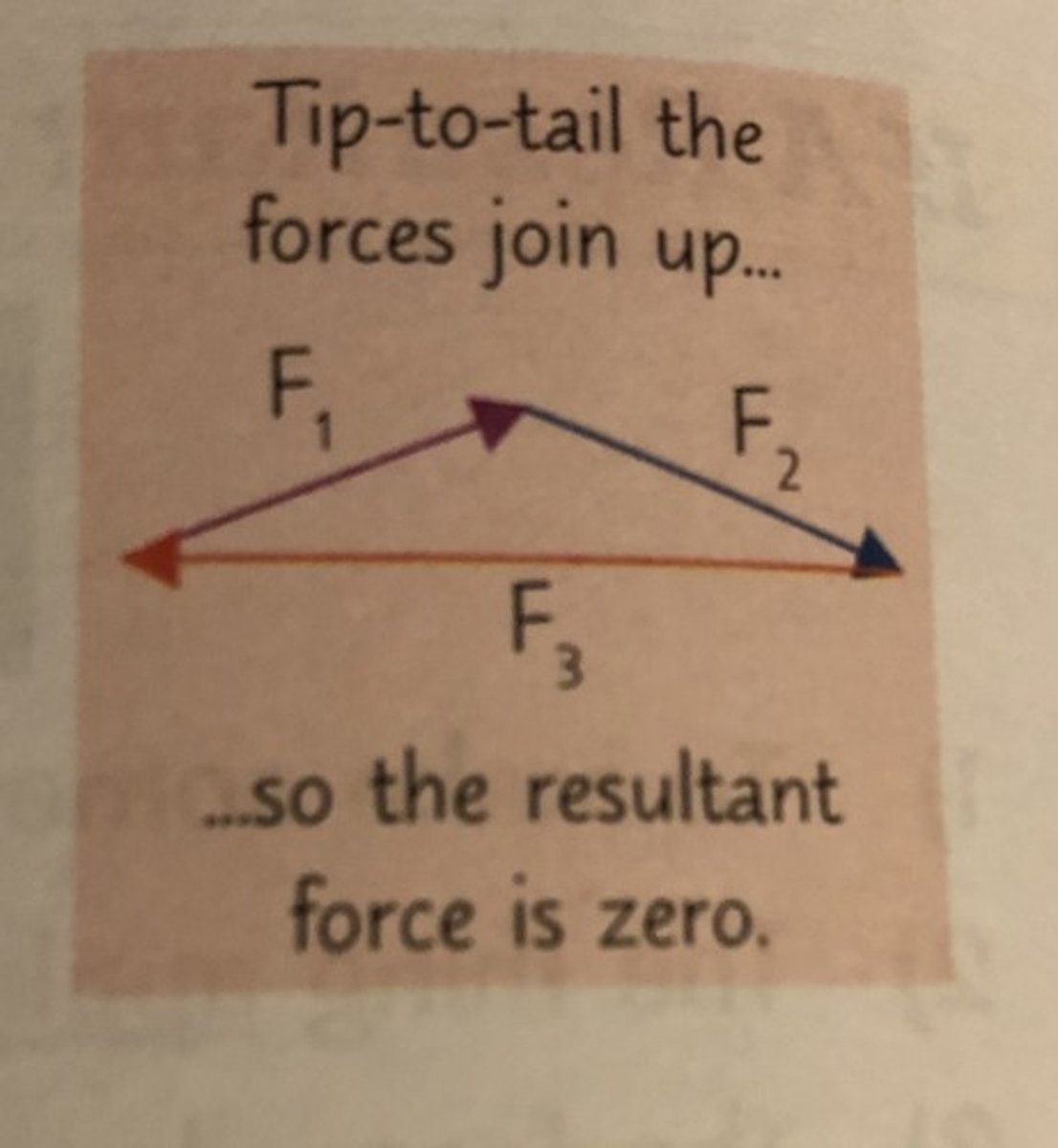
What happens when force arrows form a loop?
The forces are balanced and there is no resultant force
How to draw a scale force diagram?
1. decide on a scale, e.g., 1cm = 10N
2. Use grid paper to draw the vectors top to tail and to scale
3. Draw the resultant vector and mesure it's length, or use Pythagoras if it is a right angle
4. use the scale to convert it into newtons
How do you find parallelogram of forces?
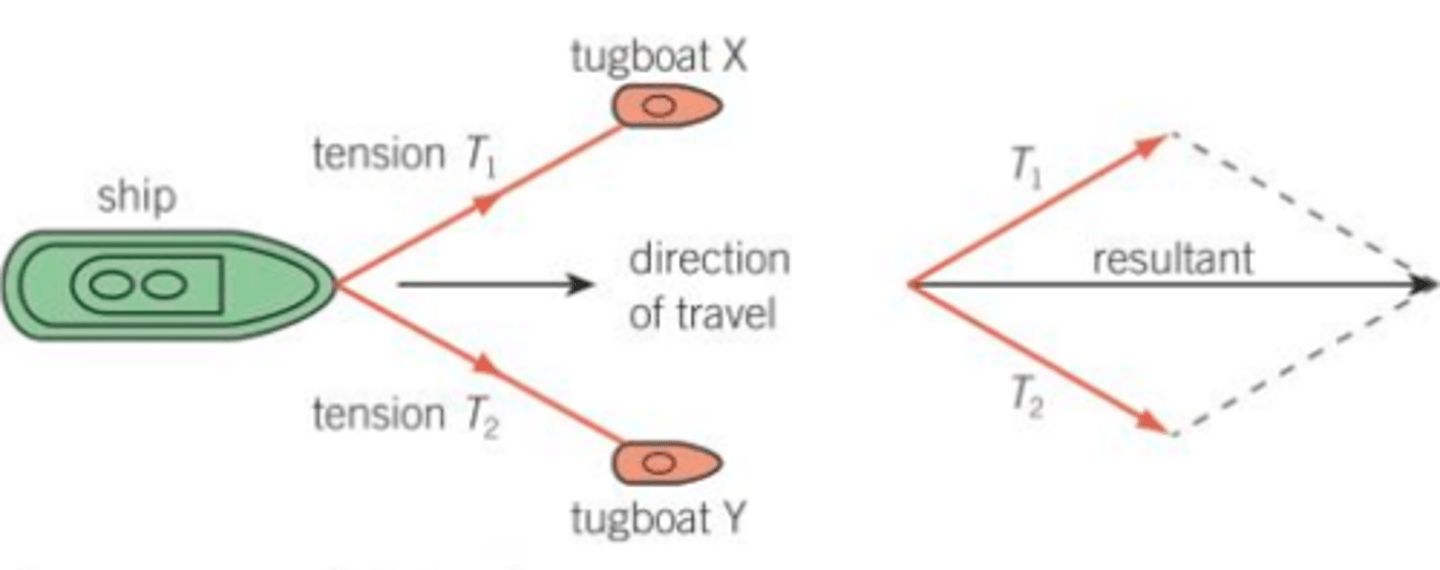
1. decide on a scale, e.g., 1cm = 10N
2. Draw two forces starting from the same point as arrows to scale (e.g, one force 5N at 0°, another force 5N at 60°
3. Copy the forces to form a parallelogram
4. Draw the straight line from the common start point to the opposite corner. This is the resultant
5. Measure the resultant and convert it back into newtons
What are resolving forces?
a single force can always be resolved (split) into two component forces at right angles to each other.
How to find resolving forces?
1. Draw the force as a vector at an angle to the horizontal
2. Choose your directions, which are usually horizontal (x) and vertical (y)
3. For right-angled triangles:
- Horizontal component = Fx = Fcos(angle)
- Vertical component = Fy = Fsin(angle)
where F is the force in newtons
What happens when there is a resultant force?
The object will accelerate in the direction of the resultant force
What is equilibrium?
a state in which opposing forces are balanced.
What are the conditions for equilibrium?
- no resultant force
- no resultant movement (total clockwise movement = total anticlockwise movement)
What is static equilibrium?
when an object is at rest
What is dynamic equilibrium?
When an object moves at a constant velocity
What is a moment?
The turning effect of a force
Example of moments
think about a door:
- if you push near the hinge, it's hard to open
- if you push from the handle (far from the hinge), it's much easier
- this is because the moment depends on both the force and the distance from the pivot
Formula for moment
moment = force x perpendicular distance
What happens to a balanced object?
Total clockwise movement = Total anticlockwise movement
What is a lever?
- a rigid bar that is free to pivot, or rotate, on a fixed point
- it makes it easier to apply a force
How do levers work?
it increases the distance from the pivot, which increases the moment, makinng the object easier to lift or move and reduces the effort needed
What is the pivot?
A point around which something can rotate or turn.
What is the effort?
force applied to a lever
What is the fulcrum?
the pivot point of a lever
What is the load?
amount of weight lifted
What is the line of action?
The line along which a force acts.
What are force multipliers?
a device that lets you use a small input force to create a larger output force
How do force multipliers work?
because the input of a force is applied further from the pivot than the load. by increasing the distance, the moment increases
Examples of force multipliers
- spanner or wrench - the long handle makes it easier to loosen tight bulbs
- car jack - small force over a long distance lifts a heavy car
- Wheelbarrow - your hands are far from the pivot (the wheel), so your small efforts lifts a heavy load
What are distance multipliers?
devices that make the output force move further than the input force
How do distance multipliers work?
The input force is applied closer to the pivot, so the effort moves a smaller distance, but the load moves a larger distance
Examples of distance multipliers
- scissors - your fingers move a small distance, but the tips of the blades move a much larger distance
- tongs or tweezers -small movement of your hands, bing movements at the tip
- gears
What are gears?
-toothed wheels that are used to transfer moments from one place to another
How do gears work?
- one gear turns, its teeth push on the teeth of another gear, making it turn in the opposite direction
- The size of the gear affects how it turns
What is low gear?
- A smaller input gear turns a larger output gear
- the smaller gear makes the larger gear turn slower but with more force (bigger moment)
What is high gear?
When a large input gear turns a smaller output gear. This leads to a high speed and a low turning effect.
What are gears used for?
to change the speed, direction or turning force
Examples of gears
in a bike, the small gear on the pedals turns the large gears on the wheels, which creates more force, making it easier to cycle uphill
What is the centre of mass?
The single point through which an object's entire weight appears to act and where its mass is considered concentrated
Where is the centre of mass in a symmetrical object?
at the point of symmetry
Where is the centre of mass in irregular objects?
at the balance point
What is suspended equilibrium?
When an object is freely suspended, it comes to rest with its centre of mass directly underneath the point of suspension
What is the parallelogram of forces?
A scale diagram of two forces, which can be used to find their resultant
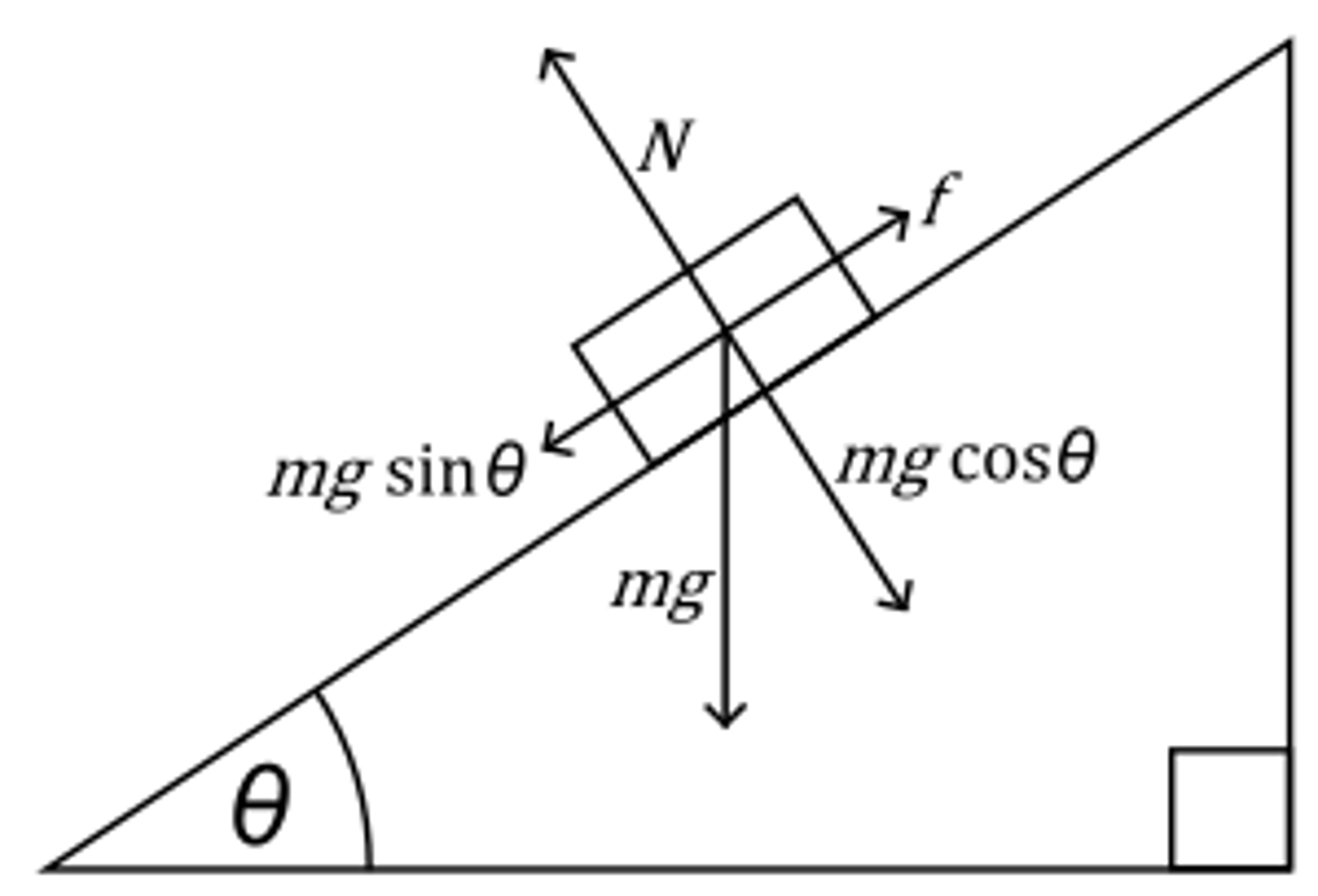
What are the resolving forces acting on an object on a slope?
- the normal component perpendicular to the slope, pressing the object into the slope
Formula: W₁ = mass x gravity cos(angle)
- the downslope component parallel to the slope, pulling the object down the slope
Formula: W₂ = mass x gravity sin(angle)
Example of resolving forces on a slope?
A 10kg box on a slope of 30 degrees
- weight = 10 x 9.8 = 98N
- parallel force = 98 sin(30) = 49N (down the slope
- perpendicular force = 98 cos(30) = 84.9N (into the slope)
- resultant = 49N - friction
Why would an object be stationary on a slope?
because the forces acting on it are in equilibrium, meaning the net force is zero. While gravity pulls the object down the slope, other forces—specifically static friction and the normal force—counteract this motion.
Reddit +3
What is velocity?
Speed in a given direction
What is displacement?
the change in position of an object
What is constant velocity?
Constant speed and constant direction
Formula for speed
speed = distance/time
Formula for velocity
velocity = displacement/time
What is acceleration?
rate of change of velocity
formula for acceleration
Acceleration = change in velocity/time
or
final velocity-initial velocity/time
or
(final velocity)² - (initial velocity)² = 2 x accelaration x distance
Is acceleration scalar or vector?
vector
What is uniform acceleration?
constant acceleration
What does negative acceleration mean?
The object is slowing down/decelerating
What is the unit for acceleration?
m/s²
What is the unit for velocity?
m/s
What are distance-time graphs?
Time graphs that show how the distance travelled by an object changes over time
- The x-axis represents time
- The y-axis represents the distance from the starting point
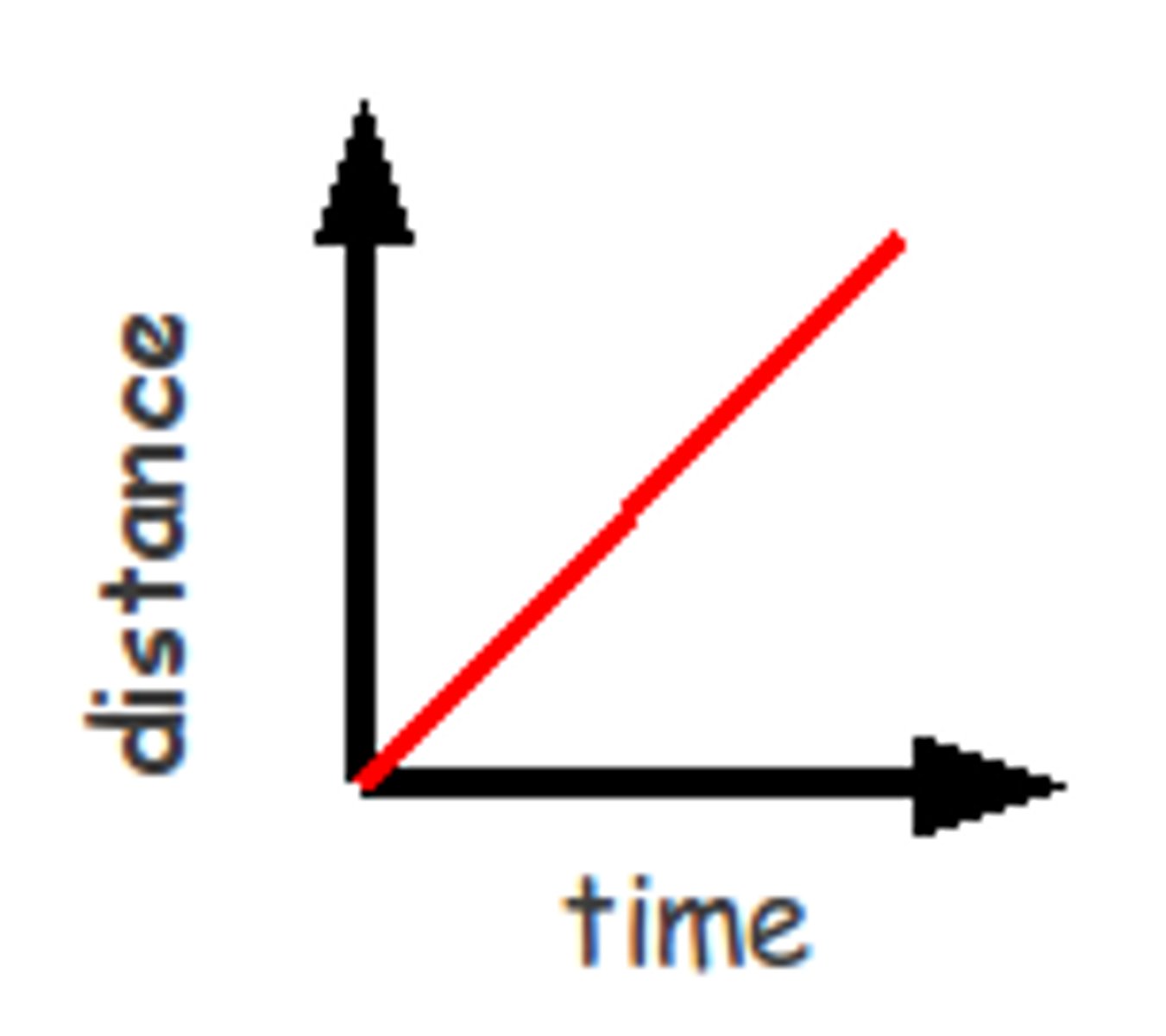
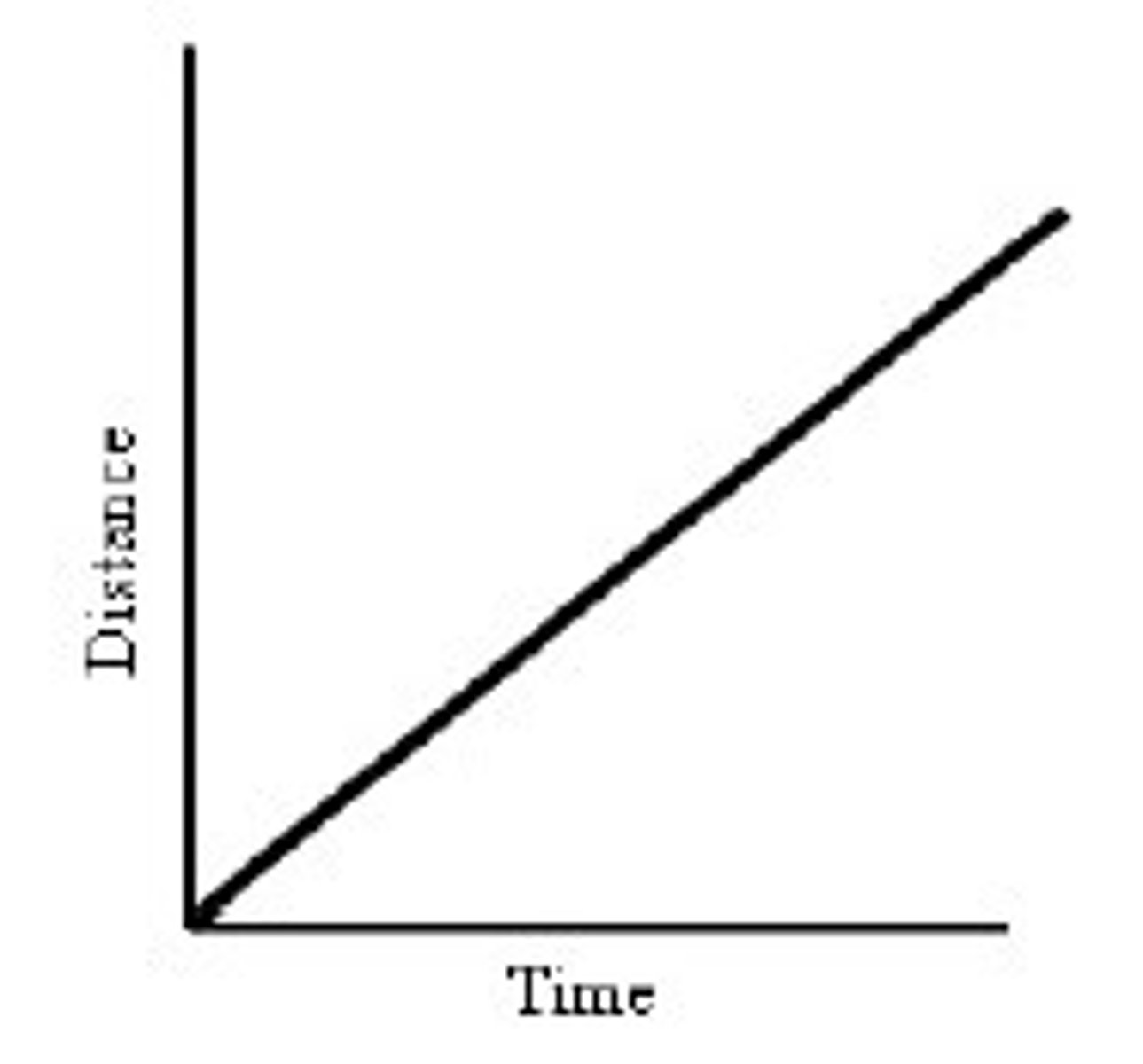
What does a straight line sloping upwards mean on a distance-time graph?
The object is moving at a constant speed (distance increases evenly with time)
What does a steeper slope mean on a distance-time graph?
The object is moving faster (covering more distance in the same time)
What does a flat horizontal line mean on a distance-time graph?
The object is stationary
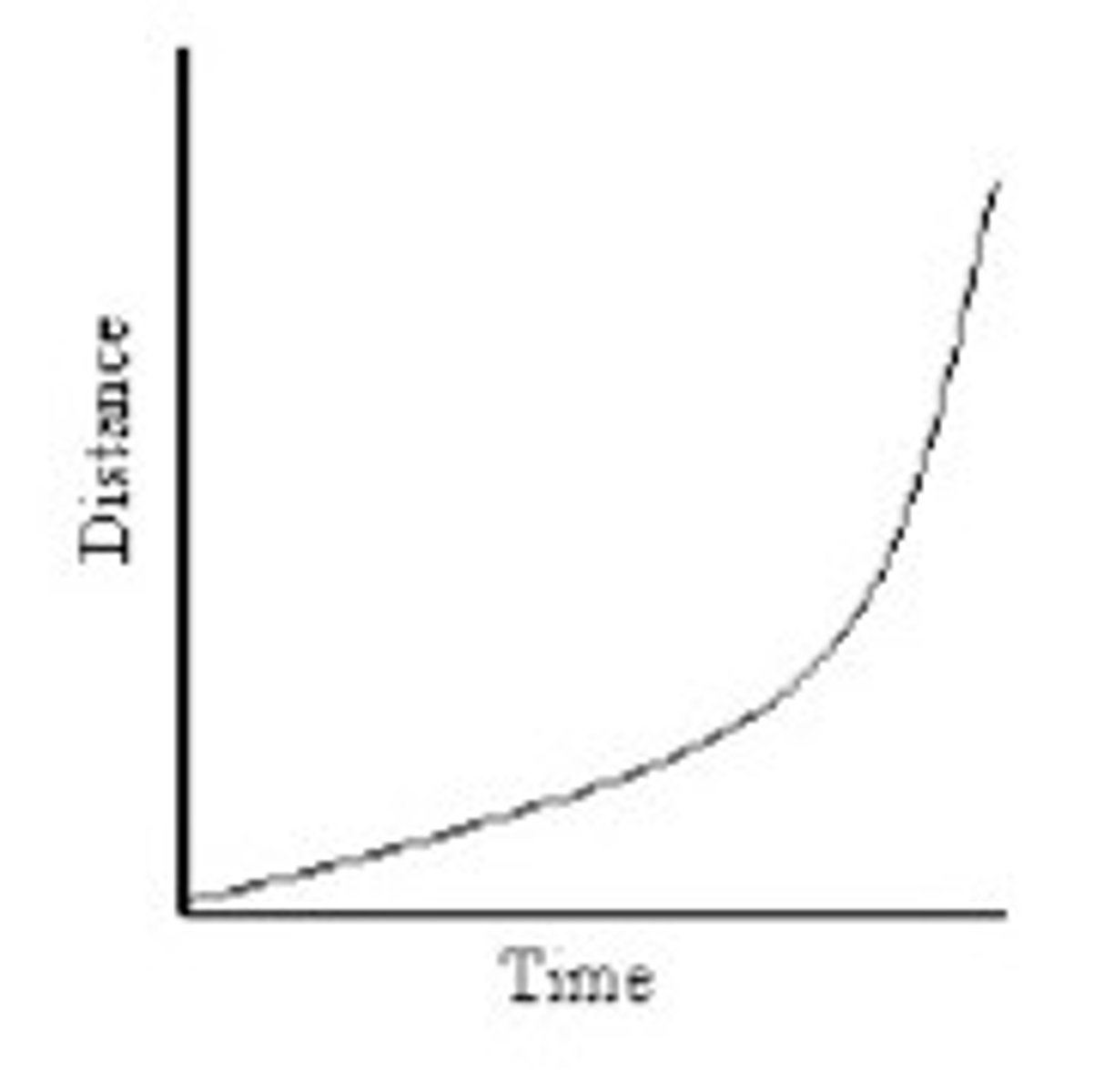
What does a curved line getting steeper mean on a distance-time graph?
The object is accelerating
What does a curved line getting flatter mean on a distance-time graph?
The object is getting slower
What does the gradient of a distance-time graph represent?
speed
Formula of a distance-time graph
speed = change in distance/change in time
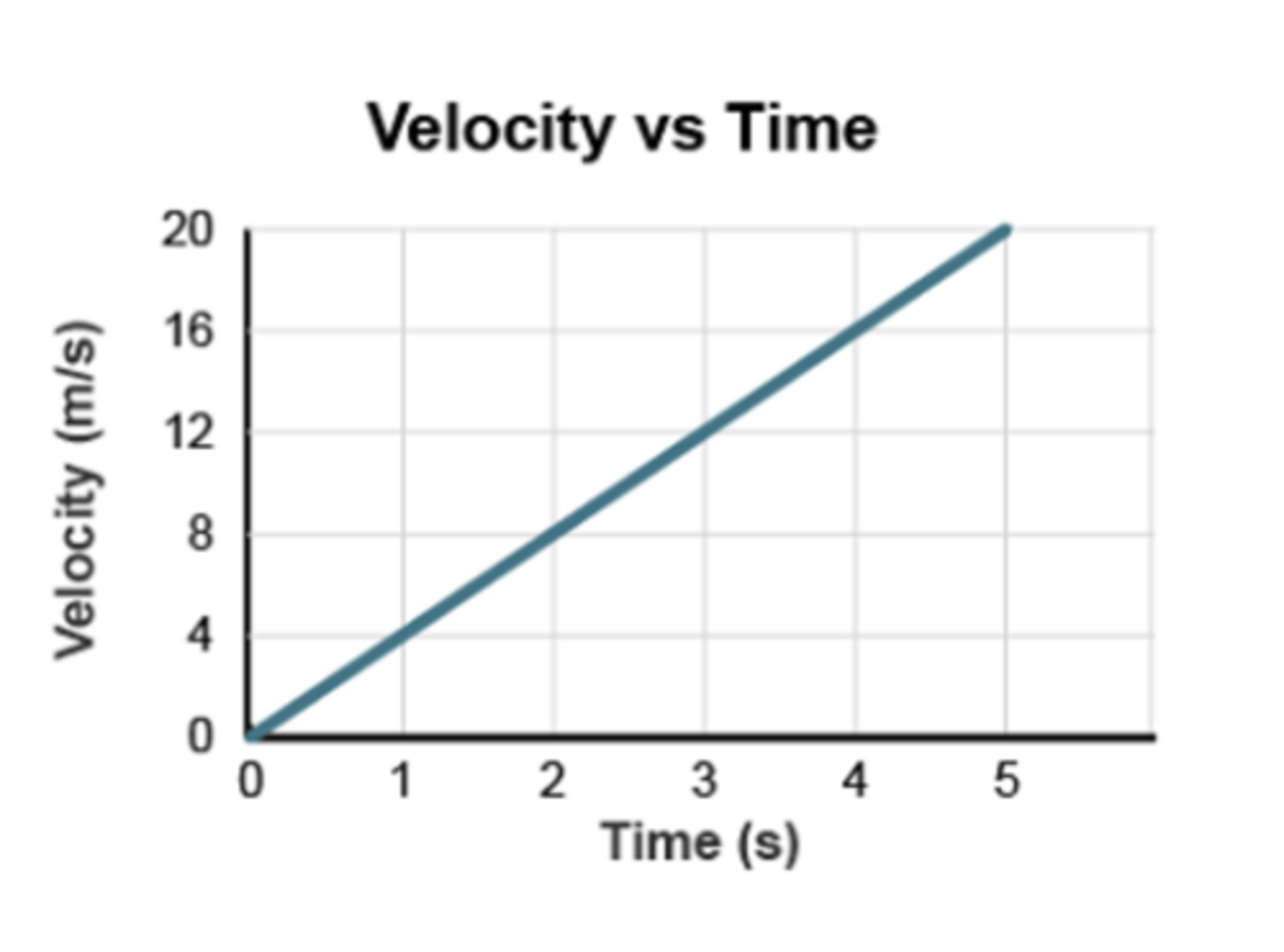
What is a velocity-time graph?
A graph that can be used to plot the velocity of an object versus time.
- the x-axis represents time
- the y-axis represents velocity
What does a flat horizontal line mean on a velocity-time graph?
constant velocsity
Not studied (99)
You haven't studied these terms yet.